You've finished a workday, but the desk still looks like a staging area for three different lives. A printer occupies the corner, charging cables cross the floor, folders lean against a monitor, and the supplies you need tomorrow are buried beneath things you rarely use. In a shared room, that clutter doesn't disappear when the laptop closes. It becomes part of the living space.
A well-chosen cabinet can solve more than a storage shortage. It can keep heavy equipment stable, place daily supplies within reach, conceal visual clutter, and make a mixed-use room easier to work in and easier to live with. The important choice is not just whether a cabinet matches your desk. It is whether the cabinet supports your workflow without creating new problems around weight, access, movement, or safety.
Why Home Office Storage Matters
A home office often starts with one practical compromise. The desk goes in a dining room corner, a guest room, or a section of the primary bedroom. At first, a stack of folders on the floor and a few bins on the desktop seem manageable. After a few weeks, the chair catches on a cable, the printer takes over useful work surface, and family members have to work around office supplies that never found a proper home.
Home office storage cabinets act as the quiet infrastructure of that room. Closed doors can hide paperwork and equipment when work is finished, while drawers keep smaller items from spreading across the desk. Open shelves can hold reference books or décor, but they work best when you're prepared to maintain a visible arrangement.
The category is larger than many shoppers realize. The U.S. storage cabinet set market is estimated at USD 8–12 billion in annual retail sales, with roughly 40–60 million sets across price tiers, according to U.S. storage cabinet market analysis. Home office storage represents about 15–20% of category volume, so this isn't a tiny specialty use. Housing changes and continued work-from-home patterns also influence demand, which means a cabinet may serve a first office today and a different room after a move.
Practical rule: Storage should reduce the number of decisions you make during the workday. If every item needs to be moved, unplugged, or searched for, the cabinet isn't supporting the workflow.
Think beyond paper. A home office cabinet may need to hold a compact printer, reams of paper, headphones, office supplies, external drives, or charging equipment. If your household also handles discarded electronics, a resource on data center hardware recycling can help distinguish ordinary office storage from responsible equipment disposal.
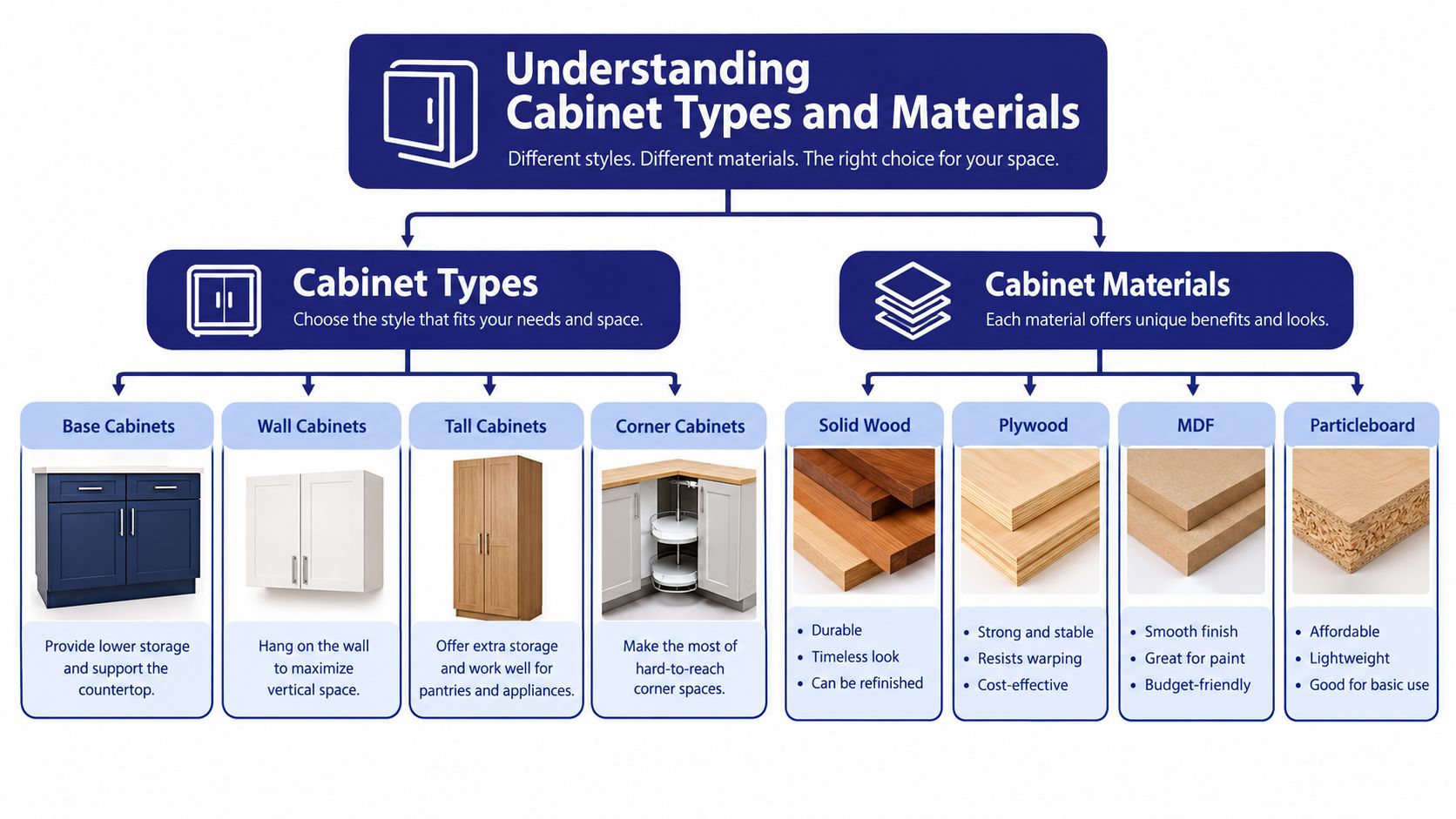
Understanding Cabinet Types and Materials
The modern filing cabinet grew out of a specific organizational problem. The vertical filing cabinet was invented in the United States in the 1890s, and by the early 1900s, metal filing cabinets had appeared as library cabinets. This marked a move away from general wooden cupboards and bound volumes toward specialized systems for documents, security, and organized access, as described in this history of the filing cabinet and information infrastructure.
That history still helps explain today's choices. Metal cabinets usually suit shoppers who prioritize filing, lockable storage, and a more office-oriented structure. Steel can provide a firm shell, but the cabinet still needs properly rated slides, stable feet, and sensible drawer loading. A tall metal unit with fully open drawers may be less forgiving in a busy room than a shorter cabinet with a broader footprint.
Solid wood brings visible grain and can work naturally beside residential furniture. It's often a good fit when the office shares space with a living room or bedroom, although construction details matter more than the label alone. Look at joinery, back-panel construction, hinges, drawer movement, and how the cabinet is supported.
Engineered wood can offer consistent panels and a wide range of finishes. It's practical for credenzas, bookcases, and hutches, particularly when the cabinet includes adjustable shelves or a reinforced top. The finish and edge treatment deserve attention because moisture, abrasion, and overloaded shelves can affect long-term appearance.
A useful comparison is functional rather than decorative:
- File cabinets: Best for documents, folders, and lockable personal records. They can waste space if your work is mostly digital.
- Credenzas: Useful for printers, supplies, and mixed storage at a reachable height. Their broad tops can become clutter magnets without assigned zones.
- Bookcases: Make reference material easy to see and reach. They expose visual disorder and may need anchoring in homes with children or pets.
- Hutches: Add vertical storage above a desk or credenza. Check ceiling height, sight lines, and whether upper doors are comfortable to operate.
This video offers another visual way to think about cabinet forms and office organization.
Measuring Your Space for the Perfect Fit
Measure the room before you compare finishes. A cabinet that fits the wall but blocks a chair, door, vent, or walkway isn't a functional fit.
Start with the usable footprint
Measure the wall width, available height, and clear floor depth. Record the dimensions in several places because older homes and divided rooms aren't always perfectly square. Mark baseboards, outlets, registers, windows, and door swings on your notes.
Modular office cabinets commonly use base heights around 29.5 inches, with depths of 18, 21, or 24 inches and widths from 12 to 72 inches, depending on configuration, according to commercial cabinet selection guidance. Those dimensions provide a useful starting point, not a guarantee that a particular unit will work in your room.
Measure for movement
Leave enough space to pull drawers open without hitting the desk or chair. Test the movement with painter's tape on the floor. Walk through the area while carrying a laundry basket, a box, or a desk chair. This simple test reveals pinch points that a tape measure can miss.
Depth affects both capacity and stability. A shallow cabinet may look tidy but fail to accommodate binders, printers, or hanging files. A deeper cabinet offers more usable interior space, but it can intrude into the chair zone and make an already narrow room feel congested.
Plan the vertical dimension
Check whether doors, drawers, and upper shelves can be reached comfortably. If the cabinet will sit beneath a window or beside a desk, confirm that hardware won't interfere with blinds, task lighting, or monitor placement. Measure the printer and any equipment before choosing an enclosed compartment, and allow room for ventilation and cable entry.
Evaluating Load Capacity and Durability
A cabinet can look substantial and still have limits that matter in daily use. Paper, printers, desktop computers, and electronics create concentrated loads, especially when they sit on one shelf or on the cabinet top.
Read the specification sheet by surface, shelf, and drawer. One commercial-grade metal file cabinet lists a maximum of 41 kg for a metal shelf and 30 kg for an 18 mm MFC shelf with ABS edge banding, according to this file cabinet specification. A separate office cabinet specification lists 225 lb, or 102 kg, on the top and 44 lb, or 20 kg, in the bottom drawer. These figures aren't interchangeable. A top rating doesn't tell you what an adjustable shelf can carry, and a drawer rating doesn't establish the safe load for the cabinet as a whole.
Look past the headline number
Shelf material matters, but span and support matter too. A long shelf with limited reinforcement can behave differently from a shorter shelf with a center support. Drawer slides also affect performance, particularly when a drawer is fully extended and loaded with dense paper.
Stability becomes more important when drawers open. The center of mass shifts forward, which can make a tall or narrow unit vulnerable to tipping. Some cabinets use an anti-tip mechanism or stability caster to help support loaded operation, but that feature doesn't eliminate the need for correct placement and installation.
Use this sequence before loading the cabinet:
- List the actual contents. Include the printer, paper, binders, books, and equipment you expect to store.
- Identify concentrated loads. A printer or compact safe may need a reinforced top or dedicated shelf.
- Match each load to its rating. Don't assume the strongest listed surface represents every component.
- Check the hardware. Look for smooth slides, firm hinges, adjustable feet, and a back that helps prevent racking.
- Ask about anchoring. Tall bookcases and narrow cabinets may require wall attachment, especially in active households.
Stability matters more than appearance once the cabinet is loaded. A unit that shifts, bows, or feels front-heavy will be frustrating even if its finish is exactly right.
Choosing the Right Style for Your Lifestyle
The right cabinet depends on how your home changes during the week. A dedicated office may welcome a tall filing wall, while a dining-area workstation may need a low credenza that closes completely after work. A guest room often benefits from furniture that can later serve clothing, linens, or hobby supplies rather than a cabinet designed only for tax documents.
North American demand is moving toward more adaptable storage. Home-office use accounts for about 30–35% of storage cabinet demand in North America, and modular or stackable systems are projected to rise from about 5% in 2026 to 10–12% by 2035, according to compact storage cabinet market analysis. Those figures point to a practical question: can the cabinet change roles without becoming awkward or unstable?
Match the style to the room
A low, closed credenza works well when you need to conceal printers and paperwork in a visible living space. A stackable system can make sense in a small room, but only if the components connect securely and the upper section won't become top-heavy. Open shelving suits books, plants, and frequently used supplies, while doors help control visual clutter.
Material choices affect ownership too. Reporting on storage furniture identifies finishes such as sintered stone, high-pressure laminates, and durable lacquers as options designed to resist staining and scratching better than lower-cost veneers. The same source discusses longer ownership, repairable hardware, and durable wood or metal bases as factors in storage cabinet material selection.
That doesn't mean a premium finish is automatically worthwhile. Pay more attention when the cabinet will receive daily contact, support equipment, or move between rooms. If it will hold light supplies in a low-traffic office, a simpler finish may be a sensible choice. Select adjustable shelves, lockable doors, and replaceable hardware when your needs are likely to change.

Organizing and Managing Cables Effectively
A cabinet can hide cables without solving the cable problem. Before placing equipment inside, confirm that the interior has enough depth for the hardware, a safe path for cords, ventilation, and lockable storage where work policies require it. The chair also needs adequate clearance, and power and data cables should have planned entry points, as explained in this guidance on computer desks inside storage cabinets.
Build separate routes
Keep power and network cables on separate pathways where possible. Avoid tight bends, pinched cords, and bundles that block ventilation around a printer, router, or computer. An opening at the back of the cabinet is useful only when it doesn't force cables against a sharp edge or prevent the door from closing.
An under-desk cable tray can hold the power strip and cable bundle beneath the desktop. That keeps the strip off the floor and makes it easier to trace connections when equipment changes. A practical office cable management guide also recommends maintaining separate pathways for network and power cabling while preserving bend radii and airflow.
Store by frequency
Place daily supplies within arm's reach. Store occasional items farther away, with each category assigned a clear zone, such as a desk drawer, cabinet shelf, or wall area, following this office supply storage guidance.
Labeling helps, but consistent placement matters more. Keep charging gear together, reserve one shelf for paper, and avoid using the cabinet as a general dumping ground. If a door conceals clutter but makes every item difficult to retrieve, the cabinet is working against the way you use the room.
Making Your Final Selection
A practical selection usually becomes clear when you describe a normal workday rather than choosing from a finish sample. Consider a remote worker who keeps a printer, paper, files, and charging equipment in a shared room. A low cabinet with a reinforced top, adjustable interior storage, cable access, and doors may serve that routine better than a tall bookcase, even if the bookcase offers more visible capacity.
Another household may need a different arrangement. If two people share the workspace, separate drawers can prevent one person's supplies from taking over the other's area. If the room doubles as a guest space, a residential-looking credenza may transition more easily than a dedicated filing unit. If sensitive records are stored at home, a lockable drawer or compartment may matter more than decorative display space.
Use a final inspection list before committing:
- Workflow: Can you reach daily supplies without standing up repeatedly?
- Equipment: Will the printer, monitor accessories, or charging devices fit with ventilation?
- Stability: Does the cabinet feel balanced when doors and drawers open?
- Capacity: Are the shelf, top, and drawer ratings appropriate for the intended load?
- Movement: Can the chair, people, and doors move freely around it?
- Future use: Could the cabinet serve another room if your office changes?
- Maintenance: Can you clean the finish and replace ordinary hardware if needed?
The U.S. home organizers and storage market is forecast to grow from USD 12.05 billion in 2025 to USD 15.21 billion by 2030, while home-office storage alone is projected to reach USD 2.38 billion by 2030, according to the material and durability discussion cited earlier. Those projections describe a growing category, but they don't choose a cabinet for your room. Your measurements, equipment, habits, and tolerance for visible clutter still matter more.
If a move or office change is part of the plan, practical commercial relocation planning tips can help you think through inventory, access, and placement before furniture arrives. For a local assessment, bring your measurements and equipment dimensions to a Woodstock Furniture & Mattress Outlet location and ask staff to help compare cabinet types, storage layouts, and room uses in person.
Woodstock Furniture & Mattress Outlet offers home office furniture such as file cabinets, bookcases, credenzas, and hutches, along with guidance for fitting storage into real rooms. Visit Woodstock Furniture & Mattress Outlet with your room measurements and workflow needs to explore functional options in person.