A standard queen mattress is 60 inches wide, and most queen headboards measure about 60 to 67 inches from outside edge to outside edge. Storage, bookcase and wingback designs push past 70 inches, and current listings run wider still.
So why does the headboard you measured at home so rarely match the number printed on the product page? Because a queen headboard isn't a fixed size. It's an outside dimension set by the frame, the padding and whatever the designer added to the sides, and the honest answer to how wide is a queen headboard depends on which piece you're measuring and how much clear floor you need to keep.
Typical Queen Headboard Widths at a Glance
The mattress is the fixed reference point. A standard queen measures 60 inches wide by 80 inches long, which is 5 feet across and just under 7 feet long, or 152.4 by 203.2 centimeters. Every headboard figure below grows out of that 60-inch starting point.
What changes is how far the finished piece extends past it. Leesa's size guide notes that a queen bed frame can run several inches wider and longer than the mattress, and lists a typical assembled queen frame at roughly 63 to 67 inches across. That gap between the mattress and the hardware around it is the first hint that the label and the tape measure disagree.
| Item | Typical outside width | What drives the difference |
|---|---|---|
| Queen mattress (sleeping surface) | 60 in (152.4 cm) | Mattress dimension only; the bed is 80 in long |
| Simple panel headboard | 60 to 62 in | Close to mattress width; a 62 in model extends about 1 in per side |
| Upholstered or framed headboard | 62 to 67 in | Frame, posts and upholstery add width; queen frames commonly measure 63 to 67 in |
| Storage, bookcase or wingback headboard | 70 in and up; 73.1 in in one 2026 listing | Shelves, side units and padding can extend past the mattress |
A simple panel headboard is the type that stays closest to the mattress. An upholstered or framed model adds a couple of inches of structure. A storage or wingback design adds the most, because the piece has to hold shelves, lighting or side units as well as padding.
Reading the numbers in practice
The arithmetic is subtraction. Take a 62-inch headboard and a 60-inch mattress: the headboard overhangs about an inch on each side. Go to 64 inches and the overhang doubles to two inches per side, a 66-inch model sits three inches past the mattress on both edges, and a 72-inch storage headboard reaches six inches per side. That's the point where nightstand placement and wall clearance start driving the decision more than the mattress does.
Current listings show how far the top of the range runs. Cozey's 2026 bed size guide lists its queen bed with a headboard 73.1 inches wide, more than 13 inches of extra width over the mattress beneath it.
The number that matters: the overall width printed in the product specification, not the size name printed in the title.
Compare that figure with the wall you have. A headboard narrower than the mattress looks undersized and leaves the bedding edges exposed. A headboard much wider than the mattress needs a wall with room around it, and a room with room to walk.
Queen Variants and Nearby Sizes That Change the Fit
Queen on a listing does not always mean a 60-inch mattress. Several sizes carry queen in the name, and a wrong pairing between mattress and headboard throws off every measurement taken after it.
| Size | Width | Length | Headboard fit note |
|---|---|---|---|
| Full | 54 in | 75 in | Narrow for a queen wall; leaves mattress edges exposed on a queen |
| Queen (standard) | 60 in | 80 in | Baseline for most queen headboards |
| Olympic queen | 66 in | 80 in | Six inches wider; needs a headboard built for this width |
| California queen | 60 in | 84 in | Same width as standard; extra length changes frame depth |
| King | 76 in | 80 in | Much wider; can overwhelm a queen room or misalign the frame |
The Sleep Foundation's mattress size comparison lists a full mattress at 54 inches wide, a queen at 60 inches and a king at 76 inches, which makes a queen 6 inches wider than a full and 16 inches narrower than a standard king. Those gaps explain two common mismatches. A full-size headboard behind a queen leaves mattress and bedding edges showing at both sides. A king-size headboard can swallow a queen wall or fail to line up with the frame's mounting points.
Width is the dimension that costs you floor space. Every extra inch of mattress or headboard is an inch the room must give up, and on a tight wall that inch can be the difference between a clear walking path and a shuffle sideways past the bed. Shoppers who need room for a wheelchair or walker feel that trade first.
Olympic and California queens create a subtler problem. Biltrite's queen size guide lists an Olympic queen at 66 by 80 inches, six inches wider than a standard queen, and notes that a California queen keeps the 60-inch width while running to 84 inches in length. A headboard sized for a standard queen stops three inches short on each side of an Olympic mattress. On a California queen the width still lines up, but the frame sits deeper in the room.
Check the mattress tag or the manufacturer's specification sheet before trusting the word in the listing. Then match the headboard to the size you own, and measure the wall against that real width rather than the name on the label.
Why Headboard Width Differs From Mattress Width
Think of the mattress as the picture and the headboard as the frame. The picture is 60 inches wide every time. The frame can hug it or extend well past it on both sides.
A standard queen's sleeping surface covers about 33.3 square feet, and Yeti's queen bed dimensions guide makes the key point plainly: a queen designation signals compatibility with the 60-by-80-inch mattress category, not a fixed exterior width. Manufacturers also build to slightly different tolerances, so two products carrying the same size name can differ by fractions of an inch.
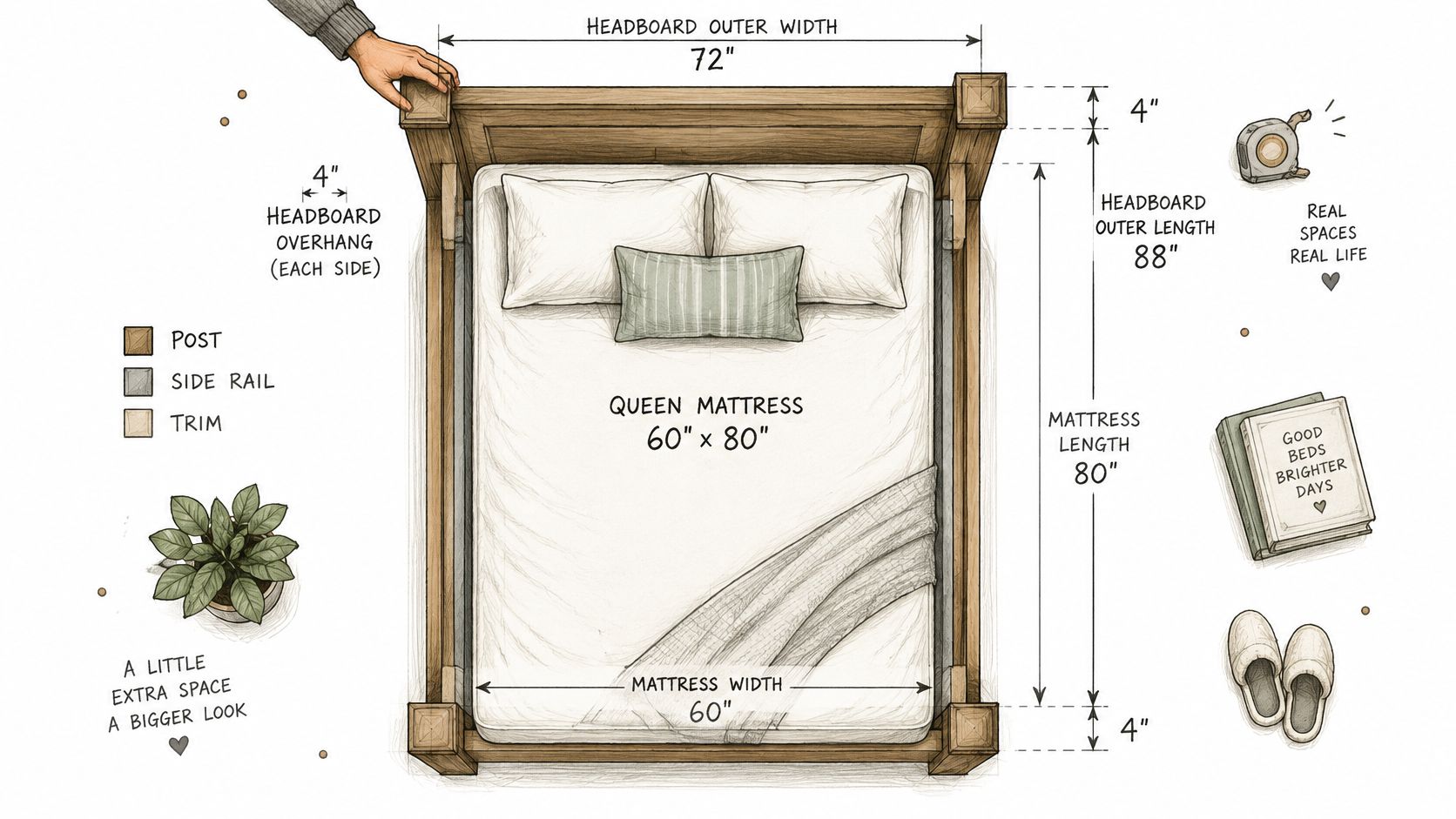
Everything attached to the frame changes the outside measurement. Posts, side rails, trim, upholstery, shelving, reading lights and built-in storage all sit beyond the sleeping surface, and any one of them can add several inches. Run the per-side math again: a 66-inch headboard adds 3 inches on each side of the mattress, and a 72-inch storage model adds 6 inches per side. Same mattress, 6 inches of difference in footprint at each edge.
A headboard is a separate piece of furniture that happens to attach to a bed, and it gets measured like one.
There's a mechanical reason to care too. The headboard, bed frame and foundation should all be built for the same queen platform, so brackets, bolts or posts meet where they're supposed to. A headboard that matches on width but not on attachment style turns into a project rather than a purchase.
If you want to see how the mattress footprint and the frame footprint sit against each other in a furnished room, this walkthrough covers it.
The finished headboard is a standalone measurement. It may equal the mattress width, slightly exceed it or run well past it, and that outside figure is the only one that tells you what happens on your wall.
How to Measure Your Space Before You Buy
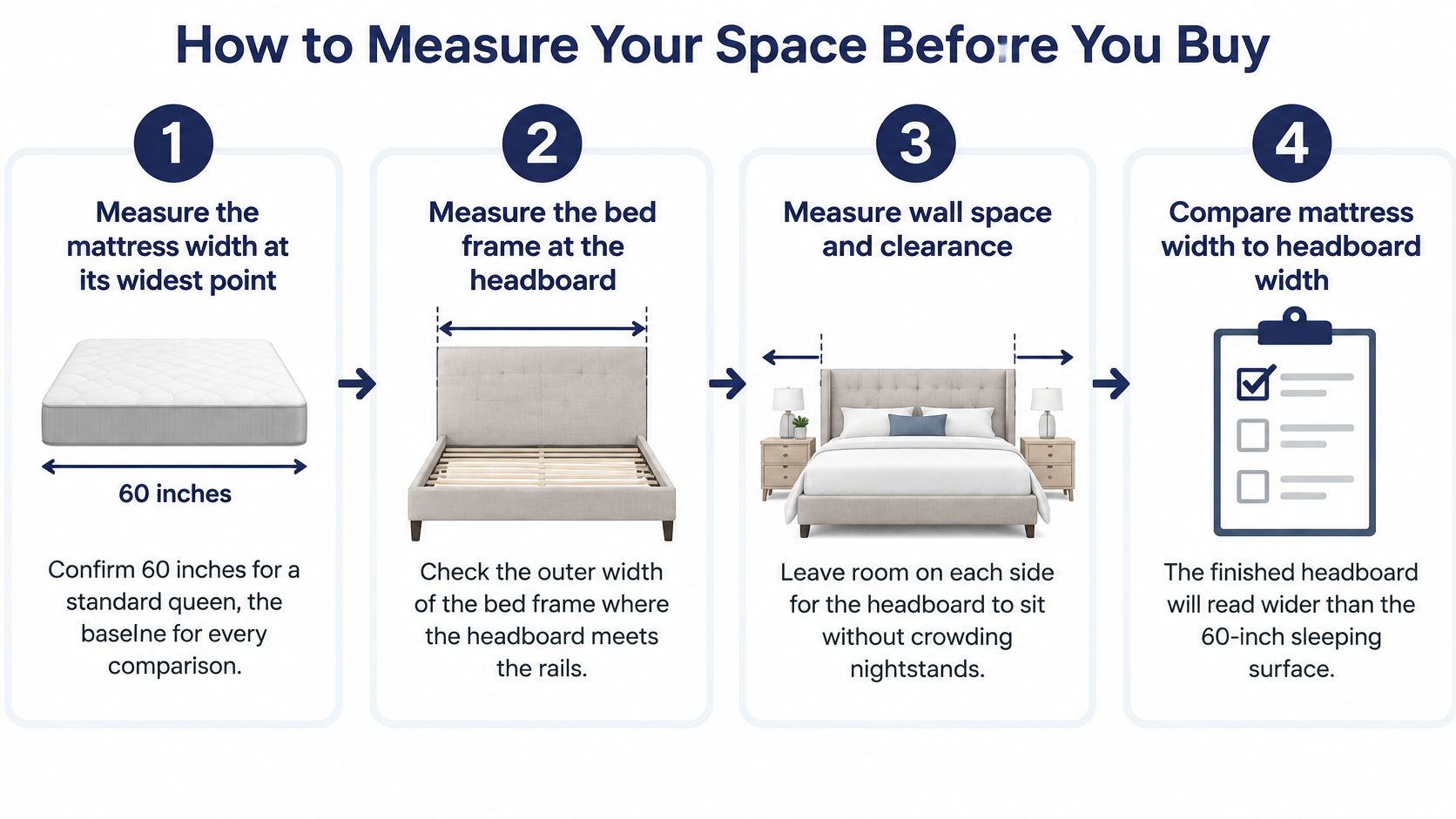
Six measurements settle the question, and they work in a fixed order because each one supplies a figure the next one depends on.
The six measurements, in order
- Mattress width at its widest point. Confirm 60 inches for a standard queen. If the tape reads 66, you own an Olympic queen and every later number changes.
- Frame width at the headboard mounting points. Measure across the rails where the headboard attaches, because the frame can be wider than the mattress even when both are labeled queen.
- Usable wall width. Measure from door trim to trim or corner to corner, then subtract the windows, closets, outlets and radiators that interrupt the run.
- Headboard overall width from the listing. Take the widest finished part, including any side shelves or wing extensions, and hold it against the wall figure from step three.
- Walking space on each side. Ash Deco's headboard and frame guide cites a planning range of 24 to 36 inches of walking space beside the bed, with about 36 inches giving easier access and room for nightstands, and notes that queen rooms are often planned around roughly 10 by 10 feet. A door and a dresser eat most of that slack quickly.
- Floor and wall footprint, marked with painter's tape. Lay the headboard width on the wall and the whole bed footprint on the floor, then open the closet, pull out the nightstand drawer and walk the route you'd take at night.
Before you shop: keep the six numbers on your phone in that order. A salesperson can answer a fit question in seconds with them, and can't guess without them.
Tape beats arithmetic here because a wall measurement ignores how a room feels once furniture occupies it. The tape shows you the walkway you'll use.
Accessible Layouts Where Extra Width Matters
Most bedroom guides treat a couple of feet of walking space beside the bed as enough. For some households it isn't close, and the extra inches a wide headboard takes can decide whether the room works at all.
Universal design bedroom specifications call for at least 42 inches of clear floor space on one side of a bed to accommodate walkers, wheelchairs, crutches and canes, plus a 60-inch turning radius wherever a wheelchair must turn. New Zealand's official accessible-bedroom guidance takes a similar position, emphasizing room for independent wheelchair transfer on one side and space for assistance at the foot or the opposite side.
That changes how you read a headboard's width. A design that fits the wall with walking space intact for a person on foot may leave too little clearance for a transfer or block the only route past the bed. The room can look generous and still fail the person who needs it most.
Wider can help in specific cases. A headboard with integrated lighting or shelves can replace a bedside table, and removing that table gives floor space back beside the mattress, provided the lighting and shelving sit high and far enough back not to obstruct a transfer.
The best width is the one that leaves the room usable for the person who needs the most space in it.
So flip the usual question. Rather than asking how wide a queen headboard can be, ask how wide it can be while keeping the side, foot, door and turning spaces clear for everyone who uses the bedroom.
Choose the Headboard Width That Fits Your Room
Decisions get easier when the numbers sit in one place. Confirm the mattress variant first, then gather three figures: the headboard's listed outside width, the clear wall width left after subtracting windows and doors, and the side, foot and turning clearances for anyone in the household who uses a mobility aid.
If the outside width fits the wall with the planned walking space still intact, the piece works and you can move on to style. A panel design that tracks close to the mattress suits a smaller room or a wall flanked by windows, while an upholstered, framed or storage model needs a longer wall and enough clearance to keep the nightstand zone usable.
When a check fails, you have three moves: drop to a narrower panel headboard, change the layout so the bed sits against a longer wall, or rethink the bedside furniture. One failed measurement points to that particular headboard, not to the room itself. A queen bed can still work in the space once the frame around it matches the clearances you have.
Seeing widths beside a real bed beats reading them off a spec sheet. Standing next to a low-profile queen headboard on a showroom floor with a tape measure, then beside a wider storage design, shows the difference in seconds. Bring the numbers you measured at home, including the mattress variant, the wall width and any accessibility clearances, so the visit settles the fit question instead of reopening it.
Woodstock Furniture & Mattress Outlet carries queen headboards across the width range covered here, from panel designs that sit close to the mattress to upholstered and storage models that add a few inches per side. Our design services can help you match a headboard's outside width to your wall, your mattress variant and the clearances everyone in your household needs, and delivery options let you plan the purchase around getting the piece into the room. You can compare headboards in person at our Georgia locations. Visit Woodstock Furniture & Mattress Outlet with your measurements and we'll help you find the width that leaves the room comfortable.