If a coffee table rolls easily, does that mean it belongs on your floor, and if its wheels lock, does that mean it will stay put? Those are different questions, and a useful coffee table on wheels needs to answer both.
Mobility can make a living room easier to clean and rearrange. But the right choice starts underneath the table, with the tread touching your floor, the brakes holding its position, and the base supporting everyday use. A freely spinning wheel isn't automatically floor-friendly, and a locked caster isn't the same as a fixed leg.
Match Casters and Locks to Your Floor
Caster and lock choices for a living-room coffee table
| Setup | Typical capacity | Better on | What the lock does | Main tradeoff |
|---|---|---|---|---|
| 2-inch hard plastic or hard urethane | About 75–150 lb per caster | Smooth hard floors, subject to finish compatibility | Often a separate wheel brake; verify the mechanism | Low profile but can mark wood, tile, or laminate |
| 2-inch soft rubber | About 75–150 lb per caster | Hardwood and resilient floors, after compatibility testing | Usually a wheel brake; verify the mechanism | Gentler tread that may drag on thick carpet and hold grit |
| 3-inch urethane swivel | About 100–300 lb per caster | Mixed floors and low thresholds, with finish compatibility confirmed | Lockable swivel configurations are available | Easier rolling with a taller, more visible wheel |
| Wheel brake only | Use the specific wheel's rated capacity | Short moves on a level floor | Stops the wheel from spinning; fork may still pivot | Can allow twisting or movement under edge pressure |
| Total lock | Use the specific wheel's rated capacity | Parked laptop or serving use, after a stability check | Stops both roll and swivel | More restrained when parked; requires unlocking before repositioning |
| Felt pads or floor cups | Not a rolling capacity; check the support rating | Hardwood when the table stays put | None; the table is parked | Helps protect the finish but gives up easy movement |
The diameter-based reference ranges above, about 75–150 lb for a 2-inch caster and 100–300 lb for a 3-inch caster, must be checked against the actual product specification; Colson Group's wheel-selection guidance explains why tread material, bearings, swivel construction, and floor conditions matter alongside size. A larger wheel generally crosses a transition more easily, while a wider tread spreads its contact with the floor.
Don't read “smooth hard floors” as “safe for every hardwood finish.” Hard plastic and hard urethane can mark wood, tile, or laminate, while softer rubber can collect grit and resist movement on thick carpet, as explained in WikiCoffeeTable's guide to caster marks. The wheel material is only part of the decision; trapped debris and the weight pressing it into the finish matter too.
Check the brake mechanism
A wheel brake stops the wheel's rotation but may leave the fork free to swivel. A total lock restrains both motions. Ask for the mechanism's actual description rather than relying on a product photo showing a pedal.
Neither design promises that the entire table will remain motionless under every load. The mounting, floor grip, and table's proportions still matter, especially when you place a laptop or serving tray near an edge.
Test the actual route
Use a clear floor and a controlled, short movement rather than pushing an unfamiliar table across the room.
- Name every surface. Include hardwood, tile, carpet, rug edges, and thresholds along the route, not just the spot where the table normally sits.
- Inspect the tread. Identify plastic, urethane, or rubber, and remove packed grit before testing.
- Roll empty, then loaded. Add representative contents within the table's stated limits. Notice whether steering becomes difficult or a wheel starts sliding instead of turning.
- Check floor contact. Every wheel should meet the floor together. Rocking can concentrate pressure at a contact point.
- Inspect the path. Stop if you see gray residue, a shiny track, or a fresh scratch. Don't keep testing in hopes that the tread will settle in.
Floor-first rule: The caster that spins most freely can still be the wrong choice for finished hardwood, pet hair, or frequent rearranging.
For a table that usually stays parked, consider an appropriate rug, protective mat, or floor cups instead of immediately replacing the wheels. The chair pad advice from Flacks Flooring provides useful context for protecting hardwood at furniture contact points, though a pad isn't a rolling solution.
Stationary glides may make more sense when the table almost never moves, provided the base accepts them. Whatever setup you choose, wipe the treads before crossing a clean floor and clear hair and lint from axles and swivel housings. Trust a stated dynamic capacity and documented floor compatibility over a blanket claim that a table rolls on any carpet.
How to Size Caster Capacity
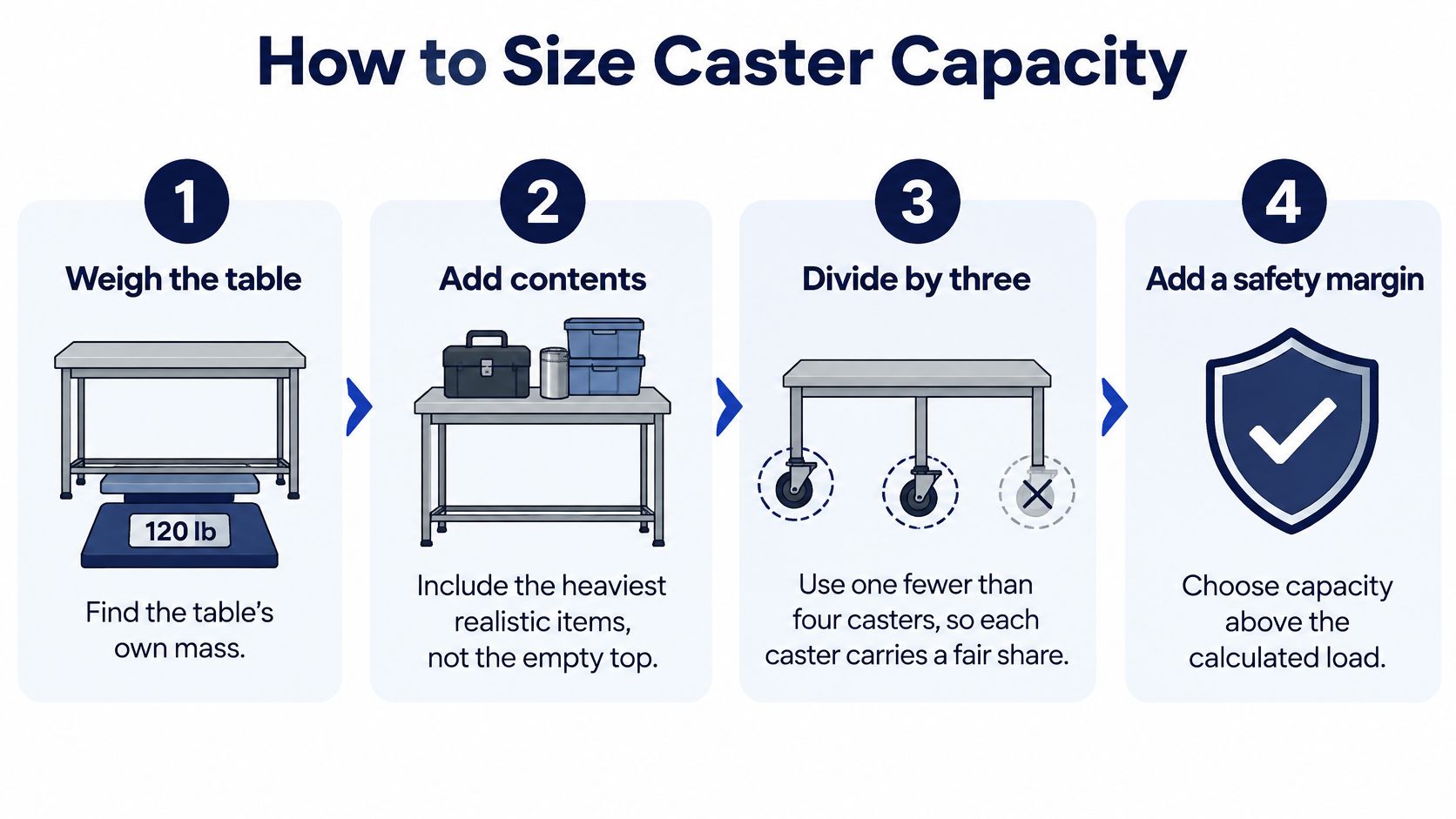
How much weight must each caster carry when a coffee table is loaded? Start with the table's own weight, then add everything placed on top or stored below. For example, a table weighing 120 lb with 80 lb of books and equipment has a total load of 200 lb. Following Biltrite Furniture's caster-capacity guidance, divide that total by three of four casters, giving a base target of 66.7 lb per caster. Then allow for the floor and route: 1.25× gives about 84 lb, while 1.5×–2× gives about 100–134 lb.
Why leave one caster out of the calculation? A floor may be uneven, or the load may sit off-center. In either case, one wheel can carry less weight for a time, leaving the others to support more. The margin is a buffer for those changing loads, not a substitute for the caster's stated rating.
Caster load targets from table weight plus contents
| Situation | Total load | Wheels used in the math | Per-caster target |
|---|---|---|---|
| Hypothetical empty 40 lb table, four casters | 40 lb | 3 of 4 | 13.3 lb before margin; about 16.7 lb with a 1.25× margin |
| Books on a 120 lb table | 200 lb | 3 of 4 | 66.7 lb before margin; about 84 lb on a smooth floor |
| Same 200 lb load over thresholds | 200 lb | 3 of 4 | About 100–134 lb using 1.5×–2× |
| Hypothetical three-caster table at 150 lb total | 150 lb | 2 of 3 | 75 lb before the floor margin |
| Static-only rating | Measured total | Casters minus one | Ask for a dynamic rating; rolling capacity is usually lower than the static figure |
These hypothetical calculations show how the method works, not the minimum rating for a particular table. The empty-table figure is only a starting point. Include books, trays, laptop equipment, and lower-shelf storage before choosing casters.
Calculate before trusting a heavy-duty label
- Find the empty weight. Use the manufacturer's table weight or weigh the empty piece with suitable equipment.
- Add realistic contents. Count what will regularly sit on the top or shelf.
- Divide by casters minus one. Use the installed caster count, including wheels that may be hidden from view.
- Apply the floor margin. Choose the smooth-floor or uneven-floor factor above, based on the route the table will take.
- Compare with the dynamic rating. Check that the rating applies to each caster, not the complete set.
This visual summarizes the calculation for a table supported by four casters.
Separate parked capacity from moving capacity
Static capacity describes how much weight a caster supports while the table is parked. Dynamic capacity applies while it rolls, when movement and impacts place different demands on the assembly. Biltrite's guidance distinguishes rolling capacity from stationary capacity and notes that impact capacity can be lower still.
A wheel that rolls easily is not automatically a good match for the floor or the load. Do not treat a static-only label as approval for everyday movement. Ask for a dynamic specification suited to the intended conditions, and check the table's own load limit and mounting strength. Higher-rated casters cannot make a weak frame stronger.
If the calculated target exceeds the rating, reduce the contents, choose a compatible caster with a suitable rating, or keep a fixed base. A larger wheel helps only when its rating and mounting fit the table.
Styles Built to Move With the Room
Start with the job the table needs to do. A household that clears the center of the room for games needs something different from a household that wants a temporary laptop surface.
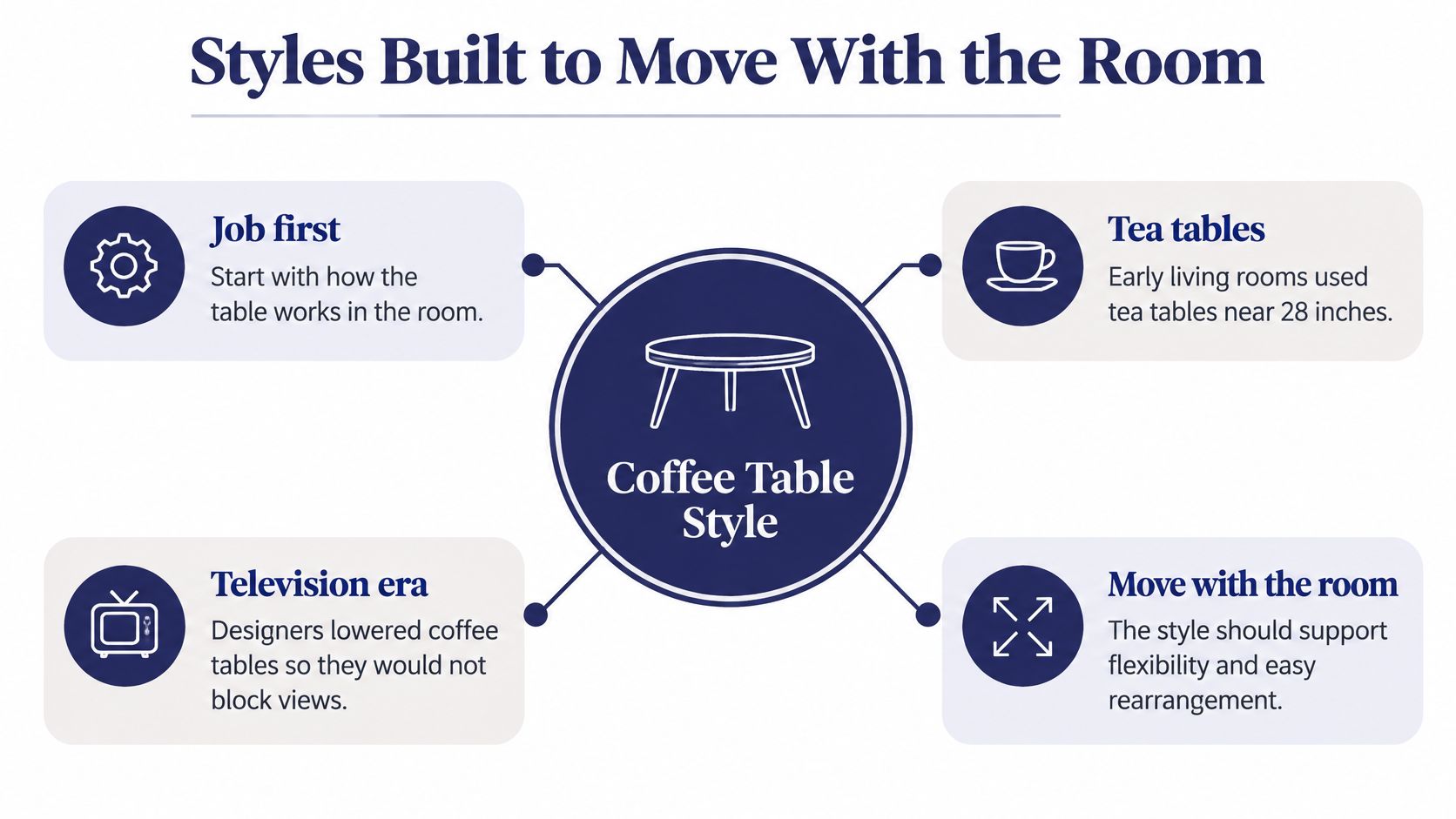
That practical approach fits the coffee table's history. Sotheby's account of the coffee table describes earlier English tea tables standing about 28 inches high, followed by lower, broader coffee tables as postwar television viewing changed living-room arrangements. Lower tops kept sightlines open while providing space for drinks, books, snacks, and remotes.
Mobility has its own furniture history. Tanger's Furniture's account of casters and coffee tables traces a documented milestone to Patent No. 821, granted to the Blake Brothers of Connecticut on June 30, 1838, for a caster attachment design. Wheels aren't an industrial-looking decoration; they serve the longstanding purpose of moving substantial furniture with less lifting.
Match a shape to a household task
Consider a room that serves as a television area during the week and a gathering space on weekends. Choose the form according to what needs to change:
- Rectangular top for a sofa. This offers a familiar central surface along a straight seating run. Wheels are especially useful for cleaning access or clearing the middle of the room.
- Round drum for a compact seating circle. A round outline avoids projecting corners along the walking route. Check the entire base, since a bulky drum still needs room to turn.
- Nesting tables for guest overflow. Separate rolling surfaces can move toward different seats, then return to a smaller footprint. Confirm that each piece parks securely.
- Industrial cart for accessible storage. An open lower shelf can hold supplies while casters let you move the whole piece for cleaning. Storage shouldn't obstruct the brake pedals.
- Lift-top for a temporary desk. The rising surface brings work closer to the seated user. Assess it with the top raised, because that working position matters more than its closed appearance.
The relationship between purpose, height, and mobility is easier to see as a connected set of choices.
Keep storage and side pieces in perspective
If organizing small belongings is the main problem, Quote My Wall's discussion of practical living room storage with vintage charm offers a useful storage-focused perspective. Decide whether you need compartments before choosing wheels just for their appearance.
A C-shaped table is a related side piece whose base can slide beneath compatible sofa clearance. It isn't a replacement for a central coffee table when several seats need access to the same surface.
Finish your selection statement in plain language: “I need a rectangular table that moves for cleaning,” or “I need nesting surfaces for guests.” A named job and a suitable shape are more useful than a style label alone.
Mobility Versus a Planted Feel
A locking pedal can make a mobile table look like a fixed one. Don't assume it will feel like one when you rest your hands on the top, type near a corner, or set down a full tray.
In household terms, you're trading some planted feel for easier repositioning. That trade can be worthwhile, but only if the table's normal use doesn't depend on it acting as an immovable support.
Decide what you gain and what you give up
The practical gains are straightforward:
- Easier cleaning access. You can move the table aside rather than reaching around its base.
- A shared surface between locations. The same table can serve a television arrangement and a conversation area when the route is clear.
- Less dragging during rearrangement. Compatible wheels can let you reposition a heavy wood table without pulling fixed legs across a rug.
The limits deserve equal attention. Hard treads can leave marks, a brake may release if its pedal is bumped, and drawers or a raised top can change the balance. A lightweight table may also feel less reassuring when someone instinctively leans on it to stand.
Creep and tipping aren't the same event. Creep is gradual sliding or movement, potentially noticeable on a slightly out-of-level floor. Tipping involves rotation toward an edge of the support base; a table can resist rolling yet still be vulnerable to that motion.
Locks limit rolling; they do not turn the table into a fixed-base piece.
A tabletop that stays level during a gentle roll hasn't passed a stability test. Likewise, a table that parks securely when empty may behave differently with a loaded drawer or a raised work surface.
Try a controlled edge-pressure check
With permission in a showroom, or carefully at home, place the table in its intended configuration and engage every available lock. Keep breakable objects off the top and make sure nobody is in the direction it could move.
Apply moderate hand pressure at each edge without sitting, climbing, or putting your body weight onto the piece. Watch for wheel rotation, swivel movement, sliding, rocking, or an edge beginning to lift. Stop immediately if the table starts to tip.
If the table walks under that pressure, don't treat it as an everyday leaning surface or a dependable platform for a heavy serving tray. It's also a poor match for a room where children may climb toward objects on top. The useful result isn't a pass/fail label for every household; it's knowing whether the table suits yours.
Stability Checks for Family Homes
Families need a decision framework, not a promise that locking wheels make a table childproof. Children may pull on edges, pets may bump the base, and an older adult may reach for nearby furniture while standing.
The U.S. Consumer Product Safety Commission's 2019 tip-over report found that tables were involved in about 34% of emergency-department-treated furniture tip-over injuries in its reported furniture category. That finding doesn't establish that wheels caused those injuries, nor does it describe the risk of a particular coffee table.
The report's discussion of voluntary standards and federal regulation is historical context, not a current legal assurance for a product. Neither a generic furniture label nor the presence of brakes should replace a household-specific assessment.
Look at the base before the storage
Prefer a low, broad support footprint over a tall, narrow form when stability is a priority. Look underneath rather than judging only the tabletop: a broad top can conceal a much smaller wheel footprint.
Use at least two locking casters, and engage locks on every wheel when the product provides them. That's a practical starting point, not a child-safety certification. A single brake doesn't compensate for a narrow base, and additional brakes don't correct weak mounts.
Storage needs a separate check:
- Drawer-heavy designs. Consider whether open drawers create a climbing invitation or change how the table balances.
- High storage or raised surfaces. Assess the usable configuration, including a lift-top left open during work.
- Tempting objects. Keep remotes, drinks, and appealing items away from outer edges; don't rely on placement alone to prevent climbing.
- Accessible pedals. Confirm that adults can reach and operate the locks without shifting the table first.
Match the decision to the people using the room
For a home with young children, apply the edge-pressure check with drawers closed and in any manufacturer-approved working configuration. Any walking, rocking, or lifting is a reason to reconsider the piece, not to assume supervision will make the behavior irrelevant.
Pets introduce a different pattern: repeated bumps, hair around moving parts, and traffic close to the base. Check that the table doesn't obstruct their usual route or require occupants to leave brakes disengaged for convenience.
For someone who steadies themselves on furniture, mobility may conflict directly with the room's needs. A coffee table should not be treated as a standing aid, even when it has fixed legs.
Choose the base for the household: If predictable, stationary support matters more than rearranging, a fixed-base coffee table may be the more suitable choice.
If a wheeled table moves under ordinary contact, choose a fixed design or investigate manufacturer-approved caster removal. Don't unscrew the wheels and assume the remaining legs are suitable floor supports. The resulting height, contact surfaces, and structural support all need checking.
Size and Set It Up Safely
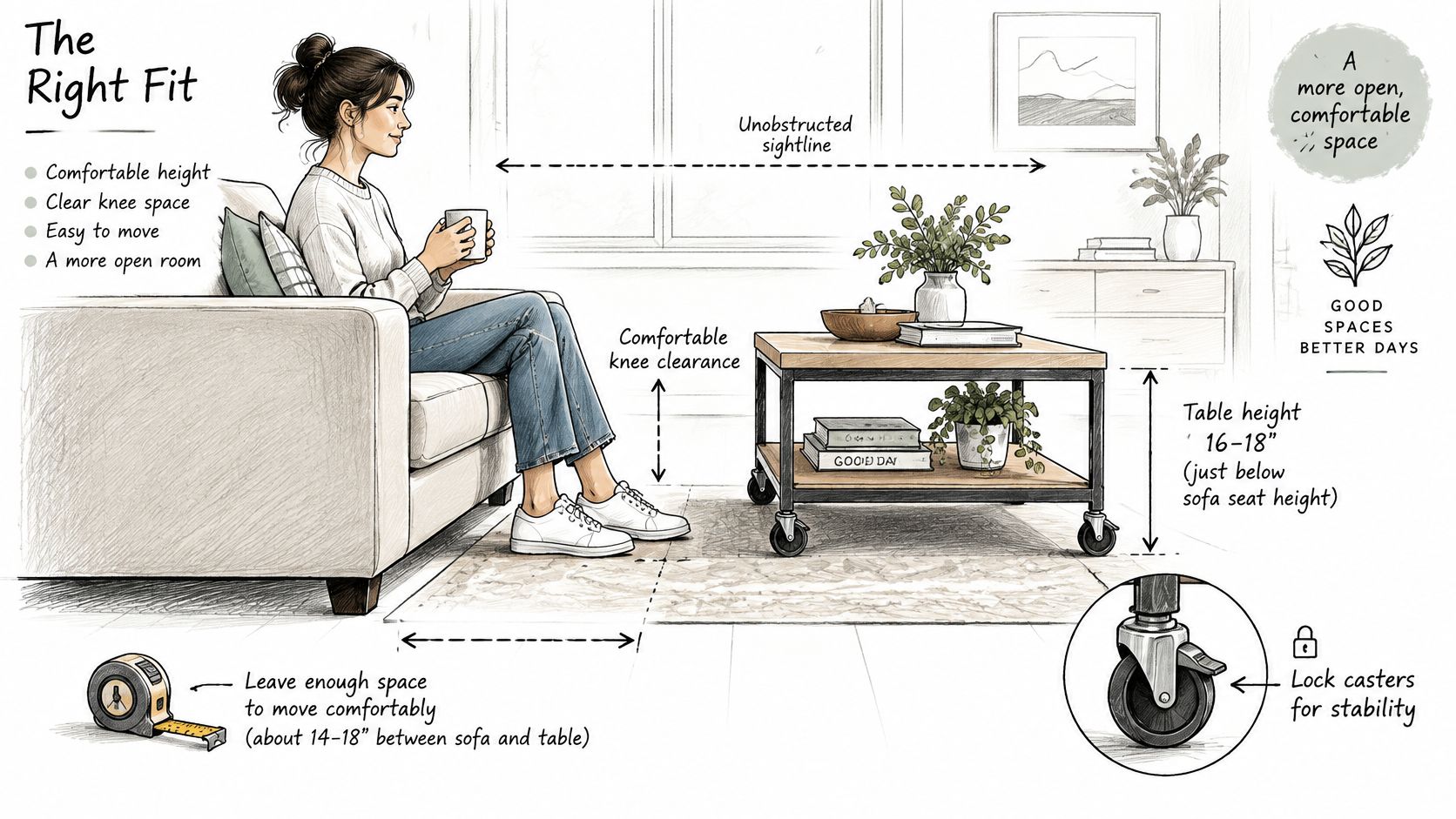
Will the table fit the seating area and leave a comfortable path through the room? Check both before choosing a finish. As practical layout starting points, a table height near the sofa seat is commonly about 16–18 inches, with roughly 12–18 inches between sofa and table. These are not safety standards or universal clearances. Sit, reach, and walk through the proposed space to see whether the dimensions work for your room.
A tabletop around two-thirds of the sofa's length can look balanced, though it is not a requirement. In a compact seating circle, a round top can make circulation easier. A rectangle often follows a long sofa or sectional more naturally.
Use the illustration as a proportion check, then measure your own furniture.
Measure the finished height
Adding casters changes the table's height, so measure from the floor to the tabletop with the complete caster assembly installed. Wheel diameter alone does not show how much height the mounting and fork add.
Mark the proposed footprint with painter's tape that is compatible with your floor finish. Sit down, stand up, and walk the route while someone uses the adjacent seat. The arrangement may look balanced yet leave too little room to pass.
A tray can keep remotes and cups grouped away from the edge. Remove loose drinks before rolling. A lighter top may be easier to reposition often, as long as the complete table remains steady.
Confirm the mounting before drilling
Mounting plates and stems attach casters in different ways, but the table must be built to accept the fitting you choose. A thin panel, hollow leg, or damaged corner may not provide sound support.
- Inspect the structure. Confirm that the manufacturer permits the conversion and identify solid material for mounting.
- Match the hardware. Use fasteners suited to the table's construction and the specified fittings. A loose stem is not a substitute for the correct socket.
- Keep support heights equal. Use matching assemblies and secure them consistently to avoid rocking.
- Test before loading. Set the table upright, check each attachment, and engage all locks before adding contents.
For another visual reference while planning the layout, use the video below.
Recheck fasteners, stems, and brakes after the first week, then whenever you notice looseness or uneven movement. Rolling and handling can loosen an attachment. Stop using the table until any movement at the mount is corrected.
A suitable table fits the seating, clears the walking route, and protects the floor under realistic use. It should also stay acceptably steady for its intended purpose. Remember that a lock helps prevent a caster from rolling, but it does not make a wheeled base identical to fixed legs. If the table does not meet these checks, consider a different base or table.
Woodstock Furniture & Mattress Outlet offers design services and delivery options to help with room planning. Bring your sofa measurements, floor details, and a photo of the layout when you visit Woodstock Furniture & Mattress Outlet, and ask the team about design services and delivery options for your room.