You're putting away clean laundry, but the sock drawer won't close and your favorite shirt is somewhere beneath a stack of clothes you rarely wear. Buying organizers feels like the obvious fix. Yet a divider can't solve a drawer that holds the wrong categories or sits at an awkward height.
Effective dresser organization starts with the furniture you have and the way you use it. Measure the interiors, give clothing clear zones, and place everyday pieces within comfortable reach. Then choose organizers only where they solve a specific problem, with safety built into the arrangement.
Measure Each Drawer Before You Buy Dividers
Start with usable width, depth, and height, not the dimensions printed on a furniture listing. The drawer front, runners, back stop, and surrounding rails don't provide clothing storage. Measuring the outside can leave you with an insert that looks suitable but won't fit.
You'll need a tape measure, paper, and a pencil. Empty each drawer before measuring, and open only one drawer at a time.
Make a drawer map
- Sketch the dresser. Label drawer positions from top to bottom, distinguishing left and right drawers where necessary. Don't assume matching fronts mean identical interiors.
- Measure the inside width. Measure side to side at the back, then check near the front for any narrowing.
- Record the interior depth. Measure from the inside front edge to the back panel, excluding hardware or projections that obstruct an insert.
- Check usable height. Measure from the drawer floor to the lowest obstruction, including the front edge or rail above. Clothing must clear that point when the drawer moves.
- Mark relative capacity. Identify shallow, medium, and deep drawers within your dresser. This makes it easier to match small essentials to shallow spaces and bulky folds to deeper ones.
Keep the dimensions beside each position on your sketch. For adjustable dividers, check both their adjustment range and their height, including any padded ends.
Practical rule: An organizer must fit the drawer's moving space, not just its open interior.
In a 2025 YouGov survey of 1,155 U.S. adult citizens, 61% said reducing clutter motivates them to organize. For that purpose, a measured layout is more useful than a drawer full of attractive containers.
Before buying, outline potential compartments on your sketch. Remember that divider walls consume space themselves, and don't force a tight insert against the drawer sides.
How to Declutter and Sort Before Adding Dividers
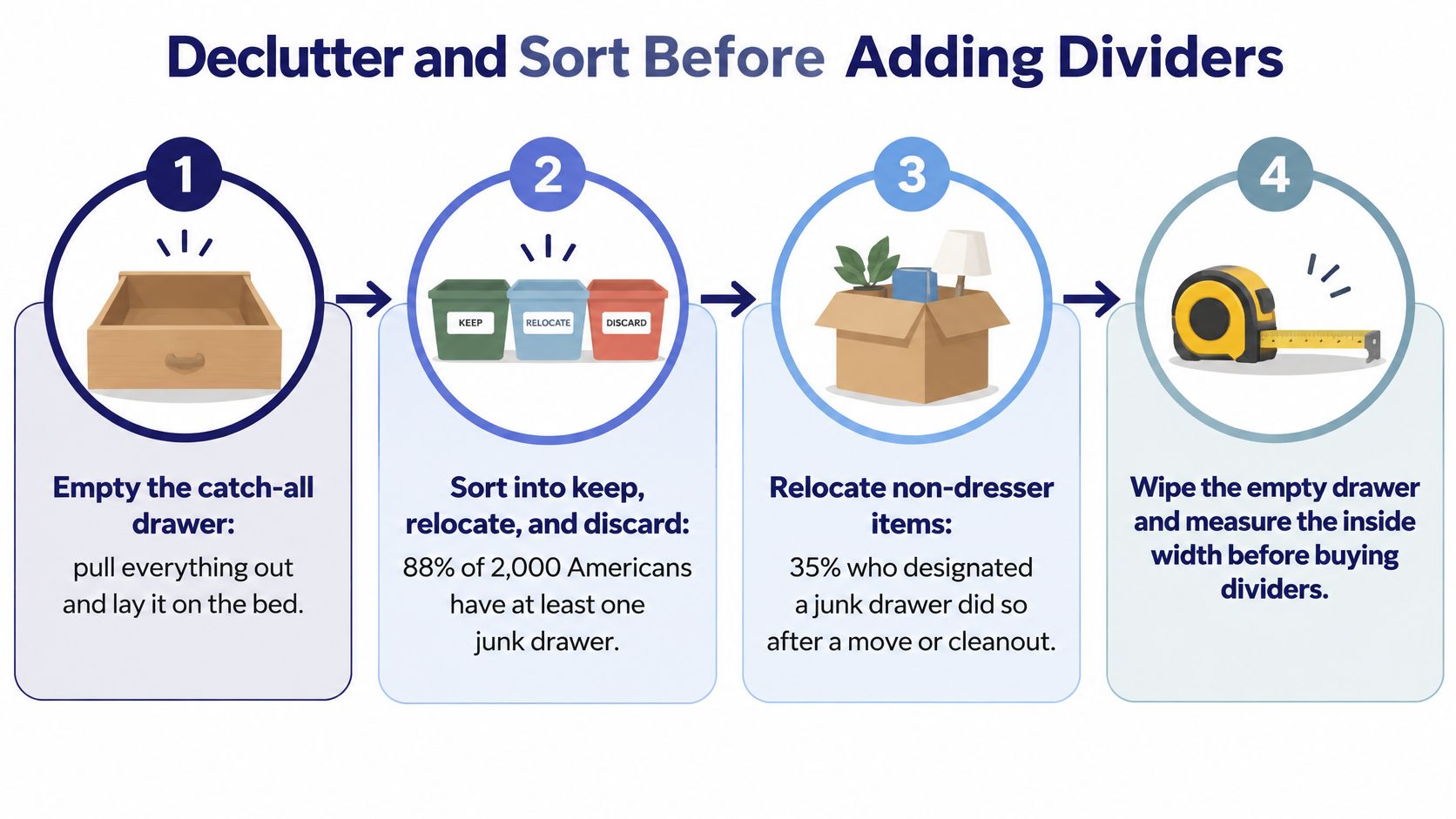
The catch-all drawer is the main obstacle to a workable clothing system. Once receipts, spare chargers, and unmatched garments share a space, you have to sort through unrelated belongings just to get dressed. A survey of 2,000 Americans, described by StudyFinds, found that 88% had at least one junk drawer.
That finding describes a household habit, not evidence that a particular organizer will fix it. The useful response is to give everything a destination before adding compartments.
Sort for the wardrobe you actually use
- Empty a manageable amount. Work through a drawer or clothing type on a bed or table. Seeing the whole category helps you recognize duplicates without covering the room in unfinished piles.
- Separate keep, relocate, and remove. Set aside damaged or unused pieces, but don't automatically discard useful duplicates. Work uniforms, caregiving needs, and laundry schedules can justify repeated garments.
- Return unrelated belongings to their proper rooms. Put paperwork with household documents and chargers with electronics. Moving them onto the dresser top only relocates the clutter.
- Group clothing by purpose. Separate sleepwear, everyday tops, underwear, socks, and workout clothing. Keep sets together when you consistently wear and wash them together.
- Give each drawer a primary category. Where a small wardrobe shares a drawer, establish distinct sections rather than allowing categories to intermingle.
- Leave breathing room. Stop before you have to press garments down to close the drawer. Spare capacity lets you remove a piece without disturbing everything around it.
Children's wardrobes need an additional decision: what fits now versus what belongs in storage. The InchBug tips for off-season kid clothes offer a useful supporting resource when seasonal pieces are crowding out current clothing.
Fold kept garments so you can recognize them without lifting the entire contents. Wipe the empty drawer before replacing clothing, using a cleaning method appropriate for its finish.
Make a brief monthly reset a practical maintenance habit. Return misplaced belongings, remove outgrown pieces, and check whether your categories still match what you wear.
Assign Each Drawer by How Often You Reach It
A balanced-looking dresser isn't necessarily an easy dresser to use. If your everyday shirts live near the floor while occasional accessories occupy the most comfortable drawer, the layout asks you to make unnecessary movements.
In the 2025 YouGov home-organization poll, 25% of respondents described their homes as “very organized,” while 42% chose “somewhat organized.” Those are perceptions of whole homes, not dresser-performance measurements. For your own drawers, judge usability by whether you can identify and retrieve what you need comfortably.
Clothing category by drawer position
| Clothing category | Best drawer | Reason |
|---|---|---|
| Underwear and socks | Upper or middle drawer | Used daily, easy to reach |
| Sleepwear | Upper or middle drawer | Used nightly |
| Everyday tops | Middle drawer, between waist and shoulder height | Most frequently worn items |
| Bulky sweaters and folded jeans | Lower deep drawer | Bulky and worn less often |
| Off-season items | Lowest drawer or a bin | Accessed a few times a year |
| Small accessories | Shallow top drawer | Small items need compartments |
Treat these placements as a starting arrangement, not a rule that overrides your routine. If you wear jeans daily, they deserve a more accessible position than sweaters you wear occasionally. A shallow top drawer also isn't convenient if its user can't see or reach inside it comfortably.
Frequency takes priority over visual symmetry. Estimate each category's folded volume against the drawer map, then assign the easiest positions to the garments you reach for most. Add a label where it helps distinguish similar-looking sections.
Color sorting can be a finishing detail within a category, but it shouldn't separate clothing you use together. Likewise, compressing shirts into a dense row may fit more pieces while making individual garments difficult to remove.
Keep valuable daily-use space for current clothing. Seasonal storage belongs there only when it doesn't displace what you need regularly.
For mixed-season wardrobes, separate the occasional extra layer from off-season clothing. You shouldn't need to unpack a storage bin whenever the weather changes.
Pick Dividers and Folding Methods That Fit Your Drawers
Choose the simplest organizer that solves the actual problem. Socks drifting into underwear may need a partition. A drawer of neatly separated sweaters may need nothing at all.
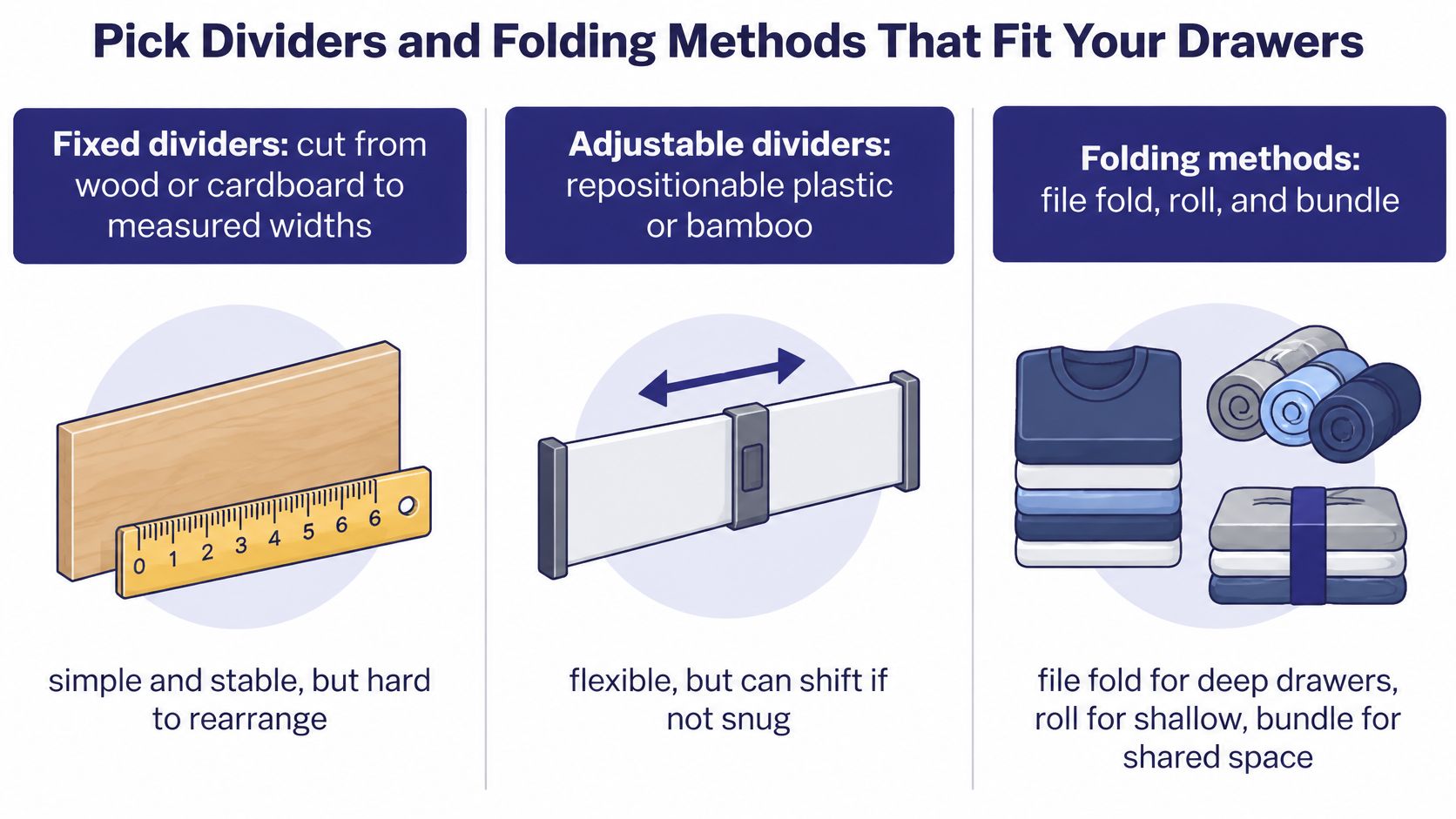
Fixed dividers suit stable categories, while adjustable dividers accommodate changing proportions. Neither creates additional interior volume. Their value is in maintaining boundaries, and their thickness is part of the space calculation.
Divider and folding options compared
| Option | Works best for | Tradeoff to know |
|---|---|---|
| Fixed wood or cardboard dividers (DIY) | Drawers with stable categories | Cannot adjust if categories change; cut to measured width |
| Adjustable dividers | Drawers whose contents change by season | Can reduce usable width and may need clearance to close |
| Fabric or mesh bins | Small items and accessories | Take up interior space and can hide contents |
| Vertical folding (KonMari-style) | Knits, tees and leggings | Needs enough drawer depth; garments stay visible |
| Rolling | Casual tops and sleepwear | Compact, but less stable in shallow drawers |
| Flat stacking | Heavy or bulky garments | Lower items get buried unless each stack holds one category |
Test the fold before committing
For vertical folding, stand a sample garment in the drawer and check that its folded height clears the opening. Drawer depth from front to back determines how long the row can be, while usable height determines whether the fold will close safely. These are different measurements.
Rolling works well for flexible casual clothing, but loose rolls can unravel or shift when the drawer moves. A small bin can contain them, provided its sides don't conceal the garments you're trying to identify.
Flat stacks suit bulky pieces that don't stand neatly. Keep stacks low and separate garment types so you aren't lifting sweaters to find jeans.
Before making wooden partitions, cut a cardboard template and use it through normal dressing and laundry routines. If the category boundaries keep changing, an adjustable solution makes more sense than a permanent insert. Smooth any DIY edges, and avoid exposed fasteners or rough surfaces that could snag clothing.
Adapting Drawer Layouts for Kids, Small Rooms and Shared Dressers
Organization isn't just about neat rows. The U.S. Consumer Product Safety Commission's tip-over report estimates an annual average of 2,000 emergency-department-treated injuries to children involving chests, bureaus, and dressers, based on 2019–2021 data.
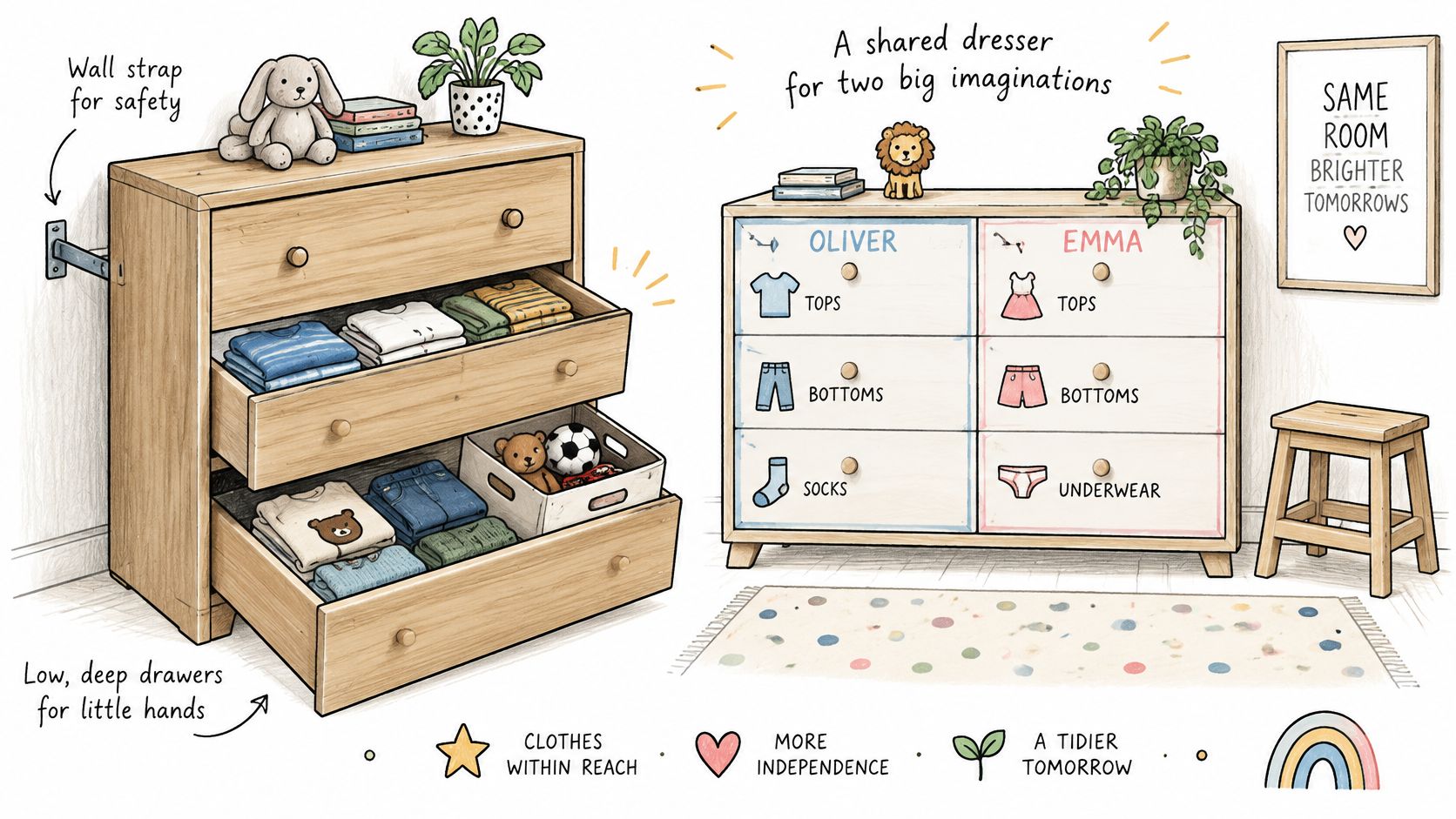
A shared dresser can have clear ownership zones without overlooking anchoring.
Build safety into placement
- Anchor the furniture. Use anti-tip hardware installed according to the dresser and hardware manufacturers' instructions, with fasteners appropriate for the wall construction. Drawer arrangement isn't a substitute for anchoring.
- Keep heavier contents low. Don't concentrate heavy belongings in upper drawers, and follow the furniture's loading instructions.
- Remove climbing incentives. Keep toys, electronics, and tempting diapering supplies off the dresser top. Store adult-use supplies elsewhere, inaccessible to children.
- Plan for the actual user. Put approved everyday clothing within a child's comfortable reach, without encouraging climbing or standing in drawers.
- Check the installation space. Account for baseboards and the clearance needed to install the anchoring system correctly. Renters should discuss approved anchoring options with their landlord rather than improvise a damage-free substitute.
For older adults and caregivers, keep daily clothing between waist and shoulder height when that suits the user's reach. If balance, mobility, or seated access changes that range, prioritize comfortable retrieval instead of a standard drawer position. Large, readable labels can make caregiver-managed categories easier to identify.
The video below provides an additional visual reference.
In a small room, don't solve limited floor space by placing essential clothing in an inaccessible tall chest. Shared dressers work better with clearly labeled ownership zones than with everyone's socks or shirts mixed together. Safety measures reduce risk, but they don't eliminate it.
Test Your Layout for a Week, Then Decide What to Change
Use the finished arrangement through a normal week, including putting away laundry. A drawer can look comfortable when part of the wardrobe is in the wash and become overcrowded when everything returns.
Check the layout during ordinary use rather than restyling it for inspection.
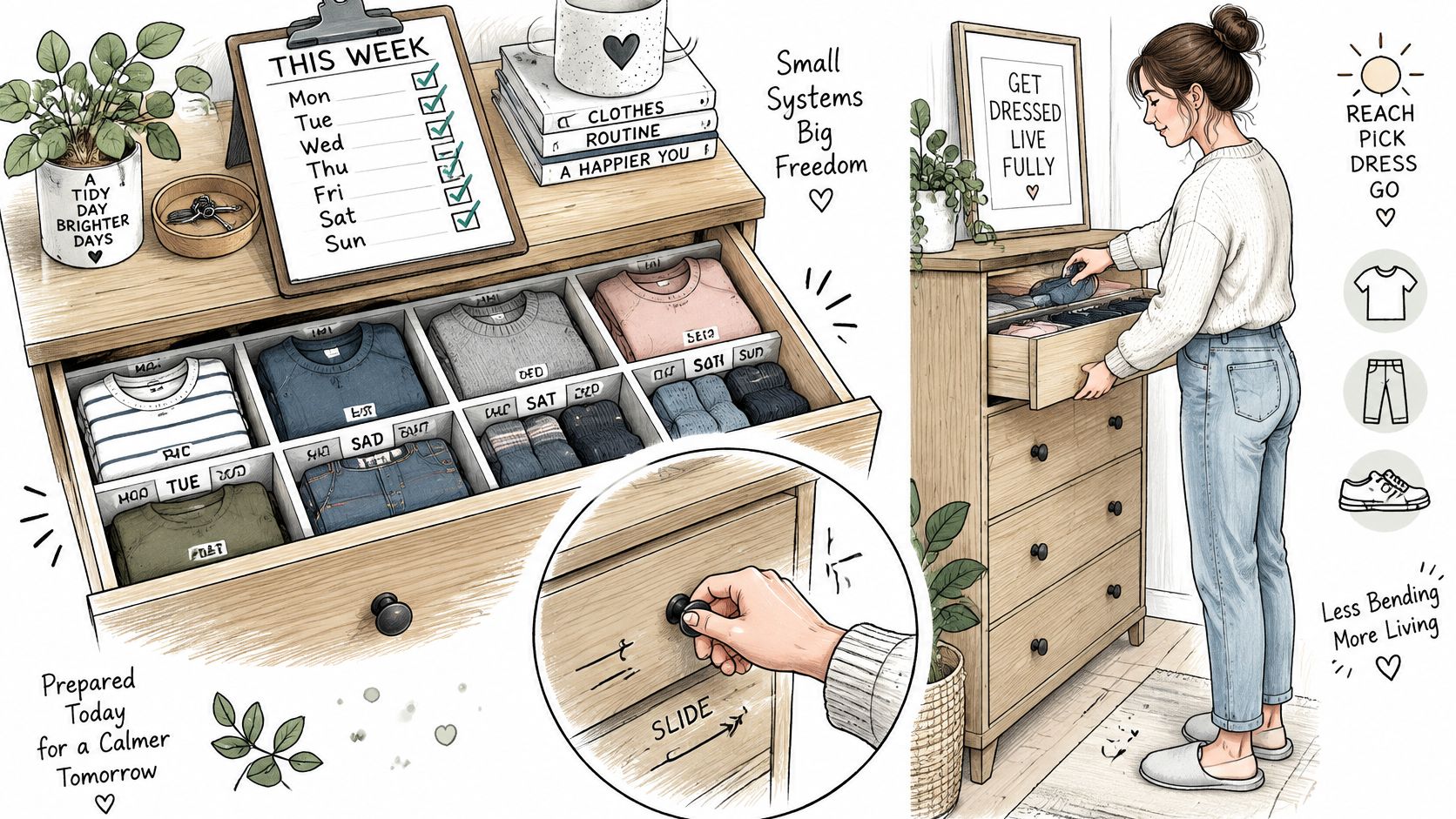
Check what happens without extra effort
- Clothing returns easily. Each category goes back into its assigned space without pushing neighboring garments aside.
- Drawers close fully. Inserts, folds, and bin handles clear the surrounding furniture without catching.
- Daily items stay accessible. You don't have to bend awkwardly, stretch overhead, or lift unrelated piles.
- Clean laundry fits. The arrangement accommodates the wardrobe you own, not just what remains between wash days.
- Boundaries remain clear. Loose belongings don't accumulate in an unnamed corner.
Record the specific failure rather than deciding the whole system doesn't work. If workout clothing spills into sleepwear, move a less-used category or give workout pieces a larger zone. If a divider shifts whenever you remove socks, change its fit or use a contained bin.
Change the smallest part that failed. Don't rebuild a usable dresser because a compartment needs adjustment.
At your monthly reset, check for recurring problems and reassess when seasonal clothing changes. Repeated overfilling after thoughtful decluttering suggests a capacity or category mismatch, not necessarily a need for more organizers.
If the furniture placement itself makes access awkward, our design services at Woodstock Furniture & Mattress Outlet can help you consider the room arrangement. A dresser that fits the wardrobe still needs a location where you can stand comfortably and open its drawers.
Choosing a Dresser Size That Fits Your Needs
Shop from a category list and room measurements, not from the outside appearance alone. Write down which categories need dedicated drawers, which can share compartments, and which belong in separate seasonal storage.
Then compare actual drawer interiors. A wide dresser with shallow drawers may suit underwear, accessories, and light tops, while a chest with deeper drawers may better accommodate folded bulk. Neither format is automatically the right choice.
Match capacity to the room
- Check drawer count and proportions. More drawer fronts don't necessarily mean more useful clothing space. Decide whether your wardrobe needs broad sections, small compartments, or a combination.
- Compare usable height and depth. Bring a folded bulky garment or a paper template of its footprint, if practical. Check whether it fits without compression.
- Measure the opening area. Mark the dresser footprint with painter's tape and allow room for drawers to extend while you stand in front of them.
- Evaluate overall height. Confirm that the intended user can see into and retrieve clothing from the daily-use drawers.
- Inspect the anchoring arrangement. Consider wall construction, baseboards, and access to the mounting points before choosing the location.
A taller chest can preserve wall width, but it may put upper drawers beyond comfortable reach. A lower, wider dresser can offer accessible storage while occupying wall space you need for another purpose. Choose the tradeoff that suits both the wardrobe and the room.
Finish matters after fit. A dresser that coordinates beautifully with the bed can still be frustrating if its drawers won't accommodate your clothes or its position blocks circulation.
In a showroom, open the drawers, inspect the interior proportions, and consider the handles as well as capacity. Handles should be comfortable for the intended user to grasp, including anyone with limited hand strength.
Bring your category list, drawer sketch, and room measurements. Those details make it easier to discuss whether a different size solves your storage problem or gives you a larger version of the same mismatch.
We offer furniture, mattresses, home decor, and design services to help you plan a room around everyday use. Bring your drawer measurements and clothing-category list when you visit Woodstock Furniture & Mattress Outlet, so we can help you compare dresser sizes and talk through placement without guessing about what needs to fit.