
Will a sofa in white still look good after ordinary life, or only when nobody's sitting on it? That's the question to answer before choosing pillows or deciding whether white looks timeless.
White is a maintenance and lighting decision first. The right choice depends on what lands on the cushions, how you're willing to clean them, and what the fabric looks like under your own lamps. A warmer shade, a replaceable cover, or a different color altogether may serve you better than the brightest white on the showroom floor.
Who a White Sofa Suits at Home
White sofa choices by household
| Household | More forgiving choice | Main risk | When to skip white |
|---|---|---|---|
| Young children | Warm ivory with a removable cover | Food dye and marker transfer | No one will spot-clean most weeks |
| Pets | Heathered oatmeal or textured weave | Hair, oils, and snags | Long light hair on flat optic white |
| Daily denim lounging | Tight weave with documented dry-crocking performance | Blue dye transfer | Dark jeans on pale cotton every night |
| Renters | Washable slipcover | Stains with no realistic reupholstery path | Replacement covers aren't available or moves are frequent |
| Frequent entertaining | Fabric with a stated cleaning code and spare cover | Spills plus sun exposure | No shade and no replacement cover |
| Long-term anchor piece | Cream or ivory plus washable throws | Yellowing over time | Zero maintenance is the real goal |
Choose the row that resembles your busiest day, not your tidiest weekend. A family that eats on the sofa needs a different maintenance plan from someone furnishing a rarely used sitting room.
For young children, warm ivory with a washable cover is usually a more forgiving starting point than optic white. That doesn't mean ivory resists food coloring or markers. It means small changes in overall appearance may be less conspicuous, while the removable cover gives you a practical cleaning route.
Texture helps, but it has limits
Pet owners can easily confuse visual camouflage with physical durability. A heathered weave may disguise minor soil, but an open, looped texture can still catch claws. Long, light-colored hair can remain visible on flat optic white because its shadows and texture stand out, even when the colors seem similar.
A dark sofa isn't an automatic solution. Light pet hair and lint can become more obvious against charcoal or navy, so bring a little of your pet's brushed-out hair when comparing swatches.
Practical rule: Choose the upholstery you can maintain on an ordinary busy week, not the upholstery you could maintain with unlimited time.
Renters should pay particular attention to replacement covers. A removable cover is useful only if it can be cleaned appropriately or replaced when necessary. Frequent moves also make delivery access and adaptable dimensions more important than achieving a particular shade.
White is a choice, not a universal default
Homes & Gardens' living-room furniture coverage describes interest in stronger colors, patterns, and distinctive details beyond standard white and gray seating. That's permission to consider alternatives, not a reason to avoid white.
In a separate catalog analysis, gray or beige was generally the most common sofa color from 2013 through 2021, according to the Brisbane Times' account of IKEA catalog research. White wasn't consistently the leading choice.
Pick your household row first. Then evaluate a large sample in morning, afternoon, and evening light before committing to the color.
Fabric Tests That Predict Daily Wear
Don't judge durability by how clean a sofa looks on display. The Association for Contract Textiles' abrasion guidelines identify 15,000 Wyzenbeek double rubs or 20,000 Martindale cycles for low-traffic/private upholstery, and approximately 30,000 double rubs or 40,000 Martindale cycles for high-traffic applications.
Those are abrasion benchmarks, not promises about years of service. For children, pets, or daily lounging, request the higher-traffic benchmark and compare results obtained using the same test method.
White sofa fabrics and what the tests cover
| Fabric or finish | Abrasion band to request | Cleaning reality | Fits best |
|---|---|---|---|
| Flat cotton or linen blend | Documented low-traffic benchmark for occasional use; higher-traffic benchmark for daily seating | Shows soil readily; check whether its code permits water or requires solvent | Low-traffic formal rooms |
| Performance polyester weave | Documented high-traffic benchmark | May allow easier blotting, but isn't stain-proof; confirm the cleaning code | Daily family seating |
| Olefin or solution-dyed fiber | High-traffic benchmark using the same comparison method | Can offer useful fade resistance; softness and approved cleaners need checking | Sunlit rooms and spill-prone seating |
| White or cream leather | Textile rub counts don't transfer directly; ask about finish type | Wipe-down care may be possible, but dye transfer, yellowing, and cracking remain considerations | People who prefer wipe-down care |
| Removable slipcover | Request specifications for the cover and underlying upholstery | Machine-wash only if expressly permitted | Renters and high-mess homes |
| Boucle or textured weave | Ask for documented abrasion results; texture isn't a durability rating | Can disguise variation but may snag and hold crumbs | Style-first rooms with moderate traffic |
What the abrasion number actually means
A Wyzenbeek double rub is a back-and-forth abrasion movement. The reported result records how many movements the specimen withstands before the test's wear endpoint, such as noticeable wear or yarn breaks.
Martindale uses a different abrasion action. Don't treat its cycle count as interchangeable with Wyzenbeek, and don't assume a larger number from one method automatically beats a smaller number from the other.
The household consequence is straightforward: abrasion testing helps you evaluate repeated rubbing from sitting and moving. It doesn't tell you whether tomato sauce will wash out or whether a seam will hold its shape.
Fiber names aren't performance guarantees
A cotton blend isn't automatically delicate, and polyester isn't automatically durable. Yarn quality, weave, backing, finish, and construction all affect how the finished upholstery behaves.
Likewise, solution-dyed describes how color is incorporated into a fiber, not a universal permission to use bleach. Only use bleach when the specific upholstery manufacturer authorizes it. Check the finished sofa's instructions, including any restrictions involving seams, backing, or cushion components.
Ask for a performance sheet containing:
- Fiber composition: Identify the actual blend rather than relying on a collection name.
- Test method and result: Compare like with like.
- Finish information: Find out what treatment has been applied.
- Cleaning code: Establish what maintenance is allowed.
- Additional testing: Request information about pilling, seam performance, and cleaning durability.
A high rub count can support a durability decision. It cannot promise that white upholstery will stay white.
Light Yellowing and Color Transfer
The sofa that looks crisp in a showroom may look creamy at home. The same upholstery can appear bright around midday, yellowish under some cool LEDs, and beige under warm bulbs. That immediate change in appearance isn't necessarily damage.
This illustration shows why the room matters as much as the fabric sample.

North-facing light often reads cooler, which can make some ivory fabrics look dull beside a cleaner white wall. Strong west-facing afternoon sun presents a different concern: prolonged exposure can contribute to actual discoloration. Move the sofa out of intense direct sunlight when the layout allows, or manage exposure with suitable window coverings.
Separate appearance changes from fabric changes
Yellowing develops through exposure and accumulated use, including light, heat, and oily soils. Color transfer happens when dye moves from another material, such as dark denim, onto the upholstery. Neither problem is answered by an abrasion rating.
ASTM's upholstery-fabric performance criteria include colorfastness to water, solvents, crocking, light, and other exposures. Request the fabric's actual results rather than treating a performance label as proof of every property.
Crocking needs a careful explanation. An upholstery crocking test checks whether the upholstery's own color transfers outward during rubbing. It doesn't guarantee that dark jeans won't deposit dye onto a white seat. For denim-heavy use, ask specifically about resistance to incoming dye transfer as well as documented wet- and dry-crocking performance.
Before relying on a video demonstration, compare the material and cleaning method shown with your own sofa's care instructions.
Run a useful swatch check
Place a large sample where the sofa will sit, not just beside the window. Hold it against your wall, flooring, and existing rug, then view it with the actual lamps switched on.
Check it in morning, afternoon, and evening light. Photographing the sample can help you remember the comparison, but make the final judgment with your eyes because a phone may adjust white balance.
If the sample looks wrong only under a particular bulb, investigate the lighting before rejecting the fabric. If it looks wrong throughout the day, choose a different undertone.
Cleaning Codes and Safer Stain Resistance
A workable care routine matters more than a cabinet full of stain removers. Start with gentle maintenance and use the manufacturer's instructions to decide what happens next.
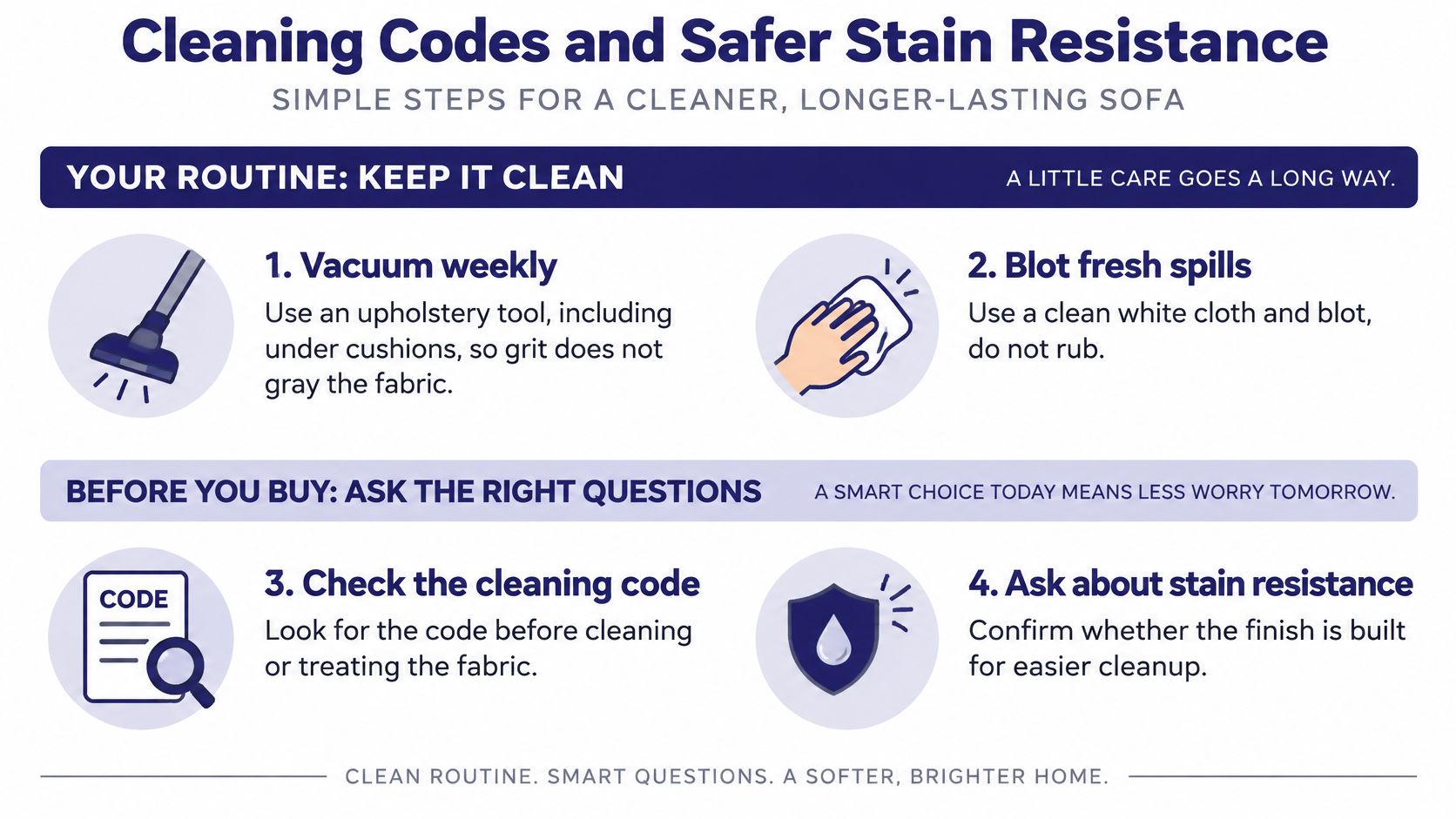
- Vacuum weekly. Use an upholstery tool across the seats, seams, and spaces beneath removable cushions. Removing loose grit helps prevent a gray, dusty appearance.
- Blot fresh spills. Press with a clean white cloth rather than rubbing. Work toward the center so you don't spread the spill.
- Read the cleaning code before adding liquid. Water isn't suitable for every upholstery fabric.
- Test and let dry. Apply an approved cleaner to a hidden area and wait until it dries before judging the result.
- Wash covers only when permitted. Follow the specified cycle and drying method. Refit slightly damp only if the maker recommends that technique.
- Protect the busiest seat. Use a washable, colorfast throw where people eat or regularly lounge in denim.
Cleaning codes on upholstery labels
| Code | Meaning | Practical note |
|---|---|---|
| W | Water-based cleaner | Test on a hidden area first |
| S | Solvent-based cleaner only | Don't use water-based products |
| WS | Either water- or solvent-based cleaner | Confirm which suits the spill and the manufacturer's instructions |
| X | Vacuum only or professional care | Don't wet-clean at home |
W doesn't mean machine-washable. A zippered cushion cover may be removable for manufacturing or servicing without being suitable for laundering. Washing it anyway can affect its size, backing, or fit.
Keep the basic routine accessible near your cleaning supplies.
Ask what makes the finish stain-resistant
Some water-, oil-, and stain-repellent finishes have relied on PFAS. Strong repellency alone doesn't tell you whether a treatment is the right choice for your household.
According to Eurofins' overview of consumer-product PFAS regulations, Washington restricts intentionally added PFAS in indoor leather and textile furniture from January 1, 2026, and several other U.S. states introduced additional prohibitions or reporting requirements during 2026. These rules aren't interchangeable across locations or product categories.
For shoppers, the useful response is to request clear manufacturer disclosures, not assume every performance fabric contains the same chemistry. Tight construction, appropriate cleaning methods, and replaceable covers deserve consideration alongside repellency.
Ask these questions before choosing:
- Chemical disclosure: Are PFAS intentionally added to the upholstery or its treatment?
- Cover removal: Which covers come off, and which are washable?
- Approved cleaning: What code and product-specific instructions apply?
- Replacement availability: Are replacement covers sold for this exact model?
- Warranty limits: Are spills, dye transfer, or discoloration excluded?
For a broader room reset, the deep-cleaning service information offers context for planning a fresh start for your home. General household cleaning is separate from specialist upholstery care, so confirm fabric suitability before booking any sofa treatment.
Buying perspective: Choose a cleaning system you understand, not a stain-proof promise you can't verify.
Styling a Sofa in White by Room
A white sofa can look unfinished when everything around it has the same brightness and similar texture. You don't need an elaborate palette to fix that. Start with a clear contrast, then stop before the room becomes busy.
These room examples show different ways to give pale upholstery a deliberate place in the layout.
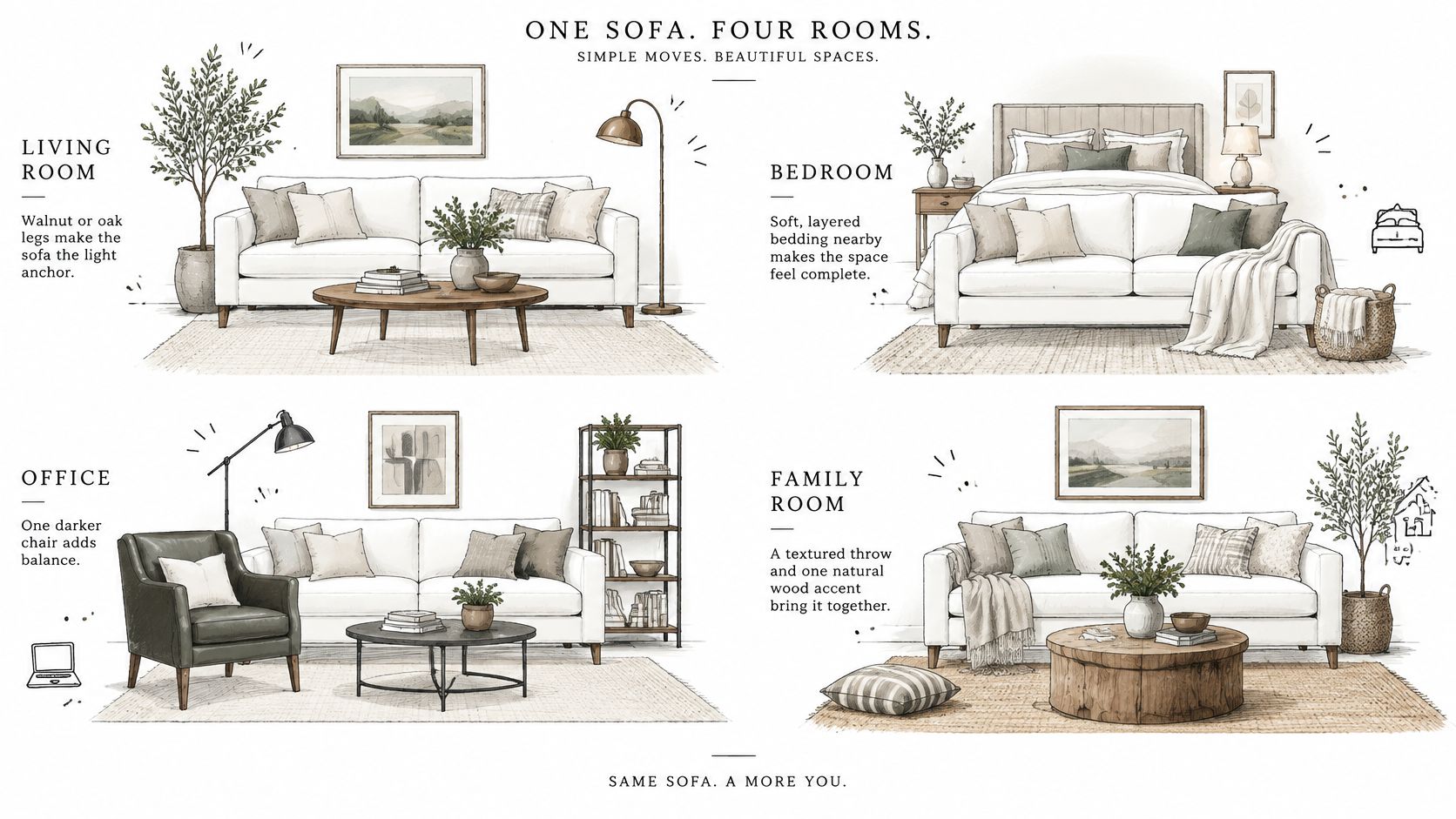
Living room
Say you're replacing a brown sofa but keeping the existing wood furniture. Let the white upholstery become the light anchor rather than replacing every surrounding piece with something equally pale.
Walnut or oak legs can connect the sofa to the furniture already in the room. A charcoal or olive lumbar pillow supplies a deeper note, while a rug containing a similar light tone helps the sofa feel connected to the floor.
Keep the coffee table far enough away for comfortable movement and an unobstructed view of the sofa's front. The useful contrast here is pale upholstery against wood and a deeper accent.
Open living-dining space
A smooth white sofa against white walls can lose definition, especially when viewed from the dining area. A textured cream fabric or fitted, skirted slipcover gives the seating a clearer outline without requiring a stronger color.
Repeat a darker dining-chair finish or a color from nearby artwork in a modest accessory. That connection makes the spaces feel related without matching every surface.
The contrast is between the sofa's soft surface and a darker, more defined element nearby.
Small apartment
A warm-white loveseat may create a lighter impression than a dark sofa that crowds the available wall. The important distinction is its footprint, not a promise that white furniture makes a room physically larger.
Choose side tables that leave circulation open, and avoid automatically adding another white upholstered chair. A washable cover may be more valuable than an extra seat if the loveseat handles most daily use.
The contrast comes from open floor space around a properly scaled piece.
Bedroom
A compact ivory settee at the foot of a bed can provide somewhere to sit without becoming another dominant rectangle. Let patterned bedding carry the visual activity and keep the settee comparatively quiet.
Before placing it, check that drawers, wardrobe doors, and the route around the bed remain usable. A beautiful seat that blocks everyday movement isn't helping the room.
The contrast is quiet upholstery beside patterned bedding.
Across these rooms, mix textures before adding more colors. Flat fabric, wood, a dimensional textile, and a restrained metal finish can be enough. An all-white sofa, rug, curtain, and pillow combination makes slight undertone differences more noticeable, so compare those materials together rather than purchasing them separately.
Measure the Room Then Compare Samples
Color won't rescue a sofa that blocks a doorway or can't make the stair turn. Measure the space where it will live and the entire route it must travel.
Bring a tape measure, a simple floor sketch, and photographs of tight corners. Record the sofa's overall dimensions separately from its usable seat dimensions, because broad arms and a thick back can take up room without providing more sitting space.
Sofa and room measurements to check
| Measurement | Starting range | Check before buying |
|---|---|---|
| Sofa depth | Start with the shallowest candidate that feels comfortable | A hypothetical 32 to 35 in depth is worth testing in a narrow room, not treating as a universal fit |
| Seat height | Start with a seat that lets your feet rest comfortably | Confirm the actual measurement on the product sheet |
| Main walkway | Test a hypothetical 30 to 36 in clear path with a floor mock-up | Verify comfortable access from the door to the seating and any applicable accessibility needs |
| Sofa to coffee table | Start with enough space to sit, rise, and pass comfortably | Keep knees clear and the sofa's front visible |
These are fit checks, not universal clearance standards. A deeper seat, a mobility aid, a reclining mechanism, or a heavily used route may require a different layout.
Make a pre-visit measurement record
Use painter's tape to mark the proposed footprint on the floor. Walk through the room carrying a laundry basket, open nearby doors, and check whether someone seated would obstruct the route.
Record these details before visiting:
- Usable wall length: Include baseboards, outlets, curtains, and nearby furniture.
- Delivery route: Measure doorway openings, stair turns, landings, and elevator access where relevant.
- Product dimensions: Save overall length, depth, height, and any documented removable components.
- Heat and light: Mark heaters and strongly sunlit areas on the sketch.
- Fabric decision: Bring your cleaning requirements and notes about the samples you tested.
A diagonal measurement alone doesn't prove a sofa will turn through a doorway. The delivery team needs enough information to assess the full route, including ceiling height and space beyond the opening.
Compare the finalists without pressure
Sit in the candidates as you use furniture. Put your feet on the floor, lean against the back, and check whether the seat supports your preferred posture. Then compare ivory, cream, and optic white side by side rather than relying on their names.
We offer design services and delivery options, so bring your room sketch and access measurements when discussing fit. Ask which fabric specifications and care documents are available for the particular sofa you're considering.
If another retailer's washable cover or smaller frame better matches your needs, that's a reasonable outcome. The goal is a sofa you can use comfortably and maintain realistically, not a white sofa that looks convincing under showroom lights.
Woodstock Furniture & Mattress Outlet offers design services and delivery options to help you work through room fit and access. Bring your measurements, lighting notes, and fabric-care questions when you visit Woodstock Furniture & Mattress Outlet to compare white, ivory, and cream upholstery in person.