If a table fits beside your sofa and keeps your coffee within reach, does it matter whether the store calls it an end table or a side table? Usually, the name matters less than shoppers expect. The more useful distinction is where the table will sit, how you'll reach it, and what you need it to hold.
That doesn't mean the terms are meaningless. They describe different starting points for arranging a room, but neither name guarantees the right dimensions. Understanding the difference helps you search more effectively without ruling out a piece that could work.
End Table vs Side Table at a Glance
An end table is usually a compact occasional table set at the end of a sofa or beside an armchair, where it holds a lamp, drink, book, or remote within reach, while a side table is the broader term for a table that can sit beside seating, against a wall, beside a bed, or in an entryway. Retail listings use the names loosely, so placement matters more than the label. In this end table vs side table comparison, pay particular attention to the height target and purchase check rows: they connect the name to the furniture and space you have.
End table and side table compared by placement and use
| Attribute | End table | Side table |
|---|---|---|
| Typical placement | Beside a sofa end or armchair | Beside a chair, bed, against a wall, or in an entryway |
| Usual job | Holds a lamp, drink, book, or remote within reach | Occasional surface in several rooms, or a writing or laptop surface when dimensions allow |
| Height target | Top approximately level with the arm, using the arm-height allowance explained below | Set by where it sits; match the nearby seating or bed and intended reach |
| Mobility | Often stays in one seating zone | Often moved between rooms, if weight and construction allow |
| Label reliability | Tied to sofa-end placement, but not a guaranteed size | Broader term, used loosely in listings |
| Purchase check | Arm height and clearance at the sofa end | Footprint, clearance, and storage for the intended spot |
Where will the table be when someone reaches for it, and what sits beside it?
Match the Table Height to Your Seating
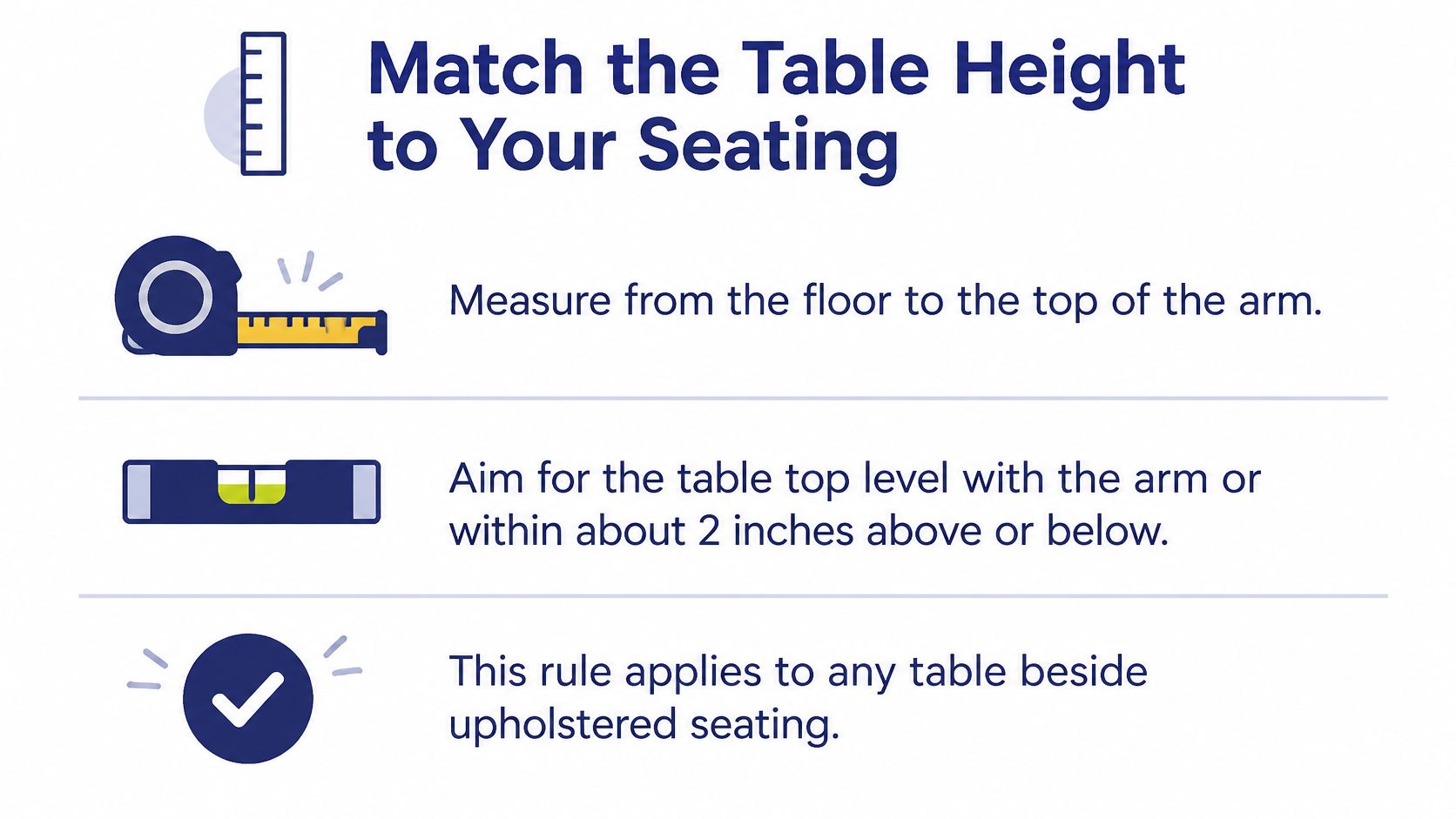
Measure from the floor to the top of the sofa or chair arm, then look for a tabletop approximately level with it. The Everything Depot's end-table height guide recommends a surface within about 2 inches above or below the arm, so a 23-inch arm gives you a starting tabletop range of approximately 21–25 inches.
The arm is the reference, not the sofa back, because it's beside the place where your hand naturally travels. A table that looks proportional against a tall sofa back can still leave you reaching upward whenever you put down a drink.
Use the range as a starting point
The lookup below applies that arm-height allowance to illustrative seating measurements. The seating descriptions are examples, not standardized furniture categories.
Target table top height for common arm heights
| Arm height | Target table top range | Typical seating example |
|---|---|---|
| 20 in | 18–22 in | Low armchair |
| 23 in | 21–25 in | Standard sofa arm |
| 25 in | 23–27 in | Taller sofa arm |
| 27 in | 25–29 in | Tall rolled arm |
Measure with your rug in place and your seating arranged as you normally use it. Cushion compression changes your seated position, while a rug beneath the chair but not the table changes their relationship. For armless seating, test your natural hand position rather than substituting the sofa-back measurement.
Practical rule: A suitable height should let you set something down without noticeably lifting your shoulder or folding forward.
Check legroom for a writing surface
A side table used for a laptop needs another check. Seat-to-table height is the vertical distance from the seat surface to the tabletop, whereas overall table height starts at the floor.
A table can have a comfortable top height yet leave insufficient space beneath a drawer or apron. An ergonomic furniture study distinguishes these measurements and discusses a guideline placing clearance approximately 20 millimeters above knee height. Treat that as an ergonomic reference, not a universal specification for every user or occasional table.
Slide the actual chair underneath, then check your knees against the lowest obstruction. Rest your hands on the surface and see whether you can work without raising your shoulders.
The same measurement-first principle applies elsewhere in the home, although the dimensions aren't interchangeable. For a separate kitchen project, Jennifer Gilmer Kitchen & Bath's island height guide for DC remodels offers context for planning island heights rather than sofa-side surfaces.
Footprint, Storage and Clearance in Real Rooms
A table doesn't occupy just the patch of floor beneath its top. You also need space to approach it, open its storage, and walk past it. Usable space matters more than nominal width.
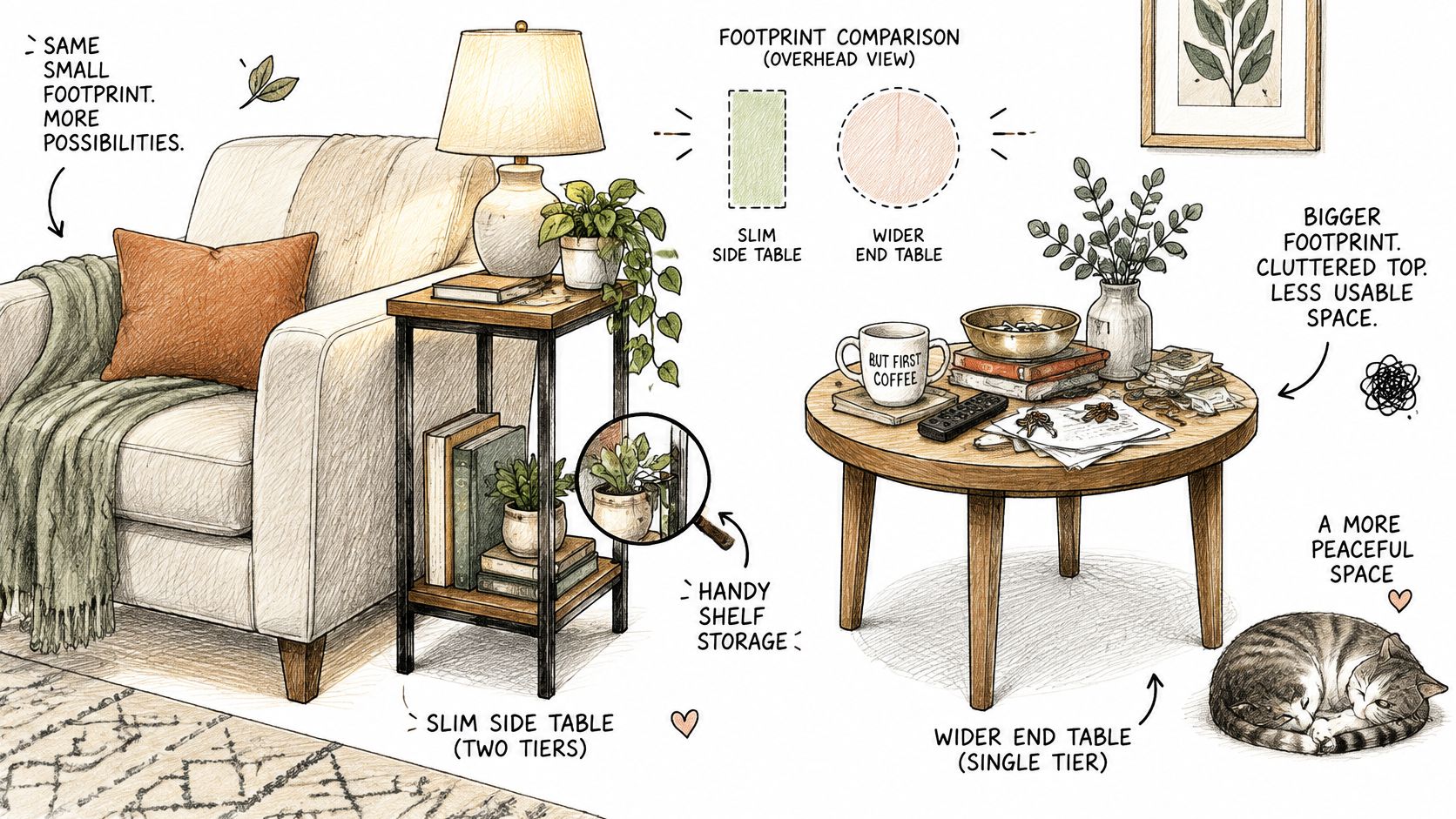
For example, a narrow table with a lower shelf may hold your reading stack and leave the top available for a lamp and drink. A wider single-surface table may offer less useful organization if those same objects crowd the entire top. Compare what you can place on each surface, not just the widest dimension.
Look below the tabletop
The base can change how closely you can approach. A pedestal may leave a clearer approach than corner legs, but a broad pedestal foot can still interfere with wheelchair footrests or someone's feet. Drawers offer concealed storage, yet their boxes can reduce knee room and their open fronts can extend into a passage.
Use these daily-use checks:
- Approach: Can the person using the table get close enough without twisting around a leg or base?
- Storage access: Can a drawer open without hitting the chair, knees, or nearby furniture?
- Surface access: Can you reach the drink position without leaning across a recliner arm?
- Stability: Does the table sit securely on the actual floor or rug?
For broader layout principles, Gates Furniture's living-room placement guidance emphasizes reducing obstacles, considering rounded edges, and preserving circulation near doors and stairs. Apply those ideas to the whole route through the room, including any walker or wheelchair used there.
Test the room in motion
Open the door fully and extend the recliner before deciding that the table fits. Rounded corners can be helpful beside a tight passage, but they don't compensate for a blocked route. Likewise, making a table smaller doesn't automatically make it accessible if its surface becomes unreachable or its base feels unstable.
If the table will stand on a rug, check its feet and any protective pads for compatibility with that surface. Rubber Ducky Rug Cleaning Birmingham's Birmingham homeowners' rug protection tips provide a separate reference for furniture-to-rug contact.
Before choosing, sit in the actual chair and mark the proposed footprint and comfortable reach zone with painter's tape. Then walk to the door and return carrying something you'd normally use, such as a laundry basket. That test reveals conflicts a stationary room photo won't show.
Which Table Fits Each Spot, Not Each Label
Side table is the broader term; end table usually describes a seating-related position. That flexibility isn't new: a MESDA Journal study of Charleston furniture terminology records side tables in documents dated 1754–1799, describing the term as a generic table placed against a wall. The name has never been limited to a compact table beside a sofa.
Modern shopping adds another complication. Product titles, retailer filters, and room-planning categories may sort similar pieces differently; the Man Cave Insider end-table glossary illustrates the sofa-end meaning and its overlap with side-table use. Searching only one term can therefore hide a suitable option.
Better-fit table and key check for common placements
| Placement | Better fit | Check first |
|---|---|---|
| Sofa end or sectional corner | End table | Arm height and clearance at the sofa end |
| Armchair or reading chair | End table | Arm height and reach from the seated position |
| Beside a bed | Side table | Bed height and drawer clearance |
| Entryway or hallway | Side table | Walkway width and door swing |
| Home office or writing corner | Side table | Seat-to-table clearance for the knees |
Translate the location into a job
At a sectional corner, consider which seated person needs access. A table tucked behind a deep arm might fill the gap neatly while remaining difficult to use. Beside a reading chair, leave enough usable top for the book or drink after accounting for the lamp base.
At the bedside, test the reach while lying down as well as sitting. A drawer should open without catching bedding, and the surface should accommodate the objects you keep nearby.
Entryways call for a different test: can you open the door, turn, and put down keys without stepping around the table? In a writing corner, prioritize posture and legroom rather than treating any flat top as a workable desk substitute.
At Woodstock Furniture & Mattress Outlet, we sell furniture, mattresses, and home decor. When you're coordinating a table with other furnishings, describe its intended location and job rather than relying on its category name.
A side table can sit at a sofa end, and an end table can work beside a bed. The exception is sensible whenever the height, reach, and clearance fit.
Tables That Move Between Rooms
A table that serves a reading chair today may be useful beside a guest bed later. For renters and homeowners furnishing mixed-use spaces, that flexibility can be more valuable than a permanent matching arrangement.
The challenge is finding a piece that works in each intended position, not merely one that's easy to carry. A sofa-side table may feel too low beside a tall mattress, while a useful bedside drawer may make the same piece awkward as a temporary writing surface.
Give each destination its own test
Consider a table shared between a living room, guest room, and home office. Beside the sofa, you'll judge seated reach. Beside the bed, you'll check access to the top and storage. At a work chair, you'll need space for your legs and a surface that supports the intended task.
Record those requirements separately rather than averaging them into a compromise that suits none of the locations. If the home-office role is only holding a printer or notebook beside the desk, for example, knee clearance may not be relevant.
Before choosing a movable piece, check:
- Liftability: Can the person who'll move it lift it without strain and grip it securely?
- Construction: Are the top and base firmly connected, and are there loose shelves or drawers to remove before carrying?
- Floor contact: Does it remain stable on each destination's flooring?
- Route: Can you carry it through doorways and around furniture without scraping the top or catching the base?
A lightweight table can be practical when you rearrange often, but lightweight and stable aren't interchangeable. Test both rather than assuming either from appearance.
Notice the cost of moving it
A table covered with a lamp, charging cables, and books isn't especially convenient to relocate, even if the furniture itself is light. Decide whether the whole setup will move or whether the table needs to remain mostly clear.
If you already own a candidate table, place it in each planned spot for a few days before assigning it a permanent role. Note which location requires the most adjustment, including moving nearby furniture or repeatedly reaching awkwardly.
A movable table is an option to weigh against a fixed, matched pair. Neither arrangement is better by default; the useful choice is the one that supports how you use the rooms.
Common Mistakes When Choosing by Name
The naming question becomes a problem when it replaces the fit check. A familiar label can make a table sound suitable before you've considered the people, furniture, and walking routes around it.
Assumptions worth correcting
- Buying a matching pair for every sofa: Symmetry can look balanced, but a narrow room or single seating position may need only one table, different sizes, or an asymmetrical arrangement, so sketch the layout before choosing a pair.
- Assuming side tables are smaller or more decorative: The label doesn't establish dimensions or visual character, so compare the listed height, width, and depth with the intended spot.
- Choosing by label alone: A piece marked end table may fit a bedside better than a sofa end, so place its measurements into your room plan before treating the name as a recommendation.
- Buying from a staged photo: A styled table may block your walkway or sit awkwardly beside your chair, so check the proposed footprint, height, and seated reach against your own furniture.
A room photo also conceals practical details. You might not see whether the drawer can open fully, whether the lamp leaves space for a cup, or whether someone has moved the table away from its normal position for the photograph.
Read dimensions as a complete set
Height alone isn't enough. Depth can push a table beyond the front of the sofa, while a projecting top can occupy more passage space than its narrow base suggests.
Check how the listing defines its dimensions, particularly for round, irregular, or nesting designs. If a measurement isn't clear, confirm it before assuming that the photograph shows the piece at the scale you need.
Shopping reminder: Use styling photos to judge appearance, then use measurements to judge fit.
The label is the least dependable selection criterion. Measurements, reach, and clearance provide a firmer basis for deciding whether the table belongs in your room.
Choose the Table by Placement Before You Buy
You don't need to settle the terminology before you start measuring. Begin with the problem you want the table to solve, whether that's finding a place for a reading lamp, clearing books off a seat, or keeping a drink nearby.
A tape measure, painter's tape, and a simple room sketch are enough to turn that need into a useful shopping checklist. Record the dimensions on your phone so you can compare options without relying on memory.
Follow a placement-first sequence
Mark the intended spot and list what the table must hold. Include the lamp base, drink, books, and charging items rather than judging an empty tabletop.
Measure the nearby seating in its normal configuration. Keep the cushions and rug in place, record the arm or seat height, and establish a comfortable tabletop target for the intended use.
Map the footprint, walking route, and reach zone. Use painter's tape to represent the table's outer edges, then check doors, reclining furniture, and your normal path through the room.
Search both end tables and side tables. Use placement and function to narrow the options rather than allowing the product title to eliminate a suitable piece.
Inspect the base and storage. Check drawer travel, shelf access, knee room where needed, and whether the feet extend beyond the tabletop.
Test the relationship in person. Sit beside a candidate table and try the reaching motion; where practical and permitted, position a lamp and drink-sized object to judge how much useful surface remains.
Bring the room with you on paper
Take your sketch, measurements, and a photo showing the intended location. The photograph communicates the surrounding furniture, while the measurements reveal constraints that perspective can hide.
Woodstock Furniture & Mattress Outlet offers design services, which can help you consider how a table relates to the surrounding layout. An in-person visit also gives you a chance to compare table heights and test reach in ways that product photos can't show.
If a candidate requires you to squeeze past it or rearrange your posture whenever you reach, keep looking across both categories. There's no need to force a correctly named table into an unsuitable spot.
Placement first, measurements second, label last.
We offer furniture, mattresses, home decor, and design services to help you consider individual pieces in the context of your room. Bring your room sketch, seating measurements, and tabletop needs when you visit Woodstock Furniture & Mattress Outlet, and compare how different tables fit the way you sit, reach, and move.