Tag: dining room layout

  • Your Guide to 8 Seater Dining Table Dimensions

    Your Guide to 8 Seater Dining Table Dimensions

    So, what are the go-to dimensions for an 8-seater dining table? Generally, you’re looking at 72 to 96 inches long for a classic rectangular table. If you prefer a round table, the standard is about 60 to 72 inches in diameter. These numbers aren't random; they're the sweet spot for seating eight adults comfortably without anyone bumping elbows.

    Finding the Perfect Fit for Your Gatherings

    Picking out an 8-seater dining table is a significant decision. It’s not just another piece of furniture—it’s destined to become the heart of your home, the place for family dinners, holiday feasts, and late-night talks. But getting the size right can feel like threading a needle.

    Go too big, and your dining room suddenly feels cramped and hard to navigate. Go too small, and your guests will feel like they're packed in sardines. The real goal here is to strike that perfect balance between having plenty of seating and maintaining a comfortable, functional room. Getting a handle on the standard dimensions is the first step to making that happen.

    Standard Dimensions by Table Shape

    The shape of your table is a game-changer. It dictates the table's footprint and how it feels in your space. Rectangular tables are a popular choice for most formal dining rooms, while round or square tables can foster a more cozy, conversational atmosphere.

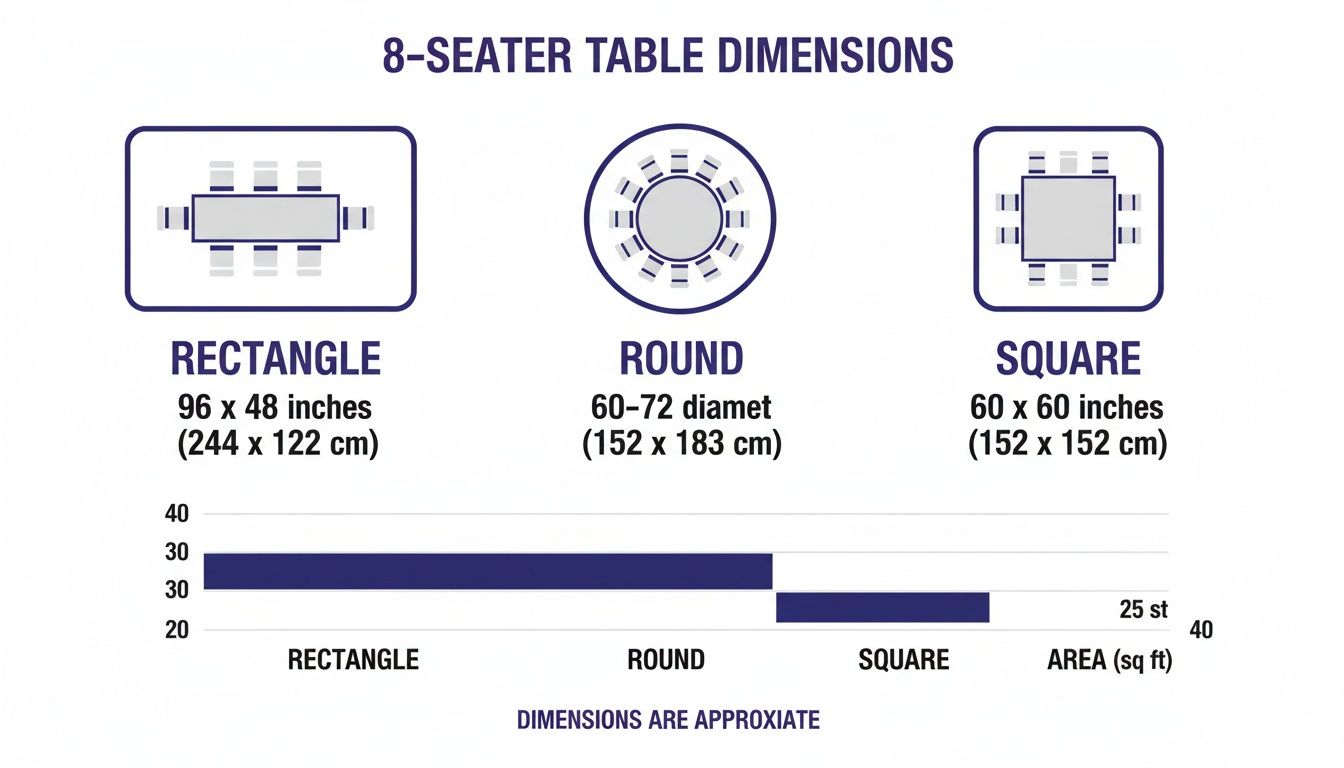
    To make things easier, here’s a visual breakdown of the typical dimensions you’ll find for each of the main 8-seater table shapes. Think of it as your starting point.

    Diagram illustrates dimensions and area for 8-seater rectangular, round, and square dining tables.

    As you can see, rectangular and oval tables use their length to make room for more people. On the other hand, round and square tables need a much wider footprint to fit the same number of chairs around the perimeter.

    Here's a quick reference chart to pull all that info together.

    8 Seater Dining Table Dimensions at a Glance

    Table Shape Standard Dimensions (Inches) Minimum Room Size (Feet)
    Rectangular 72" to 96" L x 36" to 42" W 12' x 9.5' to 14' x 10'
    Oval 72" to 96" L x 42" to 48" W 12' x 10' to 14' x 10.5'
    Round 60" to 72" Diameter 11' x 11' to 12' x 12'
    Square 60" to 72" L & W 11' x 11' to 12' x 12'

    This table gives you a ballpark idea of the space you'll need, making it easier to measure your room and see what shape works best for you before you start shopping.

    There’s a good reason why these numbers are so consistent across the furniture world. It all comes down to a simple, time-tested rule of thumb: give each person about 24 inches of table space. This ensures everyone has enough elbow room to eat comfortably. It’s why you’ll often see larger rectangular tables at 96 inches long, 42-48 inches wide, and a standard 30 inches high—designed for a spacious 12×12-foot dining room.

    If you’re planning a larger home project, understanding how these measurements work together is key. For instance, this helpful guide to standard cabinet dimensions can give you a better sense of how to create a cohesive, functional space throughout your home.

    Why Accurate Table Dimensions Matter

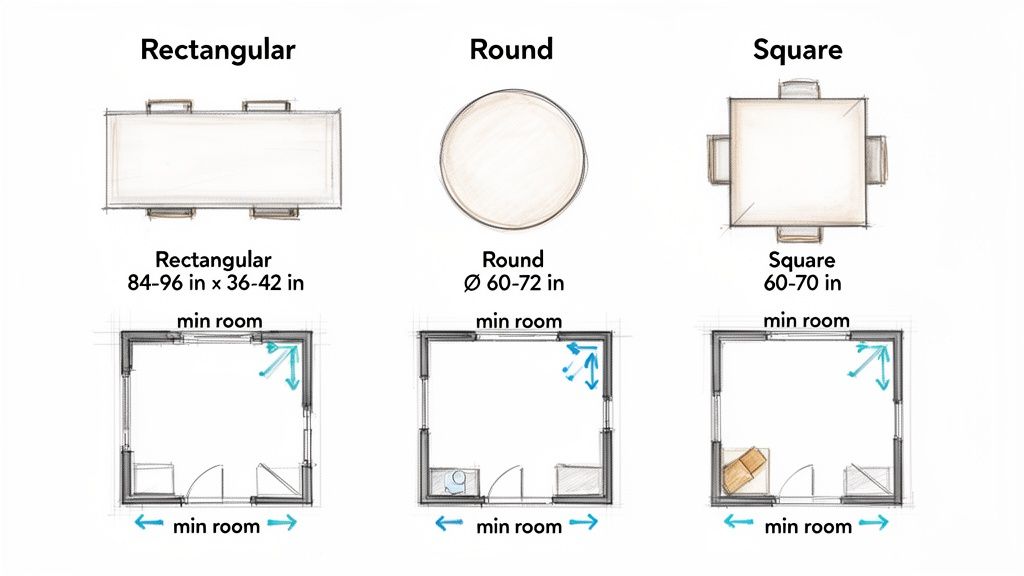
    Diagram showing rectangular, round, and square dining table dimensions with minimum room space requirements.

    Shopping for an 8-seater dining table is about so much more than just picking a style you love. It’s really about crafting a space that flows with your everyday life, and getting the dimensions right is the invisible key to making it all work. When the measurements are off, you feel it almost immediately—even if you can't quite put your finger on why.

    It usually shows up as a series of small, daily frustrations. Ever walked into a dining room that just felt "tight," forcing guests to do that awkward shuffle to squeeze past each other? Maybe you’ve sat at a table where pulling your chair out meant banging into the wall or a nearby buffet. These common headaches almost always trace back to a mismatch between the table's size and the room's proportions.

    A table that’s too big for the room can throw off the entire flow of your home, creating bottlenecks and making the space feel cluttered and small. On the flip side, a table that’s too small for eight people makes every meal feel cramped and impersonal, leaving no room for serving dishes or comfortable conversation.

    Creating a Functional and Inviting Space

    The real goal is to find a table that doesn't just fit in your room, but actually enhances it. The right measurements can transform a simple dining area into the true heart of your home. When everyone has enough elbow room and can easily slide their chair back, the whole atmosphere becomes more relaxed and welcoming.

    An accurately sized table ensures your dining room is a place of comfort, not compromise. It’s the difference between a room that feels chaotic and one that feels harmonious, supporting everything from quiet family dinners to lively holiday celebrations.

    Think of it this way: you're setting the stage for future memories. The right 8 seater dining table dimensions make everyday life effortless, whether it's kids spreading out homework, friends gathering for game night, or the whole family coming together for a special occasion.

    Solving Common Frustrations with Smart Planning

    By focusing on the numbers first, you can get ahead of the most common issues homeowners face with their dining rooms. Here’s how a little bit of measuring goes a long way:

    • Eliminates Crowding: Ensuring you have enough clearance—typically 36 to 48 inches—around the table creates clear walkways for people to move around, even when others are seated.
    • Ensures Chair Comfort: You can rest easy knowing every chair can be pulled out fully without hitting a wall, a credenza, or another piece of furniture.
    • Promotes Better Conversation: A well-proportioned table lets guests interact easily, without feeling like they're shouting across a vast expanse or sitting in each other's laps.
    • Balances the Room’s Scale: Your new table will look like it was made for the room, anchoring the design instead of overwhelming it or getting lost in the space.

    Ultimately, taking the time to measure your space and understand the ideal dimensions is the single most important step. It ensures that the beautiful table you bring home will serve your family for years to come, making your dining room everyone’s favorite gathering spot. Seeing these sizes in person can give you a much better feel for how they’ll fit in a real-world setting.

    Dimensions for Rectangular and Oval Tables

    If you're looking to seat eight people, rectangular and oval tables are probably the first shapes that come to mind. It's for good reason. Their long, elegant shape makes them a practical fit for most dining rooms, letting you host a crowd without needing a super wide room.

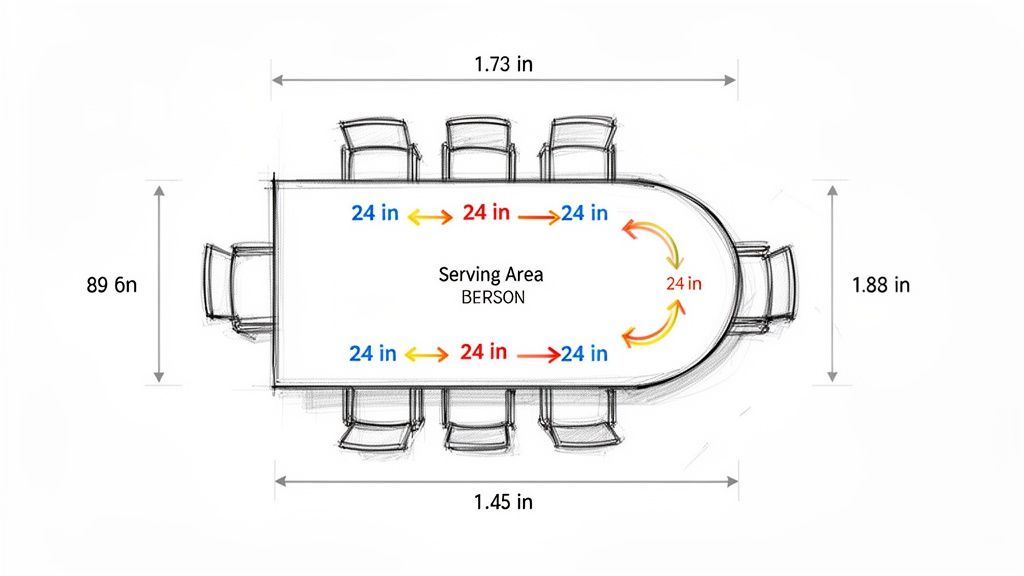
    The key is a simple rule of thumb: every person needs about 24 inches of elbow room to eat without bumping their neighbor. Rectangular and oval tables accommodate this well. The standard layout is three people on each long side, with one person at each end. It just feels balanced, organized, and ready for anything from a large holiday feast to a casual Tuesday night dinner.

    Sizing a Rectangular 8-Seater Table

    Rectangular tables are a classic. They have a way of anchoring a dining room with their strong, clean lines that remain a popular choice. When you're looking for one that seats eight, you’ll want to consider a specific size range to make sure it’s comfortable and functional.

    Typically, a rectangular table for eight will run somewhere between 78 to 96 inches long and 36 to 40 inches wide. These dimensions aren't random; they're designed to give each of those three people along the sides their 24 inches of space. As furniture experts explain in guides on standard dining table dimensions, this setup avoids discomfort.

    That length is the key to giving everyone breathing room. The width is just as important, though—it ensures there’s plenty of space for plates and glasses on both sides, plus a nice, wide channel down the middle for passing serving dishes or setting out a centerpiece.

    The Benefits of an Oval 8-Seater Table

    What if you love the seating capacity of a rectangle but want something a bit softer? Enter the oval table. It offers the best of both worlds, blending a rectangle's functional length with a round table's cozy, intimate vibe. They share similar dimensions with rectangular tables but swap the sharp corners for gentle curves.

    That one little change—rounding the corners—makes a huge difference in how a room feels and functions.

    • Easier to Navigate: Those curved edges make walking around the table a breeze. This is a massive advantage in tighter dining areas or in spaces where the dining table is in a main traffic path.
    • A Lighter Look: An oval table just feels less bulky. Without the hard corners, it creates a softer, more inviting look that can make a room feel more open.
    • More Inclusive Conversations: Even though people are seated in a line, the curved ends help the people at the head of the table feel more connected to the conversation happening along the sides. No one feels left out.

    For an 8-seater oval table, you'll be looking at dimensions of 72 to 96 inches long by 42 to 48 inches wide. You’ll notice they can be a tad wider than their rectangular cousins. That extra width helps make up for the tapered ends, so everyone still has plenty of surface area for their meal.

    Choosing Between Rectangular and Oval
    Your final decision will probably come down to the layout of your room and your own personal taste. A rectangular table makes a bold, formal statement that’s a great fit for a dedicated dining room. But if you need more flexibility for an eat-in kitchen or a multi-purpose room where people are always walking through, an oval table is a fantastic, flow-friendly solution.

    At the end of the day, both shapes are excellent choices for an 8-seater dining table. They offer a comfortable, practical setup for larger gatherings while bringing their own unique style to the table. By understanding their dimensions and how they’ll live in your space, you can pick a great centerpiece for years of family memories. Of course, there's no substitute for seeing them in person to get a true feel for their scale.

    Dimensions for Round and Square Tables

    While rectangular and oval tables are fantastic for how efficiently they use space, round and square tables bring a completely different energy to a dining room. Their symmetrical design creates this uniquely social and intimate atmosphere, which is why they are so appealing to many families and frequent hosts.

    Unlike their longer cousins, these tables place every single guest an equal distance from the center and from each other. That simple geometric shift makes for a much more communal dining experience where nobody feels like they’re stuck at the far end. Conversations just seem to flow more naturally, and everyone feels included.

    Top-down view of an 8-seater dining table, showing dimensions, serving area, and 24-inch spacing.

    Finding the Right Size for a Round Table

    A round 8-seater table is a beautiful statement piece, perfect for creating a cozy, cafe-like vibe right in your own home. But to comfortably sit eight people, you’re going to need a table with a pretty substantial diameter.

    The ideal range for an 8-seater round dining table is typically 60 to 72 inches in diameter. A 60-inch table is the absolute minimum you’ll want to consider for eight chairs, and it will be a snug fit. For a more spacious and comfortable setup where guests have plenty of elbow room, a 72-inch diameter table is a much better bet.

    Just keep in mind that as the diameter gets bigger, the distance across the center of the table grows significantly. This can make it a bit of a reach to pass the potatoes, which is why a lazy Susan is such a popular and practical add-on for larger round tables. The key is striking that perfect balance between comfortable seating and functional serving.

    Sizing a Square 8-Seater Table

    Square tables offer a similar communal feel to round ones but with a more modern, structured look. They provide a generous, balanced surface and work exceptionally well in square-shaped dining rooms, creating a wonderful sense of symmetry and order.

    For a square table to seat eight people—that’s two on each side—you will need a fairly large size. Look for dimensions in the range of 60 to 70 inches per side. A 60-inch by 60-inch square table is a common starting point, but bumping that up closer to 70 inches will give everyone a more relaxed dining experience and prevent guests from feeling crowded.

    Much like big round tables, the generous surface area means the center can be hard to reach. This makes them great for family-style meals with large platters, but it's something to think about as you plan.

    A Note on Footprint and Flow
    Both large round and square tables require a significant amount of floor space. Because their width is equal to their length, they often have a larger overall footprint than a rectangular table that seats the same number of people. This makes them a much better fit for open-plan areas or dedicated square dining rooms rather than long, narrow spaces.

    The Social Advantage vs. The Practical Tradeoffs

    Choosing a round or square table is really a decision that balances social dynamics with the practicalities of your space. The inclusive, conversational atmosphere they create is a huge draw. But, you have to weigh that against the realities of your room and your lifestyle.

    Here are the key points to consider:

    • Benefit: Conversation. Everyone faces inward, making it easy for all your guests to chat with one another.
    • Tradeoff: Footprint. These shapes need a wider room to accommodate their dimensions and the necessary clearance space around them.
    • Benefit: No "Head of the Table". The egalitarian seating arrangement feels more casual and less formal.
    • Tradeoff: Reaching for Food. The center of a large round or square table can be tough to access without standing up or asking for help.

    If your top priority is creating a warm, engaging, and social hub for dining, and you have the right-shaped room to support it, a round or square 8-seater table can be a truly wonderful centerpiece for your home. It can be especially helpful to get a real-world sense of their scale and presence in a room before you buy.

    How to Measure Your Room for a New Table

    It’s easy to fall in love with a gorgeous 8-seater dining table on a showroom floor. But before you get too attached, you’ve got to make sure it will actually work in your dining room. This is about more than just the table’s footprint; it’s about keeping your dining space comfortable, functional, and easy to walk through. A few careful measurements now will save you from the headache of a beautiful table that completely overwhelms the room.

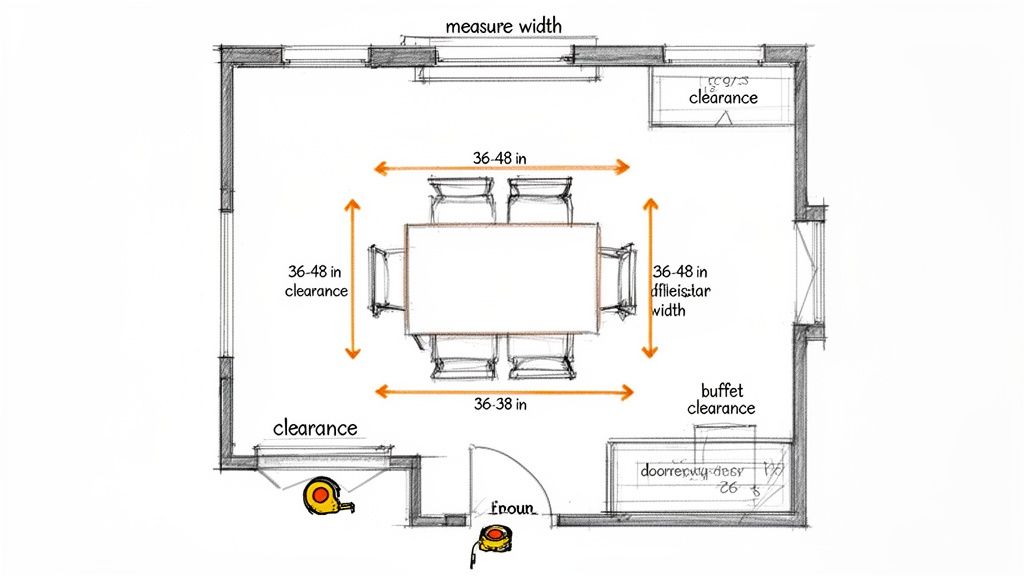
    The single most important thing to consider is clearance space—the empty area around your table. Think of it as your room’s breathing space. It’s the gap that lets people pull out their chairs without bumping into a wall, walk behind someone who is already seated, and move around the room without feeling like they're navigating a maze.

    The Golden Rule of Clearance Space

    A well-planned dining room has one simple, non-negotiable rule. You need a bare minimum of 36 inches of clearance on all sides of your table, measured from the tabletop's edge to the nearest wall or another piece of furniture.

    • 36 Inches (3 feet): This is the standard minimum. It gives you just enough room to slide a chair out and sit down. Someone can also just shimmy past behind them if they need to.
    • 48 Inches (4 feet): This is really the ideal clearance, especially if the dining room is a high-traffic area. This much more generous space allows people to walk comfortably behind seated guests without anyone having to suck in or turn sideways.

    Keep this rule in your head while you measure. It’s the difference between a dining room that feels inviting and functional, and one that feels like an obstacle course. You’re looking for a table that fits beautifully within these boundaries.

    A Step-by-Step Measurement Guide

    Ready to figure this out? Grab a tape measure and a notepad. Following these quick steps will ensure you account for everything, not just the open floor.

    1. Measure the Room's Full Dimensions: First thing's first, measure the total length and width of your dining room, from wall to wall. Jot these numbers down. This is your absolute maximum space.

    2. Account for Existing Furniture: Already have a buffet, sideboard, or china cabinet in the room? Measure how far it sticks out from the wall (its depth) and subtract that from your room’s total measurement. The real available space is now the distance from that piece of furniture to the opposite wall.

    3. Factor in Doorways and Walkways: Take a look at where your doorways and major traffic paths are. For instance, if your dining room connects the kitchen to the living room, you’ll want to protect that walkway. For these high-traffic lanes, you should aim for that more generous 48 inches of clearance if you can swing it.

    Once you have your final numbers, you can figure out your maximum table size. As a general rule of thumb, an 8-seater dining table usually runs somewhere between 80-92 inches long, 36-40 inches wide, and 29-30 inches high. That 30-inch table height is a key ergonomic detail, as it’s the most comfortable for the seated posture of most adults. For a deeper dive into this, you can find more great info on table sizes and ergonomics at BassettFurniture.com.

    A Practical Tip: Visualize the Space

    Sometimes numbers on a piece of paper just don’t cut it. A useful trick is to use painter's tape to mark the dimensions of a potential table right on your floor. This gives you a true feel for its scale and how much walking room is left. You can even pull up your existing chairs to the taped-off area to see how it all feels together.

    Knowing how a big piece like an 8-seater table will fit is even more critical if you're planning a big move, like moving furniture across country. Proper planning ensures your new centerpiece will work just as well in your new home. By taking these steps, you can shop with confidence, knowing exactly what 8 seater dining table dimensions will create the perfect gathering spot for your family.

    Considering Chairs, Benches, and Table Height

    Top-down sketch of an 8-seater dining room layout, showing table dimensions, chair clearances, and room measurements.

    Okay, so you've nailed down your 8 seater dining table dimensions. That's a huge step, but the journey to the perfect dining room isn't quite over. Now we need to think about what goes with the table—from the chairs you sit in to the very height of the table itself.

    The relationship between your table and chairs is a big deal. Get it wrong, and you'll either feel like a kid with your chin on the table or find yourself hunching over just to eat. Getting this pairing right is the secret to making every meal a comfortable, relaxing experience.

    Standard Table Height and Chair Pairing

    You'll find that most dining tables stick to a standard height of 28 to 30 inches from the floor to the tabletop. This isn't just a random number; it's the industry standard designed to work perfectly with typical dining chairs, which have a seat height of about 17 to 19 inches.

    This combination creates a gap of roughly 10 to 12 inches between the chair seat and the table surface. This little pocket of space is the sweet spot. It gives you plenty of legroom without feeling cramped and keeps your arms at a natural height for eating.

    The most important measurement isn't just the table's height or the chair's height, but the distance between the two. Aiming for that 10-12 inch gap is the key to creating an ergonomically sound and comfortable dining setup for family and guests of all sizes.

    When you're shopping, always check both measurements. It’s a simple step that can save you from the disappointment of bringing home a beautiful set that’s just not comfortable for everyday life.

    The Smart Solution of a Dining Bench

    For a lot of homes, especially those with eat-in kitchens or dining areas on the narrow side, a dining bench can be a game-changer. Benches bring a few key benefits to the table (pun intended).

    • Space Efficiency: When you're done eating, a bench can be tucked completely under the table. This instantly opens up floor space and makes it easier to walk around the room.
    • Flexible Seating: Benches are fantastic for families. Need to squeeze in one more kid or a last-minute guest? A bench makes it easy.
    • A Casual Aesthetic: Swapping chairs for a bench on one or both sides can give your dining area a more relaxed, communal, and modern feel.

    Just a quick tip: when you're picking a bench, make sure it’s a bit shorter than the distance between the table legs. That way, it'll slide underneath smoothly with no issues.

    Completing the Dining Space

    With your table and seating sorted out, it's the final touches that really pull a room together. An area rug, for instance, can do wonders for defining the dining space, especially in an open-concept layout. The rule of thumb here is to get a rug large enough so that the chair legs stay on the rug even when they’re pulled out from the table.

    Similarly, the light fixture you hang above the table should be scaled to the table, not the entire room. A chandelier or pendant light that's about two-thirds the width of your table will look balanced and give you the perfect lighting for your meals.

    Ultimately, creating the perfect dining space is about seeing how all these different pieces—the table, chairs, rug, and lighting—work together. Taking a moment to consider each element ensures your new 8-seater table becomes the true heart of a warm, welcoming, and functional room. The best way to get a feel for it all? Come see for yourself. We invite you to visit one of our North Georgia showrooms to sit at a few tables and see how different combinations look and feel in person.

    Frequently Asked Questions

    After digging into all the numbers and measurements for 8-seater dining tables, you might still have a few lingering questions. Don't worry, that's perfectly normal! Below, we've tackled some of the most common concerns we hear from shoppers to help you feel totally confident in your choice.

    What Is the Smallest Room an 8 Seater Table Can Fit In?

    This is a great question, and the answer really hinges on the shape of the table. For a more compact rectangular table, say around 78 inches long by 36 inches wide, the absolute tightest you could go is a room measuring 12.5 feet by 9 feet.

    That number accounts for the bare-minimum 36 inches of clearance you need on all sides just to slide chairs out and squeeze by. Likewise, a 60-inch round table would need an 11-foot by 11-foot room, at a minimum. But keep in mind, these are very snug fits.

    To give yourself comfortable walking space and a much better flow, we strongly recommend aiming for a room size of at least 14 by 11 feet for most 8-seater tables.

    Can I Use a Bench to Save Space with an 8 Seater Table?

    Absolutely! Using a dining bench is one of the savviest space-saving tricks in the book. A bench can slide completely under the table when you're not eating, which can instantly free up an invaluable 1 to 2 feet of floor space on one side.

    This is a game-changer in narrower dining rooms, breakfast nooks, or eat-in kitchens where every inch really does count. Plus, it's a wonderfully flexible solution that also happens to be a huge hit with families that have young kids.

    Just one pro tip: when you pick out a bench, double-check that its length is just a tad shorter than the distance between the table legs. That ensures it can tuck away cleanly without any bumps, maximizing your open floor space.

    How Do I Choose Between a Rectangular and a Round 8 Seater Table?

    The classic showdown: rectangular vs. round! The best choice really comes down to your room’s shape and how you live and entertain.

    • Rectangular tables are the go-to for traditional, long, and narrow dining rooms. They’re fantastic for hosting bigger dinner parties because they give you tons of room for serving dishes down the middle and create a more formal, structured atmosphere.

    • Round tables are a perfect match for square-shaped rooms. They’re known for creating a much more intimate, conversational vibe where everyone can easily see and chat with each other. This makes every meal feel more connected and casual.

    Think about what you’ll be doing most. If formal holiday dinners are your thing, a rectangular table is probably your best bet. But if you're all about cozy family meals and lively conversation, a round table could be the perfect heart of your home.


    At Woodstock Furniture & Mattress Outlet, our knowledgeable team is always ready to help you walk through these decisions in person. Sometimes, seeing how different 8-seater dining table dimensions actually feel in a room can make all the difference. Visit one of our North Georgia showrooms to find the perfect fit for your home.

  • A Practical Dining Table Size Guide for Your Home

    A Practical Dining Table Size Guide for Your Home

    We’ve all been there. You see a dining table you fall in love with, but the secret to a happy, functional dining room isn't just about style—it starts with size. This dining table size guide is here to take the guesswork out of the equation so you can find a table that doesn't just look great, but actually fits your room and your life.

    It's about making a subtle but important shift in thinking, from "which table is the prettiest?" to "which table will make my home better?"

    How to Find the Right Dining Table Size

    One of the most common issues shoppers encounter is choosing a table that's either too big or too small for their space. This usually leads to a room that feels either cramped and claustrophobic or awkward and empty. It's a real Goldilocks problem.

    But when you get the size just right? It completely changes the flow of your home, makes conversation easier, and turns every meal into a more pleasant experience. The goal here is to create a sense of balance—a space that feels welcoming and put together on purpose.

    This guide is your roadmap to finding that balance. We'll walk you through three core ideas that will give you the confidence to pick a table that feels like it was made for your home.

    The Three Pillars of Proper Sizing

    Think of finding the right table as a simple three-step process. Each step builds on the last, guiding you toward a choice that just plain works for your space and how you live in it.

    • Measure Your Room's True Usable Space: This is more than just measuring from wall to wall. You've got to think about doorways, other furniture like buffets or hutches, and the natural pathways people use to walk through the room.
    • Plan for Comfortable Seating: Everyone at the table needs enough elbow room to eat without bumping into their neighbor. There’s a simple rule of thumb that can put an end to the "elbow wars" at your dinner table for good.
    • Ensure Proper Clearance for Movement: This is probably the most important—and most often forgotten—step. You need enough "breathing room" around the entire table for folks to easily pull out their chairs and for others to walk behind them without having to turn sideways and squeeze by.

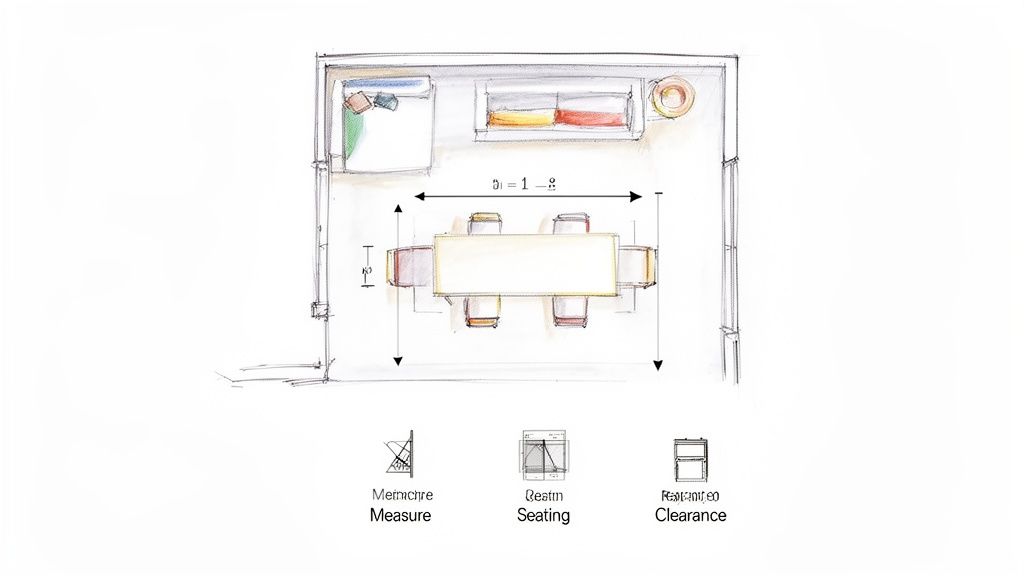
    Top-down sketch illustrating dining room layout with a rectangular table, chairs, and critical dimensions for measure, seating, and clearance.

    By focusing on these three elements—space, seating, and clearance—you’re doing more than just filling a room with furniture. You’re actively designing a better experience for your family and guests, making sure every gathering is comfortable and memorable.

    This practical approach takes the anxiety out of the decision. Instead of just guessing and hoping for the best, you’ll have a clear framework you can use to size up any dining table, whether you're browsing online or walking through a showroom. It’s all about empowering you to make a smart, lasting investment in your home.

    Here at Woodstock Furniture & Mattress Outlet, our team has helped countless North Georgia families figure this out, and we've seen firsthand how getting the size right can completely transform a room.

    Measuring Your Dining Space for a Perfect Fit

    Before you even think about browsing for a new dining table, the very first thing you need to do is get to know your room. I'm not talking about a quick length-and-width measurement. I mean really understanding the room's usable footprint. You have to account for every single thing that takes up floor space or gets in the way of walking around.

    This means you need to measure the space around doorways, windows that stretch to the floor, and any furniture you already have, like a buffet, sideboard, or china cabinet. These pieces effectively shrink your dining area's boundaries. It’s a classic mistake to ignore them, and it always leads to a cramped, frustrating room. The goal here is simple: find the absolute biggest table your room can handle without making it impossible to move.

    The Critical 36-48 Inch Clearance Rule

    For a dining area that feels comfortable and inviting instead of just… tight, designers live by one core guideline: the 36 to 48-inch clearance rule. This is all about the open space you need to leave between the edge of your table and the nearest wall or piece of furniture.

    Think of this clearance as your room’s “breathing space.” Without it, everything feels claustrophobic.

    • 36 Inches (Minimum Clearance): This is the bare minimum you need for someone to shimmy behind a pulled-out chair without having to turn sideways. It works, but it's a snug fit best reserved for smaller rooms where you're fighting for every inch.
    • 42-48 Inches (Comfortable Clearance): Now this is the sweet spot. With this much room, someone can easily walk past the table even while others are seated and eating. It makes for a much more relaxed, uncrowded vibe.

    Key Takeaway: The 36-48 inch rule is pretty much non-negotiable for a dining space that actually works. If you measure your room and then subtract this clearance from all sides, you'll know the maximum dimensions for your new table.

    A Step-by-Step Guide to Mapping Your Space

    Ready to figure out your room's perfect table size? Grab a tape measure and a notepad. Following these quick steps will take all the guesswork out of the process, leaving you with exact numbers to guide your search.

    1. Measure the Room's Full Dimensions: First up, measure the total length and width of your dining room, wall to wall. Jot these numbers down. Let's say your room is 12 feet by 15 feet.

    2. Identify and Measure Obstructions: Next, look for any other furniture that will be sharing the space—a buffet, a bar cart, a console table. Measure how far these pieces stick out from the wall. If your buffet is 18 inches deep, you have to factor that in.

    3. Calculate Your Usable Footprint: Now for some simple math. Subtract the depth of your furniture and your desired clearance from the room's total dimensions. Using our example:

      • Room Width: 12 feet (144 inches)
      • Subtract Clearance: 144 inches – 36 inches (wall side) – 36 inches (walkway side) = 72 inches of maximum table width.
      • Room Length: 15 feet (180 inches)
      • Subtract Furniture & Clearance: 180 inches – 18 inches (buffet) – 36 inches (clearance) = 126 inches of maximum table length.

    Based on that quick calculation, the absolute largest table this room could handle would be 72 inches wide by 126 inches long. And while you're carefully measuring your dining space for the perfect table, don't forget to also figure out what size area rug for dining room will best anchor the space. Getting this right ensures all the chair legs stay on the rug, even when people are getting up from the table. It’s this complete approach that makes a room feel truly put together.

    Choosing a Table Shape for Your Room and Lifestyle

    Once you’ve got the maximum table dimensions your room can handle, the next big decision is the shape. This choice is about more than just what fits; the shape of your dining table sets the tone for the entire space. It influences the flow of traffic, the vibe of your dinner conversations, and how open and airy the room feels.

    Each of the four main shapes—rectangular, round, square, and oval—brings something different to the table, literally. Let's break down their strengths so you can find the match for your home and lifestyle.

    Rectangular: The Timeless Classic

    There’s a reason rectangular tables are a popular choice. Their straight lines are a natural fit for most dining rooms, making them an easy, intuitive option. If you’ve got a big family or love hosting holiday dinners, a rectangular table is your friend for seating a crowd.

    The long sides easily accommodate a number of chairs, while the ends create distinct "head of the table" spots. This classic layout is perfect for long, narrow rooms. Just run the table parallel to the longest wall, and you'll maximize the walking space on either side.

    In fact, rectangular tables still hold a significant portion of the market, accounting for 45% of the global market share. While this classic isn't going anywhere, industry reports also show that oval tables are gaining popularity, all thanks to their space-savvy, corner-free design. You can discover more insights on dining table trends from Mordor Intelligence if you want to explore the data.

    Round: The Social Hub

    If you’re all about creating a cozy, conversational atmosphere, a round table is a fantastic choice. With no head of the table, everyone faces each other, making it easy for conversations to flow naturally between all your guests. This setup is perfect for smaller families, breakfast nooks, or eat-in kitchens where intimacy is key.

    The lack of sharp corners is also a huge plus in smaller or square-shaped rooms. People can move around them without bumping into corners, which makes the whole space feel more open and less cramped. A helpful tip: look for a round table with a pedestal base. It gets rid of the corner legs and gives everyone maximum legroom.

    Square: Modern Symmetry

    Square tables bring a clean, modern sense of balance to a room, especially if your dining space is also square. Much like round tables, they foster an intimate dining experience by seating guests close together, making conversation a breeze. It’s a look that feels both structured and inviting.

    But that symmetry can become a challenge with larger tables. As a square table gets bigger, the distance across the middle grows, and suddenly it’s tough to chat with the person across from you. Because of this, square tables are usually best for seating up to eight people.

    Oval: The Flexible Hybrid

    Can’t decide between rectangular and round? An oval table gives you the benefits of both worlds. It has the generous length of a rectangular table—great for serving dishes and seating more people—but with the soft, curved corners of a round one.

    This unique shape is a lifesaver in narrower rooms or spaces that double as a walkway. Those rounded ends make it so much easier for people to squeeze by without hitting a sharp corner. It’s also a great safety feature if you have little ones running around the house.

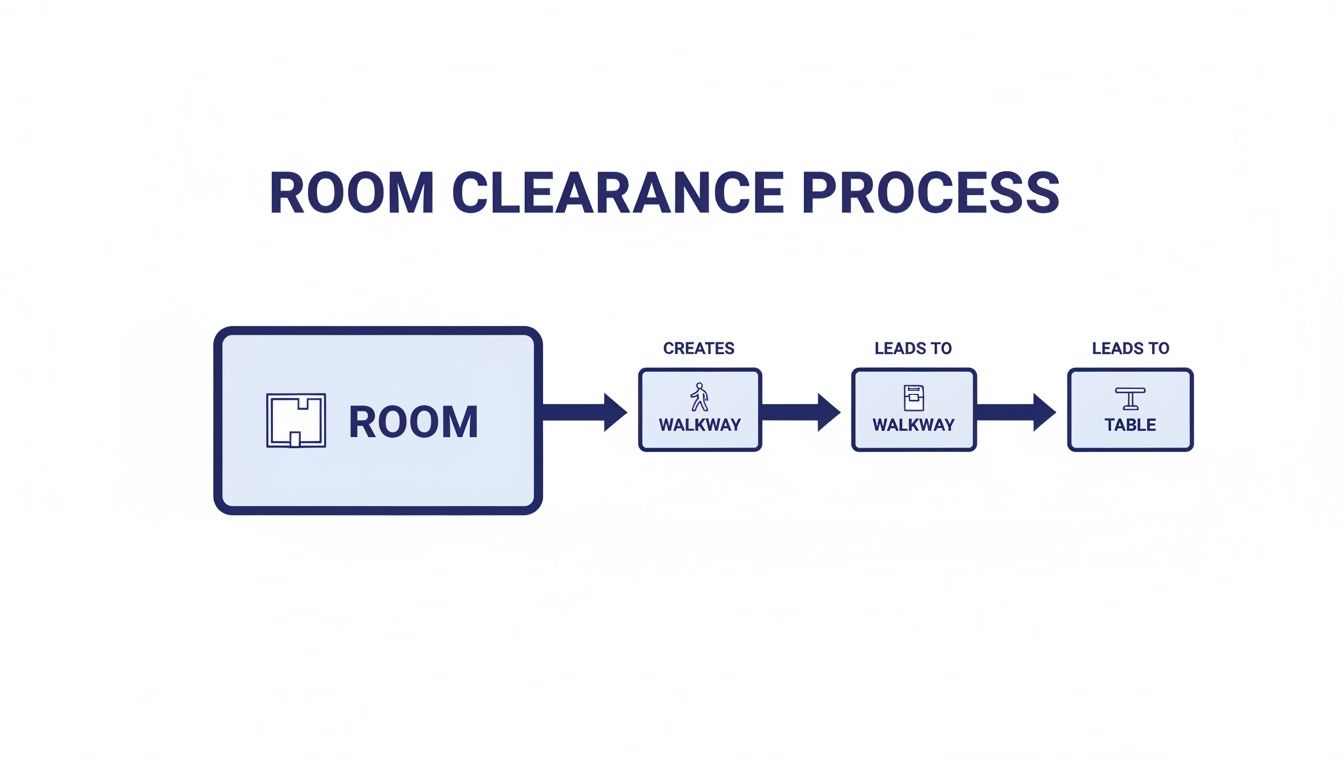
    The simple flowchart below shows just how important it is to think about your room, your walkways, and your table all at once.

    A flowchart titled 'Room Clearance Process' shows steps from 'Room' to 'Walkway', then to another 'Walkway', and finally to 'Table'.

    It’s a great reminder that your table fits into the space that’s left over after you’ve accounted for the crucial pathways you need to move around comfortably.

    Balancing Everyday Use with Special Occasions

    For most of us, a dining table has to wear at least two hats. It’s the command center for quiet weekday breakfasts and homework sessions, but it also needs to be ready for bustling holiday dinners and birthday celebrations. The key is finding a table that adapts to your life, not the other way around.

    That’s really the core challenge when choosing the right dining table size. You need something that feels right for your daily routine without making your space feel empty, but it also has to accommodate extra guests when the occasion calls for it. This is where versatile and adaptable furniture truly shines.

    It’s no surprise that the global dining table market is growing, valued at USD 8.68 billion and projected to hit USD 13.71 billion by 2032. This trend is closely tied to urbanization, as more people in new apartments and homes need compact, flexible furniture like extendable tables. You can read the full research about dining table market trends to see how homeowners are adapting to modern living spaces.

    The Rule of Personal Space

    Before we get into adaptable tables, let’s cover the most important rule for comfortable seating. To avoid bumping elbows and making everyone feel squished, the golden rule is to allow approximately 24 inches of table width per person.

    Think of this as each guest's personal bubble. A 72-inch long rectangular table, for instance, can comfortably fit three people on each side (3 x 24 = 72 inches). This simple guideline is the foundation of any good dining table size guide and ensures everyone has enough room to eat and chat without feeling squeezed.

    This 24-inch rule isn't just about comfort; it's about hospitality. Giving each guest their own space shows consideration and makes the whole dining experience more relaxed and enjoyable for everyone.

    Extendable Tables: Your Secret Weapon for Flexibility

    An extendable table is the perfect fix for this balancing act. These tables have hidden sections, called leaves, that you can add to increase the table's length, giving you extra seating capacity on demand.

    They come with a few different mechanisms, each with its own pros:

    • Traditional Leaves: These are separate panels you manually insert into the center of the table after pulling the two ends apart. They often offer the most extension but do require a place to store the leaves when you're not using them.
    • Butterfly Leaf: This clever design features a hinged leaf that’s stored right inside the table. You just pull the table ends apart, and the leaf unfolds from the center like wings. It's self-storing, which means no more hunting for leaves in a closet!
    • Drop-Leaf: This style has hinged sections on the sides of the table that can be lifted up and supported by a gateleg or bracket. Drop-leaf tables are incredibly space-efficient, making them perfect for small apartments or multi-functional rooms where the table might be pushed against a wall for daily use.

    Choosing the Right Extension Type

    So, which mechanism is best for you? It really boils down to your storage space and how often you plan to entertain.

    • For frequent entertainers: A butterfly leaf is incredibly convenient because it's always ready to go.
    • For those with ample storage: Traditional leaves often allow for the longest possible extension, perfect for those once-a-year mega-gatherings.
    • For small-space living: A drop-leaf or a console table that extends offers maximum versatility, serving as a small surface day-to-day and a full dining table when you need it.

    By choosing a table that can grow with your needs, you invest in a piece of furniture that's truly functional. It respects the scale of your room for everyday life while ensuring you're always ready to welcome more people to your table. Visiting a showroom is a great way to test these mechanisms in person and see which feels most intuitive for you.

    Visualizing Your New Dining Room Layout

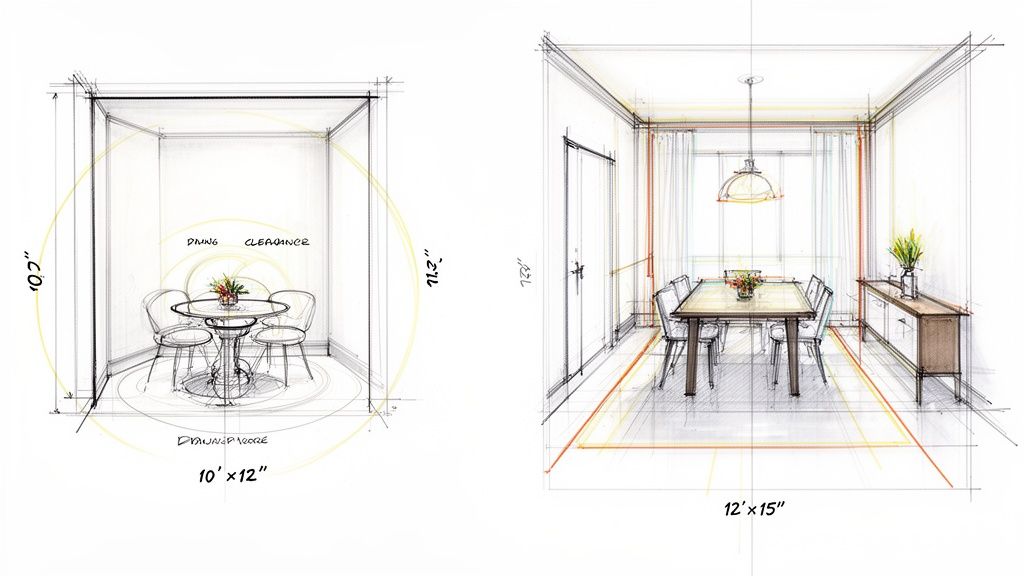
    Two hand-drawn architectural sketches illustrate different dining room layouts, table sizes, and clearance dimensions.

    All the rules of thumb and measurements are great, but the real magic happens when you can actually see it all come together. Let’s shift from theory to practice and look at how different tables fit into a couple of common room sizes. Seeing it on paper (or on screen) makes it so much easier to apply the same logic to your own home and avoid that sinking feeling of a costly mistake.

    Once you’ve mapped out your perfect dining space, it’s a good idea to think ahead about delivery day. Taking a look at a few basic furniture moving tips can save you a lot of headache when your new pieces arrive.

    Layout Example 1: The Cozy 10' x 12' Dining Nook

    A smaller dining space, say around 10-by-12 feet, is all about making smart choices to avoid feeling boxed in. The goal here is simple: fit the family without tripping over chairs.

    • The Room: A compact 10' x 12' (or 120" x 144") space. You see these a lot in apartments or as breakfast nooks in open-concept floor plans.
    • The Challenge: Seat everyone for daily meals while leaving enough elbow room and clear walking paths.
    • The Solution: A 48-inch round table is a great choice here, especially one with a pedestal base. No corners means better traffic flow, and a single pedestal frees up legroom for chairs. This size is perfect for seating four people comfortably.
    • The Math: In a 120-inch wide room, a 48-inch table leaves you with 36 inches of clearance on each side (120" – 48" = 72" / 2 = 36"). That hits our minimum clearance sweet spot for a comfortable walkway.

    This is a perfect example of why round tables are superstars in smaller, squarish rooms. They encourage conversation and make the whole area feel bigger by keeping those pathways open.

    Layout Example 2: The Standard 12' x 15' Dining Room

    For a more traditional dining room, something in the neighborhood of 12-by-15 feet, you’ve got a lot more breathing room. This gives you more flexibility for a larger table and even some extra storage furniture, like a buffet.

    • The Room: A dedicated 12' x 15' (or 144" x 180") dining room.
    • The Challenge: Find a table that’s great for dinner parties but also plays nicely with a sideboard or china cabinet.
    • The Solution: A 42" wide by 72" long rectangular table is a fantastic choice. It comfortably seats six to eight people. By placing it parallel to the longer 15-foot wall, you’re working with the room's natural flow and keeping traffic lanes clear.
    • The Math:
      • Width-wise: A 42-inch table in a 144-inch wide room gives you a generous 51 inches of clearance on each side. Plenty of room!
      • Length-wise: Let's add an 18-inch deep buffet against one of the short walls. Even with a 72-inch table, you’ll still have 42 inches of clearance on the buffet side and a roomy 48 inches at the main entryway (180" – 18" buffet – 72" table – 42" clearance = 48").

    Hopefully, seeing these examples brings all the numbers and rules to life. It shows how the right table shape and size can work in harmony with your room’s layout to create a space that’s not just beautiful, but also a true functional hub of your home.

    Your Final Pre-Purchase Checklist

    Alright, you’ve put in the work. You’ve measured your space, considered all the shapes, and have a good idea of what you’re looking for. Before you make a final decision, running through one last mental checklist is the best way to make sure you’ve covered all your bases. This isn't about second-guessing yourself; it's about locking in the confidence that you've made a choice you'll be happy with for a long, long time.

    Think of it as the final walkthrough. It’s a simple, practical step to ensure the table that looks perfect on paper (or on your screen) will feel just as perfect in your home.

    Confirming the Practical Details

    First things first, let’s revisit the numbers and tools. A tiny oversight here is an easy fix now, but a huge headache after delivery day.

    • Double-Check Your Measurements: We can’t say it enough. Grab that tape measure one more time. Confirm your room’s dimensions, the clearance space you’ve planned for, and the absolute maximum table size that will fit. It's the simplest step and prevents the most common sizing mistake.

    • Map It Out on the Floor: This is a helpful trick. Use painter's tape or even break down some cardboard boxes to create a life-size footprint of the table right on your floor. This is a great way to feel the table’s scale in your room and to physically test your walkways.

    Don't Forget the Chairs and Lighting

    A dining table doesn't live on an island. How well it works depends entirely on the pieces around it, especially the chairs you'll be tucking in and the light fixture hanging above.

    Be sure to consider these crucial companions:

    • Chair Dimensions: Got your chairs already? Perfect. Check their arm height. You want to be absolutely sure the arms can slide cleanly under the table’s apron. If they can’t, your chairs will stick out, eating up precious walkway space when they’re not in use.

    • Overhead Lighting: Now, look up. Is your chandelier or pendant light hanging right where the center of your new table will be? An off-center light fixture can throw off the balance of the whole room. Moving a fixture now is a lot easier than realizing it's wrong after your beautiful new table is in place.

    A Final Thought: Numbers and measurements are critical, but they don't tell the whole story. Nothing can replace seeing a table in person to truly get a feel for its scale, weight, and presence in a room. Some things you just have to experience firsthand.

    We designed this entire guide to give you the knowledge to shop with confidence. But if you want to see these concepts in action and get some friendly, hands-on advice, we’d love for you to stop by one of our showrooms. Our team is always here to help you finalize your choice and find a great fit for your home.

    Got Questions? We’ve Got Answers.

    By now, you’ve probably got a pretty good handle on dining table sizing. But just in case, here are a few quick answers to the most common questions our furniture experts get from shoppers every single day.

    How Much Space Should I Leave Between My Dining Table and the Wall?

    The golden rule is to leave at least 36 inches of clearance between your dining table and any walls or other large furniture. That's enough room for someone to comfortably walk behind a seated person without having to turn sideways.

    However, if you want a more spacious and relaxed feel, especially for busy family dinners or holiday gatherings, aim for 42 to 48 inches. This extra breathing room makes it much easier for guests to get in and out of their seats without bumping elbows or asking others to scoot in.

    What's a Good Dining Table Shape for a Small Room?

    When space is tight, round and oval tables are your friends. Since they don't have sharp corners, they make it much easier to navigate a cramped room and create a better sense of flow. Visually, they just make the space feel bigger and less cluttered.

    A round table with a pedestal base is a true small-space superstar. By getting rid of the corner legs, it opens up a ton of legroom and makes it way easier to squeeze in an extra chair when company drops by.

    It’s a clever design that really maximizes what you can do with a limited footprint.

    Should My Dining Chairs Tuck All the Way Under the Table?

    Absolutely, yes. For the sake of clear walkways and keeping the room tidy, your chairs should be able to slide completely under the table when you’re not using them. This small detail makes a huge difference in how functional and uncluttered your dining area feels.

    Before you fall in love with a set of chairs, be sure to measure the height from the floor to the table’s apron—that’s the wood panel right under the tabletop. If you’re eyeing chairs with arms, you’ll need to make sure the arm height is lower than the apron so they can slide underneath without getting stuck.


    Feeling ready to take the next step? Now that you've got your measurements, it's time for the fun part—seeing how different sizes and styles look and feel in person. The friendly team at Woodstock Furniture & Mattress Outlet is always here to answer any other questions and guide you to a table for your home. Come on down and explore our selection. Find your nearest showroom here