Picking out a new crib is an exciting part of preparing for a new baby, but it's about more than just finding a style you love. It’s about creating a secure space for your baby to sleep. Those standard baby crib dimensions aren't random numbers; they’re the product of decades of safety improvements, all designed to keep babies safe from harm.
Getting these measurements right is the key to a snug fit between the crib and the mattress, which is the foundation of a safe sleep environment.
Why Are Crib Dimensions Such a Big Deal for Nursery Safety?
When you're putting a nursery together, it's easy to get caught up in paint colors and themes. But the most important choices you'll make are about safety. The specific measurements for a baby crib aren't just suggestions—they are a critical part of a safety system built to protect your little one when they're most vulnerable.
The history of these dimensions in the United States shows a powerful story of continuous safety improvements driven by regulation. In 1973, the U.S. Consumer Product Safety Commission (CPSC) began regulating full-sized cribs. That work led to the 1988 ASTM F1169 standard, which locked in the exact interior dimensions we rely on today.
The results have been significant. Before 1973, the U.S. saw about 200 infant deaths related to beds each year. By 2011, that number had dropped to around 50. It's a clear sign of just how much these standards matter.
The Foundation of a Safe Sleep Environment
A crib and mattress that are properly sized work together to eliminate dangerous gaps where a baby could get trapped. This snug fit is arguably the single most important safety feature, more so than any special material or design.
Here’s why these dimensions are non-negotiable:
- Preventing Entrapment: If a mattress is too small for the crib frame, it leaves gaps around the edges. A baby can roll into one of these spaces, which creates a serious risk of suffocation.
- Ensuring Structural Integrity: When parts are made to a standard size, they are built to work together reliably. This reduces the risk of the crib itself failing.
- Providing Peace of Mind: Knowing your crib meets strict, federally required dimensions means you can have more confidence when you put your baby down to sleep.
Making your nursery safe is a bigger project than just the crib, of course. It's all part of the much larger task of baby-proofing your home. By learning the key measurements we'll cover in this guide, you can evaluate any crib and know if it meets today's safety standards.
Understanding Standard Full-Size Crib and Mattress Dimensions
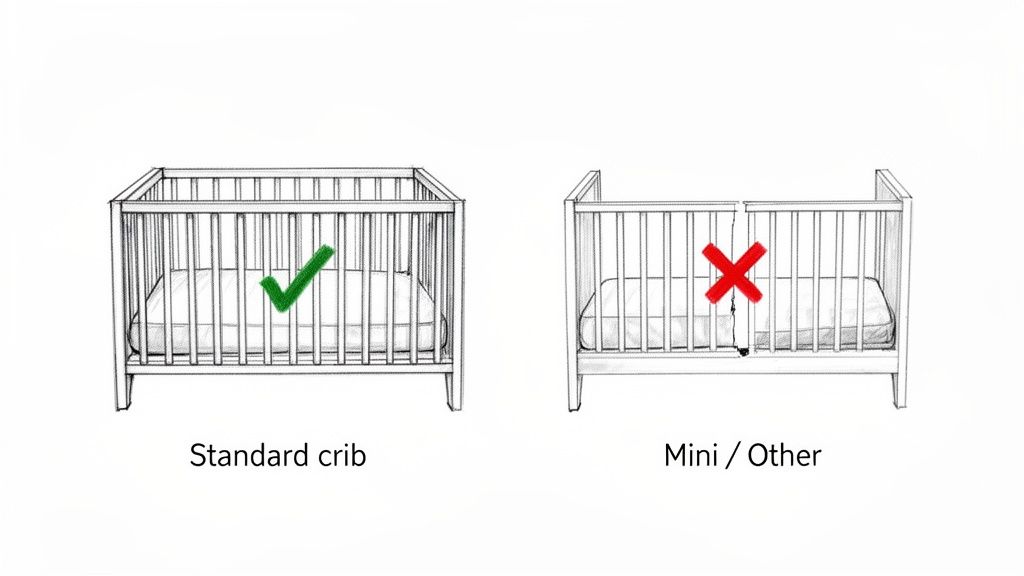
When you hear "standard" crib, it almost always refers to a full-size model. It’s the most common type you’ll find, and for good reason. These cribs are built to a federally regulated size, which takes the guesswork out of finding a mattress that fits safely. This standardization is a huge benefit for nursery safety, making the process less confusing for parents.
The U.S. standard for full-size cribs is all about the interior measurements. A compliant crib will have an interior width of 28 ± 5/8 inches (71 ± 1.6 cm) and an interior length of 52 3/8 ± 5/8 inches (133 ± 1.6 cm). The "± 5/8 inches" allows for minor manufacturing variations, meaning the actual size can vary by just over half an inch and still be perfectly safe. You can explore more about these official specifications for infant beds if you want to dive into the details.
For a quick overview of these critical measurements, the table below breaks down the key numbers.
Quick Reference for Full-Size Crib and Mattress Dimensions
| Component | Regulated Interior Width | Regulated Interior Length | Typical Exterior Dimensions |
|---|---|---|---|
| Standard Full-Size Crib | 28 ± 5/8 inches | 52 3/8 ± 5/8 inches | Varies by design (e.g., ~30-32" W x 54-56" L) |
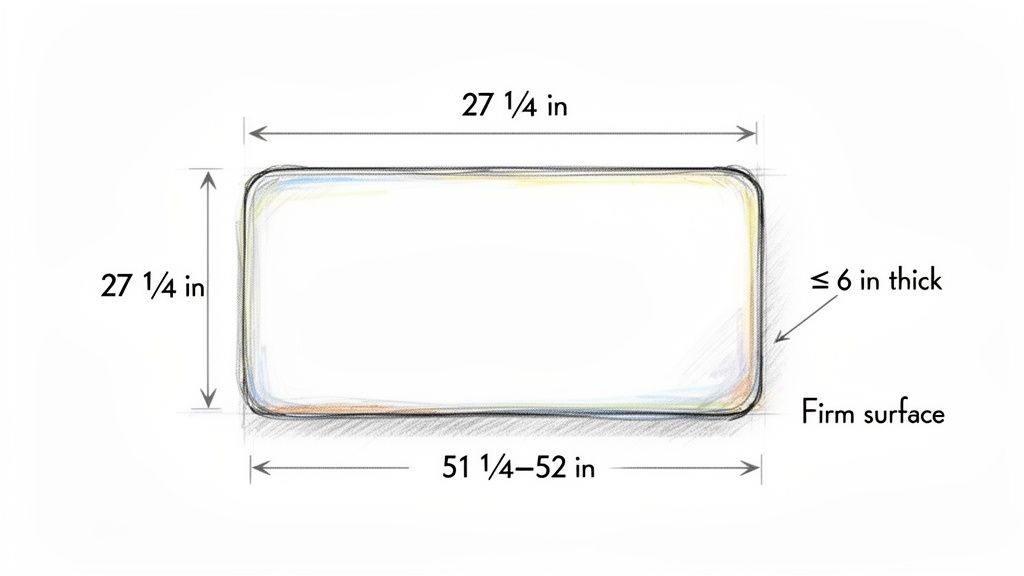
| Standard Full-Size Mattress | ~27 1/4 inches | ~51 5/8 inches | N/A (fits inside crib) |
As you can see, the specific numbers ensure a tight fit, which is exactly what you want for a safe sleep environment.
The Importance of a Snug Fit
Now, let's talk about the mattress. A standard full-size crib mattress is made to fit perfectly within those regulated crib dimensions. Most will measure roughly 27 1/4 inches wide by 51 5/8 inches long and are between 5 to 6 inches thick. This ensures the mattress sits snugly inside the crib frame, leaving no dangerous gaps where a baby could get trapped.
There’s a simple trick to double-check this at home: the two-finger test.
Once the mattress is in the crib, push it to one side and try to slip your fingers into the gap between the mattress and the crib frame. If you can fit more than two fingers, the mattress is too small and creates a safety hazard.
This visual guide shows how a secure environment, a snug mattress fit, and official safety standards all come together to protect your little one.

The main takeaway here is that these three things aren't separate concerns—they’re all interconnected parts of creating a truly safe space for your baby to sleep.
A Look at Mini Cribs and Other Alternative Sizes
While a standard full-size crib is what most people picture, it's not always the right choice for every family or every home. If you're working with a smaller nursery, sharing a room with your little one, or just need a second sleep spot at a grandparent's house, a mini crib can be a great space-saving option.
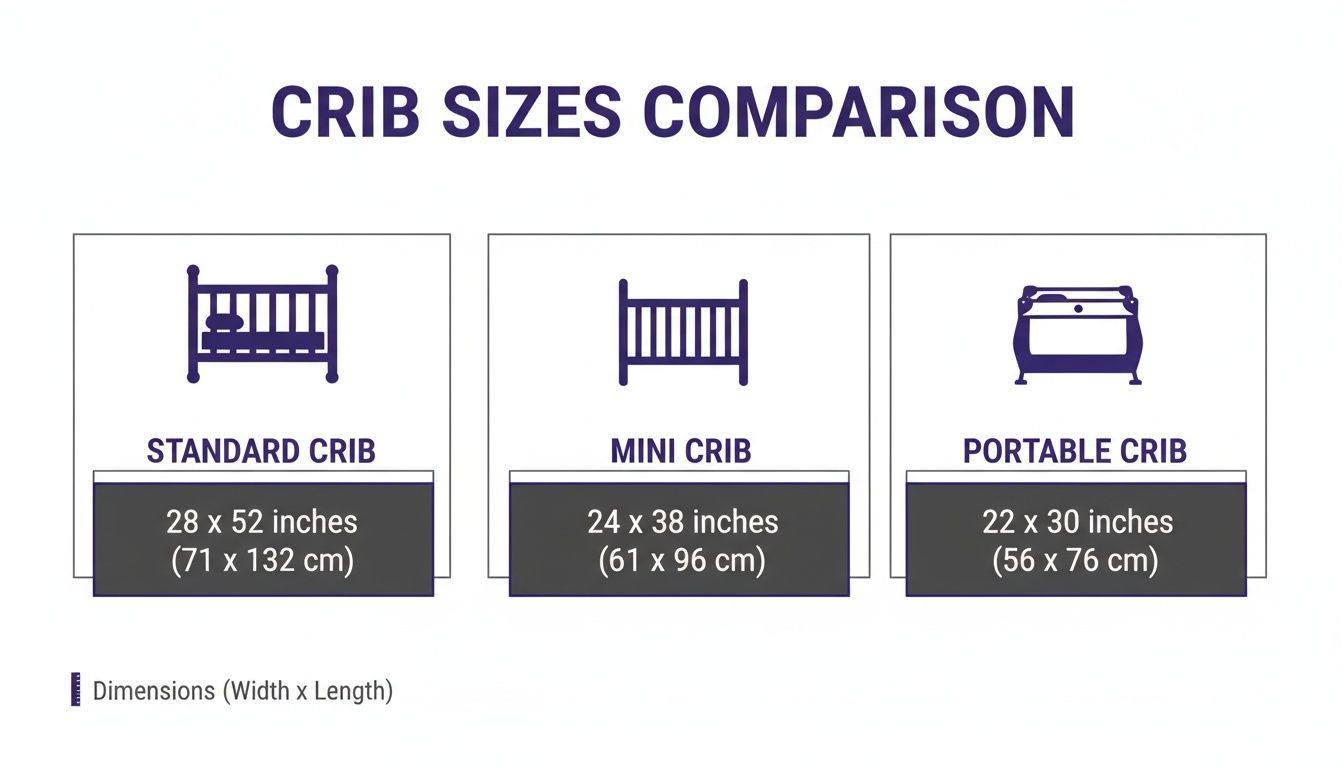
Unlike their full-size counterparts, mini crib dimensions aren't federally standardized, so you'll see variation from one brand to the next. That said, a typical mini crib usually lands somewhere around 24 inches wide by 38 inches long. Their smaller footprint makes them well-suited for apartments or any room where a full-size crib would feel bulky. They are also quite common; of the 2.4 million infant beds sold in the U.S. each year, a notable 12% are these non-standard mini sizes. You can learn more about the growing global demand for various crib sizes from market research if you're curious about the trends.
The Golden Rule for Non-Standard Cribs
Because there's no single "standard" size for mini or portable cribs, there's one rule that trumps all others: always use the mattress that was specifically designed for that crib. Never try to use a standard mattress or even a mattress from a different brand of mini crib.
The mattress that comes from the manufacturer is the only one guaranteed to fit snugly and safely. An ill-fitting mattress creates dangerous gaps around the edges, which is a serious entrapment and suffocation hazard. This is the single most important safety check for any non-standard crib.
Other Alternative Crib and Mattress Sizes
Beyond the popular mini crib, you’ll find a few other sizes out there, especially when you start looking at international brands. For instance, a common European standard is the 120 x 60 cm cot mattress, which is a bit different from what we're used to in the US.
You might also run into:
- Portable Cribs: These are often built to be lightweight and travel-friendly. Their dimensions are usually in the same ballpark as mini cribs, but with an emphasis on folding up easily for transport.
- Shaped Cribs: A round or oval crib can make a beautiful design statement, but they follow the same critical safety principle—they must be paired with their own proprietary, perfectly-fitted mattress.
No matter what shape or size you’re considering, the core safety principle doesn't change. You are always looking for a firm, flat surface with no gaps between the mattress and the crib frame.
Key Safety Measurements Beyond Length and Width
When we talk about crib safety, a snug mattress fit is just the beginning. Getting the length and width right is step one, but a truly safe sleep space relies on several other critical measurements. These aren't just suggestions; they're federally mandated standards designed to work together to keep your baby safe from common hazards. Knowing what to look for will give you the confidence that any crib you choose meets today's safety codes.

One of the most important rules governs the space between the crib slats. This one is a big deal, as it's specifically designed to prevent a baby's body from slipping through while their head gets stuck.
According to the Consumer Product Safety Commission (CPSC), the gap between crib slats must be no more than 2 3/8 inches (about 6 centimeters). A helpful way to visualize this is to use a soda can—if it fits between the slats, the gap is too wide. It's a handy trick for a quick check.
Critical Rail and Mattress Height Rules
Beyond the slats, the height of the crib rails and where the mattress sits are just as vital. These measurements are all about preventing falls, which becomes incredibly important once your little one starts to pull up and explore.
Here are the key safety heights you need to verify:
- Minimum Rail Height (Newborn Setting): When the mattress is in its highest position for a newborn, the top of the crib rail must be at least 26 inches from the mattress support. This creates a deep, secure space for your infant.
- Minimum Rail Height (Lowest Setting): Once your baby can stand, you'll drop the mattress down. At this lowest setting, the top of the rail must still be at least 26 inches above the mattress support to keep a standing baby from climbing out.
- Maximum Mattress Thickness: To make sure those rail heights do their job, a standard crib mattress can be no thicker than 6 inches.
Think of these numbers as a complete safety system. If you were to use a mattress that's, say, 8 inches thick, you'd effectively lower the guard rail by 2 inches, making it that much easier for a curious toddler to attempt an escape. Making sure all these measurements check out ensures every part of the crib is working together to keep your child secure.
How to Measure Your Nursery for Safe Crib Placement
So, you have the crib dimensions down. That's a great start, but now comes the real-world puzzle: figuring out exactly where it's going to live in the nursery. A truly safe layout is about so much more than just finding a spot where the crib fits. It means taking a careful look at the whole room to create a secure zone that keeps your baby protected from any potential hazards.

The ultimate goal here is to design a space that’s not only functional and peaceful but is, above all, fundamentally safe. This involves thinking through everything from the placement of furniture to the cords on your window blinds.
Step 1: Start with the Room's Footprint
Before you bring the crib into the room, grab a tape measure. It's time to get a clear picture of the space you're working with. Measure the length and width of the nursery and jot down a simple floor plan on a piece of paper. Don't forget to mark the locations of doors, windows, closets, and any electrical outlets.
This simple map acts as your blueprint. It helps you visualize the flow of the room and spot potential placement headaches before you start hauling heavy furniture around.
Step 2: Create a Safe Buffer Zone
If there's one golden rule of crib placement, this is it: never put the crib right next to certain items. Your baby's safety depends on keeping the crib away from anything they could potentially pull down or, as they get older, use to climb out.
Always make sure the crib is positioned away from:
- Windows: This means keeping it from being directly under or right up against a window. There’s a risk of falls, and dangling cords from blinds or curtains are a well-known strangulation hazard.
- Heaters and Radiators: Keep the crib clear of all heat sources. This prevents your baby from overheating and reduces the risk of burns.
- Wall Decorations: Avoid the temptation to hang heavy pictures, shelves, or large mobiles directly over the crib. As your baby gets stronger, they could find a way to pull these items down.
- Other Furniture: A determined toddler might see a nearby dresser or changing table as a stepping stool for an escape attempt.
A good rule of thumb is to maintain a "buffer zone" of at least one to two feet all the way around the crib. This space should be completely clear of any furniture or large objects, ensuring your baby can't reach anything dangerous from inside their sleep space.
This clear zone also has a practical benefit for you—it gives you easy access to the crib from multiple sides. You'll be grateful for that during middle-of-the-night check-ins and wrestling with fitted sheets. It all adds up to creating a nursery that works for you and keeps your little one safe and sound.
Dimension Considerations for Convertible Cribs
Convertible cribs are a practical idea for families thinking long-term. You get one piece of furniture that can grow with your child, from infancy into their school years. However, that long-term utility requires some forward-thinking, especially when it comes to space. What starts as a compact crib will eventually become something much bigger.
A 4-in-1 convertible crib, for instance, goes through quite a transformation:
- Crib: To start, it functions just like any other standard full-size model, using the same baby crib dimensions and mattress.
- Toddler Bed: The front rail comes off and is usually replaced with a low safety rail. The overall footprint doesn't change much at this stage.
- Daybed: Once the safety rail is removed, you're left with an open-sided daybed. Again, the dimensions are still pretty close to the original crib.
- Full-Size Bed: This is where the major shift happens. The crib's headboard and footboard are paired with a completely separate metal bed frame. This dramatically increases the crib’s length and width to fit a full-size mattress.
Planning for Future Growth
The main thing you need to think about is whether your nursery can actually handle that final, full-size bed. A crib that fits snugly in a cozy room today might leave you with very little walking room once it’s converted.
Before you purchase a convertible crib, get out the tape measure. Visualize a full-size bed in the nursery, which is generally about 54 inches wide by 75 inches long. This simple step will tell you whether converting the crib in that same room is practical down the road.
Storing the conversion kit is just as important as planning the room space. When you first assemble the crib, find a safe, dry place for all the extra rails, hardware, and instructions. A helpful tip is to tape the instruction manual directly to one of the larger stored pieces. This can save you a significant headache years from now.
Putting in this little bit of effort upfront is what makes a convertible crib a true investment. It ensures that when it's time to change things up, you have everything you need to keep the furniture safe and functional for years to come.
A Quick Guide to International Crib Dimensions
If you've shopped for baby gear online, had family send a gift from overseas, or planned a move abroad, you might run into a confusing—and potentially dangerous—hiccup. Crib and mattress dimensions aren't universal. What's standard in the United States is different from what you'll find in the United Kingdom, Europe, and elsewhere.
For instance, you'll often see European brands offering two common crib sizes: 120 x 60 cm (that's about 47 x 23.5 inches) and 140 x 70 cm (roughly 55 x 27.5 inches). Neither of these perfectly matches a U.S. full-size mattress, which runs about 52 inches long. This is exactly why mixing and matching baby gear from different countries is not a good idea.
The Universal Rule for All Cribs
No matter where your crib or mattress was made, there’s one safety rule that is absolutely non-negotiable.
The mattress must fit snugly inside the crib frame, leaving no dangerous gaps. An ill-fitting mattress is a serious suffocation and entrapment hazard, regardless of the country's specific dimensional standards.
This is the single most important thing to remember. Never try to squeeze a U.S. mattress into a European cot, or the other way around. Even a small difference in width or length can create just enough space for a baby to become trapped.
The best approach is to always buy the crib and mattress together as a set. If you can't, make absolutely sure the mattress you're buying is specifically made for the exact model and dimensions of your crib. A secure, gap-free sleep space is always the top priority.
Frequently Asked Questions About Baby Crib Dimensions
Picking out the right crib and mattress can feel like a huge responsibility, and it's normal to have questions. New parents often ask us about the little details that make a big difference in safety and fit.
We've put together answers to some of the most common questions our furniture experts hear. Think of this as your quick-reference guide to creating a safe and sound sleep space for your little one.
What Happens If a Crib Mattress Is Too Small?
A mattress that’s too small for the crib is one of the biggest safety hazards you can have. Any gap between the mattress and the crib frame is a space where an infant can roll and become trapped, creating a serious risk of suffocation or injury.
There’s a simple way to check the fit, often called the "two-finger test." Try to slide your fingers into the gap between the mattress and the crib side. If you can fit more than two fingers, the mattress is too small and is not safe to use.
Is It Safe to Use an Old or Hand-Me-Down Crib?
We get this question all the time, and our advice is to be extremely cautious with older or second-hand cribs. Federal safety standards for cribs got a major update in 2011, and one of the biggest changes was banning the manufacture and sale of traditional drop-side rail cribs.
Older models might not just have drop-sides; they could have unsafe slat spacing, worn-out hardware, or even old lead paint. While a hand-me-down from a friend or family member may seem like a good way to save money, purchasing a new, certified crib is the best way to ensure it meets today's strict safety standards.
Is There a Standard for Crib Mattress Thickness?
This is a great question. While the length and width of full-size crib mattresses are standardized, the thickness isn't. However, there is a very important federal rule here: a crib mattress must not be more than 6 inches thick.
This isn't an arbitrary number—it's all about rail height. A mattress thicker than 6 inches would reduce the effective height of the crib's rails, making it easier for a growing baby to climb or fall out.
Do Mini Cribs Require Special Sheets?
Yes, absolutely. This is a critical point that sometimes gets overlooked. Because mini cribs don't follow a single standard size, you have to buy fitted sheets made specifically for your mattress's exact dimensions.
Never try to use a standard crib sheet on a mini crib mattress. It will be far too loose and baggy, and that extra fabric is a major suffocation hazard. Always look for sheets that are labeled for "mini cribs" and confirm they match your mattress's length and width.
Choosing the right crib is a big decision, and our team is here to help you understand all the options. At Woodstock Furniture & Mattress Outlet, we believe in providing clear, honest information so you can create a safe and beautiful nursery for your family. Visit us in person to see a great selection and have your questions answered by our knowledgeable staff. Learn more at https://woodstockoutlet.com.