
Can an accent chest of drawers fit your wall perfectly and still be the wrong piece for your home? Yes, if its drawers can't open comfortably, its storage doesn't suit your belongings, or its intended use doesn't match how your family will use it.
The useful starting point isn't the finish. It's the job you need the chest to do. Once you've identified that job, you can compare proportions, construction and placement without mistaking a decorative label for proof of capacity or safety.
What an Accent Chest of Drawers Is and Where It Fits
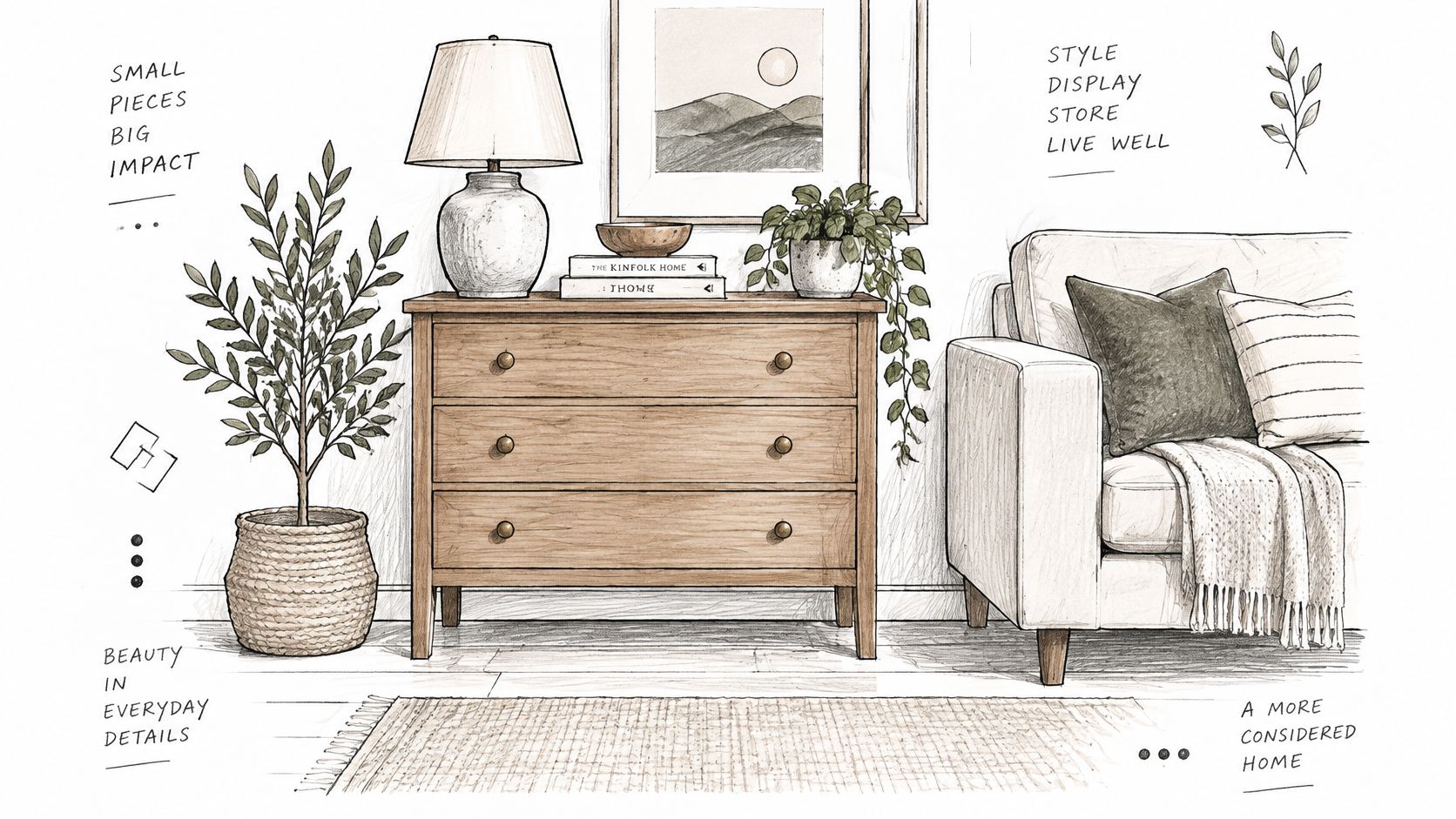
An accent chest of drawers is generally a low- to mid-height cabinet with drawers, chosen both for visible character and enclosed storage. Rather than serving as a bedroom's main clothing unit, it might hold everyday clutter while giving a lamp, artwork or decorative object a place to sit.
Say your living room has an empty wall beside the sofa, but board games and charging cables keep collecting on the coffee table. An accent chest could provide separate places for those belongings while adding a finish or texture the room needs. Its usefulness comes from the combination, not from having drawers alone.
How it differs from neighboring furniture categories
Furniture names overlap, so treat them as starting points rather than specifications.
- Dresser: Usually intended for daily clothing storage, often with a broad arrangement of drawers. It isn't necessarily taller than an accent chest.
- Sideboard or console: A sideboard commonly serves dining storage, sometimes behind doors; a console is often a shallower surface for an entry or living area.
- Nightstand: Designed for bedside access, with proportions and storage suited to that location.
The underlying furniture form isn't new. The Metropolitan Museum of Art records an American chest with drawers made approximately 1670 to 1700, probably in Boston, using oak, pine and maple. Modern accent chests reinterpret that established form through different proportions, finishes and hardware.
Practical distinction: A decorative appearance tells you how a chest might look in a room, not what its drawers are designed to hold.
Possible uses include entryway accessories, living-room games, dining linens and bedroom overflow. A nursery might need supply storage too, but don't assume an ordinary chest can double as a changing table. That requires explicit manufacturer approval and a compatible setup.
Accent is a use label as much as a style label. If you're planning daily clothing storage or furnishing a home with children, intended use deserves as much attention as appearance.
Choosing an Accent Chest by Room
Start with the task that isn't working today. A chest chosen to organize incoming mail needs different drawers from one intended to hold folded blankets.
The same furniture shape can serve different purposes, but its interior must support the room's routine.
Match the interior to the task
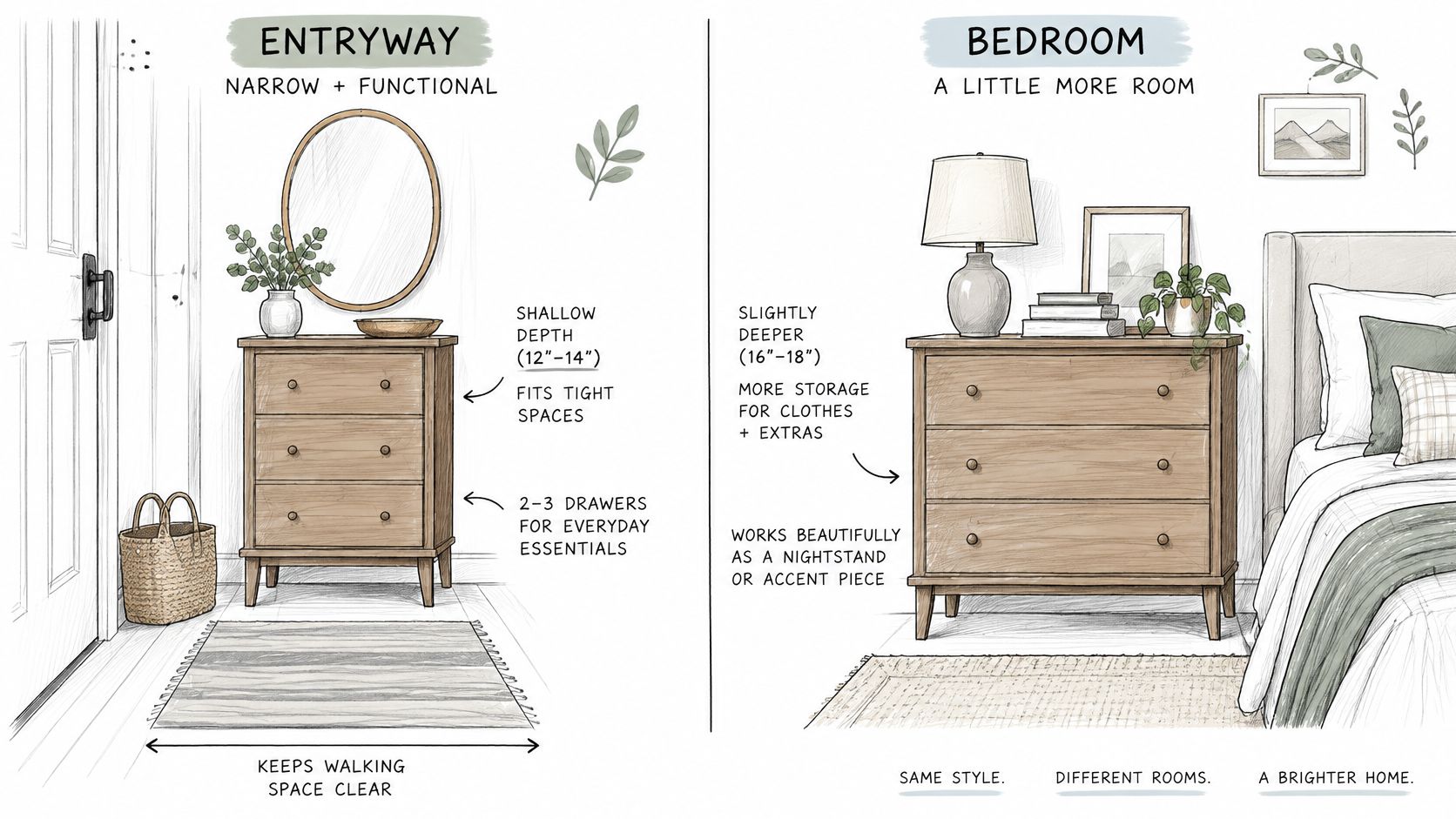
In an entryway, prioritize an accessible landing place and drawers that make small belongings easy to find. Deep compartments can turn keys, sunglasses and envelopes into a pile. Use removable organizers, and check that handles won't catch bags or coats as people pass.
In a bedroom, distinguish occasional accessories from the household's main clothing supply. Scarves and spare pillowcases create a different storage assignment from regularly packed clothing drawers. Beside a bed, opening space matters as much as the cabinet's closed footprint.
In a living room, measure the actual game boxes, controllers or folded throws you want to store. A decorative drawer front may conceal a surprisingly shallow box. If electronics will sit on top, verify the equipment's support and ventilation requirements instead of assuming the chest is a media stand.
In a home office, shallow drawers can keep stationery visible, while bulky supplies may need taller compartments. A cable gap helps only when there's a practical, unobstructed route to power. Keep the chair's pull-back area out of the chest's footprint.
The following video offers additional visual context for considering furniture in a room.
Plan for the room's next use
Dining-room storage should accommodate your folded linens and table accessories without forcing them into awkward stacks. If you'll store serving pieces, confirm their size and the drawer's stated load capacity.
For a multipurpose room, favor features you could use elsewhere: a flat top, accessible drawers and proportions that aren't tied to a particular nook. A neutral finish may simplify a future move, but it isn't mandatory if a stronger color suits your home.
Ask yourself:
- Task: What exactly will go inside?
- Access: Which belongings need to stay visible and easy to reach?
- Movement: What activity happens in front of the chest?
- Future use: Would this interior still help if the room changed?
A task-driven choice gives you more to evaluate than whether the color matches.
Sizing an Accent Chest for Your Wall and Walkways
Typical accent chest depth and clearance by placement
Use these depth bands as illustrative shopping starting points, not standardized product sizes or guaranteed fit. Clearance must be measured in your actual room.
| Placement | Typical depth |
|---|---|
| Entryway wall | 12 to 16 in |
| Bedroom wall beside bed | 16 to 18 in |
| Living room under art or TV | 16 to 18 in |
| Dining room or hallway | 14 to 18 in |
| Home office corner | 16 to 20 in |
A chest can fit between neighboring objects and still be inconvenient to use. Measure both its closed footprint and the space needed to operate it.
Measure the wall, then the working space
Start with a tape measure, painter's tape and a simple sketch. Record the usable wall width, not merely the distance between corners. Mark trim, outlets, switches, vents and nearby doors.
Baseboards can hold the cabinet away from the wall. Include that gap when checking how far the front will project into the room, and account for protruding knobs or pulls.
Next, mark the proposed footprint on the floor. Walk past it carrying the things you normally carry there, such as a laundry basket, groceries or a work bag. A passage that feels acceptable empty may become awkward during the household's usual routine.
A cabinet's closed dimensions tell you where it stands. Its open drawers tell you whether you can use it there.
Ask for the drawer's extension distance, or measure an open display model. Mark that extension beyond the cabinet front, then allow space for yourself to stand, bend and reach. Check whether a nearby bed, sofa or door prevents full opening.
Compare usable capacity, not just exterior size
A narrow, deep chest isn't automatically the better small-room option. A wider, shallower cabinet may preserve the walking route while making small belongings easier to see.
Inspect interior drawer width, usable depth and usable height. Thick sides, decorative fronts and hardware can reduce the space available inside. Try a paper template cut to the size of an awkward item, such as a game box, rather than estimating by eye.
Finally, trace the delivery route:
- Entry points: Measure door openings with the doors in their actual open positions.
- Turns: Check hallway corners, stair landings and any space needed to tilt the cabinet.
- Obstructions: Note railings, low ceilings and fixed fixtures.
- Handling details: Confirm whether legs or other components are removable according to the manufacturer's instructions.
At Woodstock Furniture & Mattress Outlet, we offer delivery options. Bring your access measurements when discussing delivery so the route can be considered alongside the furniture dimensions.
Materials and Finishes and What a Label Can Prove
Common accent chest materials compared
| Material | What the label means | Weight and care | What to verify |
|---|---|---|---|
| Solid wood | Structural parts cut from solid lumber | Can be heavy; responds to humidity; refinishing potential depends on construction and finish | Joinery, drawer-box material, stated weight limit |
| Engineered wood (MDF or particleboard) | Pressed wood fibers or particles, often faced with laminate or veneer | Weight isn't necessarily lower; protect edges from impact and moisture | Edge banding, fastener connections, drawer-glide rating |
| Veneer over core | Thin wood layer bonded to a core | Avoid standing water; deep sanding can cut through the veneer | Core type, finish-care instructions, warranty terms |
| Metal frame with wood or laminate top | Metal support structure with a wood or laminate surface | Weight follows the full design; cleaning and scratch resistance follow the finish | Frame finish, top load rating, anchoring hardware |
No material label proves overall quality by itself. A chest's drawer construction, connections, hardware and intended loading matter alongside its visible surfaces.
Solid wood responds to changes in humidity, and some pieces can be refinished. That doesn't mean every solid-wood chest tolerates the same treatment. Engineered wood can offer dimensional consistency, but MDF isn't automatically lightweight, and exposed or damaged edges deserve attention.
Read the whole construction description
Veneer is real wood applied as a thin surface layer. It isn't synonymous with laminate, and its presence alone isn't a reason to reject a piece. The important questions concern the core, edge treatment, finish and allowable repair methods.
Metal framing also needs context. A slim-looking frame doesn't establish the cabinet's weight, rigidity or load rating. Inspect connections and request documentation rather than judging by appearance.
The Federal Trade Commission's advertising guidance states that advertising must be truthful, not misleading and supported by an appropriate basis. For shoppers, that means claims such as solid wood, scratch-resistant or built to last should lead to specific evidence, not replace it.
- Construction: Which parts use each material, including drawer sides and bottoms?
- Capacity: What limits apply to individual drawers and the top?
- Care: Which cleaners and moisture precautions does the manufacturer specify?
- Coverage: What do the warranty terms cover?
Consider refinishing separately from buying
If your existing chest functions well but looks dated, changing its finish may be worth investigating before replacing it. Alex Trend Painters' resource on spraying dated pine furniture is relevant when considering that route, but first identify your piece's surface and existing coating.
Refinishing changes appearance. It doesn't establish drawer capacity, repair inadequate structure or turn occasional furniture into a clothing-storage unit.
Styling and Placement Tips That Hold Up in Real Homes
Begin with the chest's relationship to nearby furniture. Compare its top with a sofa arm, mattress or adjacent cabinet, then decide whether you want a quiet grouping or a deliberate height contrast. There isn't a universal alignment that works in every room.
A cardboard outline taped to the wall helps you judge height before committing. Look from the doorway and from your usual seated position, since a cabinet can feel balanced from one viewpoint and visually crowded from another.
Make the arrangement usable first
Keep the drawer fronts clear of rug edges and door swings. Make sure the cabinet won't block a vent or leave an outlet inaccessible when you need it.
If the chest will support a lamp or charging area, plan the cord route before styling the top. Don't pinch cables behind the cabinet or run them through drawer mechanisms. A nearby outlet is useful only if you can use it without creating a snagging or tripping problem.
- Repeat an undertone: Echo the chest's warm wood, cool painted finish or metal detail in a frame, textile or nearby accessory.
- Leave landing space: Keep part of the top available for the activity the chest supports.
- Edit decorative objects: Choose pieces that won't obstruct drawer access or require constant rearranging.
Style the chest for the way you enter, sit and move through the room, not just for the view in a photograph.
Choose display pieces deliberately
A lamp, a small tray and a modest decorative object can create a layered arrangement without filling the entire surface. Check each object's weight and stability rather than assuming decorative items are inconsequential.
If you're combining contemporary furniture with sculptural art, HD Asian Art's guide to placing Southeast Asian sculptures offers relevant styling context. Consider the sculpture's base, support requirements and placement, not only its visual relationship to the chest.
Leave the taped footprint in place through ordinary household routines before buying. Notice where people turn, set down bags or pull out chairs. If you repeatedly step around the outline, revise the location or proportions instead of expecting everyone to adapt.
Confirm Fit, Use and Anchoring Before You Buy
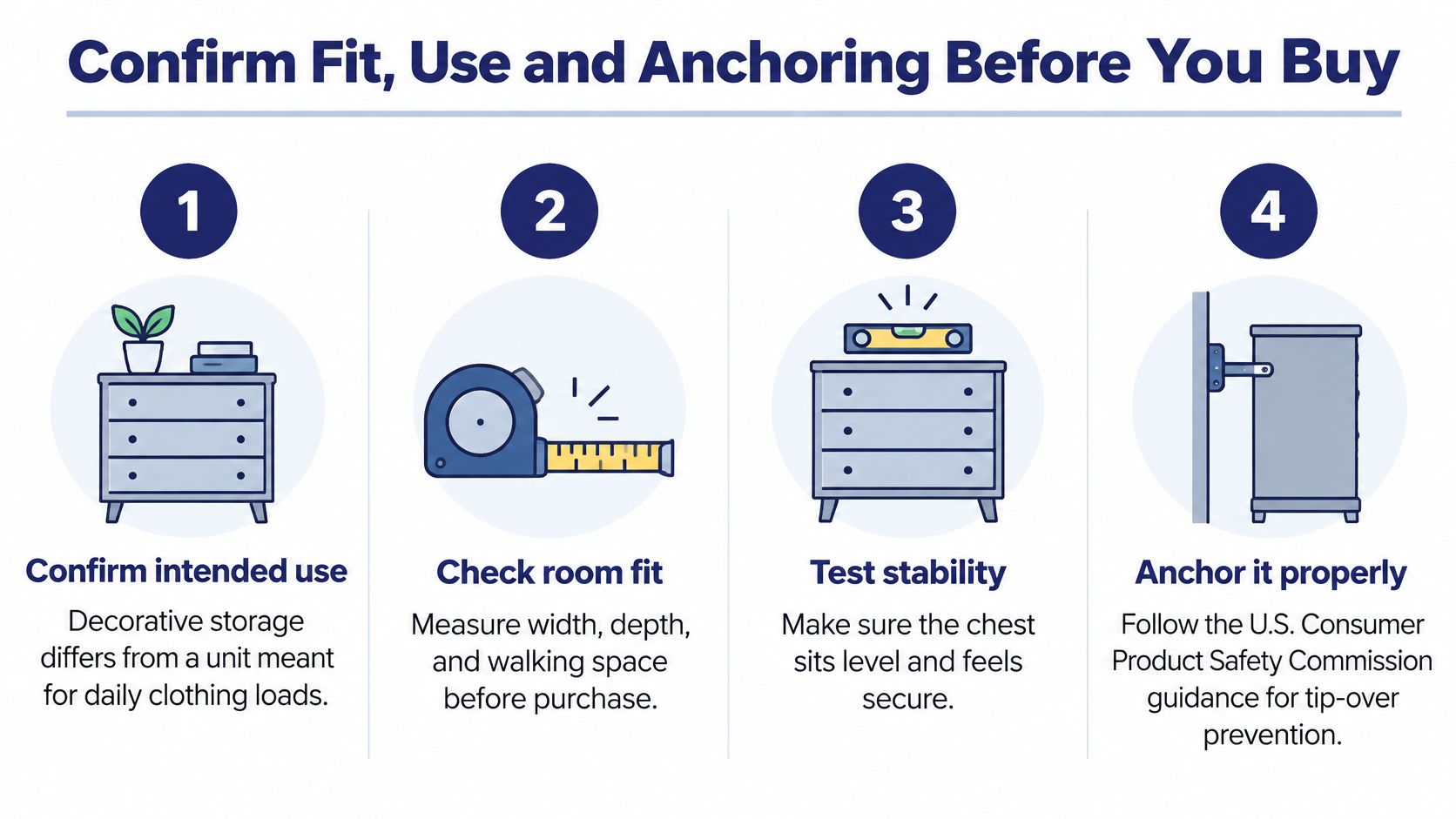
A small or decorative chest isn't automatically low risk. The U.S. Consumer Product Safety Commission estimates that chests, bureaus and dressers accounted for 2,000 emergency-department-treated child injuries annually during 2019 to 2021.
The agency distinguishes clothing-storage units from occasional or accent furniture not intended for bedroom use, which is excluded from that rule. A retail label alone doesn't establish which requirements apply to a particular piece.
Take this checklist into the showroom
Confirm intended use. Explain what you'll store and where the chest will live. Request manufacturer documentation confirming suitability for that use, especially if it will hold everyday clothing. Don't treat a decorative category name as approval.
Check drawer behavior. Ask whether the drawers have interlocks, whether multiple drawers can open together and whether an anti-tip restraint is included. Test normal drawer operation, but don't deliberately create an unstable condition to assess safety.
Review the floor and anchoring plan. Small footprints, top-heavy designs, unstable or sloped floors, heavy objects on top and multiple open drawers can increase tip-over risk. Follow the manufacturer's anchoring instructions using hardware appropriate to the wall construction. If you're renting, arrange permission and installation rather than assuming anchoring can be skipped.
Consider children's access. Avoid arrangements that encourage climbing toward toys, controls or other desirable objects. A chest that feels steady during an ordinary showroom check hasn't thereby been proven safe under loaded or climbing conditions.
Bring a written fit sheet. Include available width, depth, height, walking space, drawer-opening space and delivery constraints. Add your storage list and questions about construction, care and load limits so appearance doesn't crowd out practical decisions.
Keep the decision specific
Ask to see how the proposed chest meets your actual requirements. If its intended use or anchoring instructions remain unclear, pause the choice and consider a different piece.
We sell furniture, mattresses and home decor, and we offer design services to help you consider how an accent chest fits your room. Bring your measurements, storage list and showroom checklist when you visit Woodstock Furniture & Mattress Outlet to compare proportions, examine drawers and discuss the details that matter for your home.