Babies and toddlers under 6 should not sleep on the upper bunk, and children under 2 belong in a crib rather than a bunk bed. Those limits apply even when a child climbs confidently or the bed looks sturdy.
If a bunk bed meets safety standards, doesn't that mean it's suitable for every child? Compliance and age appropriateness are different questions. A compliant frame can reduce certain hazards without being an appropriate sleep space for a baby or toddler.
For families searching for bunk beds for toddlers and baby room arrangements, the useful starting point isn't a particular bed style. It's deciding where each child can sleep appropriately, then checking whether the furniture and room layout support that plan.
Age Limits for Bunk Beds at a Glance
Choose the sleep surface by the child's age before choosing the furniture. The CPSC bunk-bed test manual prohibits upper-bunk use for children younger than 6 and recommends guardrails on both sides; CPSC guidance also recommends a crib rather than a bed for children under 2.
Bunk bed age limits by child age
| Child age | Lower bunk | Upper bunk | Guidance |
|---|---|---|---|
| Under 2 | Not a bunk bed; use a crib | No | CPSC recommends a crib rather than a bed |
| 2 to 5 | Only with a compliant bed and full rails; a toddler bed is simpler | No | Children under 6 should never use the top bunk |
| 6 and older | Yes | Yes, with guardrails on both sides and a secure ladder | Follow the manufacturer's age restrictions and warning labels |
The lower-bunk entry isn't blanket permission to put a toddler into any bunk system. Check that the manufacturer allows that use and that the rails are part of an approved configuration. Don't improvise by attaching a portable rail to a frame it wasn't designed to fit.
A standalone toddler bed is the simpler choice for a child transitioning out of a crib. It avoids introducing an overhead sleeping level and an accessible ladder into the toddler's immediate sleep space.
Practical rule: A child's ability to climb onto a bed doesn't establish that the child should sleep there.
Read the label, not the product nickname
Terms such as low bunk, house bed, and floor-style bed describe appearance, not permission for a particular child to use them. A lower overall profile doesn't turn a raised sleeping level into a toddler bed.
Likewise, reaching the minimum age for an upper bunk doesn't settle developmental readiness. Consider whether your child follows ladder rules consistently, avoids leaning over rails, and can manage nighttime access without using nearby furniture.
Find your child's row, then check the actual model's permanent warnings and assembly instructions. If the label is more restrictive than your intended arrangement, change the arrangement rather than working around the label.
Why Babies and Toddlers Face Higher Bunk Bed Risks
The American Academy of Pediatrics' bunk-bed safety guidance, citing a 2008 study, reported approximately 36,000 children treated in U.S. emergency departments each year for bunk-bed-related injuries, with head and neck injuries making up most cases and about half of injured children younger than 6. Those historical estimates explain why age guidance matters, but they don't predict the outcome for an individual bed.
Falls involve height and movement
A fall can happen while a child climbs, turns at the ladder opening, or moves near an unprotected edge. Young children have less developed balance and judgment, and they may not respond effectively when they lose their footing.
Consider a child waking to use the bathroom. Climbing down while sleepy requires different judgment from climbing up during supervised daytime play. Daytime confidence isn't a substitute for age-appropriate use.
Entrapment involves openings
Entrapment is a separate hazard, not another name for falling. A child can become caught between the mattress, guardrail, frame, or wall without falling to the floor.
The CPSC's bunk-bed warning identifies openings greater than 3.5 inches as hazardous because a child may slip through feet first as the mattress compresses; the federal regulatory findings report that more than 96% of reviewed entrapment fatalities involved children age 3 or younger.
Check the locations a child's body could enter:
- Bed-to-wall gaps: A narrow space can catch a child rather than provide a clear route to the floor.
- Openings beneath guardrails: A rail can be present while the space below it remains hazardous.
- Poorly fitted mattresses: A mattress that shifts or sinks can expose openings around the frame.
A bed can feel solid when pushed and still contain an entrapment hazard. Frame strength, mattress fit, and opening geometry require separate checks.
Measure and Install a Bunk Bed Safely
Bunk bed measurement and gap checks
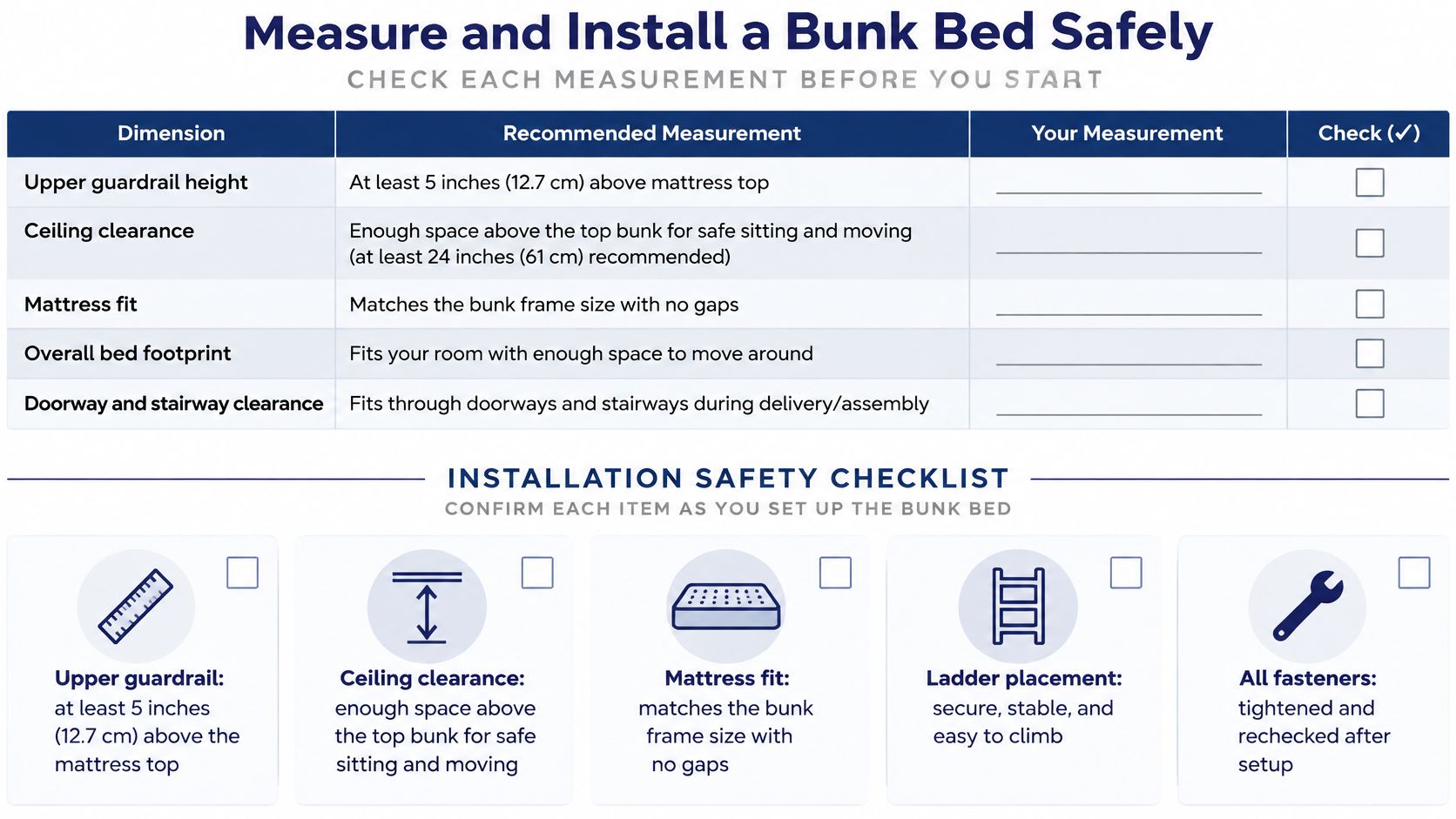
The CPSC's bunk-bed business guidance requires upper guardrails to extend at least 5 inches (12.7 cm) above the mattress and describes continuous wall-side protection and entrapment testing. Use these checks with the manufacturer's instructions, not as a replacement for product testing.
| Check | Requirement | How to check |
|---|---|---|
| Upper guardrail height | At least 5 inches (12.7 cm) above the mattress top | Measure from the installed mattress surface, not the bare platform |
| Wall-side rail | Runs continuously from end to end | Look for breaks or gaps along the wall side |
| Openings at headboard, footboard, rails and wall | No gap a child could become trapped in; openings above 3.5 inches are hazardous | Measure gaps with a tape measure; confirm prescribed wedge-test compliance with the manufacturer |
| Mattress thickness | Within the manufacturer's stated maximum | Check the label or manual; a thicker mattress lowers effective rail height |
| Fasteners and hardware | Tight and not able to release accidentally | Check all bolts at setup and again on a regular schedule |
A tape measure alone can't certify entrapment safety. The prescribed wedge test uses specified equipment and procedures. Don't substitute a household object or assume that a gap smaller than the warning dimension is automatically acceptable.
Keep this visual checklist beside the assembly instructions while planning the installation.
Assemble the complete system
Read the instructions and warning labels. Confirm the intended user meets the model's age restrictions. Lay out the hardware and identify each part before joining the frame.
Choose a level location. Check the bed's footprint, the ladder projection, and the space needed to move around it. Allow enough overhead room for the upper-bunk user to sit and move without contacting the ceiling or nearby fixtures.
Install every specified fastener. Start bolts as directed, align the parts, and tighten in the manufacturer's sequence. Don't force a misaligned joint together or replace missing hardware with something that merely looks similar.
Attach upper guardrails on both sides. The wall doesn't replace a required rail. Check that each attachment is secure and that the access opening remains in its intended position.
Position, fit, and verify
Evaluate the wall interface. A corner with walls on adjacent sides may suit the layout, but only if the placement leaves no hazardous gap. Use wall anchoring when the manufacturer calls for it, following its specified attachment method.
Fit the specified mattress. Confirm its length, width, and thickness against the bed label. Measure the exposed guardrail above the installed sleeping surface, including any permitted topper.
Secure the ladder and clear its approach. The ladder shouldn't slide or shift during normal use. Remove toys, baskets, and furniture that obstruct access or invite a child to climb by another route.
Check movement and schedule follow-up inspections. Push gently on the rails and frame to identify unexpected movement, without treating this as a substitute for formal testing. Recheck hardware after initial use and regularly thereafter, using the manual's schedule where provided.
This video can supplement your preparation, but the instructions for your particular bed remain the assembly reference.
A completed bunk bed should match its instructions, not simply look finished.
A suitable installation has the correct mattress, secure rails, supported slats, stable ladder access, and no unresolved openings. If a check fails, stop using the bed until the fit is corrected or the manufacturer confirms an appropriate fix. Never modify rails or add an unapproved mattress, because those changes can alter the geometry the bed was designed and tested to maintain.
Safe Sleep Spaces for a Baby in a Shared Room
Give the baby a separate, compliant crib or approved play yard. A bunk bed's compliance doesn't make either berth an infant sleep surface. The CPSC's bunk-bed safety FAQ explains the product-safety framework, but meeting that framework isn't the same as meeting a baby's sleep needs.
Don't place the crib beneath the upper bunk or immediately alongside its ladder and rails. That arrangement puts the baby close to the older child's climbing route and the bunk's fall and entrapment areas.
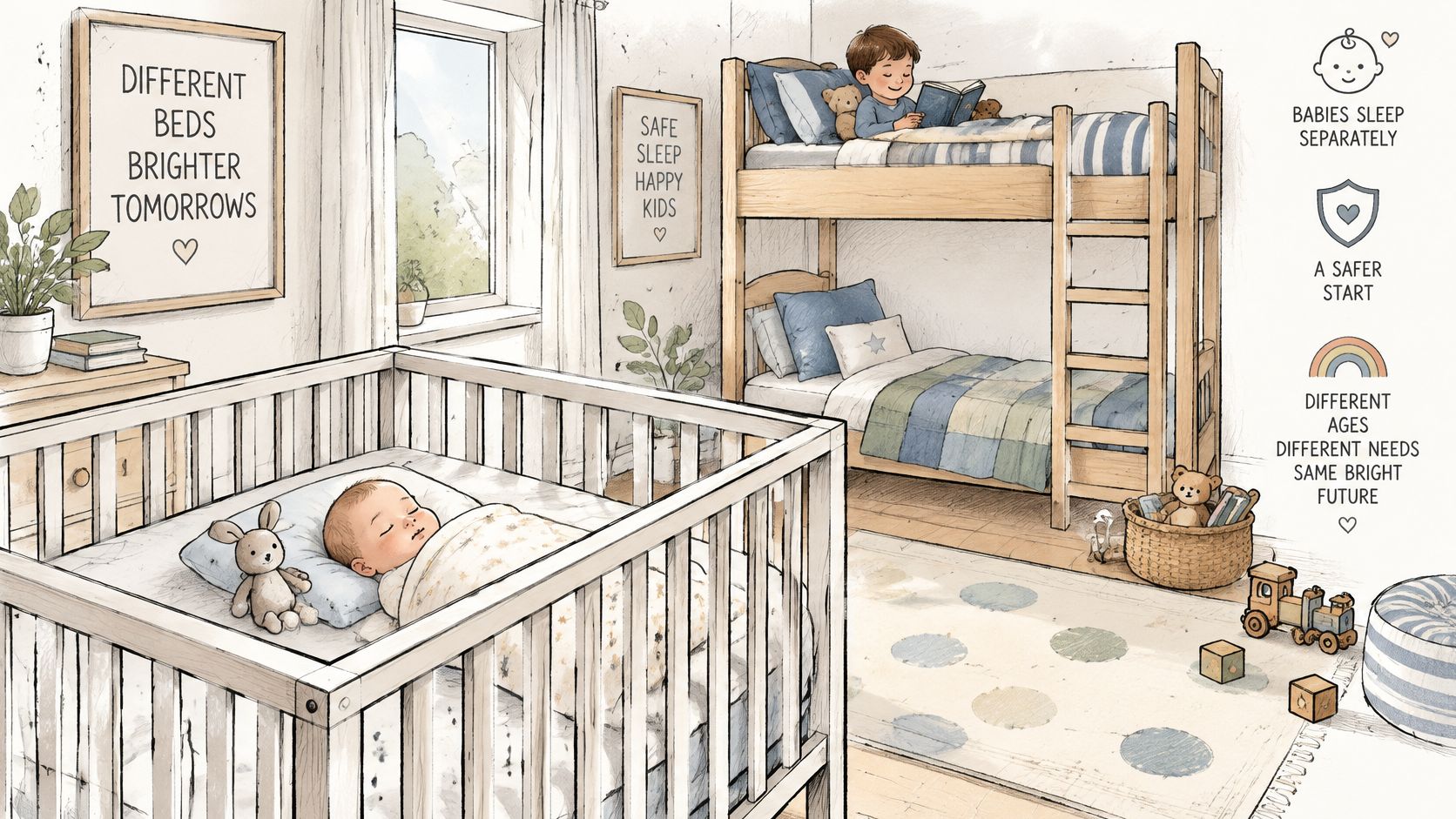
Treat a shared-room illustration as inspiration, not a measured safety plan. Actual spacing must keep the baby's sleep surface separate from the bunk structure.
Give each child a distinct sleep area
Say an older sibling uses a bunk along a suitable wall. Place the baby's crib in another part of the room, with an unobstructed route for an adult to reach it. Keep the ladder's approach directed away from the crib rather than making the crib part of the path.
Use this layout checklist before moving furniture:
- Separate the structures: Keep the crib beyond reach of the bunk's ladder, rails, and wall gaps.
- Remove climbing connections: Don't place a dresser, chair, or storage cube where it creates a route between the crib and bunk.
- Keep the crib interior clear: Leave out loose bedding and keep cords and hanging mobiles out of the baby's reach.
- Check the floor and access: Set the crib on a stable surface and leave clear working space around it for caregiving.
If the room won't accommodate separate sleep areas, reconsider the bunk configuration or the room assignment. Saving floor space isn't useful if it requires placing the crib inside the older child's climbing area.
Plan for the next sleep stage
When the baby is ready for an age-appropriate toddler bed, reassess the whole room. A child who can leave the bed independently can also approach the bunk ladder, so the original crib layout may no longer work.
For help evaluating caregivers who support sleep routines, Superstar Nannies' resource on choosing a safe infant sleep expert offers a starting point. Caregiver support complements, rather than replaces, an appropriate sleep surface and careful room arrangement.
Before the first night, check whether the baby's bed sits within reach of the bunk's rails or ladder. If it does, move the furniture.
Buying and Checking a Used Bunk Bed
A seller's photo can make a used bunk bed look ready for a child's room. The parts that decide safety are the ones photos leave out: the identification label, the hardware bag, the underside of the slats. Like a secondhand car seat, a used bunk carries a hidden history, and previous owners may have misplaced hardware, removed labels, or substituted parts.
Appearance isn't enough to establish suitability. Ask for clear photographs of the label, rails, mattress supports, and joints before arranging collection.
Inspect identity and condition
- Permanent labels and model information: Confirm the manufacturer, model, warnings, and assembly instructions. A compliant bed assembled differently stops being the bed its certification describes.
- Complete guardrails: Check that upper rails are present on both sides, undamaged, and secured with the intended fittings.
- Slats and frame: Look underneath for cracks, splits, bent components, loose supports, or previous repairs.
- Mattress specifications: Match the mattress to the model's stated dimensions rather than assuming any mattress with the same general size name will fit.
- Original hardware: Reject stripped bolts, missing connectors, and substitute fasteners unless the manufacturer approves replacements.
- Modification history: Ask about altered rails, non-original parts, repairs, and coatings of unknown composition.
- Recall status: Search CPSC recall listings using the exact manufacturer and model, and check whether any required remedy was completed.
Structural inspection matters even when damage isn't obvious. Broken slats have been a reason for bunk-bed recalls, so run a hand along each one and press gently near its center: a sound slat flexes slightly, while a cracked one may show a split line or feel soft at the break.
Stop-use decision: Missing labels, guardrails, or structural parts keep the bed out of service until the correct components are in place.
A recalled model stays out of use until its remedy is completed. If the bed can't be identified or matched with the right instructions and parts, choose a different sleep solution. And remember what the checklist cannot tell you: a sound frame is still only suitable for a child who meets the model's age guidance, a separate question from whether the bed itself is in good condition.
Confirm the Sleep Plan Before You Buy
Decide who will sleep where before comparing finishes, storage drawers, or ladder styles. A room can accommodate a bed's footprint without accommodating its safe use.
Ask yourself:
- Who will use the upper level? The child must meet the model's age guidance and reliably follow ladder and guardrail rules.
- Where will the youngest child sleep? Choose a compliant crib or age-appropriate toddler bed, rather than treating spare space in a bunk system as a ready-made solution.
- Can the room support the arrangement? Allow clear access, resolve wall gaps, and remove furniture that creates unintended climbing routes.
If an answer is no, change the sleep plan before choosing the bed. If the arrangement works, verify the model's warnings, mattress limits, rail configuration, and recall status before committing.
Bring a room sketch showing doors, windows, ceiling fixtures, and furniture positions when shopping. It's easier to discuss a workable layout when everyone can see where the ladder and separate baby sleep area will go.
Your first step is simple: write down each child's age and planned sleep surface before shopping. That short list keeps the decision centered on the children rather than the furniture.
At Woodstock Furniture & Mattress Outlet, we offer design services and delivery options to help you plan a children's room. Bring your room measurements and sleep-surface list when you visit Woodstock Furniture & Mattress Outlet, and we can help you consider furniture placement around each child's needs.