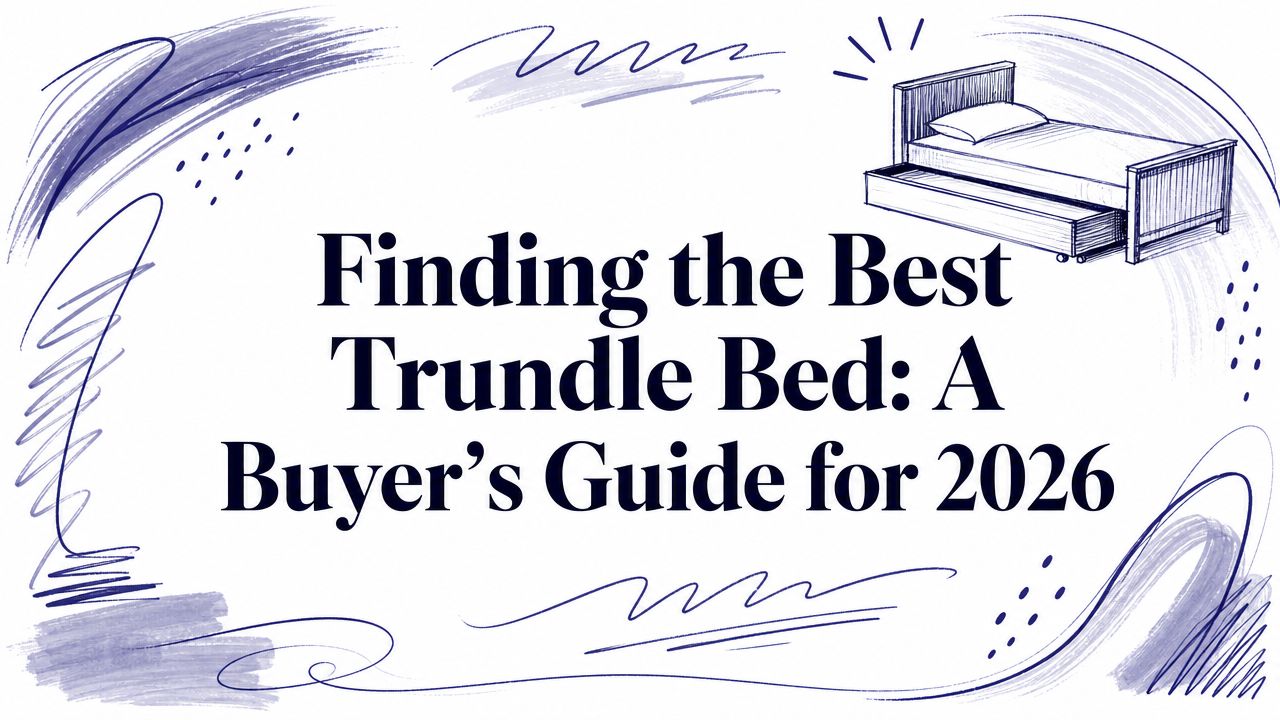
You're usually looking for a trundle bed when one room has to do two jobs.
Maybe it's a kid's bedroom that also hosts cousins on holidays. Maybe it's a home office that turns into a guest space a few times a year. Maybe you want a daybed in a den, but you don't want a second full-size bed taking up the floor all the time. That's where trundle beds make sense. They tuck an extra sleep surface under the main bed, then pull out only when you need it.
This idea isn't new. Trundle beds go back to the 17th century, when the original “truckle bed” was used to fit more sleepers into tight spaces, and the name came from the Old English word “tryndel,” meaning wheel. Their purpose was simple then, and it's still simple now: make one footprint do the work of two sleeping spaces, as noted in this history of the trundle bed.
If you're trying to find the best trundle bed, style matters, but fit matters more. A beautiful frame won't help much if the lower bed is hard to pull out, the mattress is too thick to slide in, or the setup doesn't match who will be sleeping there. That's the part many shoppers don't get walked through clearly.
The Smart Solution for Small Spaces and Extra Guests
A lot of trundle-bed shopping starts with a very ordinary household problem. You need an extra bed, but you don't want a room to feel crowded every day.
A family room for one child can suddenly become a sleepover room. A guest room can also be a craft room, office, or reading nook. In those situations, a trundle bed works because the second bed stays out of sight until someone needs it. You keep the open floor space most of the time, then gain another place to sleep without dragging out an air mattress.
Where trundles help most
Trundles tend to fit best in rooms where flexibility matters more than a permanently visible second bed.
- Kids' rooms: Sleepovers are the obvious use, but trundles also help when siblings share a room part-time.
- Guest spaces: A daybed with trundle can make a room feel like seating by day and sleeping space by night.
- Small homes and apartments: One furniture footprint can sleep two people, which is a practical advantage noted in Saatva's explanation of what a trundle bed is.
A trundle bed isn't just “an extra bed.” It's a layout tool for homes that need open floor space during the day.
That also changes how you should judge one. The best trundle bed for your home may not be the one with the prettiest headboard. It's the one that opens easily, fits the room without blocking traffic, and feels appropriate for the people who will use it.
If you're also thinking about how to make that guest setup feel welcoming, these guest bedding ideas can help with the comfort side of the room once the bed itself is sorted out.
Understanding Trundle Bed Types and Mechanisms
Two trundle beds can look almost identical when they're closed. The big difference shows up when you pull the lower bed out.

The standard roll-out trundle
This is often the first version that comes to mind. The lower bed sits on casters or wheels and rolls straight out from under the main frame. Once it's open, it stays low to the ground.
That low profile is useful in children's rooms because it's simple, compact, and easy to store. There's usually less hardware involved, which can mean fewer moving parts to think about. If your goal is basic extra sleeping space and you don't need both sleepers at the same height, this design is often enough.
Still, there's a trade-off. A floor-level trundle can feel less convenient for some adults because getting in and out is lower than a standard bed. It also tends to make the two sleeping surfaces feel more separate.
The pop-up trundle
A pop-up trundle does something more adaptable. The lower bed rolls out, then raises up with a mechanism so it can sit closer to the height of the main bed. Some setups let the two surfaces work side by side more comfortably for guest use.
That matters because the most effective trundle designs often come down to mechanical adaptability. Modern pop-up versions can raise the lower sleep surface to the height of the main bed, which can reduce the awkward mismatch between the two and create a more flexible setup for guests, as explained in this guide to comparing trundle bed designs.
Practical rule: If adults will use the trundle often, pay close attention to how the lower bed opens and whether it stays low or lifts up.
What to check on the mechanism
Shoppers often focus on the frame finish and forget to test the moving parts. On a trundle, the mechanism is the whole story.
Here's what deserves a closer look:
- Wheel quality: Better casters usually roll more smoothly and feel less jerky when you pull the bed out.
- Frame alignment: If the lower unit looks slightly off even in the showroom, it may not improve at home.
- Lift action on pop-ups: The mechanism should feel controlled, not awkward or unstable.
- Intended sleeper: Some frames are more appropriate for children or occasional guests, while others are built with more regular adult use in mind.
A quick comparison
| Type | Best for | Main advantage | Main trade-off |
|---|---|---|---|
| Roll-out trundle | Kids' rooms, occasional use | Simple and compact | Lower sleeping height |
| Pop-up trundle | Guest rooms, more flexible use | Brings beds closer in height | More moving parts to evaluate |
If you remember one thing from this section, make it this: the best trundle bed is not just a frame style. It's a moving system. If that system doesn't suit your room or your guests, the bed won't feel like a smart choice for long.
How to Choose a Trundle Bed for Your Needs
You are standing in a guest room with a tape measure in one hand and two very different visitors in mind. One weekend it is your child's friend sleeping over. The next month it is your sister and her husband. A trundle that feels easy for one situation can feel awkward in the other, so the right choice starts with use, not style.

A helpful way to shop is to picture the trundle as a piece of moving furniture, not just a second mattress hidden underneath. The lower bed needs enough room to slide, enough support for the sleeper, and a mechanism that fits how your household uses the room. That practical geometry gets missed in a lot of style-first guides.
If the room is mainly for kids
For a child's room, simpler usually works better. A basic roll-out trundle is often easier to pull open, close, and remake than a design with extra lifting parts. If an adult will be the one handling bedtime and sheets, that matters just as much as how the frame looks.
Low sleeping height is usually less of an issue for kids, too. Children and teens often adapt easily to a mattress that sits closer to the floor, while adults may find it less comfortable to get in and out. That makes a standard trundle a practical match for sleepovers, siblings sharing a room, or a space that needs an extra bed only once in a while.
If adults will actually sleep there
Adult guests change the math. A low roll-out trundle can still work for occasional visits, but many shoppers are happier with a sturdier frame and, in some cases, a pop-up trundle that raises the lower mattress. The benefit is simple. The guest does not have to climb down close to floor level, and the sleeping setup can feel more like a regular bed.
Mechanism type matters more here than upholstery color or headboard shape. If the lower bed will be used by grandparents, taller adults, or anyone with limited mobility, pay attention to how much bending, lifting, and reaching the setup requires.
A daybed with trundle can also make sense in a mixed-use room because it looks like seating when closed. Woodstock Furniture & Mattress Outlet lists options such as the Philipa Oatmeal Upholstered Twin Trundle Daybed and Philipa Green Upholstered Twin Trundle Daybed, along with kids' beds that include trundles. That gives you a clear picture of how wide this category is, from casual youth-room pieces to more finished guest-room furniture.
Match the bed to the pattern of use
Start with the room's real job.
- Frequent sleepovers: Choose a design with easy roll-out motion, accessible corners for sheet changes, and hardware that feels steady after repeated use.
- Occasional adult guests: Give extra weight to support, entry height, and whether a pop-up trundle would be more comfortable.
- Office or multi-use room: A daybed with a trundle usually blends in better when the room is not acting as a bedroom every day.
- Regular use of both beds: Look closely at how often the lower unit will be opened and whether the mechanism feels durable enough for routine use.
For a quick visual overview of how these setups work in real rooms, this video gives helpful context before you shop in person.
Questions worth asking before you buy
A good trundle choice usually becomes obvious once you answer a few practical questions.
- Who will use the lower bed most often? A younger child, teen, and adult guest all place different demands on the frame and sleeping height.
- How often will you open it? A bed used every week should have a mechanism that feels easy and repeatable, not stiff or fussy.
- How much floor space do you have when it is open? The trundle needs clear slide-out room, and nearby rugs or furniture can get in the way.
- Would a lower sleeping position bother the guest? If yes, a pop-up model may be a better fit.
- Do you want the room to read as a bedroom or as flexible furniture? That answer often points shoppers toward either a standard bed frame or a daybed shape.
If you are choosing between two models, pick the one that fits the sleeper's comfort and the room's clearance, not the one with the nicer product photo.
The Critical Guide to Sizing and Mattress Fit
A common trundle-bed mistake happens after everything arrives. The frame looks right, the mattress says twin on the label, and then the lower bed scrapes, sticks, or refuses to close all the way.
The problem is usually geometry, not style.

Why size alone does not guarantee a good fit
Shoppers often match width and length and stop there. With a trundle, mattress thickness matters just as much because the lower bed has to slide under another frame with only limited vertical room.
Elle Decor points out this issue clearly in its discussion of trundle mattress height constraints. A standard twin can still be the wrong choice if the profile is too tall once you add the mattress cover, protector, and fitted sheet.
That is why two mattresses with the same twin label can behave very differently in the same trundle.
The measurements that actually decide whether it works
A trundle has a stack height. That stack includes the lower frame, the wheels or casters, the mattress, and a little breathing room so the unit can move without rubbing. If that stack is too tall, the trundle will fight you every time you open or close it.
This is the part many style-first guides skip. The useful question is not only, "What mattress size fits?" It is, "How much vertical clearance is left after the mechanism and frame take their share?"
Pop-up trundles need even more attention here. Their hardware can take up space differently than a simple roll-out tray, so the mattress that fits one trundle may be wrong for another even if both are labeled the same size.
Measure the under-bed opening first. Then subtract the height of the trundle frame and rolling or lifting hardware before choosing the mattress.
A measuring routine that prevents expensive mistakes
Use this quick check before you buy:
- Measure the clear inside height from the floor to the bottom of the upper bed rail or side frame.
- Measure the usable inside width and length of the lower compartment.
- Ask for the trundle frame height if the product page only lists overall bed height.
- Confirm the maximum mattress thickness recommended for that exact model.
- Account for bedding bulk such as a protector or quilted cover, which can add just enough height to create drag.
If you are shopping in person, pull the trundle out and push it back in yourself. It should move with light, predictable resistance, not with the feeling that fabric or foam is being squeezed into place.
Fit problems that show up after delivery
A trundle usually gives clear warning signs when the mattress profile is wrong:
- The lower bed drags on the way out. The stack height may be too tall, or the bedding may be catching.
- The unit stops short before closing. The mattress or sheet set is often taking up more vertical space than the frame allows.
- The mattress bows against the side rails. Width can be too tight, even if the label says it is the correct size.
- The pull feels rough from day one. That can point to weak casters, but it can also mean there is almost no clearance to begin with.
For homes that use the lower bed often, a lower-profile mattress is usually the smarter pick. It may look less plush in a product photo, but it tends to work better in real rooms and causes fewer day-to-day frustrations. Pairing that with an essential bedding schedule also helps the setup stay cleaner and more comfortable over time.
A good trundle fit should feel boring in the best way. It opens easily, closes fully, and does not ask you to wrestle with sheets, foam, or floor clearance every time a guest stays over.
Evaluating Materials Durability and Long-Term Value
Once the mechanism and fit make sense, the next question is what the bed is made of. Materials affect sturdiness, upkeep, and how the bed will look after years of use.

Solid wood, engineered wood, and metal
Each common trundle-bed material comes with trade-offs. None is automatically right for every room.
| Material | What it often does well | What to watch |
|---|---|---|
| Solid wood | Feels substantial, ages attractively in many styles | Heavier to move, varies by construction quality |
| Engineered wood | Can offer a polished look at a lower cost | Edges and surfaces may show wear sooner in busy rooms |
| Metal | Often lighter-looking and simple to clean | Can feel less warm visually, and some frames may develop movement noise over time |
Match the material to the room
A child's room can be hard on furniture. Feet kick rails, toys hit corners, and beds sometimes get used as daytime seating. In that case, the right choice often comes down to how the frame handles repeated daily contact, not just whether it looks stylish on delivery day.
Guest rooms are different. If the bed won't be used constantly, appearance may carry more weight in the decision. Upholstered daybeds with trundles, painted wood frames, or cleaner-lined metal options can all make sense depending on the room's style.
The original trundle bed was built for practical space-saving, not luxury. That's still a useful lens for judging value today.
Look past the finish
The finish tells you very little by itself. A trundle bed earns its value through the parts you touch and move over time.
Check these areas closely:
- Joinery and attachment points: Loose-feeling corners can become bigger problems later.
- Slats and supports: The sleep surface should feel properly supported, not flimsy.
- Caster mounting: Wheels take repeated stress. They shouldn't look like an afterthought.
- Touch-up realism: Ask yourself whether this material will still look good after everyday family use.
And once the bed is in your home, maintenance matters too. If you want a simple care reminder for the sleep setup around it, this essential bedding schedule is a useful companion resource.
Bringing It All Together and Shopping with Confidence
The best trundle bed usually comes down to four decisions. Who will sleep on it, how the lower bed opens, whether the mattress profile will fit, and how sturdy the frame feels in person.
A shopper who needs occasional space for kids can often keep the decision simple. A shopper planning for adult guests should be more careful about sleeping height, mechanism quality, and how substantial the frame feels when opened and closed. Those are different jobs, even when the beds look similar online.
A quick final checklist
- Use case first: Kids' sleepovers, adult guests, or a multi-purpose room all point toward different choices.
- Mechanism second: Standard roll-out and pop-up styles behave differently in daily use.
- Fit before finish: Mattress thickness and under-bed clearance can make or break the purchase.
- Construction last: Check wheels, supports, alignment, and how the frame feels when handled.
Seeing a trundle bed in person can help in ways product listings can't. You can pull the lower bed out yourself, feel whether the frame shifts, and ask specific questions about mattress thickness instead of guessing from a product photo. That kind of hands-on check is often the easiest way to avoid the common mistakes.
Frequently Asked Questions About Trundle Beds
Can adults sleep on a trundle bed
Sometimes, yes. The better question is what kind of adult use you have in mind.
For an occasional guest, many trundle beds work fine. For regular use, the lower bed's height, the frame's support system, and the mechanism matter much more. A low roll-out trundle can feel a bit like sleeping closer to the floor, while a pop-up trundle often feels more like a standard bed setup once opened. If the sleeper is taller, heavier, or staying for several nights at a time, look for a sturdier frame and check the stated weight capacity before you buy.
Do trundle beds need a special mattress
Usually, yes. Most trundles need a low-profile mattress so the lower bed can slide in and out without rubbing the bed above it.
Many shoppers get tripped up by mattress thickness. A mattress can be the right length and width and still be too thick to fit properly. The simplest way to picture it is garage-door clearance. If the opening is low, even a good vehicle will not fit. Trundle beds work the same way. You need enough space for the mattress, the tray or frame, and the wheels or glides to move freely.
Why won't my trundle bed slide in easily
The first thing to check is mattress thickness. If the mattress is too tall, the trundle may drag, stop partway, or require extra force to close.
Wheels can also be part of the problem, but fit is usually the starting point. Small differences in clearance matter here. The lower frame needs enough room to roll straight, and it also needs a little tolerance so fabric, piping, or quilted mattress tops do not catch on the rails. If a trundle is hard to close from day one, that usually points to a fit issue or a misaligned mechanism, not normal behavior.
Is a daybed with trundle different from a standard trundle bed
Yes. The lower unit works in a similar way, but the upper furniture piece serves a different role.
A daybed is built to look more like seating during the day, so it often has a back and side panels that make it feel more like a bench or sofa frame. That can be a smart choice in an office, den, or guest room that has to do double duty. The practical checks stay the same, though. Measure mattress thickness, confirm slide clearance, and ask whether the lower unit is a basic pull-out or a pop-up style.
Is the best trundle bed the same for every room
No. A child's bedroom, a guest room, and a home office ask different things from the same piece of furniture.
In a kid's room, easy operation and durable hardware often matter most. In a guest room, sleeping height and comfort usually move up the list. In a multi-use room, the closed look of the bed may matter more, but you still do not want to ignore the mechanics hidden underneath. Style gets attention online. Fit geometry is what decides whether the bed is easy to live with.
If you'd like to compare trundle daybeds, kids' trundle beds, or mattress options in person, Woodstock Furniture & Mattress Outlet is one place North Georgia shoppers can visit to test mechanisms, check frame feel, and ask practical fit questions before bringing a bed home.