You're tired of meeting elbows in the middle of the bed, but a larger mattress might leave barely enough room to open the dresser. Or perhaps you have plenty of bedroom space, yet you're not sure whether more width would help when your partner's early alarm is what wakes you.
The best mattress size for couples is the size that accommodates both sleepers without making the bedroom awkward to use. A queen is a sensible starting point, a king offers more personal space, and a split configuration deserves consideration when partners need different sleeping surfaces. The right choice depends on what's disturbing your sleep and what your floor plan can comfortably support.
Mattress Sizes for Two Sleepers Compared
A full, queen, king, or California king can all fit two sleepers, but each gives them a different amount of room. Standard U.S. mattress dimensions help compare sleeping surfaces; the bedroom's usable clearance and each partner's comfort determine which size works in practice.
The table uses standard U.S. dimensions from the RoomSketch3D bed-size guide. Per-sleeper width assumes the mattress is divided evenly between two people.
Couple mattress sizes and sleeping width per person
| Size | Dimensions | Width per sleeper | Best fit |
|---|---|---|---|
| Full (double) | 54 × 75 in | 27 in | Small rooms; tight for two adults |
| Queen | 60 × 80 in | 30 in | Moderate bedrooms; common starting point |
| King | 76 × 80 in | 38 in | Larger bedrooms with circulation room |
| California king | 72 × 84 in | 36 in | Taller couples; narrower than a king |
| Split king | Two 38 × 80 in twin XL surfaces | 38 in each side | Partners with different comfort needs |
What these labels actually tell you
A full is the narrowest option here. It may suit partners who prefer close contact or a room where a wider mattress would crowd the furniture, but its sleeping surface leaves less room to spread out.
A queen gives each partner 30 inches of width on paper. A king adds width, while a California king trades some of that width for extra length. The California king is longer, not larger in every direction.
A split king uses two separate twin XL surfaces. That arrangement can suit partners who want different mattress comfort, but the center seam and compatibility of the mattresses, support system, and fitted sheets matter.
Practical rule: Use mattress dimensions to narrow your choices, then check how the size fits your room and sleep habits.
Dimensions describe the mattress surface, not the outside of its frame. They also cannot predict whether you will feel crowded near the edge or notice your partner moving. Those details vary by sleeper, so treat the numbers as a starting point rather than a promise.
How Much Width and Length Each Partner Really Needs
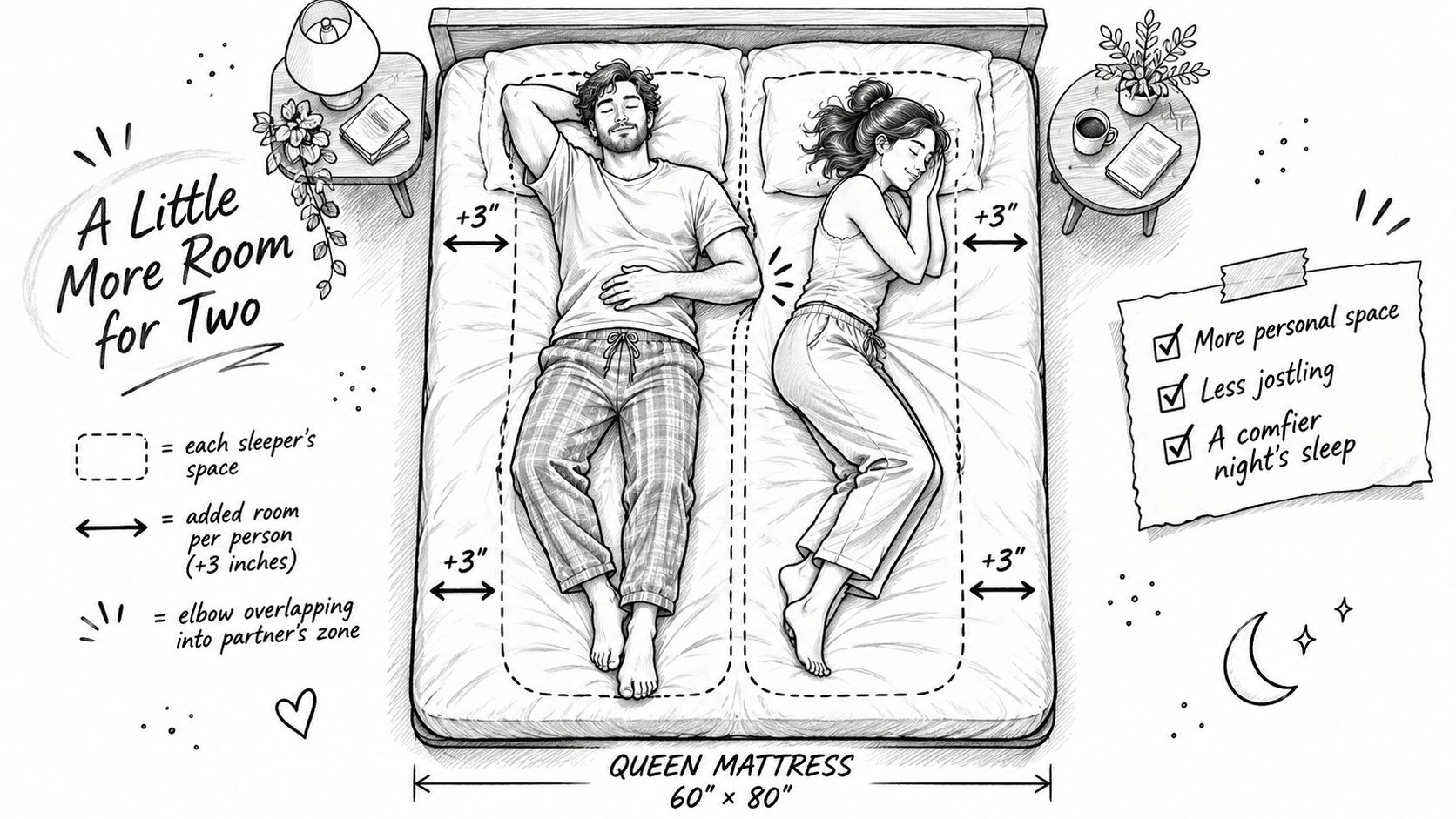
Size upgrades do not all buy the same thing. Working from the standard dimensions in the comparison above, moving from a full to a queen adds 6 inches of total width, or 3 inches per sleeper, plus a modest gain in length. Moving from a queen to a king adds 8 inches per person, roughly 27% more lateral space, while retaining the same 80-inch length, as described in ArchStudent's bedroom-planning guidance.
Three extra inches per sleeper is about the width of a forearm resting between two bodies. Eight inches is closer to the width of a pillow. The first upgrade relieves crowding; the second creates real separation. Neither one changes how long the bed feels under a tall sleeper.
That is the useful way to read a size label. A name like "queen" or "king" describes a rectangle on paper, not how that rectangle serves two particular bodies, so the question is which dimension your nights are short on.
Decide which direction feels restrictive
Start with your usual sleeping positions rather than how neatly you can lie next to each other in a showroom. A side sleeper with bent knees needs room in front of the body. Someone who changes positions often needs space to turn without brushing a partner.
Extra width makes those movements less restricted, though it cannot promise the other person won't feel them. Space between bodies and motion transfer through a mattress are different concerns, and only the first one is solved by sizing up.
For a taller sleeper, the binding question may be whether the feet approach the end of the usable surface. Pillow placement, a footboard, and sleep position all change where the usable surface ends.
Consider a couple where the taller partner runs out of length while the shorter one spreads out sideways. A California king is worth testing if legroom is the requirement driving the purchase. If neither partner runs out of length, choosing it for the name alone trades away useful width and solves nothing.
Ask each other: Which gap matters more to us, width or length?
Answer it in both normal sleeping positions and mid-turn, not just lying still. Paying for extra length to fix a hypothetical problem while a nightly width problem goes unresolved is the most common way this decision goes wrong.
Measure the Room Before Choosing a Size
A mattress can fit between the walls and still make a bedroom difficult to use. Measure the complete setup, including the frame, headboard, storage furniture, and the space people need to move.
The Naturepedic couple-sleeping planning reference gives the dimensions used below: about 30 inches beside a used side, avoiding less than 24 inches; approximately 30 to 36 inches beside a queen or larger bed; and 36 to 42 inches at the foot of a king or California king.
Check the complete footprint
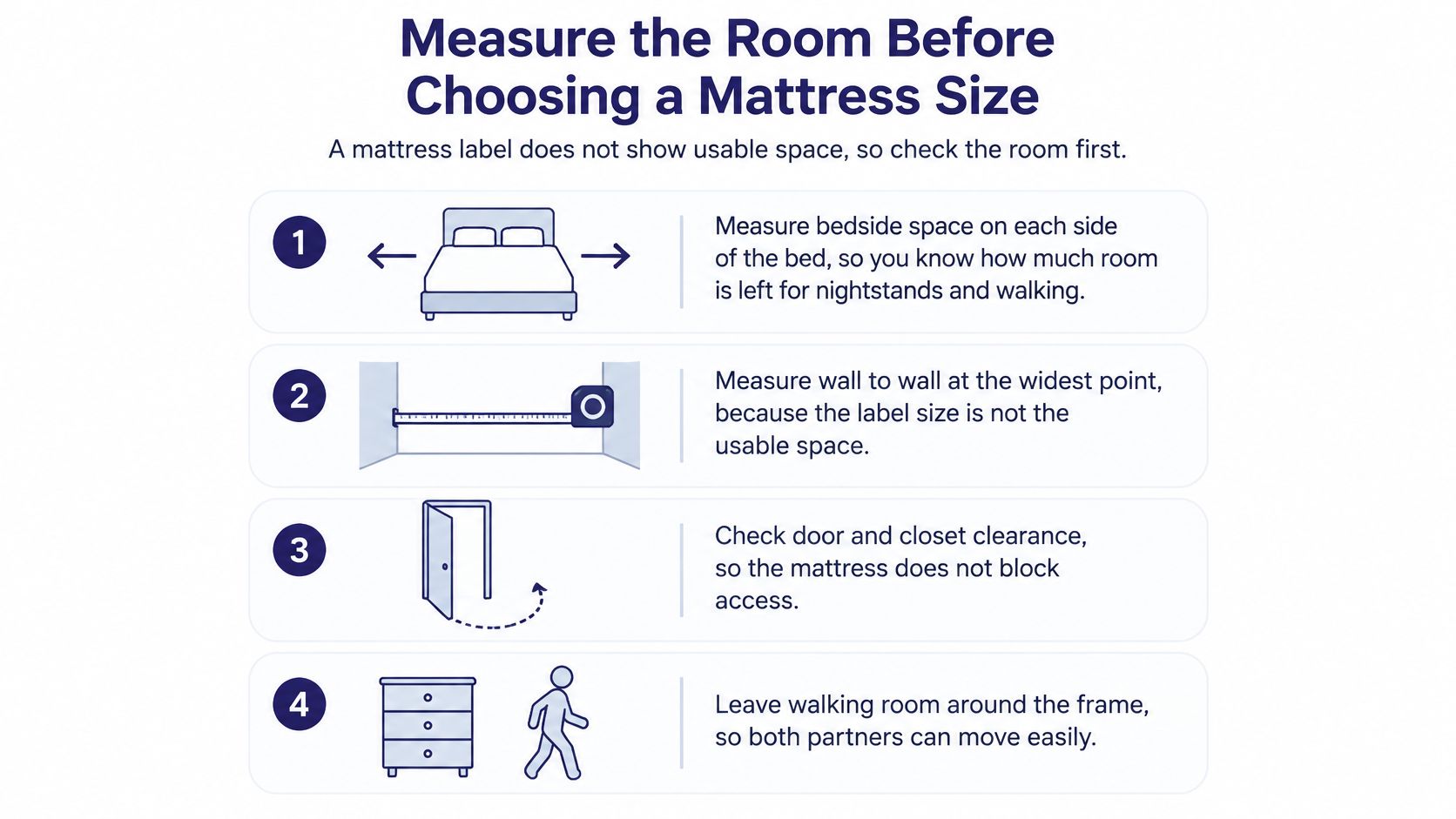
- Measure each used bedside. Aim for the recommended bedside space, and don't plan a regularly used side below the minimum above. Narrow passages make getting up, changing bedding, and reaching bedside storage awkward.
- Check the queen's side clearances on both sides, not just the easier side. A generous passage beside one sleeper doesn't compensate for trapping the other against a wall.
- Test the foot clearance for a king or California king. Include any dresser opposite the bed, and check the space with its drawers open.
- Tape the mattress outline on the floor, then extend it to the true outside dimensions of the frame and headboard. Use the manufacturer's measurements rather than assuming the frame matches the mattress.
- Open everything. Swing the bedroom door and closet doors fully, pull out dresser drawers, and stand where you'd use them.
- Trace the delivery route through stairs, hallways, doorways, and tight turns. A clear bedroom footprint doesn't prove that every component can reach it.
Use this visual checklist to keep the room measurements organized.
Make the room work for both people
These are planning ranges, not accessibility standards or mattress dimensions. If either partner uses a mobility aid or needs assistance, test the layout around those actual needs rather than relying on a general minimum.
We offer design services at Woodstock Furniture & Mattress Outlet, which can help when the bed choice affects the rest of the room. The practical test remains simple: both sleepers should be able to get out independently, and doors and storage should operate freely.
When Movement and Sleep Schedules Change the Answer
One partner gets up at 5 a.m. while the other is still asleep. A king may leave more room between them, but the alarm and light can still wake the sleeping partner. Mattress size helps with some disturbances, not all of them.

Sharing a bed can mean more movement and less room to spread out, but partners' experiences vary. The key is to identify what interrupts sleep before choosing a larger mattress.
Match the response to the disturbance
- Personal space: Consider a king for more width, or a California king if extra length matters too.
- Motion transfer: Compare mattresses by having one partner turn or get up while the other lies still. A split king or separate surfaces may help, but the full setup needs to suit both sleepers.
- Height: Prioritize usable length rather than choosing a wider mattress.
- Temperature: Consider whether different bedding or mattress constructions would suit each partner.
- Different schedules: Consider how movement, alarms, light, and getting in or out of bed affect the sleeping partner.
- Loud snoring or suspected sleep apnea: Discuss symptoms with a clinician. A larger mattress does not treat these conditions.
Test the problem you actually have
Suppose one partner wakes when the other gets up early. More space may reduce accidental contact, while a separate surface may limit some movement disturbance. Neither changes the alarm or light, so those may need a different solution.
Use the accompanying video as a prompt for discussing shared-sleep needs.
A wider mattress can address crowding. When the disturbance comes from movement or mismatched schedules, the sleeping arrangement and daily routine matter too.
Matching Size to Your Room and Budget
The most useful room-size recommendation is conditional: consider the larger bed only if the complete layout still works. A compact bedroom may benefit more from preserved floor space than additional sleeping width.
The Open Mattress Lab couples guide emphasizes usable circulation, door swings, closet access, and furniture placement rather than nominal mattress size alone. Treat the room descriptions below as starting points for testing a layout, not guarantees that a particular bed will fit.
Recommended size by room and sleeper situation
| Situation | Room size | Size to consider | Trade-off to check |
|---|---|---|---|
| Compact bedroom | Under about 11 by 14 ft | Queen | Keeps floor space for nightstands and walking paths |
| Standard primary bedroom | About 11 by 14 ft or larger | King | Needs 36 to 42 in clearance at the foot of the bed |
| Taller couple | Room fits a king with clearance | California king | 72 in wide, 4 in narrower than a king |
| Restless or light-sleeping couple | Room fits two separate sets | Split king | Two surfaces to buy, fit and maintain |
| Shared guest room | Small to moderate | Queen | Limited width for two adults on regular nights |
Compare the complete cost
A larger size can cost more within the same mattress line, but don't assume every king costs more than every queen. Construction, model, and support choices also affect the price. Compare written totals for the configurations you're considering.
Include the mattress, foundation or base, frame, bedding, and delivery. If your existing sheets and support system won't fit, they're part of the replacement budget, not incidental extras.
A split setup also adds decisions. Confirm compatible mattress heights, support requirements, fitted-sheet sizes, and how the center seam feels when you lie near it. Don't assume separate mattresses automatically provide independent adjustment; that depends on the bases and controls.
A queen gives up sleeping width. A king uses more floor space. A split configuration adds components and decisions.
We sell furniture, mattresses, and home decor, so we can help you consider the bedroom as a complete arrangement. The goal isn't to fit the largest label into the room. It's to meet both sleepers' needs while keeping the room comfortable and accessible.
Confirm Your Size Before You Shop
Choose a size with a reason you can explain in plain language. “We need more room to turn without touching” is useful. “King sounds better” doesn't tell you whether the change will improve your nights.
A short written plan also keeps the showroom visit focused. Bring a tape measure, your floor-plan sketch, and photos showing doors, closets, and the delivery route.
Turn your shortlist into a decision
- Write down both sleepers' heights and the main complaint. Each person should identify what matters most: personal space, movement, temperature, or schedules. If your answers differ, keep both on the page rather than letting one preference disappear.
- Match the complaint to a size or configuration. Choose the smallest option that meets the actual need, not necessarily the smallest option available. If a wider mattress won't address the complaint, compare construction or separate-surface options instead.
- Test that choice in the room. Tape the complete frame footprint and check normal bedroom tasks. Include the headboard, bedside furniture, and any storage built into the bed.
- Confirm delivery access before ordering. We offer delivery options to customers, so bring details about stairs, narrow halls, and tight turns when discussing arrangements. Ask what measurements are needed for the specific mattress, base, and frame you're considering.
- Compare together in the showroom. Lie in your normal positions, turn over, and have each partner get up while the other stays still. Ask staff to walk through your room measurements and the complete configuration with you.
Know what a showroom test can tell you
Hands-on comparison can reveal an obvious width restriction, an uncomfortable center seam, or movement you notice immediately. It can't reproduce an entire night at home, so treat it as a practical comparison rather than a promise of uninterrupted sleep.
If you're making a special trip to compare a particular size or configuration, confirm what's available to try beforehand. There's no need to make a purchase decision just because you've visited.
You're ready to move forward when you have one chosen size, a taped footprint, and a clear reason for the choice. That's a more dependable starting point than choosing by mattress name, room appearance, or the assumption that larger must be better.
We offer mattresses, furniture, home decor, design services, and delivery options to help you plan a bedroom that works for both sleepers. Bring your room measurements and each partner's priorities when you visit Woodstock Furniture & Mattress Outlet, and ask us to help compare suitable sizes and configurations without pressure to decide on the spot.