Tag: bedroom layout guide

  • Queen Size Bed Dimension: A Practical Shopper’s Guide

    Queen Size Bed Dimension: A Practical Shopper’s Guide

    A standard queen mattress is 60 inches wide by 80 inches long. That's the starting point, but for most shoppers the more important numbers are the actual bed frame footprint and the clearance space you need around it to live comfortably in the room.

    If you're shopping for a queen right now, you're probably not wondering about the mattress in the abstract. You're wondering whether it will crowd the bedroom, whether your nightstands still fit, whether two people can sleep on it without bumping elbows, and whether delivery day is going to turn into a wrestling match on the stairs.

    That's where most size guides fall short. They give you the label on the mattress and stop there.

    In a real Georgia home, a bed isn't just a rectangle on paper. It's the mattress, the frame, the headboard, the walkway to the bathroom, the dresser drawers that need to open, and the turn at the top of the staircase. A queen can be a smart middle ground, but only if you plan for the whole setup and not just the sleeping surface.

    So You Think You Want a Queen Size Bed

    A lot of shoppers start with the same sentence: “We want a queen.” They've already ruled out a full because it sounds too tight, and a king feels like it may take over the room. On the surface, that seems simple enough. Then the practical questions show up all at once.

    Does a queen feel roomy enough for two adults? Will the frame stick out farther than expected? Can you still fit a dresser, or will the room feel like one big mattress with walls around it? And if you live in a two-story home, can the mattress and foundation even get upstairs without scraping every corner on the way?

    Those are good questions. They're the questions people ask in a showroom after they've looked at tags and product photos and realized the label “queen” doesn't tell the whole story.

    Where people usually get tripped up

    Most confusion comes from mixing up three different measurements:

    • The mattress size. This is the sleeping surface.
    • The frame size. This is the furniture footprint once rails, headboard, and side panels are included.
    • The room space you need. This includes walking room, drawer clearance, and everyday use.

    If you only measure for the mattress, the room can look fine on paper and feel cramped in real life.

    A queen often fits physically before it fits comfortably.

    That's why it helps to think like a furniture planner, not just a mattress buyer. Stand in the room and picture your normal routine. Where do you get dressed? Which closet door swings open? Do you need a clear path to a bathroom or window? Are you hoping to use a storage bed or a bench at the foot of the bed?

    The real-life version of this decision

    In a local store, this usually plays out one of two ways. One shopper wants the biggest bed they can fit. Another wants to keep the room feeling open. Neither approach is wrong. The right answer depends on how you use the space, who sleeps in the bed, and what furniture has to work around it.

    A queen earns its popularity because it often lands in the middle. It gives many people more room than a full without the larger footprint of a king. But “middle ground” doesn't mean “automatic fit.” You still need to account for the complete setup, from the mattress and frame to the bedding and delivery path.

    The Standard Queen Mattress Dimension Explained

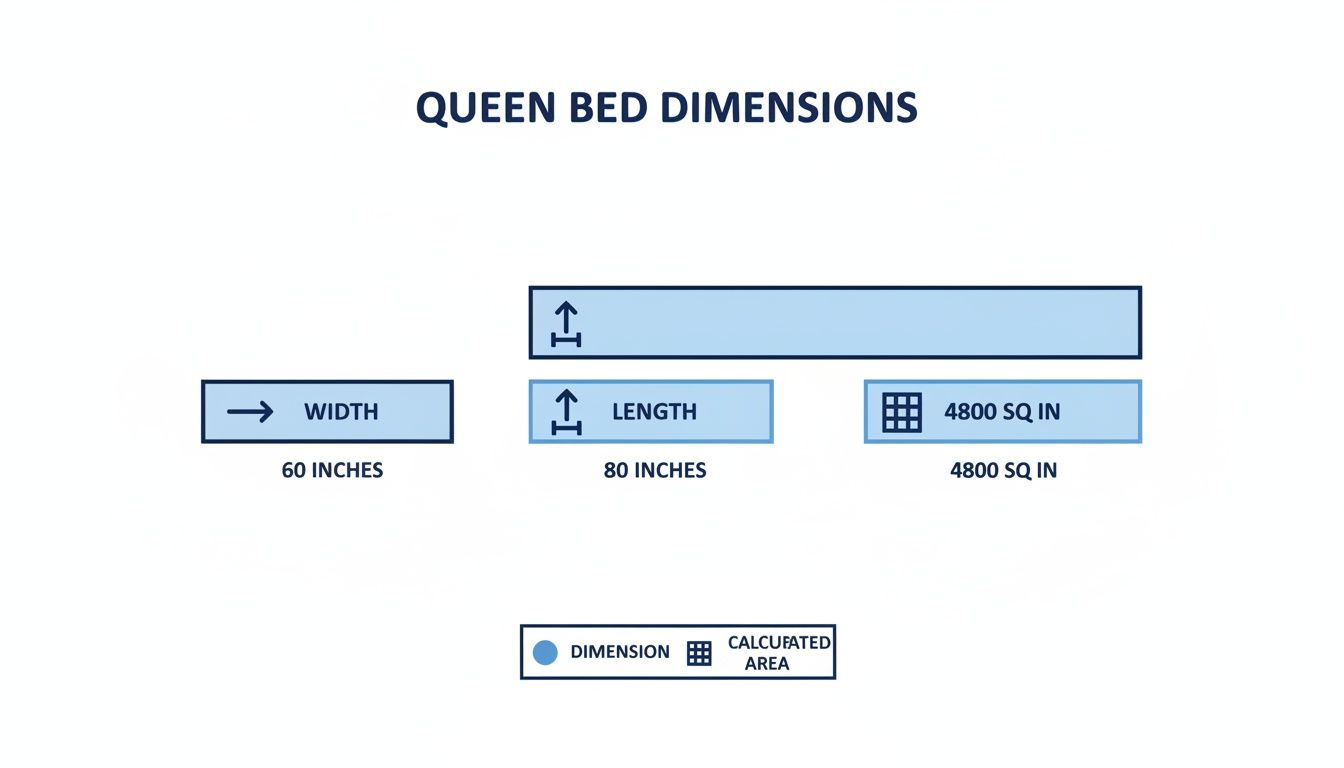
    A queen sounds simple until you start translating the label into real life. The mattress itself has a standard size of 60 inches by 80 inches, and that measurement is the starting point for nearly everything else you shop for, from sheet sets to mattress protectors to many frame options.

    According to DreamCloud's queen bed dimensions guide, a standard queen-size bed measures 60 inches wide by 80 inches long, which equals 4,800 square inches, or about 33 square feet, of sleeping surface.

    An infographic detailing the dimensions of a standard queen mattress, highlighting its width, length, and benefits.

    That 60 by 80 measurement refers only to the sleeping surface. It does not include the bed frame, headboard, footboard, or the walking room you need around it. Shoppers often miss that distinction and assume a queen bed and a queen mattress take up the same amount of space. They do not.

    What 60 x 80 actually feels like

    For one adult, a queen usually feels roomy. There is enough width to turn, stretch, or stack a few extra pillows without feeling pinned to the edge.

    For two adults, the experience changes. As noted in Dimensions.com's queen bed reference, two sleepers on a queen are effectively sharing the width, with about 30 inches per person. That helps explain why a queen works well for many couples but does not feel spacious to every couple. If one person sleeps spread out, changes position often, or shares the bed with a child or pet, those 60 inches can fill up fast.

    A good everyday comparison is this: a queen gives many couples enough room to sleep. It does not always give them enough room to sleep the way they prefer.

    Why queen became the standard choice

    Queen size remains popular because it sits in a practical middle spot. It offers a noticeable step up from a full for shared sleeping, but it still fits more homes than a king.

    It also makes shopping easier. Because the standard queen mattress size is widely used, manufacturers build a huge range of compatible products around that footprint. That is helpful later, too. If you replace your frame, buy a new protector, or grab extra sheets for guests, you are shopping within one of the most common size categories in the market.

    That consistency matters more than it sounds. A standard size saves you from the kind of mismatch that happens when a fitted sheet corners poorly or a foundation runs slightly off from the mattress.

    Queen vs. full, in plain English

    The difference between a queen and a full is easy to underestimate on paper. A full can work well for one sleeper, but couples often notice the tighter width pretty quickly. The queen gives extra room side to side and a little more length, which helps taller sleepers and anyone who does not like feeling shoulder-to-shoulder all night.

    This is why many shoppers land on queen before they ever start comparing frame styles or room layouts. The mattress size itself solves a common problem. It gives more sleeping room without jumping straight to the largest option.

    The key is to treat 60 x 80 inches as the baseline, not the whole story. The mattress tells you how much space you sleep on. The full bed setup, your bedding, and even your delivery path decide whether a queen works comfortably in your home.

    Beyond the Mattress Bed Frames and Foundations

    A queen mattress gives you the sleep surface. The bed you bring home takes up more space than that.

    That gap catches shoppers all the time. A couple measures for a queen, finds a frame they love, and then runs into the physical bed frame: thicker side rails, a broad headboard, a footboard that pushes farther into the room, or drawers that need space to open. The mattress size stayed the same. The footprint did not.

    The frame is usually larger than the mattress

    A standard queen mattress is the baseline. The assembled bed is usually wider and longer.

    According to Nilkamal Sleep's queen size bed dimension guide, a typical queen bed frame ranges from about 62 to 65 inches wide and 82 to 86 inches long.

    A few inches may not sound like much on paper. In a bedroom, those inches behave like the difference between a suitcase that slides into an overhead bin and one that will not quite go. They affect how the room works every day.

    Those extra inches often decide whether:

    • A nightstand fits comfortably beside the bed
    • A dresser drawer opens fully near the foot of the bed
    • You can walk around the bed normally instead of turning sideways

    If your room is on the smaller side, shop by the full frame dimensions for the exact model, not by mattress size alone.

    Different frame styles use space in different ways

    Two queen beds can hold the same mattress and still live very differently in a room.

    A platform bed usually has a simpler profile and can make a room feel less crowded. A panel bed often adds more visible structure through the headboard, rails, and footboard. Storage beds help with organization, but they also ask more from the room because drawers need clearance to open. Sleigh beds and heavier statement frames can feel larger both physically and visually.

    That last part matters more than many shoppers expect. A bed can fit by the tape measure and still feel too bulky once it is in place.

    If you are comparing two queen beds, compare the full outside dimensions and how the bed functions, not just the mattress size listed on the tag.

    Foundations change height and setup

    The support under the mattress matters too.

    Some queen beds use slats or a platform, so the mattress sits right on the frame. Others need a foundation or box spring. That choice changes the finished height of the bed, how easy it is to climb into, whether your headboard looks proportionate, and how substantial the whole setup feels in the room.

    It also affects delivery and assembly. A low-profile platform bed may be easier to handle in a tight stairwell than a bulky foundation plus frame combination. In our Georgia stores, this is one of the questions families ask after they have checked bedroom size: not just "Will it fit in the room?" but "Can we get every piece into the room?"

    What to measure before you fall in love with a frame

    Before you shop, write down:

    1. Open floor width
    2. Open floor length
    3. Door swings, closet doors, windows, and nearby drawer paths
    4. Stair turns, hallway width, and tight entry points if the bed is going upstairs

    That last item gets missed all the time. A queen mattress can bend some during delivery. A rigid headboard, foundation, or long side rail cannot.

    If you are comparing options online or in the showroom, check the assembled bed dimensions and the size of the largest individual pieces if that information is available. Then compare those notes against your room and your delivery path, not the mattress tag. That small habit prevents a lot of expensive frustration.

    Planning Your Bedroom Layout and Clearance

    A queen can fit in a room and still be the wrong choice for the layout. That's the part many people only discover after delivery, when the bed is in place and the room suddenly feels hard to use.

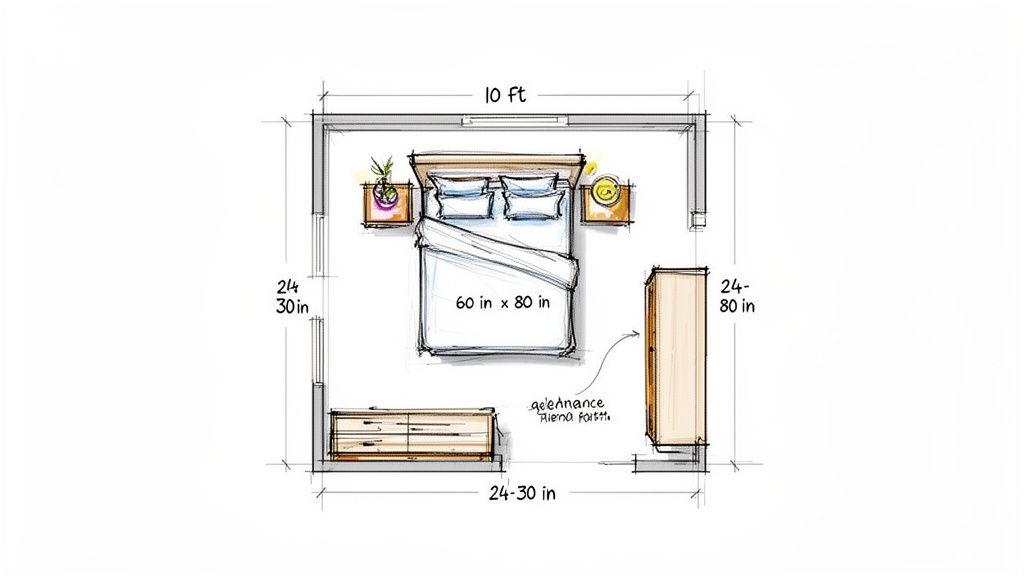
    For everyday comfort, bedroom planning guides commonly recommend a minimum room size of 10 x 10 feet for a queen, with at least 24 to 27 inches of walking clearance on both sides and at the foot. For a more open layout, a 10 x 11-foot room with about 36 inches of clearance is often suggested, according to Max & Lily's queen bed frame sizing guide.

    A simple layout visual helps more than a page of measurements.

    What clearance actually does for you

    Walking space isn't just about appearance. It affects how the room works every day.

    If the bed is too close to the wall or another piece of furniture, simple tasks become annoying fast. You may struggle to make the bed, open drawers, reach outlets, or get in and out without brushing the frame. That's why even a correctly sized queen can feel wrong in the room.

    Think about clearance in terms of use:

    • Side clearance gives you room to enter and exit the bed comfortably.
    • Foot clearance helps with traffic flow and keeps the room from feeling blocked.
    • Furniture clearance determines whether dressers, closet doors, and nightstands still function as intended.

    A room shouldn't only hold the bed. It should still let you live around the bed.

    Here's a video that can help you think through bedroom flow and spacing before you move furniture:

    A simple way to test the room before buying

    Use painter's tape on the floor. Mark out the installed bed footprint, not just the mattress. Then walk the room like you normally would.

    Open the closet. Stand where a nightstand would go. Pretend to pull out dresser drawers. If the taped outline already feels intrusive, the actual bed will feel even larger once bedding, pillows, and daily use enter the picture.

    A quick floor test is especially helpful in:

    • Apartments
    • Guest rooms
    • Smaller primary bedrooms
    • Rooms with angled walls or multiple doors

    Common layout mistakes with queen beds

    A few issues come up again and again:

    Layout problem Why it happens What to do
    Bed fits but room feels cramped Shopper measured mattress, not frame and clearance Measure the full bed footprint and walk space
    Nightstands look squeezed Bed width plus table width overwhelms the wall Use slimmer nightstands or reconsider frame bulk
    Dresser drawers hit the bed Foot clearance was too tight Recheck drawer swing and circulation path
    Room feels closed in Bed is technically appropriate, visually too heavy Choose a simpler frame profile

    Comfort on paper versus comfort in real life

    A room can meet the minimum and still not match your habits. If you like a spacious feel, need storage furniture, or share the room with a partner on a different schedule, more clearance usually makes the space easier to live with.

    That's why “Can a queen fit?” isn't the only question worth asking. A better one is, “Can I move around this room without thinking about the bed every five minutes?”

    Queen Bed Variants and Special Considerations

    When seeking queen size bed dimension information, the reference is typically to a standard queen. But once you start comparing options, you may run into names that sound similar and behave very differently.

    That's where mistakes happen. A shopper orders sheets too quickly, assumes all queen frames are interchangeable, or chooses a mattress setup that changes the room more than expected.

    Comparing standard and non-standard queen options

    The standard queen is still the baseline, but there are a few related sizes worth knowing.

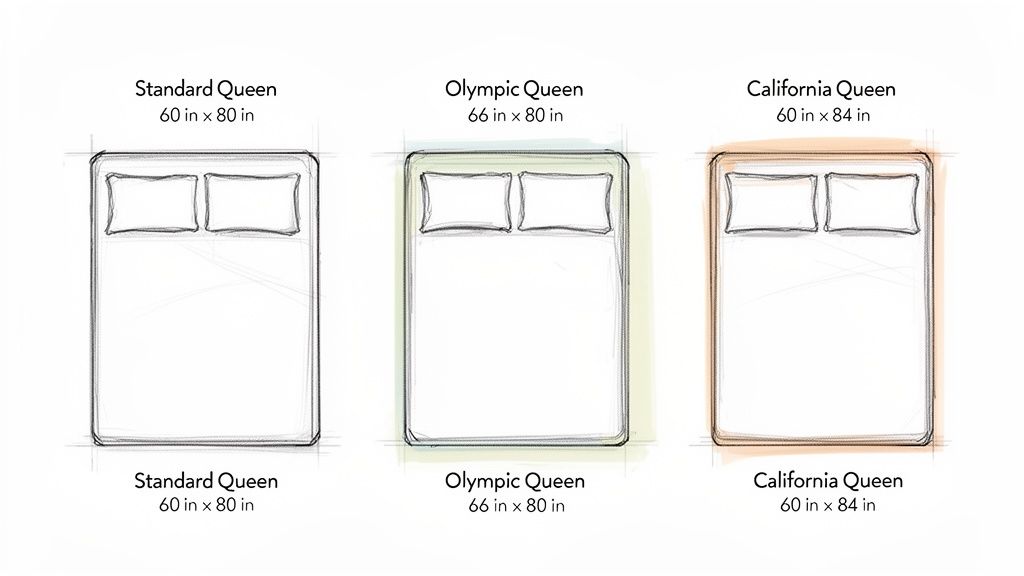
    A comparison chart showing dimensions and key benefits for standard, olympic, and california queen size beds.

    Size Name Width (inches) Length (inches) Primary Use Case
    Standard Queen 60 80 Everyday choice for single adults or many couples
    Olympic Queen 66 80 Extra width without moving to a king
    California Queen 60 84 Extra length for taller sleepers

    A standard queen gives each sleeper about 30 inches of width, while a king gives about 38 inches per person, according to Mattress Firm's full vs. queen comparison. That difference is one reason some couples who share the bed with children or pets decide a wider bed improves comfort.

    When a standard queen may not feel big enough

    A queen can work very well for two adults. It can also feel crowded depending on sleep habits.

    A few signs you may need to look beyond standard queen:

    • One or both sleepers sprawl and regularly drift toward the edge
    • A child or pet joins the bed often enough that personal space disappears
    • You wake each other when changing positions
    • You like a “buffer zone” between sleepers rather than shoulder-to-shoulder sleep

    Some couples don't need more bed. They need more width. That's an important distinction.

    An Olympic Queen can appeal to shoppers who want more width but aren't ready for the footprint jump of a king. A California Queen can make sense if height is the issue and width isn't.

    Extra-thick mattresses change the feel of the room

    Even when the width and length stay standard, mattress depth changes the overall look and use of the bed. A thicker mattress can make the bed sit higher, feel more substantial, and require more attention when shopping for sheets or choosing a headboard proportion.

    This matters in smaller bedrooms because a taller, bulkier sleep setup can read visually heavier. It may still fit, but it can make the room feel more crowded than a lower-profile setup.

    It also affects daily use. If the bed sits high once the mattress and foundation are combined, some sleepers love the taller look while others find it awkward getting in and out.

    Adjustable bases need compatibility checks

    Adjustable bases introduce another layer of planning. The mattress has to work with the base, and the bed frame has to accommodate that setup if you want the adjustable unit inside a decorative bed.

    That doesn't mean adjustable options are hard to shop. It just means shoppers should confirm compatibility before ordering a headboard, footboard, or storage bed based on appearance alone.

    Questions worth asking before buying:

    1. Will the mattress work on an adjustable base?
    2. Will the bed frame accept the base inside it?
    3. Will the final height still feel comfortable?
    4. Will bedding stay practical once the head or foot is raised?

    Those aren't glamorous questions, but they prevent a lot of returns and a lot of disappointment.

    Choosing the Right Size Bedding and Accessories

    Buying the bed is one job. Dressing it correctly is another.

    People often assume “queen is queen” and toss a set of sheets in the cart. Sometimes that works. Sometimes the fitted sheet pops loose every corner, the comforter barely covers the sides, and the whole bed looks off even though the mattress size is correct.

    Start with fitted sheets, not comforters

    The first thing to match is the fitted sheet. The label should match the mattress size, but that still isn't enough by itself. The sheet also has to suit the mattress depth.

    If the pockets are too shallow, the corners pull up. If they're too loose, the fabric bunches and shifts. Neither feels good.

    When shoppers have trouble with sheets, it usually comes down to one of these:

    • The mattress is thicker than expected, especially after adding a protector or topper
    • The fitted sheet pocket is too shallow
    • The sheet fabric loosens with use, making a borderline fit worse over time

    Measure the mattress height at home before replacing linens. Don't guess based on what the bed “looks like” from the side.

    Think about drape and proportion

    Comforters, duvets, and coverlets aren't only about whether they technically fit. They change the way the bed sits in the room.

    A bed can look skimpy if the top layer barely drops over the sides. It can also look overloaded if the bedding is too bulky for the room and frame style. That's especially noticeable in smaller bedrooms where the bed already dominates the visual space.

    A cleaner look usually comes from balancing three things:

    Bedding item What to check Why it matters
    Fitted sheet Size and pocket depth Keeps corners secure and smooth
    Flat sheet Overall scale on the bed Affects tuck and overhang
    Comforter or duvet Side drop and visual bulk Changes how full or tailored the bed looks
    Mattress protector Depth and flexibility Can affect sheet fit more than expected

    Bedding problems often look like size problems, but they're really depth and proportion problems.

    Pillow choices matter more than shoppers expect

    Pillows also affect how a queen bed reads visually. Too many oversized pillows can swallow the width of the bed. Too few can make it look unfinished.

    If you want the bed to feel balanced, bring your pillow plan into the decision early. That's especially true if you like a layered look with sleeping pillows, shams, and decorative pillows.

    A few common-sense questions help:

    • Are you trying to create a specific hotel-style look or a casual everyday setup?
    • Do you want the bed easy to make every morning, or are you comfortable styling multiple layers?
    • Will the bed be used daily, occasionally for guests, or in a shared primary bedroom?

    Accessory shopping goes easier when you slow down

    This is one of those areas where buying everything in one fast click can backfire. Mattress protectors, toppers, fitted sheets, and duvets all interact. One extra layer can change how the next layer fits.

    If you're unsure, bring the mattress specs with you or take a quick photo of the law tag and product label. That gives a store associate enough information to help you narrow the right sheet depth and accessory sizing without guesswork.

    Will It Fit Through the Door A Delivery Checklist

    A queen that fits the bedroom still has to make it to the bedroom.

    This is the step people skip because it feels obvious until it isn't. Hallways narrow. stair landings turn tighter than expected. Headboards are rigid. Foundations don't flex much. And the path from truck to room is often harder than the room layout itself.

    Measure the path, not just the destination

    Before delivery day, walk the entire route from the outside entry to the final room.

    Check each of these points:

    • Doorways. Measure width and height.
    • Hallways. Look at narrow stretches and sharp turns.
    • Stairwells. Pay attention to ceiling height, railing pinch points, and the landing at the turn.
    • Elevators, if applicable. Cab depth and door opening both matter.
    • Room entry. Bedroom doors can be tighter than front doors.

    This visual checklist is a good reminder before the truck arrives.

    A delivery day checklist illustrating steps to measure pathways and ensure a queen bed fits your home.

    What usually causes delivery trouble

    The mattress itself may have some flexibility, depending on construction and packaging. The rigid pieces are usually the issue.

    Watch closely for:

    1. Headboards with wide wings or heavy side panels
    2. Foundations or bases that don't bend
    3. Tight stair turns at the top or bottom landing
    4. Low overhead clearance above stairs
    5. Older homes with narrow interior doors

    If you're dealing with a difficult route, it helps to review a practical guide on handling difficult mattress moves from Emmanuel Transport. It's useful for understanding how movers think about angles, obstacles, and protecting the mattress during tight moves.

    The hardest part of bed delivery usually isn't the bedroom. It's the turn before the bedroom.

    A simple pre-delivery routine

    You don't need special tools. A tape measure, your phone camera, and a few notes are usually enough.

    Do this before delivery:

    • Measure every opening on the route and write it down.
    • Photograph stair turns and hall corners so you can review them clearly.
    • Remove obstacles early such as rugs, wall art, small tables, or fragile lamps.
    • Know which pieces come assembled and which will be assembled in the room.
    • Ask questions ahead of time if your home has unusual access points.

    This is also where professional delivery and setup can earn their keep. Experienced crews usually know what to look for, how to protect walls and furniture, and when a tight path needs a different approach than a straight carry.

    Don't forget the old bed coming out

    One last point that catches people off guard: if the new bed has to go in, the old one usually has to come out first.

    That means you should think about the reverse path too. If the existing foundation barely made it upstairs years ago, replacing it may involve the same set of obstacles all over again.

    Take a few extra minutes before delivery day and you'll avoid the most common surprises.


    If you'd like help comparing queen mattresses, bed frames, and room-fit options in person, Woodstock Furniture & Mattress Outlet is a practical place to start. Their team can help you look at queen-size setups, think through frame dimensions, and plan for delivery and layout in a way that matches how your room works.

  • A Complete Guide to the Dimensions of a Queen Size Bed

    A Complete Guide to the Dimensions of a Queen Size Bed

    If you've ever found yourself asking "just how big is a queen bed?", you're not alone. The standard queen size bed measures 60 inches wide by 80 inches long, which works out to roughly 152 cm x 203 cm. These dimensions have made it an extremely popular mattress size across the United States, and for good reason—it offers a practical balance of space for couples without demanding a massive bedroom.

    A Measurement Breakdown of the Standard Queen

    The queen bed's popularity is no accident; it hit a sweet spot for modern homes. It rose to prominence in the 1950s, becoming a new standard for American couples who needed an upgrade from the traditional full bed. At just 54 inches wide, a full bed left each person with less sleeping space than a baby gets in a crib.

    To really understand how these numbers translate to your own space, it helps to break them down.

    Queen Bed Dimensions at a Glance

    This quick-reference table lays out the essential measurements for a standard queen mattress and the typical footprint it will have once you add a basic bed frame.

    Measurement Inches (in) Centimeters (cm)
    Standard Mattress Width 60" 152 cm
    Standard Mattress Length 80" 203 cm
    Typical Width with Frame 62" – 65" 157 – 165 cm
    Typical Length with Frame 82" – 85" 208 – 216 cm
    Recommended Room Size 120" x 120" (10' x 10') 305 x 305 cm

    Keep in mind that these figures can vary based on international standards. If you're shopping for bedding outside the US, a resource like this bedding size chart Australia can be helpful for comparing different regional sizes.

    Understanding Queen Bed Size Variations

    While the standard queen mattress is by far the most common choice, you might learn that it’s not the only "queen" available. Several variations exist, each designed to solve a specific problem—like adding a bit more legroom for taller sleepers or giving couples just a little extra space to spread out. Knowing these alternatives is key to making sure you land on the right fit.

    The tricky part is that not all beds labeled "queen" share the exact same measurements. This can cause a real headache when you're buying bedding or trying to map out your room. Before you commit, it’s always a good idea to double-check the exact dimensions. A quick confirmation can save you the frustration of wrestling with a fitted sheet that won't cooperate or discovering your new bed is shorter than you thought.

    The standard queen's measurements provide the baseline for all its variations.

    Diagram illustrating queen bed dimensions: 60 inches in width and 80 inches in length.

    These familiar 60-inch by 80-inch dimensions are the starting point, but let’s dive into how they get modified.

    Comparing Queen Bed Size Variations

    To help you get a clear picture of what's out there, we've put together a quick comparison of the most common queen mattress variations. Each one serves a different purpose, so take a look to see which might be the right solution for your bedroom.

    Queen Type Dimensions (in) Ideal for
    Standard Queen 60" x 80" The go-to for most couples, single adults, and guest rooms.
    California Queen 60" x 84" Taller individuals who need more legroom but don't have space for a wider bed.
    Olympic Queen 66" x 80" Couples who crave a bit more personal space than a standard queen offers.
    Split Queen Two 30" x 80" Couples with adjustable bed bases who want individual comfort settings.

    As you can see, the differences are subtle but significant. A few extra inches can make a world of difference in your comfort and how well the bed fits your space.

    Common Queen Mattress Variations

    Let's break down these non-standard sizes a bit more. Here’s a closer look at what each one offers and who it's built for.

    • California Queen: Measuring 60 inches wide by 84 inches long, this mattress tacks on four extra inches of length. It's a useful solution for taller folks whose feet tend to dangle off a standard queen but who don't have the bedroom width for a king.

    • Olympic Queen (or Expanded Queen): At 66 inches wide by 80 inches long, this option gives you an extra six inches of width. That additional space can be a great benefit for couples who find a standard queen a little too cozy but aren't ready to commit to the full 76-inch width of a king.

    • Split Queen: A split queen isn't one mattress but two, each measuring 30 inches wide by 80 inches long. This setup is almost exclusively paired with adjustable bed bases. It allows each partner to independently raise or lower their side's head and foot, offering personalized comfort without needing a king-size frame.

    How Bed Frames Impact Total Space Requirements

    So, you've got the standard queen mattress dimensions down. That's a great start, but the mattress itself is only part of the story. It's a common oversight to measure your room for the mattress and completely forget about the frame. The bed frame you choose can significantly alter the total footprint of your new bed, a detail that’s critical for proper planning.

    Diagram illustrating bed frame dimensions, including a 60x80 inch mattress, metal, and sleigh frame.

    A simple metal frame or a sleek, low-profile platform bed might only add one to three inches to the total width and length. On the other hand, more substantial styles with large headboards or decorative footboards can add much more.

    Accounting for Different Frame Styles

    Think of your bed frame as a piece of furniture with its own dimensions, not just a support system for the mattress. The design directly influences how much floor space it will occupy. To avoid any unwelcome surprises, it helps to know the typical allowances for different styles.

    Here’s a general guide to how much extra space you should plan for:

    • Simple Metal Frames: These are your most space-efficient option. They typically add only 1-2 inches to the total length and width.
    • Platform Beds: This really depends on the design. Some are nearly flush with the mattress, while others feature a wide lip that can add anywhere from 2-5 inches all the way around.
    • Upholstered Frames with Headboards: A plush, padded headboard and footboard can add considerable bulk. You'll often need an extra 5-10 inches in length for these.
    • Sleigh Beds: Known for their large, curved headboards and footboards, sleigh beds are among the most space-intensive. They can easily add 8-12 inches (or even more) to the bed's total length.

    Always check the final dimensions of the bed frame itself—width, length, and headboard height—before you purchase. This is the true footprint your bed will have in the room, and getting it wrong is an oversight you want to avoid.

    Planning Your Bedroom Layout for a Queen Bed

    Figuring out your bedroom layout is about more than just making sure the furniture fits. It’s what turns a room with a bed in it into a functional, relaxing retreat. The dimensions of your queen mattress are your starting point, but how you place it in the room dictates the entire flow and feel. Getting this right is key to creating a space that’s both pleasant and easy to live in.

    Detailed bedroom floor plan illustrating ideal clearances for a queen size bed.

    As a general rule of thumb, a queen bed works well in a room that's at least 10 feet by 10 feet. This provides enough room for the bed and a basic walkway. However, a slightly larger room—something like 10 by 12 feet—is often more comfortable, especially if you want to add a dresser or an armchair without things feeling cramped.

    Creating Comfortable Pathways

    The secret to a layout that works is leaving enough open floor space. Aim for at least 30 to 36 inches of clearance on two or three sides of the bed. This is important for the main pathways you use every day, like getting to the closet or just getting in and out of bed.

    • Main Walkway: The path from the door to the other side of the room should be clear and wide. 36 inches is ideal.
    • Bedside Space: Leaving 30 inches on both sides of the bed gives you ample room for nightstands and allows two people to move around without bumping into each other.
    • Foot of the Bed: If you have a path at the foot of your bed, make sure you keep at least 30 inches clear. Anything less can make the whole room feel tight.

    For a deeper dive into arranging your furniture, understanding how to plan a room layout is a huge help in getting the placement of your queen bed just right.

    Your bed should be the focal point of the bedroom. A good spot is usually against the longest, uninterrupted wall, ideally opposite the door. This often creates an immediate sense of balance and calm the moment you walk in.

    A Practical Checklist for Measuring Your Space

    Before you select a new queen bed, it's crucial to take a few precise measurements. This is one of the most important steps in the entire process. It’s a simple way to avoid headaches later on.

    This quick checklist can help remove the guesswork, making sure the bed you choose not only fits your bedroom but can also make it through the front door. Just grab a tape measure and a notepad, and you'll be ready to shop with more confidence.

    First, The Bedroom

    Let's start where the bed will actually live. A quick sketch of the room can be a huge help here.

    • Measure Room Dimensions: Jot down the exact length and width of the bedroom. This gives you the total square footage you have to play with.
    • Note Obstructions: Take a moment to mark the locations of windows, doors (and the direction they swing open!), closets, and even electrical outlets. This will make it much easier to decide which wall is best for your headboard.
    • Check Ceiling Height: Are you considering a dramatic, tall headboard or a canopy bed? If so, measure the height from the floor to the ceiling to make sure you have enough clearance.

    Next, The Delivery Path

    This next part is key. Don't forget about the journey your new bed has to take to get to the bedroom. A bed that fits the room but gets stuck in the hallway is a common and frustrating problem.

    • Doorways: Measure both the width and height of every doorway on the path from your front door to the bedroom.
    • Hallways: Check the width of your hallways, paying special attention to any tight corners or turns.
    • Stairwells: If stairs are involved, measure their width and keep an eye out for any low-hanging light fixtures or sloped ceilings that could get in the way.

    Still Have Questions About Queen Bed Dimensions?

    To wrap things up, let's go over a few of the most frequent questions shoppers have when they're trying to figure out queen bed dimensions. These quick answers should clear up any confusion and help you decide if a queen is the right call for your space.

    How Much Bigger Is a King Bed Than a Queen Bed?

    A standard king bed is significantly wider than a queen, giving you an extra 16 inches of space. While they share the same 80-inch length, a king measures 76 inches wide compared to the queen’s 60 inches.

    That extra width means each person gets the same amount of sleeping space as if they were on their own Twin XL mattress. It's a great upgrade for couples who value their personal space at night.

    Can Queen Sheets Fit on a Full Mattress?

    It might seem like they'd be close enough, but putting queen sheets on a full (or double) mattress is often a recipe for frustration. A full mattress is 6 inches narrower and 5 inches shorter than a queen.

    A queen fitted sheet will be baggy and loose, leading to bunched-up, uncomfortable fabric that will not stay put through the night. It's always a good practice to get sheets that match your mattress size.

    For a comfortable and functional bedroom layout, a minimum room size of 10 feet by 10 feet is generally recommended for a standard queen bed.

    What Is the Minimum Room Size for a Queen Bed?

    A 10-foot by 10-foot room is about the smallest space that can comfortably accommodate a queen bed while still leaving you enough room to walk around.

    However, if you're planning on adding furniture like a dresser and a pair of nightstands, or if you have your eye on a bulkier bed frame, you'll be much happier with a room that's at least 10 feet by 12 feet. That little bit of extra space makes a world of difference.


    Finding the right mattress is about more than just the numbers; it’s about discovering the perfect fit for your home, your lifestyle, and your comfort. The experienced team at Woodstock Furniture & Mattress Outlet can help you explore all the options in person. We're here to answer your questions and help you feel confident in your choice.

    Feel free to visit any of our North Georgia showrooms to learn more. You can find a Woodstock Furniture & Mattress Outlet location near you on our website.

  • How to Arrange Bedroom Furniture for a Functional Layout

    How to Arrange Bedroom Furniture for a Functional Layout

    Arranging your bedroom furniture is about more than just making it look nice. It’s about creating a space that actually works—a place that feels functional, promotes restful sleep, and serves as your personal sanctuary. A good approach is to start with your bed as the focal point, make sure you can walk around easily, and then logically place everything else around it.

    Your Blueprint for a Better Bedroom Starts Here

    Ever feel like your bedroom is just a little bit… off? Maybe it’s cluttered, awkward to move around in, or just doesn't feel relaxing. A simple plan can change all that. The way you arrange your furniture has a huge impact on how a room feels, and can make it seem larger, more organized, and more calming. We're going to walk through the practical steps to rethink your layout, focusing on function and flow first.

    This isn’t about chasing the latest design trend; it's about making your room work for your real, everyday life. A well-arranged bedroom just makes things easier, from getting ready in the morning to winding down at night.

    The Impact of a Thoughtful Layout

    Getting your furniture placement right can solve a bunch of common frustrations you might not even realize are layout-related. Here’s what you stand to gain:

    • Better Traffic Flow: Creating clear, open paths from the door to the closet and around the bed means no more awkward shuffling or bumping into things.
    • A Bigger Feel: Even a small room can feel surprisingly open and airy when furniture isn't blocking walkways or crammed against every wall.
    • Improved Functionality: This is key. A good layout ensures drawers can open all the way, your nightstand is actually within reach, and every piece of furniture can do its job without getting in the way.
    • A More Relaxing Vibe: Cutting down on both physical and visual clutter is a game-changer for creating a peaceful atmosphere where you can actually relax and get better sleep.

    A well-planned bedroom layout is foundational. It’s much easier to move furniture on paper or in a digital planner than to physically shuffle heavy dressers and bed frames multiple times.

    Before we dive into the nitty-gritty of placement, let's nail down the core concepts. Think of these as the fundamental principles for any bedroom layout.

    | Core Principles of Bedroom Furniture Arrangement |
    | :— | :— | :— |
    | Arrangement Principle | Key Action | Why It Matters |
    | Bed as the Anchor | Position the bed first, ideally on the main wall opposite the door. | This establishes a clear focal point and naturally organizes the rest of the room's flow. |
    | Clear the Pathways | Leave at least 30-36 inches for main walkways. | Ensures you can move freely without feeling cramped or bumping into furniture. |
    | Scale and Proportion | Choose furniture that fits the room's size—avoid oversized pieces in small rooms. | Properly scaled furniture prevents a room from feeling cluttered and overwhelming. |
    | Functional Placement | Place items like dressers and nightstands where they are most useful. | Easy access to daily essentials simplifies routines and reduces clutter. |
    | Create Zones | If space allows, group furniture to create distinct areas (e.g., a sleeping zone, a reading nook). | This adds function and makes the room feel more intentional and organized. |

    Getting these basics right will set you up for success as you start placing individual pieces.

    Why Getting This Right Matters

    The push for functional, beautiful bedrooms isn't just a trend; it's a reflection of how much we're all investing in our home comfort these days. The global bedroom furniture market is large for a reason—people want smart arrangements. Industry experts often recommend treating the bed as the room's anchor. Placing it against the longest wall or opposite the entrance is a classic strategy that makes any room feel more spacious.

    Once the bed is set, you can bring in the supporting cast. Nightstands should be roughly the same height as your mattress for easy access. After that, position your dresser to create balance, but be sure to leave at least 36 inches for your main walkways. This single rule is crucial for avoiding that cramped, hard-to-navigate feeling. If you're curious about the bigger picture, you can find more on furniture industry trends in reports from sources like Custom Market Insights.

    Laying the Groundwork by Measuring Your Space

    I know it’s tempting to just start shoving furniture around to see what fits. But trust me, that approach almost always ends in frustration—scuffed walls, a bed that won’t quite clear the doorway, or a dresser that unexpectedly blocks an outlet you desperately need.

    The single most important step in arranging your bedroom furniture is to start with a solid plan. Before you even think about lifting anything heavy, grab your tape measure. Creating a simple floor plan saves you a ton of time, a sore back, and prevents those layout mistakes that drive you crazy later. It turns guesswork into intentional design.

    Taking Accurate Bedroom Measurements

    First things first, let's get the raw numbers. Don't just eyeball it; being precise here will pay off big time. Jot these down on a piece of paper or in a notes app on your phone.

    • Wall-to-Wall Length and Width: Get the main dimensions of the room to figure out your total square footage. This is your canvas.
    • Window and Door Placements: Measure the width of every window and door. Here's a pro tip: also measure the distance from the corners of the room to the edges of their frames. This tells you exactly how much solid wall space you have to work with.
    • Architectural Features: Don’t forget to account for any fixed elements. This means radiators, built-in shelving, fireplaces, or any odd bump-outs that eat into your usable floor space.
    • Ceiling Height: While this doesn't directly impact your floor plan, knowing your ceiling height is critical when you're looking at furniture with any kind of vertical presence, like a tall headboard or a statement armoire.

    Once you have these numbers, you can sketch out a quick, to-scale drawing on graph paper. A good rule of thumb is to let each square represent six inches or one foot. Suddenly, you can see your space in a whole new way.

    Translating Measurements into a Functional Plan

    With your room’s blueprint in hand, it's time to measure your furniture. Get the length, width, and height of every single piece you plan to use—your bed, dresser, nightstands, and any seating or desks.

    Now for the fun part. Grab another piece of paper and create small cutouts for each piece of furniture using the same scale as your room sketch. You can now move your "furniture" all over your floor plan without breaking a sweat.

    This simple exercise helps you answer critical questions ahead of time:

    • Will my dresser drawers actually be able to open all the way without banging into the bed?
    • Is there enough room to comfortably walk between the foot of the bed and the wall? You should really aim for at least 30 inches for main pathways.
    • Does that perfect spot for the nightstand end up blocking the closet door?

    Planning isn't just about making furniture fit; it's about designing a room that truly works for you. By mapping everything out first, you ensure the final layout is both practical and peaceful.

    Ultimately, a solid plan is about more than just measurements. For instance, if you want to learn how to decorate a baby room, mapping out the design is a key step to a stress-free project. The same principle applies to any room refresh, guaranteeing a better outcome when you think about function from the very beginning.

    Placing Your Bed as the Anchor of the Room

    Now that you've got your room’s measurements, it's time to tackle the most important piece of furniture you own: your bed. Make no mistake, the bed is the anchor of the bedroom. Its position dictates not just the flow and feel of your space, but where every other item will logically fit. Getting this one decision right sets the stage for a layout that feels intentional and effortless.

    The most common advice you'll hear—and for good reason—is to place your bed against the longest, uninterrupted wall. Ideally, this is the wall you see first when you walk into the room, creating an immediate and calming focal point. Designers call this the "commanding position," and it establishes a sense of order that makes the room feel balanced from the moment you enter.

    Finding the Best Wall for Your Bed

    While putting the bed opposite the door is a classic rule, not every room cooperates. You might be dealing with windows, closets, or awkwardly placed doors that make this setup feel impossible. Don't worry, there are plenty of excellent alternatives that work just as well.

    Consider these options when you're figuring out where the bed should go:

    • Under a Window: This can look beautiful, especially with an attractive headboard that complements the window frame. The trick is to choose a headboard that's lower than the windowsill so you don't block that precious natural light. You'll also want to invest in good window treatments for privacy and to keep the morning sun from waking you up too early.
    • On a Diagonal: If you want a more dynamic, unconventional feel in a square-shaped room, angling your bed out from a corner can be a great move. It really breaks up the boxy feel, but it does take up more floor space. This is best suited for larger bedrooms where you won't feel cramped.
    • Between Two Windows: Got a wall with two windows? Placing the bed between them creates a gorgeous, symmetrical look. It frames the bed perfectly and turns that entire wall into an impressive feature.

    The goal is to find a spot that feels natural and gives you a clear view of the doorway from your bed. There's an instinctual comfort in being able to see who is entering the room without being directly in the line of sight from the hallway.

    Matching Bed Size to Room Scale

    The size of your bed plays a huge role in how the room feels. A massive king bed can completely overwhelm a small room, while a twin might feel lost in a large primary suite. Scale is everything.

    • For King & California King Beds: These require a substantial wall to anchor them properly. In a primary suite, placing a king bed on the main wall opposite the entrance creates that grand, hotel-like feel and leaves plenty of space on either side for sizable nightstands.
    • For Queen & Full Beds: These are the versatile workhorses of the bedroom world and fit well in most average-sized rooms. A queen bed still has enough presence to be a focal point without eating up all the floor space, leaving room for a dresser or even a small seating area.
    • For Twin Beds: In a smaller guest room or a child's room, pushing a twin bed against a wall or into a corner is a classic space-saving trick. This opens up the center of the room, making it feel larger and providing more floor area for play or other furniture.

    Believe it or not, studies show that a poor furniture arrangement can waste up to 40% of a room's usable space. One simple principle to reclaim that space is creating "traffic triangles" by arranging the bed, dresser, and closet so paths between them are 36 to 42 inches wide. This rule alone can significantly cut down on frustrating navigation issues. And for the growing number of people with a home office nook in the bedroom, tucking a desk beside the bed at a 90-degree angle maintains function without wrecking the room's flow. You can learn more about the trends shaping how we furnish our homes in this bedroom furniture market research.

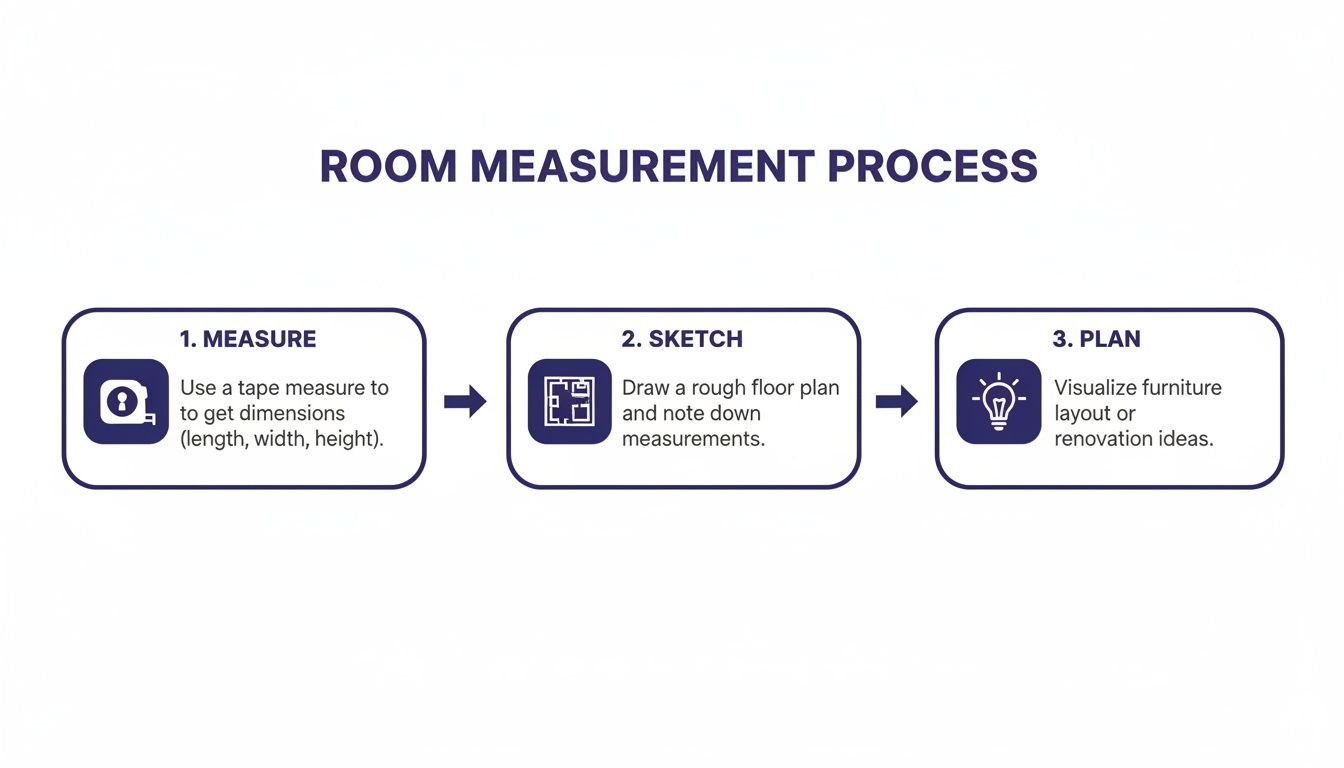
    This simple infographic breaks down the foundational process of measuring and planning your room's layout.

    Infographic illustrating a three-step room measurement process: measure, sketch, and plan for furniture.

    Following these steps—Measure, Sketch, Plan—ensures that your furniture arrangement is based on accurate dimensions, preventing common layout mistakes before they happen.

    Arranging Other Essential Bedroom Furniture

    Once your bed is in the right spot, everything else starts to click into place. Now we can figure out where to put the other key pieces—nightstands, dressers, and maybe some seating—to build a layout that’s balanced and works for you. These pieces are the supporting cast; they complement the bed and make the whole room feel complete.

    The idea isn’t just to cram furniture into empty corners. It’s about being intentional with each piece so your daily flow feels natural, from grabbing your phone in the morning to putting away clean laundry.

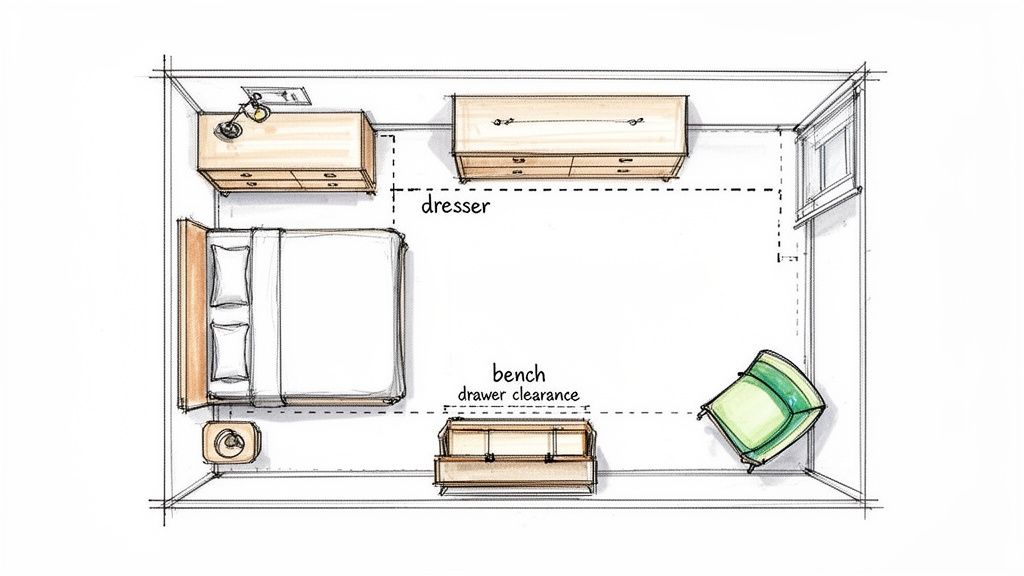
    A top-down sketch of a bedroom layout with a bed, nightstand, dresser, bench, and armchair, including clearance lines.

    Positioning Your Nightstands and Dresser

    Nightstands do more than just hold a lamp; they frame the bed and give you that crucial bedside storage. Here’s a simple but solid guideline: pick nightstands that are about the same height as the top of your mattress. This makes it easy to reach for a glass of water or hit snooze without fumbling around.

    For your dresser or chest of drawers, you’ve got a couple of go-to options:

    • Opposite the Bed: Sticking a long dresser on the wall facing the bed is a classic move that creates a really pleasing sense of symmetry.
    • On the Longest Wall: If the wall opposite your bed has a window or door in the way, your next best bet is the longest uninterrupted wall. This gives you plenty of space without throwing off the room's balance.

    Before you settle on a spot for any storage piece, do this one crucial check: can you open all the drawers and cabinet doors completely? Make sure they don't smack into the bed frame or anything else. Trust me, there’s nothing more annoying than a drawer that only opens halfway.

    Incorporating Seating and Creating Zones

    If you’ve got the room for it, adding a spot to sit can transform your bedroom from just a sleeping space into a real personal retreat. It also helps to create different "zones" for different activities.

    • A Bench at the Foot of the Bed: A bench adds a nice visual finish to the bed, gives you a place to sit while putting on shoes, and is perfect for laying out your outfit for the next day.
    • An Accent Chair in a Corner: An empty corner is the perfect home for a comfy armchair and a small side table. Add a floor lamp, and you’ve instantly carved out a cozy reading nook for when you need to unwind.
    • A Small Loveseat or Settee: For larger primary bedrooms, a small loveseat can anchor a whole separate seating area. It’s the perfect spot for sipping your morning coffee or chatting before turning in for the night.

    No matter what seating you add, the key is making sure it doesn’t block your main walkways. You should always have a clear, easy path from the door to your bed and from the bed to your closet.

    As the North American bedroom furniture market grows, homeowners are getting smarter about layouts that look good and function well. It really boils down to symmetry and scale. For instance, in about 65% of standard 12×14-foot rooms, centering the bed creates that visual harmony we all crave. Just be sure to leave at least two to three feet of clearance around it. One clever trick we've seen is putting wardrobes or dressers on the shorter walls—it can actually make the floor space feel bigger. For a deeper dive into these trends, check out the latest industry analysis from Grand View Research.

    Avoiding Common Bedroom Layout Mistakes

    Even with the best intentions, a bedroom layout plan can go sideways. But learning how to arrange bedroom furniture is often about knowing what not to do. By understanding the most common slip-ups, you can dodge them entirely and create a space that feels like it was put together by a professional.

    The good news? Most of these mistakes are incredibly easy to fix. They usually come down to issues with scale, flow, and lighting. Sometimes, a few small tweaks can take a room from feeling awkward to absolutely perfect.

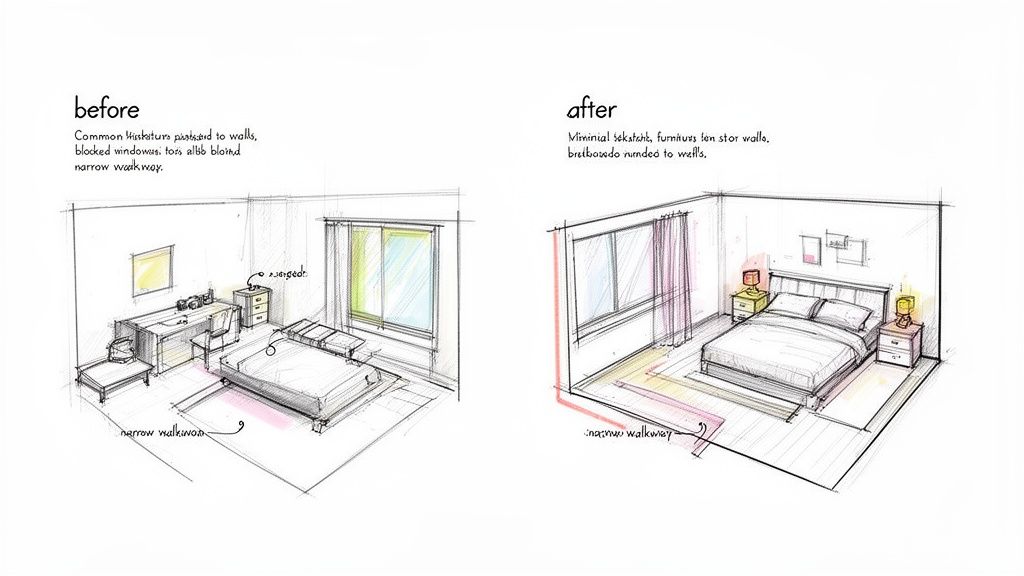
    Sketches illustrating 'before' and 'after' bedroom furniture arrangements for improved space.

    We see homeowners make the same few mistakes over and over again. Here’s a quick troubleshooting guide to help you spot them—and fix them—in your own space.

    | Common Bedroom Layout Problems and Solutions |
    | :— | :— | :— |
    | Common Mistake | Why It's a Problem | How to Fix It |
    | Pushing Everything Against the Walls | It creates a "racetrack" effect with a dead zone in the middle, making the room feel static and less inviting. | Pull furniture, especially the bed and seating, a few inches away from the walls to create depth and let the room breathe. |
    | Ignoring Scale and Proportion | Tiny furniture gets lost in a big room, and oversized pieces make a small room feel cramped and claustrophobic. | Match furniture size to the room. Use your measurements to ensure pieces fit with adequate clearance before buying. |
    | Blocking Natural Light | Placing tall furniture in front of windows casts shadows and makes the room feel smaller, darker, and less welcoming. | Keep windows as unobstructed as possible. Position tall pieces like armoires or bookcases on solid walls away from windows. |
    | Obstructing Traffic Flow | A blocked path from the door to the closet or bathroom creates daily frustration and makes the room feel poorly planned. | Ensure major walkways are at least 30-36 inches wide. Walk the paths yourself—if you have to shuffle, rearrange. |
    | Forgetting a Focal Point | Without a clear focal point, the room can feel chaotic and unfocused, with no clear place for the eye to rest. | Make the bed the star of the show. Center it on the main wall and use a beautiful headboard or artwork to draw attention. |

    By keeping these common issues in mind, you can design a layout that's not just beautiful but also functional for your daily life. A well-arranged room just feels better, and avoiding these simple mistakes is the key to getting there.

    Bringing Your Vision to Life with Planning Tools

    Okay, this is where the magic happens. After you've measured your space and have a good idea of where the bed should go, it's time to put your plan to the test. This is one of the most rewarding parts of the process, because you finally get to see your vision start to take shape.

    Thankfully, you don’t have to start shoving heavy furniture around just to see if something works. Instead of guessing how a layout will feel, you can use a few handy digital tools to experiment without breaking a sweat. This approach saves you a ton of physical effort and helps you spot potential problems before you’ve lugged that heavy dresser up the stairs.

    The Value of a Virtual Walkthrough

    Digital room planners are a game-changer for visualizing how furniture will actually fit and function in your room. You just plug in your dimensions, then drag and drop furniture pieces to see how everything plays together.

    This lets you confirm all the critical details right from your couch:

    • Check Your Clearances: Can you actually walk around the bed? See if you have the recommended 30 to 36 inches for your main pathways.
    • Test Drawer & Door Swing: This is a big one. You can place a dresser and instantly see if the drawers will smack into your bed frame when you open them.
    • Experiment with Scale: Wondering if a king bed will overwhelm the space? Drop one in your virtual room and see how much floor space you have left compared to a queen.

    A good planning tool is like a blueprint for your bedroom. It takes the guesswork out of the equation, making sure the layout that looks great on paper will actually work in real life. The result is a more functional, harmonious space.

    To get started, you can check out some of the useful online interior design tools that let you play with different layouts and styles. They’re a fantastic way to explore the possibilities and lock in your plan.

    From Digital Plan to Real-World Feel

    As great as these digital tools are for logistics and floor plans, nothing beats seeing and touching the furniture in person. Once you’ve mapped out a layout that you're happy with, the final piece of the puzzle is visiting a showroom. It’s the only way to get a true sense of a piece’s scale, quality, and texture—things a screen just can't fully capture.

    At our Woodstock Furniture & Mattress Outlet showrooms, you can see firsthand how different pieces look and feel. This helps you find options to fit the plan you’ve so carefully crafted. Our team is always here to offer guidance and help you bring that vision to life, making sure the final result is a bedroom you’ll love coming home to.

    Frequently Asked Questions About Arranging Bedroom Furniture

    Even with the best-laid plans, questions always seem to pop up once you start moving the heavy stuff around. Arranging bedroom furniture can bring up some tricky challenges that feel totally unique to your own space. We get it. Here are some straightforward answers to the questions we hear most often from homeowners just like you.

    What Is the First Piece of Furniture I Should Place in a Bedroom?

    Always, always start with the bed. No exceptions. It's the biggest, most important piece in the room, and everything else will revolve around it. Placing the bed first acts as an anchor for your entire layout.

    From there, you can arrange your nightstands, dressers, and everything else in relation to it. This approach keeps things logical and balanced, and you won't risk boxing yourself in with smaller items only to realize you have to start all over again.

    How Much Space Should I Leave for Walkways in My Bedroom?

    You'll want to aim for at least 30 to 36 inches of clear space for your main traffic paths. Think about the route from your doorway to the bed, and from the bed to the closet. These are the paths you'll walk every single day.

    For secondary paths, like the space between the side of your bed and a wall, you can get away with as little as 24 inches. But honestly, more is always better if you want to avoid that cramped, claustrophobic feeling.

    Here's a helpful trick from our designers: After you think you've placed your furniture, actually walk the paths. If you have to turn sideways or do a little shuffle to get through, it’s too narrow for comfortable, everyday use.

    Can I Put My Bed in Front of a Window?

    Yes, you absolutely can! Placing a bed in front of a window can create a stunning focal point, but you have to be thoughtful about it.

    First, make sure your headboard is low enough that it sits nicely beneath the windowsill. This way, you're not blocking out all that wonderful natural light. Second, invest in some quality curtains or blinds. This is non-negotiable for light control and privacy, but it also helps insulate against any drafts that could mess with your sleep.

    How Do I Arrange Furniture in a Very Small Bedroom?

    When you're working with a small bedroom, the name of the game is maximizing every single square inch. The secret is to think vertically and be strategic with your choices.

    • Bed Placement: The best move is usually to push the bed into a corner or up against the longest wall. This opens up as much floor space in the center of the room as possible.
    • Vertical Storage: Go for tall, narrow dressers instead of the wide, low ones. This simple switch draws the eye upward and saves precious floor real estate.
    • Smart Furniture: Look for pieces that do double duty. A bed with built-in drawers underneath or a storage bench at the foot of the bed can be a lifesaver.
    • Off-the-Floor Solutions: Wall-mounted shelves and floating nightstands are your best friends in a small room. They free up the floor and make the space feel much larger and less cluttered.

    At Woodstock Furniture & Mattress Outlet, our team has seen just about every layout challenge you can imagine. We can offer practical advice to help you figure out what works for your unique space. Come on down and let's find the right furniture for your vision.

    Find a Woodstock Furniture & Mattress Outlet location near you

  • How Big is a Queen Size Bed? A Guide to Dimensions and Room Fit

    How Big is a Queen Size Bed? A Guide to Dimensions and Room Fit

    If you're wondering, "how big is a queen size bed?", the standard queen mattress measures 60 inches wide by 80 inches long. It’s the most popular mattress size in the United States, offering a good balance between spacious comfort and a manageable footprint that fits well in most bedrooms.

    The Standard Queen Bed Dimensions Explained

    Understanding the exact measurements of a queen bed is the first step in making sure it’s the right fit for your room and your lifestyle. For couples, singles who enjoy spreading out, or guest rooms, the queen has become a go-to choice because it offers ample space without making smaller rooms feel cramped.

    Introduced in the 1950s, the queen bed offered a welcome upgrade from the full size bed, which was the standard at the time. A queen mattress has a total surface area of 4,800 square inches. For couples, that provides about 30 inches of personal space for each person — a noticeable improvement over the 27 inches per person available on a full mattress.

    For those who need to see the numbers laid out, here's a quick reference table to make your bedroom planning a bit easier.

    Queen Bed Dimensions at a Glance

    This table breaks down the standard queen bed dimensions in both inches and centimeters, providing a clear reference for your planning.

    Measurement Inches Centimeters Total Surface Area
    Width 60 in. 152 cm
    Length 80 in. 203 cm
    Surface Area 4,800 sq. in. (3.09 sq. m.)

    With these exact numbers in hand, you can start measuring your space and determining how a new queen bed will fit with your other bedroom furniture.

    Comparing the Queen Bed to Other Mattress Sizes

    Knowing the exact dimensions of a queen bed is a great start, but those numbers can feel a bit abstract. To get a better feel for its scale, it helps to see how it compares to other common mattress sizes. This isn't about finding a "winner," but about helping you visualize the real-world trade-offs in space and comfort.

    This quick visual gives a clear breakdown of a standard queen bed’s width, length, and total sleeping surface.

    Infographic detailing queen bed dimensions, showing 60 inches width, 80 inches length, and 4800 square inches.

    Seeing the 60-inch width and 80-inch length helps put its 4,800 square inches of sleeping surface into perspective.

    Queen vs Full Bed

    One of the most common decisions shoppers face is choosing between a queen and a full size bed. A full mattress, also known as a double, measures 54 inches wide by 75 inches long. While a six-inch difference in width and five-inch difference in length might not sound like much, that extra space can be significant in practice.

    A full bed can feel comfortable for a single sleeper. For couples, however, those missing inches mean each person only gets 27 inches of personal space, which is the same width as a crib mattress. The queen’s slightly wider frame gives each person 30 inches, which can contribute to a more comfortable night's sleep without bumping elbows.

    A queen bed is 6 inches wider and 5 inches longer than a full bed. This extra space makes a considerable difference for couples or taller individuals seeking more room to stretch out without feeling cramped.

    Queen vs King Bed

    Going up in size, a standard king bed measures 76 inches wide by 80 inches long. It offers the same length as a queen but provides an additional 16 inches of width.

    A king is a suitable choice for couples who value personal space, often share their bed with children or pets, or simply prefer a more luxurious, sprawling feel. Each person gets 38 inches of width—the same as a twin mattress. The main trade-off is bedroom real estate. Choosing a king often means sacrificing floor space that could be used for a dresser, a chair, or walking room.

    Why the Queen Bed Became a Household Staple

    Have you ever wondered why the queen bed is so common in homes across America? The story behind it reflects major changes in how we live. Before the 1950s, the much smaller full bed was the primary choice for couples — a size that can feel quite snug by today’s standards.

    This began to change after World War II as American homes started getting larger. With more space available, people began to place a higher value on personal comfort and a good night's sleep. The queen bed emerged as an ideal solution, offering a significant upgrade in sleeping room without needing the massive footprint of a king mattress. It filled a gap in the market, giving couples more breathing room.

    A Shift in American Lifestyles

    This move toward more spacious living is a huge piece of the puzzle. It wasn't just about the dimensions; it was about the idea of a more comfortable life. Mattress marketers in the 1950s and 60s tapped into this by using regal names like "queen" and "king" to associate these larger beds with luxury and status.

    This marketing approach was effective. By 1999, the once-dominant full size bed saw its popularity decline, while the queen bed became the new standard for couples. Today, it remains the top-selling mattress size, making up a large portion of all mattress sales in North America. It’s a testament to its blend of comfort and practicality. You can get more information on the history of mattress sizes at The Bedding Mart.

    The queen bed solved a real problem for millions of people: it offered a more comfortable sleep experience for two without requiring an oversized master bedroom. Its rise in popularity mirrors the country's growing focus on personal wellness and comfort at home.

    Ultimately, understanding how big a queen size bed is goes beyond just its measurements. It’s about recognizing its role as a practical, comfortable centerpiece that fits the way many people live today.

    Planning Your Room Layout Around a Queen Bed

    Knowing the measurements of a queen bed is a good start, but the real test comes when you place it within your bedroom. A bed’s dimensions on paper can feel very different once it’s actually in the room. Thoughtful planning can help create a space that feels open and functional.

    Bedroom layout sketch with queen size bed, nightstands, dresser, wardrobe, and dimensions.

    Before committing to a bed frame or bedroom set, it’s always a good idea to use a tape measure. Once you have your queen bed’s dimensions, the next step is to figure out how to arrange your bedroom furniture for a space that feels both balanced and functional. This planning stage can help you avoid the common issue of buying furniture that is too large for your home.

    The Minimum Room Size for a Queen Bed

    So, how big of a room do you need? While every layout is different, a general guideline is that a queen bed fits most comfortably in a room that's at least 10 feet by 10 feet. This size provides enough space for the bed while leaving room for other essential pieces and for you to move around.

    For a room to feel comfortable, you need clear pathways. It is recommended to leave at least 24 to 30 inches of open space on two or three sides of the bed. This clearance allows you to walk around without difficulty, make the bed, and access your closet or dresser.

    Leaving at least two feet of clearance around your bed is more than just a design tip—it's a practical necessity. This space ensures you can navigate your room comfortably and prevents the layout from feeling crowded and stressful.

    Arranging Furniture for a Balanced Feel

    Smart furniture placement is key to a well-balanced bedroom. Placing the queen bed against the longest, uninterrupted wall usually creates a natural focal point and makes the entire room feel more spacious. This placement typically leaves enough room on either side for nightstands.

    When you start adding in other pieces, think about their function and footprint:

    • Nightstands: Try to find nightstands that are about the same height as the top of your mattress. This makes them easier and more comfortable to reach from bed.
    • Dressers: If you have the space, place your dresser on the wall opposite the bed. Be sure to account for the clearance needed to fully open all its drawers.
    • Walkways: Before you finalize the layout, do one last check. Is your main path—from the door to the bed and over to the closet—clear and easy to walk?

    By thinking through these layout details ahead of time, you can ensure your new queen bed not only fits but also enhances your bedroom’s overall comfort and style.

    Exploring Queen Bed Variations You Should Know

    While the standard 60-inch by 80-inch queen is the most common mattress size, it's not the only option. A few less-common variations were created to solve specific problems, such as needing more width or preventing feet from hanging off the end. Knowing about these alternatives can help you find the right mattress for your home.

    Illustration comparing standard, Olympic, and California queen bed sizes with their dimensions.

    The standard queen remains a versatile choice, fitting a wide range of accessories and accounting for a significant portion of mattress purchases in the U.S. You can learn more about how mattress sizes became standardized in this article on the evolution of mattress sizes on gottasleep.com. But if the standard queen doesn't quite meet your needs, one of these unique sizes might be a better fit.

    Olympic Queen

    The Olympic Queen mattress adds six inches of width to the standard queen, measuring 66 inches wide by 80 inches long. For couples who feel a bit cramped on a regular queen but don’t have space for a king, that extra space can be a useful alternative.

    It’s an interesting "in-between" solution, but be aware that finding sheets and bed frames that fit this non-standard size can be more challenging.

    California Queen

    If you or your partner are tall and find your feet dangling off the end of the bed, the California Queen might be a solution. It keeps the standard 60-inch width but adds four inches of length, making it 60 inches by 84 inches. For taller sleepers, those extra inches can make a significant difference.

    Much like its more famous counterpart, the California King, the California Queen is built with one thing in mind: extra length for a more comfortable night's sleep for taller individuals.

    Split Queen

    A Split Queen is a unique setup. Instead of one mattress, it consists of two separate mattresses, each measuring 30 inches by 80 inches. When placed side-by-side on a bed frame, they have the exact footprint of a standard queen.

    This design is often used with an adjustable bed base. It allows each person to raise or lower their head and feet independently, accommodating different sleeping preferences.

    Choosing the Right Frame for Your Queen Mattress

    The mattress is only half of the equation. The bed frame you choose sets the style and determines the final footprint of your bed in the room. While a queen mattress will always be 60 inches wide by 80 inches long, the frame can add anywhere from a couple of inches to over a foot in both directions.

    This is a detail that is often overlooked when planning a room layout. A simple metal frame or a sleek, modern platform bed will keep the overall size close to the mattress dimensions, making them a good fit for smaller spaces. On the other hand, a large sleigh bed or a frame with a thick, upholstered headboard can dramatically increase how much floor space the bed occupies.

    Measuring for Your New Bed Frame

    When browsing different styles, it's important to think beyond the mattress size. Always ask for the frame's total dimensions—including the headboard and footboard—to ensure it won’t overwhelm your bedroom or block walkways.

    Always measure the full dimensions of the bed frame—not just the mattress. A larger frame with a decorative headboard can easily add several inches to the length and width, impacting your room's available space and layout.

    Don't forget to consider vertical height. If you’re pairing a thick mattress with a new, taller frame, your bedding might suddenly look too short. For instance, a king-size comforter often drapes better and looks more balanced on a high-profile queen bed than a standard queen comforter would. Keeping these details in mind helps ensure your entire setup looks cohesive and functions well in your room.

    Common Questions About Queen Size Beds

    Choosing a new bed is a significant decision, and it’s natural to have questions. Here are answers to some of the most common questions we hear from shoppers.

    Can Two Adults Sleep Comfortably on a Queen Bed?

    Yes, a standard queen bed was designed to accommodate two adults. It provides each sleeper with 30 inches of personal space, which is enough room for most couples to sleep soundly without feeling cramped. This balance of individual space and a manageable footprint is why the queen is the most popular mattress size in America for couples.

    What Is the Real Difference Between a Full and Queen Bed?

    A queen bed is 6 inches wider and 5 inches longer than a full-size bed. A queen measures 60” x 80”, while a full is 54” x 75”. While those numbers might not seem like a huge jump, the difference is often noticeable. That extra room is beneficial for couples who want more personal space or for taller individuals who find their feet hang off the end of a full bed.

    Do I Need Special Sheets for a Thick Queen Mattress?

    It is very likely. If your new queen mattress is particularly thick—especially if it’s over 14 inches tall—you will likely need to buy deep-pocket sheets. Standard sheets may not have enough fabric to wrap all the way around and under, which can cause the corners to pop off during the night.

    Before shopping for new bedding, measure your mattress’s height. Then, check the sheet packaging for its "pocket depth" to ensure it can accommodate your mattress.

    Quick tip: Don't forget to include your mattress topper when you measure! A plush topper can easily add another 2 to 4 inches, making deep-pocket sheets a necessity for a snug, secure fit.

    Is an Olympic Queen the Same as a Standard Queen?

    No, they are two different sizes. An Olympic Queen is a non-standard mattress that measures 66" x 80", making it 6 inches wider than a standard queen. While that extra width can be nice, be prepared for a challenge when it comes to finding frames and bedding that fit correctly, as they may need to be special-ordered.


    Still have questions? The team at Woodstock Furniture & Mattress Outlet has extensive experience and is here to help you find the right mattress and bedroom furniture for your home. Visit us in person to explore our great selection and see these options for yourself!