Tag: bedroom layout

  • What Is the Width of a Queen Bed? A Complete Guide

    What Is the Width of a Queen Bed? A Complete Guide

    If you're trying to figure out the width of a queen bed, the simple answer is 60 inches. This has become a very popular mattress size across the country, and for good reason. It’s a comfortable upgrade from a full bed without taking up the massive footprint of a king.

    The Official Width of a Queen Bed

    A standard queen mattress measures 60 inches wide by 80 inches long. These dimensions became more common after World War II as homes grew larger and people sought more room to stretch out. Today, it’s a leading choice, making up a significant portion of mattress sales in North America. If you're curious about the history, you can learn more about how mattress standards have evolved over time.

    To really get a feel for what that 60-inch width means, it helps to see how it stacks up against other common sizes you might have slept on.

    How Queen Width Compares to Other Sizes

    Moving up from a full-size bed (sometimes called a double) to a queen gets you an extra six inches of width. That might not seem like a huge number on paper, but it can make a real difference in sleep quality—especially for couples. Those extra inches mean more personal space and can reduce accidental wake-up calls from a partner who likes to toss and turn.

    For couples, a queen mattress provides 30 inches of personal space for each person. Many people find this is a comfortable amount of space for two adults to sleep without feeling like they're on top of each other. It's a noticeable upgrade from the 27 inches per person a full bed offers.

    Sometimes it helps to have a quick reference when you're trying to visualize these differences.

    Standard Mattress Widths at a Glance

    Mattress Size Standard Width (Inches) Width Per Person (For Couples)
    Full 54 inches 27 inches
    Queen 60 inches 30 inches
    King 76 inches 38 inches

    As you can see, the queen occupies a middle ground between the cozier full and the expansive king.

    This chart below gives you a clear visual of how these mattress widths compare side-by-side.

    Bar chart comparing full, queen, and king mattress widths in inches. Full and queen are 80 inches, king is 60 inches.

    It’s understandable why the queen has become a frequent choice for master bedrooms. It offers ample room for most single sleepers and couples, all while fitting comfortably into many average-sized rooms.

    Why 60 Inches Became a Popular Choice for Sleep

    The queen bed didn’t become a leading mattress size by chance. It effectively solved a common problem that couples had experienced for years: the "double" or full-size bed often felt too small.

    While a full bed was a step up from a twin, it only gave each person 27 inches of space. To put that in perspective, that’s about the same width as a baby’s crib. For many couples, this was a recipe for a restless night filled with tossing, turning, and bumping into a partner.

    Comparison of Full (54 in), Queen (60 in), and King (76 in) bed widths, with a person for scale.

    A Balance of Comfort and Space

    This is where the queen bed’s 60-inch width provides a solution. Those extra six inches compared to a full bed were a significant change. Suddenly, each partner had a more comfortable 30 inches of personal space, which helped cut down on nighttime disturbances and led to better sleep for many. It’s no wonder this specific width is a main reason for the queen's popularity.

    Over the decades, the queen bed's market share has grown, now accounting for a majority of mattress sales. This is largely driven by couples, as studies suggest that a queen can improve sleep satisfaction and reduce disruptions from a bed-sharing partner. You can explore the full data and research on how bed size impacts sleep quality.

    This trend also went hand-in-hand with changes in home construction. As master bedrooms in new homes started getting bigger in the second half of the 20th century, people had room for something larger than a full-size bed without making the space feel cramped.

    The queen mattress offered a practical compromise: more personal space than a full, but without the room-dominating footprint of a 76-inch king. It became a go-to choice for millions of American homes.

    The “Just Right” Solution for Modern Bedrooms

    Ultimately, the 60-inch width became an industry standard because it’s a practical solution for a wide range of sleepers and homes. It’s a versatile size that works well in many situations.

    Consider its uses. A queen is suitable for:

    • Couples who need enough personal space to sleep without waking each other up.
    • Single sleepers who enjoy having plenty of room to stretch out.
    • Guest rooms, providing a comfortable stay for either single guests or couples.
    • Most master bedrooms, because it fits comfortably without overwhelming the layout.

    This combination of comfort, practicality, and versatile sizing is why the 60-inch queen bed is more than just a mattress—it's the foundation of a good night's sleep in many homes today.

    Understanding Variations of the Queen Size

    While the standard queen mattress is a solid 60 inches wide, it’s not the only queen size available. The mattress world has a couple of specialized variations built to solve specific problems. Think of these not as replacements for the standard queen, but as custom solutions for sleepers who need a bit more room in one direction or another.

    Knowing about these less-common sizes can help you make a more informed decision and avoid the frustration of buying a bed that almost works. They offer some unique benefits, but they also have a few practical trade-offs you should know about before making a choice.

    Olympic Queen

    The Olympic Queen, sometimes called an Expanded Queen, is the most common queen variation you're likely to find. It addresses the desire for a little more elbow room.

    • Dimensions: An Olympic Queen mattress measures 66 inches wide by 80 inches long.
    • Best For: This can be a great option for couples who feel just a tad cramped in a standard queen. Those extra six inches of width give each sleeper three more inches of personal space, which can make a real difference if one or both of you tend to toss and turn.

    It’s a middle ground for folks who don’t quite have the floor space for a king but still crave more room to themselves.

    The biggest hurdle with an Olympic Queen is finding accessories that fit. Since it's a non-standard size, you'll have a more difficult time finding bed frames, sheets, and mattress protectors designed for its unique 66-inch width.

    California Queen

    Another specialty size you might see is the California Queen. Unlike its Olympic cousin, this one isn’t about adding width; it’s all about adding length for taller sleepers.

    • Dimensions: A California Queen mattress comes in at 60 inches wide by 84 inches long.
    • Best For: This bed was made for anyone over six feet tall who is tired of their feet dangling off the edge of a typical 80-inch mattress. It gives you the same four inches of extra legroom you'd find in a California King, but keeps the more manageable 60-inch width of a standard queen.

    Ultimately, variations like the Olympic and California Queen serve a specific slice of the market. While these specialty sizes have their place, the 60×80-inch standard queen remains the most practical choice for the vast majority of bedrooms. It simply fits better in most rooms and is a top seller for a reason. If you're curious about the market dynamics, you can learn more about how different bed sizes compare in sales and bedroom fit.

    How to Know if a Queen Bed Will Fit Your Room

    Knowing a queen mattress is 60 inches wide is one thing, but making sure it actually fits and feels right in your bedroom is another. It's a common experience where a bed can technically squeeze into a space but leave the room feeling cramped and unusable.

    The secret isn't just about fitting the bed itself. The real key is to plan for comfortable movement around the bed.

    A good rule of thumb is to leave at least 24 to 30 inches of walking space on the three open sides of the bed (the left, right, and foot). This clearance gives you enough room to walk without turning sideways, make the bed without scraping your knuckles, and fully open dresser drawers or closet doors without them bumping into the frame.

    For a queen bed, this means your room should ideally be at least 10 feet by 10 feet. This size gives you just enough space for the 60-inch-wide bed, two average nightstands (around 20-24 inches each), and still keeps that critical walking path clear.

    While a 10×10 room is a great starting point, many people find a slightly larger space, like 12 feet by 12 feet, to be ideal. That little bit of extra square footage offers more breathing room and flexibility for other furniture, like a dresser, a bench at the foot of the bed, or a cozy reading chair.

    Measure Your Room Like a Pro

    Before you decide on a new bed set, it's time to grab a tape measure and get the true lay of the land. And don't just measure from wall to wall; you need to map out all the real-world obstacles that can affect your layout plans.

    Here’s a simple checklist our experienced team recommends:

    • Measure Wall to Wall: First, get the total length and width of the room. This gives you your maximum canvas to work with.
    • Map Out Obstacles: Take note of where your windows (especially low ones), radiators, air vents, and electrical outlets are. You don’t want your headboard blocking your only usable outlet or sitting awkwardly in front of a window.
    • Check Door Swings: This is a big one people forget! Measure how far your bedroom and closet doors swing into the room. A new bed won't feel so great if it keeps a door from opening all the way.
    • Account for Other Furniture: Finally, measure the depth and width of your existing dressers, nightstands, and any other pieces you plan on keeping in the room.

    Once you have these numbers jotted down, you can sketch out a quick floor plan. For a helpful visual, use painter's tape to mark out the 60-inch by 80-inch footprint of a queen mattress right on your floor. This simple trick lets you see and feel exactly how much space the bed will take up and how your walking paths will be affected. This small step can save you from the headache of buying a bed that’s just too big for your space.

    Accounting for Your Bed Frame's Total Width

    A detailed floor plan showing a queen-size bed, nightstands, and furniture layout in a bedroom with dimensions and recommended clearances.

    It’s one of the most common things shoppers can overlook. They focus so much on the mattress itself that they forget a bed is more than just a mattress. While a standard queen mattress has a firm width of 60 inches, the bed frame you put it on can add anywhere from a couple of inches to a foot or more to the bed's total footprint.

    This is a critical detail, because it directly impacts how the bed will actually fit in your room. If you only plan for the mattress, you might end up with a bed that overwhelms your space, blocks walkways, or even keeps you from opening your dresser drawers. The style of the frame is the single biggest factor here.

    How Frame Style Impacts Total Bed Width

    Different bed frame designs have widely different profiles. For instance, a sleek, modern platform bed is built for minimalism and might only add 2 to 3 inches to the total width. These are good choices for smaller bedrooms where every inch of floor space is precious.

    On the flip side, a substantial sleigh bed with wide, curved side rails or a bed with a bulky, decorative headboard could easily add 8 to 12 inches — or even more! These are beautiful statement pieces, but they demand a more spacious room to avoid feeling cramped.

    Always check the product specifications for the bed frame's exact dimensions, not just the mattress size it’s made for. This ensures you're planning your room layout with the bed's true, fully-assembled footprint in mind.

    To give you a better idea of what we mean, here’s a quick look at how different frame styles can change the final width of your new queen bed.

    Estimated Total Bed Width by Frame Style

    The table below breaks down some common bed frame styles and how much width they typically add to a standard 60-inch queen mattress.

    Bed Frame Style Estimated Added Width (Inches) Total Estimated Bed Width (Inches)
    Metal Frame 1 to 2 inches 61 to 62 inches
    Platform Bed 2 to 4 inches 62 to 64 inches
    Upholstered Bed 4 to 8 inches 64 to 68 inches
    Sleigh Bed 8 to 12+ inches 68 to 72+ inches

    While these numbers are a helpful guide, seeing these options in person can help you understand their scale. Visiting a showroom lets you compare how a simple platform frame feels in a space versus a more commanding sleigh bed. This hands-on experience can help you confidently choose a style that complements your room's layout without overpowering it.

    Choosing the Right Bedding for a 60-Inch Bed

    Three illustrations compare the width of a 60-inch mattress, a platform bed adding 2-3 inches, and a sleigh bed adding 10 inches.

    You’ve picked out the perfect queen bed and frame. Now for the fun part — dressing it up! Since the standard queen mattress’s 60-inch width is the most popular size in the country, finding bedding is usually a breeze. Sheets, comforters, and duvets labeled "queen" are all made to fit that classic 60×80 inch mattress surface.

    Most of the time, that is. While standard queen bedding works great for most people, there are a couple of common situations where you might need to think about a different approach. A few simple adjustments can make a real difference between a bed that just looks good and one that gives you a truly comfortable night’s sleep.

    Practical Tips for a Polished Look

    Ever found yourself in a nightly tug-of-war over the blankets? It's one of the most common complaints we hear from couples. If you or your partner tend to pull the covers, or if you have a pillow-top or extra-deep mattress (anything over 14 inches tall), here's a helpful tip: consider sizing up to a king-sized comforter or duvet.

    That extra fabric provides more overhang on both sides of the bed, ending the midnight cover-stealing and keeping everyone cozy. For more on getting the dimensions just right, it can be helpful to check out a guide on what size is a queen flat sheet.

    Just remember that while a bigger blanket is a great fix, you must stick with a queen fitted sheet. A king fitted sheet will be far too big for a 60-inch mattress, leaving you with a bunched-up, uncomfortable mess.

    Finally, let’s talk pillows. The 60-inch width of a queen bed is the ideal canvas for two standard or queen-sized pillows. They’ll sit perfectly side-by-side without looking cramped or leaving a large gap in the middle. This simple setup creates a sleep space that’s as inviting and comfortable as it is visually pleasing. With these little tricks up your sleeve, your new bed will be well-outfitted for years of great sleep.

    Got a Few More Questions About Queen Bed Width?

    We've covered the main specs, but you probably still have a few "what if" questions. That's completely normal. When you're making a decision like buying a new bed, the details matter. Our knowledgeable staff gets these kinds of questions all the time, so let's clear up a few of the most common ones.

    Is a Double Bed the Same Width as a Queen Bed?

    No, they are two different sizes. A "double bed" is just another name for a full-size mattress, which comes in at 54 inches wide. A standard queen, on the other hand, is 60 inches wide.

    Those extra six inches can make a significant difference, especially for couples. That bit of extra elbow room means less bumping into your partner and can lead to a more restful night's sleep.

    Can I Use Queen Sheets on a Full Mattress?

    You might be tempted to make it work, but we would advise against it—at least for the fitted sheet. While you could probably get away with using a queen flat sheet or comforter on a full bed, the fitted sheet is another story.

    A queen fitted sheet is built for a 60 x 80-inch mattress. Trying to put it on a 54 x 75-inch full mattress will leave you with loose, baggy fabric that's likely to slip off the corners. For that snug, crisp feeling, you should always match your bedding to your exact mattress size.

    Speaking of bedding, figuring out the right blanket or comforter size is key to getting that perfectly draped look. For a detailed guide on exactly what size blanket for a queen bed, this is a helpful resource to check out.

    How Wide Does My Doorway Need to Be for a Queen Mattress?

    Here's some good news. Most modern queen mattresses are flexible and can be squeezed, angled, or gently bent to get through standard doorways, which are usually about 30 to 32 inches wide. The real challenge often isn't the doorway itself, but navigating tight hallways, sharp corners, and tricky stairwells.

    If you're worried about getting a solid, rigid box spring through a difficult delivery path, a split queen box spring is an excellent solution. It’s delivered in two smaller, more manageable pieces, making it much easier to get into just about any room.

    Is the Queen Bed Width the Same in Other Countries?

    Not always, and this is a great question if you're shopping for international brands. While the standard queen in the US is 60 inches wide (or about 152 cm), the sizes and names can vary once you go abroad.

    • United Kingdom: What they call a "King" is 150 cm wide, which is almost identical to a US Queen.
    • Australia: An Aussie "Queen" is also 152 cm wide, matching the US standard perfectly.

    Because of these regional quirks, it’s always a smart move to double-check the exact measurements in both inches and centimeters before buying a bed frame or bedding from an overseas company. It saves a lot of headaches and ensures a proper fit.


    At Woodstock Furniture & Mattress Outlet, our team is passionate about this stuff. We're here to answer your questions and help guide you to the right sleep setup for your home. Come visit one of our North Georgia locations to see our great selection of mattresses and bed frames for yourself. You can find us online at https://woodstockoutlet.com.
  • Your Guide to King Size Bed Measurements

    Your Guide to King Size Bed Measurements

    Thinking about upgrading to a king size bed? It's a popular move for anyone craving more room to stretch out, whether you're sharing the bed or just want a more spacious sleep experience. The first question on most people's minds is usually about the actual size. A standard king size bed measures 76 inches wide by 80 inches long.

    But these numbers are more than just a measurement; they're the key to unlocking a better night's sleep and making sure your bedroom stays a functional, relaxing retreat. Let's break down what those dimensions really mean for you.

    Why King Size Bed Measurements Matter

    Understanding the exact size of a king mattress is the first step in planning your new bedroom layout. That generous surface area isn't just a number—it’s a practical answer to some of the most common issues that keep people from sleeping soundly.

    Diagram illustrating a Standard King bed's dimensions (76" x 80") as two Twin XL mattresses (38" x 80"), with human figures for scale.

    Visualizing the Space

    Here’s a helpful way to picture just how big a king mattress is: imagine two Twin XL mattresses sitting side-by-side. A single Twin XL is 38 inches wide by 80 inches long. Put two together, and you get the exact 76-inch by 80-inch footprint of a standard king.

    This is exactly what a "split king" adjustable bed is—two separate Twin XL mattresses. For couples, this means each person gets 38 inches of personal width. That's the same amount of space you'd have all to yourself on a twin bed.

    The Impact on Sleep Quality

    That extra real estate can be a significant factor in your sleep quality. With more room to spread out, you’re far less likely to be woken up by a partner who tosses and turns. It's a common reason why many couples report sleeping better after upgrading to a king.

    This now-iconic size gained popularity with the housing boom after World War II. As homes got bigger, so did the demand for bigger furniture and comforts. Today, king mattresses make up a significant portion of all mattress purchases, a substantial increase from just 1% in the 1950s. You can dive deeper into the history of mattress sizes over at HowStuffWorks.com.

    Ultimately, getting familiar with king size bed measurements isn't just about memorizing numbers. It’s about making sure your new bed gives you the comfort you deserve while still fitting well into your bedroom, creating a space that’s both functional and deeply relaxing.

    Standard King vs. California King Dimensions

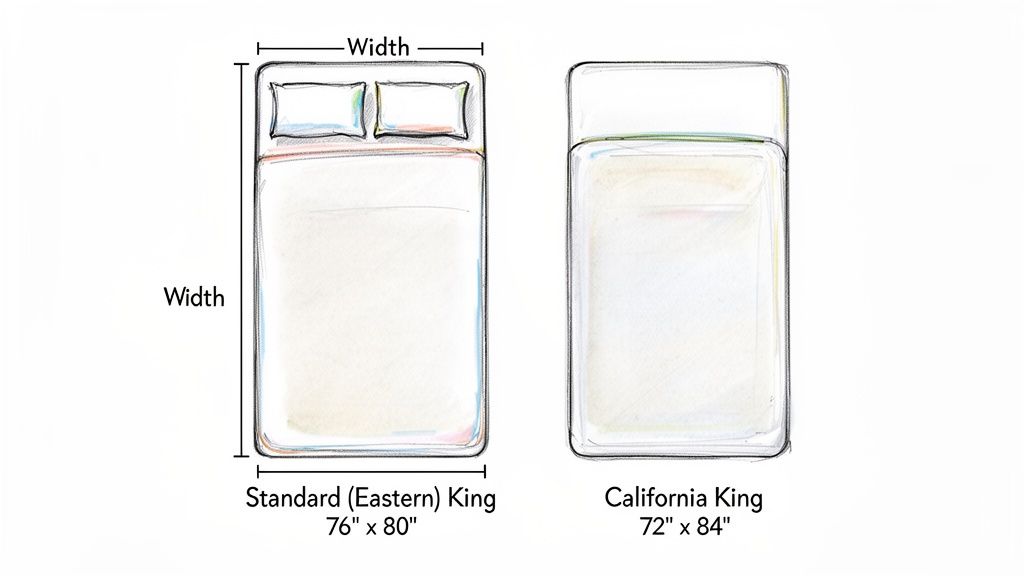
    When you start shopping for a king size bed, one of the first things you'll notice is that there isn't just one king. A frequent point of confusion is the difference between a standard king and a California king. While they both sound massive, they’re actually built for very different needs and different rooms.

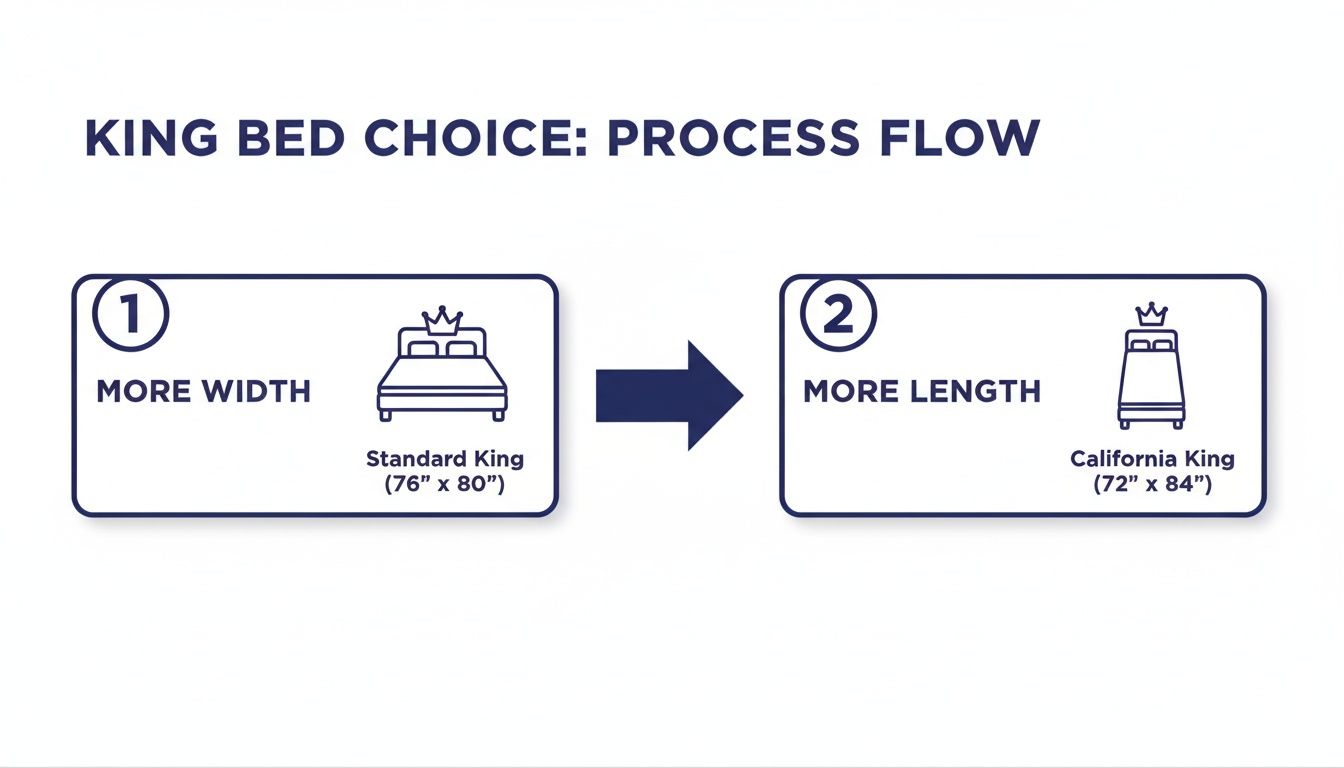
    Getting this choice right is important, since it's a decision you'll be living with (and sleeping on) for years. The main difference boils down to a trade-off: width versus length. One is wider, the other is longer. It sounds simple, but it makes a huge difference in how the bed feels and fits in your space.

    Illustration comparing Standard King bed dimensions (76" x 80") to California King bed dimensions (72" x 84").

    Who Should Choose a Standard King?

    A standard king, sometimes called an Eastern king, measures 76 inches wide and 80 inches long. If you prioritize horizontal space, this is your go-to.

    • Couples Who Value Personal Space: At 76 inches wide, each person gets 38 inches of their own space. That’s the exact same width as a Twin XL mattress, meaning you'll be less likely to notice if your partner is a restless sleeper.
    • Families with Kids or Pets: If your weekend mornings involve kids or pets piling into bed, the extra width of a standard king provides ample room for everyone.

    If you often feel like you’re fighting for elbow room or teetering on the edge of your current mattress, the expansive width of a standard king can be a great solution.

    When a California King Is the Better Fit

    The California king flips the script. It measures 72 inches wide by 84 inches long, making it 4 inches narrower but also 4 inches longer than a standard king.

    The California king has a fascinating backstory. It was developed in the 1960s by a Los Angeles furniture company for celebrity mansions. Many of their clients, like tall actors, found their feet dangling off the end of standard beds, and the Cal king was designed to solve that exact problem.

    This history tells you exactly who this bed is for. The California king is an excellent choice for:

    • Taller Individuals: If you’re over six feet tall, those extra four inches of length can make a real difference. No more curling up or dealing with foot overhang.
    • Longer, Narrower Bedrooms: In rooms where every inch of width counts, the slimmer 72-inch profile of a Cal king can make the space feel less cramped while still offering luxurious length.
    • Sleepers with Pets at the Foot of the Bed: That additional length gives your dog or cat a dedicated spot to curl up without getting kicked or stealing your legroom.

    The California king’s unique origin shows how mattress sizes have evolved to meet real-world needs. It remains very popular, with some data showing it accounts for a notable percentage of sales in states with taller-than-average populations. To learn more about how different mattress sizes came to be, you can check out the historical journey of bed standardization.

    How to Measure Your Room for a King Bed

    Bringing home a new king size bed is exciting. But a common mistake is getting so focused on the mattress itself that you forget to measure your room for the entire bed.

    To make sure your new bed is the centerpiece of a relaxing retreat—not a cramped obstacle course—you have to think beyond the mattress and account for the space around it. A bed that technically "fits" but leaves you shuffling sideways will make the whole room feel claustrophobic.

    The Rule of 30 Inches

    Here's a guideline from the world of interior design: try to leave at least 30 to 36 inches of open space on the sides and at the foot of your bed. This isn't a random number; it's a good benchmark for comfortable movement.

    This clearance is critical for a few reasons:

    • Walkways: It gives you clear, comfortable paths to get around your room.
    • Door Swings: It ensures your bedroom door and closet doors can swing open all the way without hitting the bed frame.
    • Furniture Access: It lets you fully open dresser drawers or easily reach your nightstands.

    Before making a purchase, grab a tape measure and mark out these pathways in your room. If leaving 30 inches on all sides makes things feel too tight, a king might overpower your space. A queen could be a more functional choice.

    A Practical Trick to Visualize the Space

    Numbers on a tape measure can feel abstract. If you want a tangible feel for how a king bed will change your room, try this simple trick.

    Get some painter's tape and mark the bed's exact footprint on your floor. For a standard king, that's a rectangle measuring 76 inches wide by 80 inches long. Once you've taped it off, you can physically walk around it and see exactly how it uses floor space.

    This little exercise takes just a few minutes but helps you answer some major questions before the delivery truck ever shows up:

    1. Placement: Where does the bed look best? Centered on the main wall, or would it work better elsewhere?
    2. Furniture Fit: Will your existing nightstands still fit next to it? Do you still have room for your dresser?
    3. Overall Feel: Does the room still feel open and airy, or does that taped-off rectangle make it feel crowded?

    Taking the time to do this can save you from the headache of realizing your new bed is just too big on delivery day. It removes much of the guesswork and helps you buy with confidence.

    Accounting for Bed Frames and Headboards

    A classic mistake when planning for a new bed is forgetting that the mattress dimensions are only part of the story. It’s easy to focus on the mattress measurements alone, but the bed frame and headboard you pick will add to the bed's total footprint.

    Failing to account for this extra space is a common cause of frustration on delivery day.

    You might have the king mattress dimensions memorized (76” x 80”), but the furniture supporting it has its own size. A sleek, minimalist metal platform frame might only add an inch or two to the total length and width. But a more substantial bed—perhaps one with built-in storage, a wide decorative ledge, or a thick, upholstered frame—can easily add 2 to 5 inches or more on every side.

    Key Takeaway: Always check the product specifications for the total dimensions of the bed frame itself, not just the mattress size it’s designed to hold. This is the only way to make sure your clearance calculations are accurate and your new bed won't make the room feel cramped.

    How Different Styles Impact Your Space

    The style of bed you choose has a direct impact on how much floor space it will occupy. For instance, a sleigh bed, with its grand, curved headboard and footboard, could add a foot or even more to the total length of your bed. This is critical information, especially in rooms where every inch is valuable.

    Think about these common styles and their spatial demands:

    • Platform Beds: These are often the most space-efficient option. Many designs have the mattress sitting flush with the frame's edges.
    • Panel Beds: This traditional style features a flat panel headboard and sometimes a matching footboard. They typically add a few inches to the overall length and width.
    • Sleigh Beds: Known for their dramatic, scrolling headboards and footboards, these make a statement but demand significantly more floor space, particularly in length.
    • Storage Beds: If your bed has built-in drawers on the sides or at the foot, you have to plan for extra clearance to make sure you can open the drawers all the way.

    This simple process of mapping out your space becomes even more crucial when you're factoring in a larger, more decorative frame.

    A three-step room measurement process showing icons for measuring, taping outline, and adding clearance.

    Following these steps—measure, tape, and account for clearance—is the best way to truly visualize the final footprint of your entire bed setup, not just the mattress.

    Don't Forget Headboard Height

    Beyond width and length, headboard height is another measurement people often overlook. If you’re planning to place your bed under a low-hanging window, a favorite piece of artwork, or another wall feature, you need to know how tall that headboard is.

    Before you buy, measure from the floor to the bottom of your window sill or the bottom of the wall art.

    Comparing that number to the headboard’s total height will tell you instantly if it’s going to fit without blocking anything important. This simple step can prevent the disappointment of a new headboard that cuts off your window view or awkwardly covers a painting. Taking these few extra measurements for both the frame and headboard helps ensure a stress-free fit from day one.

    Choosing Bedding That Actually Fits

    So you’ve brought home the perfect king size mattress. The next step is to dress it up with new bedding, but this is where a lot of people get tripped up. Have you ever bought a new set of fitted sheets, only to have the corners constantly pop off? It’s one of the most common—and frustrating—bedding problems.

    The issue usually isn't the length or width of the sheet. The real culprit is a measurement most people forget to check: mattress depth.

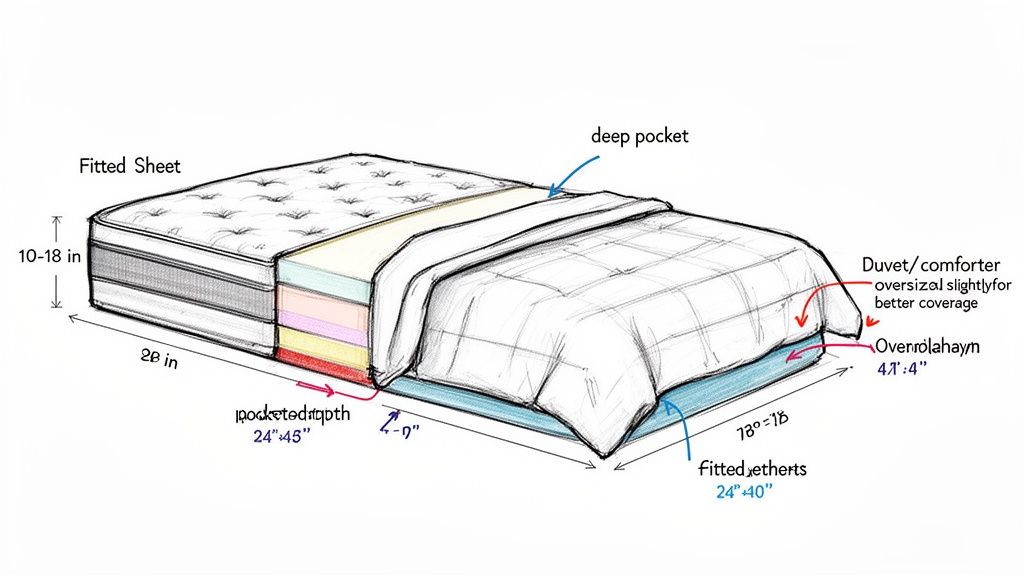
    Today’s mattresses come in a variety of thicknesses. You can find everything from slim, 8-inch models to plush pillow-tops that are well over 18 inches tall. A standard king fitted sheet is typically designed to fit mattresses in the 10- to 12-inch range. If your mattress is any thicker, that sheet simply won’t have enough fabric to wrap securely underneath, and you’ll be stuck fighting with the corners.

    Finding the Right Pocket Depth

    To avoid this common headache, the solution is simple. When you're shopping, keep an eye out for sheets labeled as “deep pocket” or “extra-deep pocket.”

    The packaging will almost always list the maximum mattress depth the sheet can handle, which typically falls somewhere between 15 and 22 inches. Just be sure to measure your mattress height before you shop to guarantee a secure, no-slip fit.

    The idea of a spacious king bed was a massive leap in sleep comfort. Prior to the 1950s, full-size beds were the norm, giving each person a mere 27 inches of space—less than a modern twin. As homes got bigger, so did the demand for more sleeping space. In fact, some research suggests upgrading to a king can reduce sleep disturbances caused by a partner by up to 50%. You can learn more about how the king bed became so popular and its effect on our sleep from Queen Anne Pillow.

    Sizing Comforters and Duvets

    This same logic applies to the top layers of your bed, like your comforter and duvet. While a standard king comforter will technically cover the surface of your mattress, it might not give you enough overhang on the sides. On a thicker mattress, this can look a bit skimpy.

    For a more luxurious, hotel-like look, consider sizing up. An oversized king or even a California king comforter will provide that extra drape needed to cover the sides of the mattress and frame. Plus, it’s a simple way to help end the nightly tug-of-war over the covers.

    Navigating Delivery and Setup Challenges

    So you've picked out your ideal king size bed, but now you might be wondering: how are you going to get that giant mattress and foundation into your bedroom? It can seem like a monumental task, but a little planning can make the whole process much smoother.

    The trick is to think like a delivery professional before your new bed even leaves the warehouse. Grab a tape measure and walk the entire path from your front door to its final destination. Measure the height and width of every doorway, hallway, and staircase on that route. Don’t forget to note any tight corners or low-hanging light fixtures that could get in the way. A good rule of thumb is to have at least a few inches of clearance on all sides to pivot and maneuver.

    The Split Box Spring Solution

    One of the biggest obstacles homeowners run into is the box spring or foundation. A standard, one-piece king box spring is a single, rigid frame measuring 76 by 80 inches. It’s notoriously difficult to wrangle up a flight of stairs or around a sharp 90-degree turn in a hallway.

    This is precisely why the split king box spring was invented. It’s a simple solution: two separate foundations, each measuring about the same as a Twin XL mattress (38" x 80"). These two smaller pieces are much easier to carry through tight spaces, and you just place them side-by-side on your bed frame to create the full king-size base.

    If you have an older home, narrow staircases, or any doubts at all, choosing a split box spring is one of the smartest moves you can make for a hassle-free delivery.

    • Measure First: Before you buy, confirm that the path to your bedroom can handle a large, inflexible item.
    • Consider a Split: If you foresee any issues with tight corners or stairs, opting for a two-piece split foundation is a proactive step that can save a lot of stress.

    Given the sheer size and weight of a king bed, you might also think about calling in experts. Using professional moving services for the initial setup can save hassle and prevent damage to your new bed or your home. A few proactive steps are all it takes to turn a potentially stressful day into a simple success.

    Frequently Asked Questions About King Bed Measurements

    You’ve sorted out the big measurements, but a few practical questions often pop up right before you’re ready to buy.

    Think of this as a quick-fire round to clear up those final, common concerns about king size bed measurements and make sure you have all the information you need.

    What Is the Minimum Room Size for a King Bed?

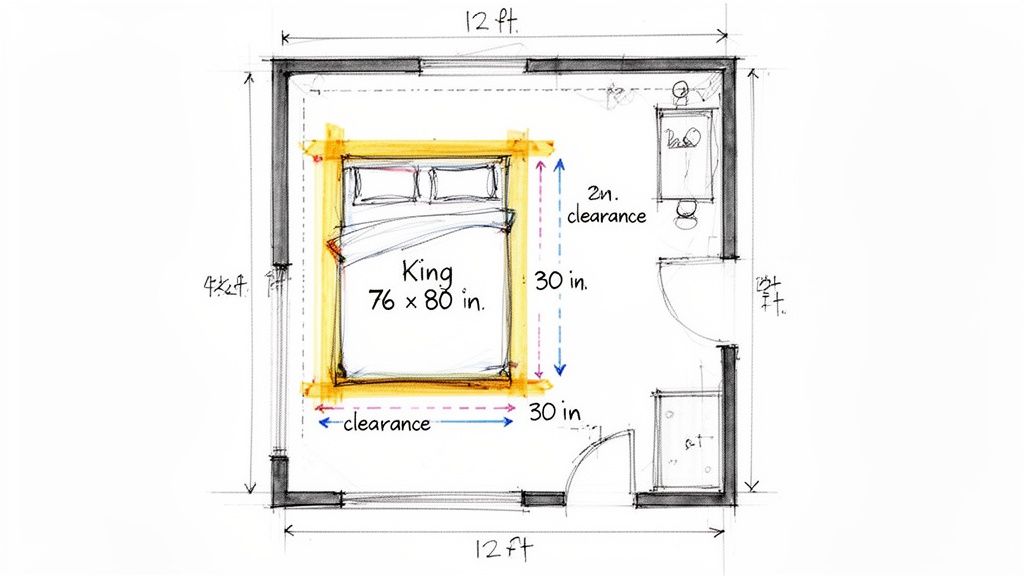
    We get this question frequently. For a standard king bed to feel comfortable—and not just crammed into a corner—your room should ideally be at least 12 feet by 12 feet.

    This isn't an arbitrary number; it’s about function. A room this size accommodates the bed itself (about 6.3 ft x 6.7 ft) while still leaving you that recommended 30 to 36 inches of clearance on three sides. That's the crucial space you need to walk around, open dresser drawers, and keep the room from feeling claustrophobic. If your room is smaller, a queen bed might be a more practical fit.

    Are King and California King Sheets Interchangeable?

    No, and mixing them up is a common and frustrating mistake. A standard king fitted sheet is cut for a 76" x 80" mattress, while a California king sheet is made for a different 72" x 84" shape.

    If you try to force a standard king sheet onto a Cal king mattress, you'll find it’s too wide and too short, leaving the corners exposed. Go the other way, and a Cal king sheet on a standard king will be too narrow to wrap around the sides, leaving you with bunched-up fabric at the head and foot. Always buy the sheet size that specifically matches your mattress name.

    Do I Need a Special Frame for a King Size Mattress?

    Yes, you need a frame built specifically for a king size mattress. It’s not just about matching the length and width; it’s a matter of proper structural support.

    A proper king frame must have center support legs. These legs prevent the mattress and foundation from bowing or sagging in the middle over time. Without that critical center support, your mattress can wear out prematurely, which leads to uncomfortable sleep and will almost certainly void your mattress warranty. Don't put a king mattress on a frame that’s missing this feature—it’s that important for the bed's lifespan and your comfort.


    Here at Woodstock Furniture & Mattress Outlet, our team is ready to walk you through these details in person. Stop by one of our North Georgia showrooms to see a great selection of mattresses and bed frames, and let our experienced staff help you find the right fit for your home. You can learn more and find a location near you right here.

  • 10 Practical Bedroom Furniture Arrangement Ideas

    10 Practical Bedroom Furniture Arrangement Ideas

    Arranging bedroom furniture is more than just deciding where the bed goes; it's about creating a space that feels balanced, functional, and genuinely restorative. A well-planned layout can transform a cluttered room into a peaceful sanctuary, improve traffic flow, and even contribute to better sleep. Many homeowners, however, face common challenges that generic advice fails to solve. How do you handle an awkward L-shaped room or a small bedroom where every square foot counts? How do you integrate a sitting area into a master suite without it feeling cramped?

    This guide provides actionable solutions to these real-world problems. We move beyond the basics to deliver ten distinct, problem-solving bedroom furniture arrangement ideas tailored to specific needs and room types. Each layout is designed to address a common pain point, from maximizing floor space in a kid's room to optimizing the flow in a bedroom with an ensuite bathroom.

    Inside, you will find practical rules, specific furniture sizing guidance, and clear traffic-flow tips to help you implement each concept effectively. We’ll explore proven layouts that work for various room shapes and sizes, helping you create a bedroom that not only looks thoughtfully designed but truly supports your daily lifestyle. Forget the guesswork and start building a functional, serene space today.

    1. The Centered Focal Point Layout

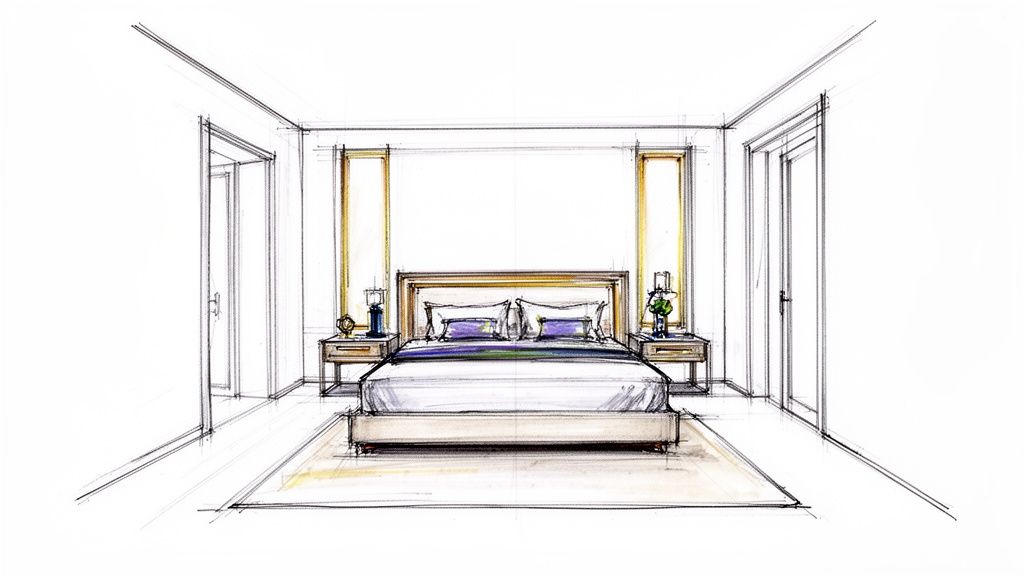
    The Centered Focal Point Layout is a timeless and popular approach to organizing a bedroom. This classic arrangement establishes the bed as the room's undisputed centerpiece by placing it against the longest, most prominent wall, usually the one you see first when entering. It's a foundational technique in interior design that creates a sense of order, calm, and deliberate composition, making it one of the most reliable bedroom furniture arrangement ideas.

    This layout is prized for its inherent symmetry and balance. By positioning the bed in the middle and framing it with matching nightstands, you create a visual anchor that the rest of the room revolves around. This approach not only looks intentional but also feels restorative, which is ideal for a space dedicated to rest. It is commonly seen in thoughtfully designed hotel rooms and master suites.

    A hand-drawn sketch of a contemporary bedroom layout featuring a bed, two nightstands, and two doors.

    How to Implement This Layout

    Successfully executing a centered layout depends on proportion and thoughtful placement. Your goal is to achieve harmony without making the space feel rigid or cluttered.

    • Establish the Anchor: Choose a substantial headboard to solidify the bed's role as the focal point. A well-chosen headboard can add texture, height, and style.
    • Balance with Nightstands: Select nightstands that are proportional to your bed. A large, king-sized bed looks well-balanced with wider nightstands, while a full or queen bed pairs well with more moderately sized tables. Ensure their height is level with or just slightly below the top of your mattress for easy access.
    • Maintain Clear Pathways: To ensure comfortable movement, leave at least 24 to 36 inches of clear walking space on both sides of the bed.
    • Create Symmetrical Storage: For complete visual balance, place a dresser or media console directly opposite the foot of the bed. This arrangement creates a satisfying sense of equilibrium.
    • Lighting and Finishing Touches: Mount matching wall sconces or place identical table lamps on each nightstand to reinforce the symmetry. To add softness and dimension, consider adding a bed skirt.

    2. The Corner Bed Placement Strategy

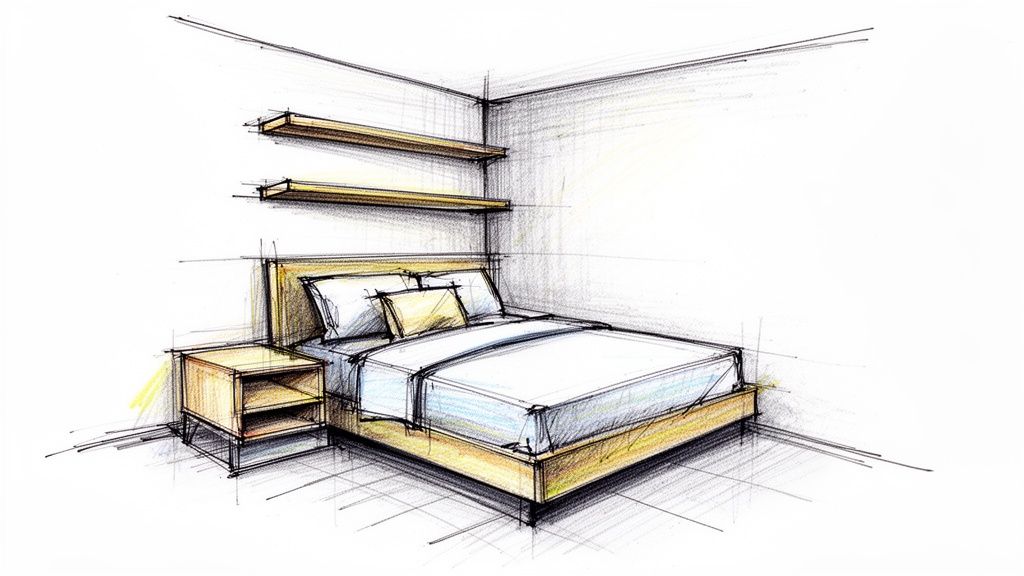
    The Corner Bed Placement Strategy is an innovative approach that tucks the bed into a corner, using two walls as an anchor. This arrangement creates a cozy, intimate sleeping nook and is one of the most effective bedroom furniture arrangement ideas for maximizing floor space. It is particularly useful in smaller bedrooms, studio apartments, or rooms with challenging layouts, like those often found in efficient Atlanta metro area homes or kids' bedrooms.

    This layout is a favorite in Scandinavian design because it challenges the traditional "bed against the center of a wall" rule. By pushing the bed into a corner, you open up a significant amount of central floor space, which can make a compact room feel surprisingly airy and spacious. This setup feels intentional and snug, transforming an underutilized corner into the room's most comfortable and functional zone. It's an ideal solution for guest rooms or multi-purpose spaces where flexibility is key.

    A hand-drawn sketch of a minimalist bedroom interior with a bed, nightstand, and floating shelves.

    How to Implement This Layout

    Successfully creating a corner bed layout is about smart furniture choices and space-saving techniques. Your goal is to make the corner feel like a deliberate design feature, not an afterthought.

    • Choose the Right Bed Frame: Opt for a low-profile headboard or no headboard at all to avoid a cramped look. A frame without a bulky footboard is essential to keep sightlines open and maintain a feeling of spaciousness.
    • Utilize Vertical Space: Install floating shelves above the bed in the corner. This provides a perfect spot for books, decor, and a small lamp without taking up any floor space.
    • Streamline Your Nightstand: Place a single, compact nightstand on the accessible side of the bed. This keeps essentials within reach while maintaining a clean, uncluttered look.
    • Think About Lighting: Since one side is against a wall, traditional lamps may not work. Consider mounting a wall sconce or a plug-in pendant light in the corner to provide focused task lighting for reading.
    • Keep Colors Light: Use light, neutral paint colors on the walls within the corner. This prevents the sleeping nook from feeling dark or enclosed and helps reflect light throughout the room.

    3. The Floating Bed Island Layout

    The Floating Bed Island Layout is a contemporary and dramatic approach that positions the bed away from the walls, turning it into a sculptural centerpiece. This sophisticated arrangement creates a "floating" effect, making a bold statement in larger bedrooms. It is one of the more daring bedroom furniture arrangement ideas, ideal for open-concept lofts or spacious master suites where you want to create distinct functional zones.

    This layout transforms the bed from a simple piece of furniture into a destination within the room itself. By pulling it away from the walls, you establish a dynamic and luxurious atmosphere often seen in boutique hotels and architectural magazine features. This approach requires ample square footage but rewards you with a unique, high-design aesthetic that redefines the entire space.

    How to Implement This Layout

    Executing this layout successfully is about creating a deliberate, well-anchored composition rather than just placing a bed in the middle of a room. The goal is to make the arrangement feel intentional and integrated.

    • Anchor the Space: Use a large area rug (at least 8×10 feet) to define the sleeping zone and visually ground the bed. The front legs of the bed and nightstands should sit comfortably on the rug.
    • Choose a Statement Headboard: Since the back of the bed is exposed, a headboard with a finished back or a compelling design is crucial. A substantial, well-crafted headboard can serve as a stunning focal point.
    • Maintain Ample Clearance: Ensure at least 30 to 36 inches of clear pathway on all sides of the bed. This generous spacing is essential for the layout to feel open and luxurious, not cramped.
    • Create a Functional Backdrop: Place a low console table, bench, or a pair of chairs behind the headboard to create a functional and stylish backdrop. This adds visual weight and utility to the arrangement.
    • Rethink Your Lighting: Traditional table lamps may not work if power outlets aren't in the floor. Instead, consider pendant lights hung from the ceiling over each nightstand or elegant floor lamps to provide balanced, ambient light.

    4. The Dual-Purpose Master Suite Layout

    The Dual-Purpose Master Suite Layout transforms a large bedroom into a multifunctional sanctuary that accommodates both rest and daily activities. This sophisticated approach is ideal for modern living, where the primary bedroom often doubles as a home office, a reading nook, or a private lounge. It stands out among bedroom furniture arrangement ideas by thoughtfully zoning a single space to serve distinct purposes without feeling cluttered.

    This layout is perfect for spacious master bedrooms where homeowners want to maximize every square foot. By creating separate zones for sleeping and living, you craft a resort-style environment that feels both luxurious and highly functional. It’s a design seen in high-end properties, offering a practical solution for remote workers or anyone seeking a private retreat within their own home.

    How to Implement This Layout

    Successfully creating a dual-purpose layout hinges on clear visual separation and cohesive design. The goal is to define distinct areas while maintaining a harmonious flow throughout the room.

    • Define Zones with Rugs: Use area rugs to create visual boundaries. Place a large rug under your bed and a separate, complementary rug in your seating or work area to clearly delineate the two spaces.
    • Create Functional Areas: Position a seating area or workspace opposite or perpendicular to the bed. For a home office zone, ensure you have a comfortable desk chair and dedicated task lighting to prevent eye strain.
    • Balance Furniture and Storage: Choose furniture that works for both zones. A versatile dresser, for instance, can store clothing while also organizing office supplies. Maintain at least 30 to 36 inches of pathway between zones for easy movement.
    • Layer Your Lighting: Install different lighting for each function. Use soft, ambient lighting like table lamps near the bed and brighter, focused task lighting over a desk or reading chair.
    • Maintain Cohesion: Tie the zones together by using a consistent color palette and similar furniture finishes. A neutral backdrop allows you to add unique accents to each area, giving them personality while ensuring the entire room feels connected. Consider an open bookshelf as a gentle divider that adds storage without closing off the space.

    5. The Window-View Priority Layout

    The Window-View Priority Layout is an arrangement that elevates your bedroom's best architectural feature: its window. This approach positions the bed to either face or frame the window, making natural light and the outdoor scenery the room's main attraction. It’s one of the most refreshing bedroom furniture arrangement ideas, especially for rooms with scenic views.

    This layout is deeply rooted in biophilic design principles, which emphasize a connection to nature to improve well-being. By prioritizing the view, you create a dynamic and calming environment that changes with the time of day and seasons. It's an ideal choice for transforming a master suite into a resort-like retreat, where waking up to sunlight and nature becomes part of your daily routine.

    Watercolor sketch of a serene bedroom with a bed, large window overlooking nature, and floating shelf.

    How to Implement This Layout

    Successfully creating a window-focused layout is about enhancing the view, not obstructing it, while maintaining functionality and comfort.

    • Orient the Bed: Place your bed directly facing the window for an immersive experience, or on the wall adjacent to it so the view is to your side. A bed with a low-profile headboard is an excellent choice to keep sightlines clear.
    • Control the Light: Invest in a layered window treatment. Combine sheer curtains for daytime privacy and light diffusion with blackout curtains to ensure you can control light levels for restful sleep.
    • Frame the Feature: Use decorative drapery panels on either side of the window to frame it like a piece of art. This adds softness and a touch of elegance to the focal point.
    • Create a Functional Zone: Enhance the window area by adding a comfortable armchair or a low bench beneath it. This creates a cozy reading nook and makes the space more intentional.
    • Balance the Room: Place a dresser or console table on the wall opposite the window. This provides necessary storage without competing for attention and helps balance the room's visual weight. Ensure pathways remain clear, with at least 24 to 30 inches for easy movement around the furniture.

    6. The L-Shaped Bedroom Configuration

    The L-Shaped Bedroom Configuration is a strategic approach designed to maximize the potential of rooms with unconventional layouts. This method embraces architectural quirks, such as alcoves or angled walls, by arranging furniture to create distinct, functional zones. It’s a smart solution for rooms that defy a simple, symmetrical setup, transforming awkward spaces into highly practical and organized bedrooms.

    This layout is particularly valuable in homes with unique architectural features. Instead of fighting against an irregular floor plan, this configuration works with the room's natural lines. By thoughtfully placing furniture within the two "legs" of the L-shape, you can establish separate areas for sleeping and other activities like dressing, working, or reading. This is one of the most effective bedroom furniture arrangement ideas for making an odd-shaped room feel intentional and cohesive.

    How to Implement This Layout

    Successfully arranging an L-shaped room depends on careful measurement and creating a sense of visual harmony across the different zones. The goal is to make the unconventional shape feel like a deliberate design choice rather than a limitation.

    • Anchor the Main Zone: Place the bed against the longest, most prominent wall in the main section of the L. This establishes a clear primary zone dedicated to rest and relaxation.
    • Utilize the Secondary Leg: Position secondary furniture, like a dresser, vanity, or small desk, in the shorter leg of the L. This creates a functional secondary zone that feels separate yet connected.
    • Choose Proportional Furniture: Select pieces that fit comfortably within each specific area. Avoid oversized furniture that can overwhelm one section and make the room feel unbalanced. Modular furniture can be an excellent choice for its adaptability.
    • Unify with a Rug: Use a large area rug to visually connect the two zones. Placing the rug so that it bridges both sections helps tie the entire room together and defines the space.
    • Create Visual Cohesion: Paint all walls the same color to minimize the irregularity of the room's shape and create a unified backdrop. You can also use mirrors strategically to reflect light and make the space feel larger and more open.
    • Plan Your Lighting: Install lighting that serves both zones effectively. Consider a central overhead fixture for general illumination, supplemented by task lighting like a desk lamp or reading sconce in the secondary area.

    7. The Bedroom with Ensuite Bathroom Flow Layout

    The Bedroom with Ensuite Bathroom Flow Layout is a modern approach that prioritizes a seamless connection between your sleeping area and a private bathroom. This arrangement strategically positions furniture to create an intuitive and unobstructed path to the ensuite, enhancing daily routines while preserving the bedroom's tranquil atmosphere. It's a crucial consideration in master suites where the integration of bedroom and spa-like bathroom is a key element of the home's design.

    This layout transforms a master bedroom into a cohesive personal retreat. By carefully planning the flow, you avoid creating an awkward or disjointed space, ensuring that frequent trips to the bathroom don't disrupt the room's primary purpose: rest. It is a hallmark of thoughtful residential architecture, commonly seen in new construction and luxury properties aiming for a resort-style living experience. This is one of the more functional bedroom furniture arrangement ideas for contemporary living.

    How to Implement This Layout

    Creating a successful ensuite flow is about balancing accessibility with privacy. The goal is to make the two spaces feel connected yet distinct, supporting both your morning and evening routines without compromise.

    • Prioritize Privacy: Position your bed so it is not in the direct line of sight from the bathroom door. This creates a sense of separation and comfort, especially in a shared space.
    • Define Zones with Rugs: Use area rugs to visually separate the main sleeping area from the path to the bathroom. A well-placed runner or a large rug under the bed can establish clear zones without physical barriers.
    • Coordinate Finishes: Create visual harmony by selecting a color palette and materials that complement both the bedroom and bathroom. This continuity makes the transition between spaces feel natural and intentional.
    • Create a Transition Area: Place a stylish bench at the foot of the bed or a small seating area with an accent chair just outside the bathroom. This creates a functional "buffer zone" for dressing or relaxing.
    • Choose Appropriate Furniture: If placing a dresser or chest near the bathroom entrance, consider materials with moisture-resistant finishes. Many brands feature durable options suitable for various home environments.
    • Manage Lighting: Ensure bathroom lighting doesn't spill into the bedroom and disturb a sleeping partner. Dimmers and targeted task lighting in the ensuite are essential for nighttime use.

    8. The Multi-Purpose Kids' Bedroom Layout

    The Multi-Purpose Kids' Bedroom Layout is a functional and adaptable approach designed to accommodate sleeping, studying, playing, and storage within a single room. This arrangement prioritizes durability, safety, and age-appropriate design, allowing the space to evolve with a child from toddler to teen. It’s an essential strategy for maximizing limited space and is one of the most practical bedroom furniture arrangement ideas for growing families.

    This layout excels at creating distinct "zones" for different activities, which helps maintain order and gives children a sense of ownership over their environment. By clearly defining areas for rest, work, and play, you can design a room that feels both organized and spacious, even when square footage is tight. This thoughtful approach helps select furniture that can serve multiple functions and support a child's development.

    How to Implement This Layout

    Creating a successful multi-purpose kids' room is about smart furniture choices and strategic zoning. The goal is to build a flexible environment that supports various needs without feeling chaotic.

    • Zone the Space: Use area rugs and furniture placement to create separate zones. For instance, place a desk and chair near a window for a dedicated study nook, and use a small rug and storage bins to define a play area.
    • Go Vertical: Maximize floor space with bunk beds or loft beds. This opens up valuable room below for a desk, a reading corner, or additional storage, making it ideal for shared sibling bedrooms.
    • Select Quality Bedding: Choose a durable twin or full mattress that provides proper support for growing bodies and ensures restorative sleep.
    • Prioritize Smart Storage: Incorporate modular furniture that can be reconfigured as your child grows. Use under-bed drawers, wall-mounted shelving, and storage ottomans to keep toys, clothes, and books organized and accessible.
    • Layer the Lighting: Use multiple light sources to suit different activities. A bright task lamp is essential for the desk, a soft, warm lamp works well for a reading corner, and an overhead light can illuminate the entire play space.
    • Plan for Durability: Choose furniture with resilient finishes and opt for washable paint on the walls. A child's room should be built to handle daily life, from homework sessions to creative messes.

    9. The Under-Window Bed Nook Layout

    The Under-Window Bed Nook Layout is a charming arrangement that positions the bed directly beneath a window or a series of windows. This design choice transforms the bed into a cozy, light-filled nook, creating an intimate and inviting sleeping environment. It’s an effective strategy for maximizing natural light and turning an architectural feature into the room's highlight, making it one of the most aesthetically pleasing bedroom furniture arrangement ideas.

    This layout is celebrated for its ability to make a room feel both airy and snug. Placing the bed under a window draws the eye upward, highlighting the room's height and the view outside. It is a hallmark of cottage, farmhouse, and Scandinavian design styles, which prioritize natural elements and a sense of warmth. This arrangement is particularly effective in smaller bedrooms, guest rooms, or historic homes with distinctive window frames, where it adds character and charm.

    How to Implement This Layout

    Creating a successful under-window nook requires balancing light control, functionality, and comfort. The goal is to craft a space that feels intentional, cozy, and practical for daily use.

    • Choose a Low-Profile Bed: Select a bed with a low headboard or no headboard at all to avoid obstructing the window and your view. This maintains clear sight lines and allows maximum sunlight to enter the room.
    • Prioritize Light Control: Install effective window treatments to manage light and privacy. Blackout curtains or cellular shades provide excellent control, allowing you to darken the room for sleep.
    • Create Functional Bedside Storage: Since traditional nightstands might block window access, consider using floating shelves on either side of the window. C-shaped tables that can slide over the mattress also work well as space-saving solutions.
    • Manage Thermal Comfort: Windows can be a source of drafts or heat. Invest in a mattress with temperature-regulating properties to ensure you stay comfortable regardless of the season.
    • Enhance the Nook Feeling: Add layers of texture with throw pillows and a plush blanket to make the space feel extra cozy. Wall-mounted reading lights on either side of the window frame can provide focused lighting for nighttime reading.

    10. The Adjacent Nightstand Storage Solution Layout

    The Adjacent Nightstand Storage Solution Layout is a highly functional approach that prioritizes organization and accessibility. This method treats storage furniture not as afterthoughts but as integral components of the bedroom's core design. By strategically placing dressers and nightstands adjacent to and around the bed, this layout creates an efficient, cohesive, and clutter-free environment perfect for modern living.

    This arrangement is particularly valuable for those who need to maximize every square inch for storage without sacrificing style. A thoughtful layout can showcase both aesthetic harmony and real-world functionality. It turns your bedroom into a well-organized sanctuary where everything has its place, making daily routines smoother and more peaceful.

    How to Implement This Layout

    Creating a storage-centric layout requires a focus on proportion and smart placement. The key is to integrate storage pieces seamlessly so they enhance the room's flow and feel intentional rather than crowded.

    • Select Smart Nightstands: Choose nightstands with multiple drawers or shelving. For optimal bedside convenience and storage, carefully consider the placement and style of nightstands to complement your bed arrangement. Many brands offer options with both style and ample storage.
    • Balance with a Dresser: Position a substantial dresser directly across from the foot of the bed or along an adjacent wall. This creates visual balance and consolidates clothing storage in one accessible zone.
    • Maintain Clear Pathways: To ensure the room remains easy to navigate, leave at least 24 to 36 inches of clearance around major furniture pieces like the bed and dresser.
    • Go Vertical with Storage: Install floating shelves above your dresser for displaying photos, books, or decorative items, freeing up the surface for daily-use items.
    • Coordinate for Cohesion: Opt for a matching bedroom set or pieces with coordinating finishes and hardware. This creates a unified look that makes the integrated storage feel deliberate and high-end. Use drawer dividers to maximize the efficiency of every inch of storage space.

    Top 10 Bedroom Layouts Comparison

    Layout Implementation complexity Resource requirements Expected outcomes Ideal use cases Key advantages
    The Centered Focal Point Layout Low — straightforward, symmetrical setup Moderate — bed, matching nightstands, clear wall space Balanced, organized visual focus Master bedrooms, hotels, most room sizes Strong symmetry, easy to style
    The Corner Bed Placement Strategy Low–Medium — simple placement, access trade-offs Low — compact frames, possible single nightstand Space-saving, cozy sleeping nook Small bedrooms, studios, rentals Maximizes floor area, intimate feel
    The Floating Bed Island Layout High — requires careful clearance and anchoring High — large room, area rug, bespoke lighting Dramatic, modern, clearly zoned space Large master suites, lofts, designer homes High-end aesthetic, 360° access
    The Dual-Purpose Master Suite Layout High — complex zoning and balance High — extra seating, desk, larger square footage Multifunctional, hotel-like retreat Remote workers, spacious master bedrooms Increases functionality and resale appeal
    The Window-View Priority Layout Medium — light and sightline management needed Moderate — quality window treatments, low headboard Enhanced natural light, outdoor connection Rooms with scenic windows, biophilic designs Better circadian alignment, strong views
    The L-Shaped Bedroom Configuration Medium–High — requires measurement and planning Moderate — scaled or custom/modular pieces Makes odd shapes functional; distinct zones L-shaped or angled rooms, attics, historic homes Turns awkward plans into usable space
    The Bedroom with Ensuite Bathroom Flow Layout Medium — traffic flow and visual coordination Moderate — coordinated finishes, humidity control Efficient routines, cohesive bedroom-bath flow Master suites with attached baths, luxury homes Convenience, improved daily workflow
    The Multi-Purpose Kids' Bedroom Layout Medium — flexible planning for multiple zones Moderate — durable furniture, storage solutions Organized, adaptable space for play/study/sleep Kids' and teen rooms, shared bedrooms Multi-functionality, grows with the child
    The Under-Window Bed Nook Layout Low–Medium — light control and headboard choices Low–Moderate — good window treatments, low bed Cozy, light-filled alcove Small to medium bedrooms, cottages, bay windows Charming aesthetic, preserves wall space
    The Adjacent Nightstand Storage Solution Layout Medium — balancing storage and circulation Moderate — coordinated nightstands, dressers Highly organized, accessible storage Families, practical master bedrooms, staged homes Maximizes storage and daily convenience

    Bringing Your Ideal Bedroom Layout to Life

    Choosing the right bedroom furniture arrangement is about more than just fitting pieces into a room; it’s about crafting an environment that supports your lifestyle, promotes tranquility, and reflects your personal taste. Throughout this guide, we've explored ten distinct layout strategies, from the classic Centered Focal Point that creates immediate balance to the clever Corner Bed Placement designed to maximize every square inch of a compact room. We’ve seen how a Floating Bed Island can add a touch of luxury to a spacious master suite and how a Dual-Purpose Layout can seamlessly integrate a home office or a relaxing reading nook into your personal sanctuary.

    Each of these bedroom furniture arrangement ideas serves as a blueprint, not a rigid rule. The true magic happens when you adapt these concepts to your unique space and needs. Remember the core principles we've discussed: establishing a clear focal point (usually the bed), ensuring unobstructed traffic flow with at least 30-36 inches for main pathways, and layering lighting to create both function and ambiance. Whether you're tackling an L-shaped room or optimizing flow around an ensuite bathroom, the goal remains the same: to build a cohesive, comfortable, and highly functional space.

    Key Takeaways for Your Design Journey

    As you move from planning to placement, keep these essential takeaways in mind:

    • Measure Everything: Before you move a single piece of furniture or make a new purchase, measure your room, your doorways, and your existing furniture. A detailed floor plan, even a simple sketch, is your most powerful tool for avoiding costly and frustrating mistakes.
    • Function First, Form Second: Ask yourself what you need your bedroom to do. Is it purely for sleep? Does it need to accommodate a workspace, a vanity area, or extensive storage? Prioritizing your functional needs will guide your layout decisions and ensure the final arrangement serves you well day in and day out.
    • Embrace Iteration: Your first attempt at a new layout might not be perfect, and that's okay. Live with an arrangement for a few days. Walk through the space at different times, notice any pinch points or awkward transitions, and don't be afraid to tweak the placement of a chair, a rug, or a lamp until it feels just right. Sometimes, the most effective solutions are discovered through trial and error.

    Expert Insight: The most successful bedroom designs are those that feel personal and intentional. Don't be afraid to break from convention if it means creating a layout that genuinely works for you. To move beyond traditional designs and truly personalize your space, explore some uncommon furniture arrangements that can work wonders in any room, including your bedroom.

    Ultimately, mastering these bedroom furniture arrangement ideas empowers you to transform your most personal space into a true haven. It's a skill that allows you to adapt to new homes, evolving needs, and changing tastes with confidence. By applying these principles, you can create a bedroom that is not only beautiful and organized but also a powerful tool for enhancing your daily well-being and ensuring restorative rest. Your perfect bedroom is waiting to be discovered, one well-placed piece of furniture at a time.


    Ready to find the perfect pieces for your new layout? Visiting a showroom allows you to see, touch, and experience furniture firsthand, making it easier to visualize how it will work in your space. At Woodstock Furniture & Mattress Outlet, our friendly, knowledgeable team can help you navigate our great selection and provide expert guidance to bring your ideal bedroom furniture arrangement ideas to life.

  • What Size Is a King Bed? Your Complete Dimensions Guide

    What Size Is a King Bed? Your Complete Dimensions Guide

    If you've ever asked, "what size is a king bed?", you're not alone. The simple answer is that a standard king bed is 76 inches wide by 80 inches long.

    A helpful way to visualize this is to picture two Twin XL mattresses sitting side-by-side. Put them together, and you have the exact footprint of a standard king. This generous width is precisely why it’s a popular choice for couples who want more personal space.

    Understanding Standard King Bed Dimensions

    A standard king mattress, which you'll sometimes hear called an Eastern King, is one of the widest mattress sizes you’ll typically find. That expansive surface gives each sleeper 38 inches of personal space. To put that in perspective, that's a significant upgrade in elbow room compared to what a full or queen mattress can offer. This makes it a great mattress for couples who value stretching out without bumping into their partner all night.

    The king bed became more common during the post-WWII suburban boom in the 1950s and 60s. As American homes became larger, so did the desire for more spacious furniture. The king bed fit that need well and has remained a popular option for master bedrooms ever since. If you're curious, you can find some interesting information on how mattress sizes evolved and became standardized over the years.

    Standard King Bed Dimensions at a Glance

    To make it even easier to picture how a king bed will fit in your space, we've put together this quick reference with all the key numbers.

    Measurement Inches Feet Centimeters
    Width 76" ~6.33 ft ~193 cm
    Length 80" ~6.67 ft ~203 cm
    Surface Area 6,080 sq. in. ~42.2 sq. ft ~39,174 sq. cm

    Having these measurements handy will be very useful when you're taping out the floor of your bedroom or shopping for a new bed frame.

    Comparing a King Bed to Other Mattress Sizes

    Knowing the exact dimensions of a king bed is a great start, but those numbers only tell part of the story. To get a feel for how it works in a real room, it helps to compare it to other popular sizes, like the Queen and California King. Understanding these trade-offs is key to picking a mattress that fits your life.

    A standard king mattress offers the most width available in standard mattress sizing. That makes it an excellent choice for couples who prefer their own personal space. If you find yourself sharing the bed with kids or pets, that extra real estate can be the difference between a restless night and a peaceful one.

    King vs. Queen: The Width Factor

    The most noticeable difference between a king and a queen is the width. A king bed is a full 16 inches wider than a queen. While they’re both the same length (80 inches), that extra foot-and-a-half of side-to-side space on a king is like giving each person their own Twin XL mattress to sleep on. For many, that's a significant improvement in comfort.

    On the other hand, a queen bed, at 60 inches wide, is often a more practical choice for smaller master bedrooms. It still provides ample space for a single sleeper and is usually comfortable for couples who don't mind sleeping closer together.

    King vs. California King: Length vs. Width

    This is where things can get a little confusing for shoppers, so let's clear it up. A California King is not wider than a standard king. In fact, it’s actually four inches narrower, measuring 72 inches across. The trade-off is that it’s also four inches longer, hitting 84 inches from head to toe. This makes it a great mattress for taller folks (usually over 6 feet tall) who are tired of their feet dangling off the end of the bed.

    The decision really boils down to this: a standard king is built for more width, while a California King is built for more length. Pick the one that solves your biggest sleep problem.

    It’s an interesting bit of history that the California King was introduced back in the 1960s to offer a longer option for taller individuals, providing 7% more length than a standard king. You can read more about the history of mattress standardization and its impact if you're curious!

    For our North Georgia customers, we're seeing more people pair spacious king mattresses from brands like Helix or DreamCloud with adjustable bases. They can be helpful for improving circulation and easing back pain.

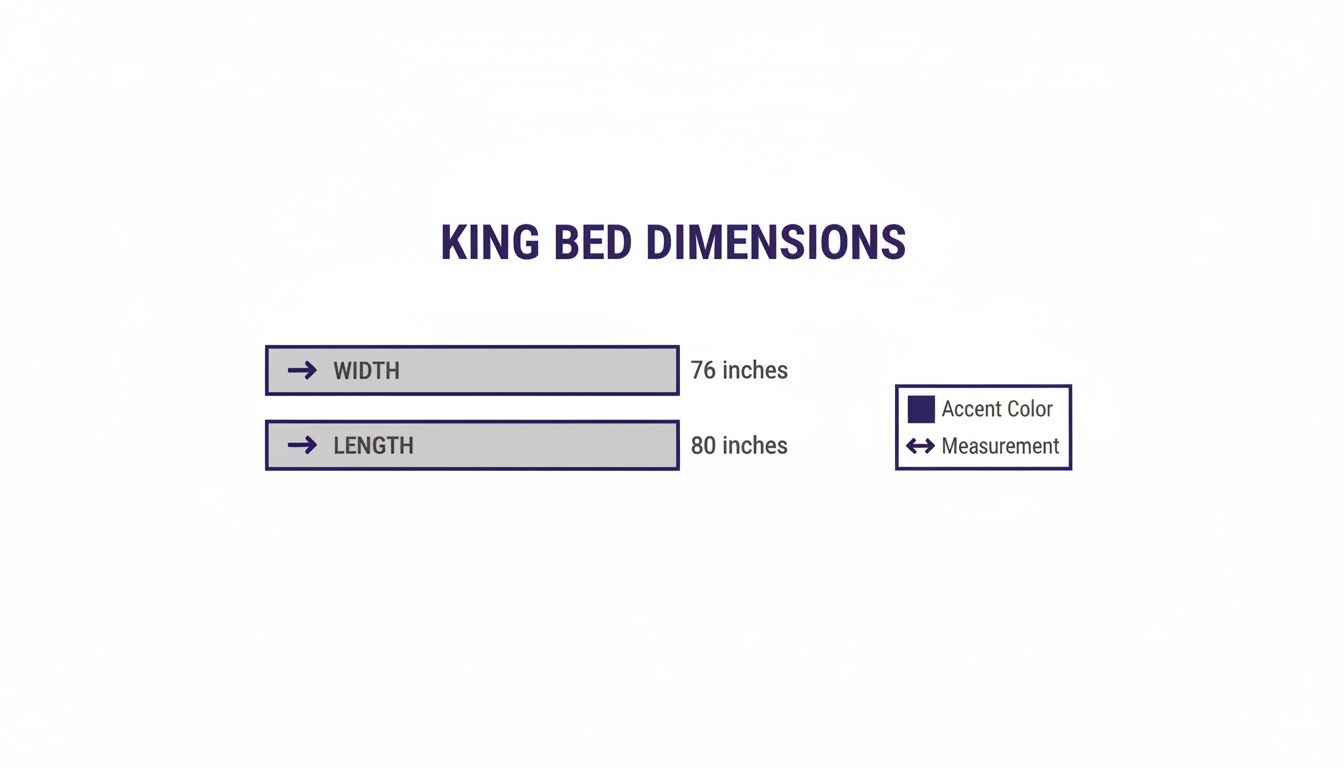
    This diagram gives you a simple, clear look at a standard king bed's measurements.

    A diagram illustrating the standard width and length dimensions for a King size bed.

    As you can see, that 76-inch width is the defining feature that delivers its roomy feel, especially for couples.

    To make comparing sizes even easier, we've put together this simple chart.

    Mattress Size Comparison Chart

    Mattress Size Dimensions (Inches) Surface Area (Sq. Inches) Best For
    Twin 38" x 75" 2,850 Children, single adults in small spaces
    Twin XL 38" x 80" 3,040 Taller children, college dorms, single adults
    Full 54" x 75" 4,050 Single sleepers who want more width
    Queen 60" x 80" 4,800 Single sleepers, couples, guest rooms
    King 76" x 80" 6,080 Couples who value personal space, families
    California King 72" x 84" 6,048 Taller individuals and couples (over 6')

    Seeing the numbers side-by-side really helps put the sheer size of a king mattress into perspective.

    Will a King Bed Fit in Your Bedroom?

    We see it all the time. A customer loves the spacious feel of a king mattress, only to get it home and realize it swallows their bedroom. A common pitfall when buying a king bed is underestimating its sheer size. A little planning upfront can save you a ton of hassle and keep your bedroom feeling like a peaceful retreat, not a cluttered obstacle course.

    As a good rule of thumb, your bedroom should be at least 12 feet by 12 feet to comfortably house a king bed. This size generally gives you enough room for the bed itself, a couple of nightstands, and a dresser without making the room feel cramped.

    Floor plan sketch showing a 12x12 ft room with a King bed, clearances, and furniture.

    Measure Twice, Buy Once

    Before you start browsing, grab a tape measure. Accurately measuring your room is the one step you should not skip.

    Once you have your room's dimensions, here's a simple trick we always recommend: use painter's tape to mark out the bed's footprint (76 inches by 80 inches) on the floor. This gives you a powerful visual of exactly how much space it will take up. It's much more effective than just trying to picture the numbers in your head.

    Your goal is to leave at least 30 inches of clearance around the sides and foot of the bed. This is a good amount of space for comfortable walking paths and for opening drawers or closet doors without having to squeeze by.

    That clearance is what keeps your bedroom functional. Anything less, and the room starts to feel difficult to navigate. If you want to get a better sense of your layout without the guesswork, you can even use a home design AI tool to get a clear preview of your new bedroom setup.

    Choosing the Right Frame and Foundation

    A great mattress is only half the equation for a good night's sleep; what’s underneath it is just as important. The right support system isn't just for looks—it plays a huge role in how your mattress performs and how long it lasts. Let's make sure your entire bed setup works together.

    Your frame or foundation choice should fit both your mattress type and your lifestyle. For example, most memory foam or hybrid mattresses sold today work well on a solid platform bed. This setup gives them the firm, even support they need to feel their best.

    Common Foundation Types for a King Bed

    When it comes to supporting your king mattress, you generally have three main options. Each one has its own set of benefits, and figuring out which one is right for you is a key step to building a comfortable bed.

    • Box Spring: This is the traditional choice, typically a fabric-wrapped wooden frame. For a king mattress, you'll almost always see a "split" foundation, which is just two separate Twin XL-sized boxes placed side-by-side. This design makes it much easier to navigate tight corners, stairwells, and doorways during delivery.

    • Platform Bed: These beds have a built-in solid or slatted surface, which means you don't need a separate box spring. They offer a clean, modern look and the kind of consistent support that memory foam and hybrid mattresses thrive on.

    • Adjustable Base: If you want more customizable comfort, an adjustable base lets you raise your head and feet with a remote. It's a great option for anyone who likes to read or watch TV in bed, or for those who need to sleep in a specific position to help with things like snoring or acid reflux.

    One of the biggest things to think about when it comes to a king foundation is just getting it into your house. A split foundation (two 38” x 80” bases) is the standard for a reason—trying to move a single 76” x 80” foundation through a doorway would be next to impossible for most people.

    Finding the Perfect Bedding for Your King Bed

    You’ve brought home your new king mattress, and now comes the fun part: dressing it up. But this is also where many people run into a common snag, especially when it comes to the difference between a standard king and a California king. We see this all the time. Just remember this one critical fact: their bedding is not interchangeable.

    It all comes down to their different shapes. A standard king is wider and a bit shorter (76" x 80"), while a Cal king is narrower but longer (72" x 84"). If you try to put a Cal king fitted sheet onto a standard king mattress, you'll find it's too narrow to fit and has frustrating extra fabric at the ends. The reverse is just as problematic; a standard king sheet will never stretch to cover the full length of a Cal king. Getting this right is the key to a snug, clean fit.

    Detailed diagram illustrating bed dimensions and various bedding components like fitted sheets and duvets.

    Tips for a Perfect Fit

    Beyond just grabbing the right "king" label off the shelf, a couple of tips can make a world of difference in how your bed looks and feels.

    • Check Mattress Depth: Today's mattresses come in all sorts of thicknesses, from sleek low-profile models to plush pillow tops. Before you buy a fitted sheet, always check the "pocket depth" listed on the packaging. This tells you the maximum mattress height it can handle, ensuring it wraps securely around the corners without popping off every time you move.
    • Consider Upsizing Your Comforter: For a luxurious, hotel-style vibe where the comforter drapes generously over the sides, consider buying your comforter or duvet one size up. Using a California king comforter on a standard king bed provides extra overhang for better coverage and a plush look.

    Paying close attention to these details isn't a new concept. While massive communal beds like the 11×11 foot Great Bed of Ware existed in the 16th century, the California King didn't show up until the 1960s to accommodate taller people. Even now, bed sizes vary across the globe, with places like New Zealand and Portugal having their own unique king dimensions. You can learn more about the fascinating history of bed sizes if you're curious.

    Common Questions About King Size Beds

    Even after you've done your homework, a few questions always seem to pop up when shoppers are trying to decide if a king bed is the right choice. Getting straight answers can make all the difference, so we've put together the most common questions we hear on our showroom floors to help you feel confident in your choice.

    Are a King and a California King the Same Size?

    No, and this is probably the single most common point of confusion we see. They are different. A standard king is wider and a bit shorter, clocking in at 76 inches wide by 80 inches long. This makes it a great choice for couples who value their personal space and don't want to bump elbows all night.

    A California king, on the other hand, flips those priorities. It's narrower but longer, measuring 72 inches wide by 84 inches long. That extra length makes it a helpful solution for taller folks who are tired of their feet dangling off the end of the bed. Just remember to buy the right sheets and frame for whichever one you choose!

    Can I Use Two Twin XL Mattresses on a King Frame?

    Yes, you can! In fact, it's a popular and clever setup that we call a split king. When you place two Twin XL mattresses side-by-side, they measure 76" x 80" — the exact same dimensions as a standard king mattress.

    This is the go-to configuration for adjustable bed bases. It allows each person to raise or lower their side of the bed independently. So, if one of you wants to sit up and read while the other lies flat, a split king makes it happen.

    Key Takeaway: A split king offers customized comfort for couples. It's the standard solution for pairing a king size bed with an adjustable base, giving you a level of flexibility that a single mattress just can't match.

    What Is the Minimum Room Size for a King Bed?

    To keep your bedroom from feeling like it's all bed and nothing else, we generally recommend a room that's at least 12 feet by 12 feet. This usually gives you enough room for the bed and a couple of nightstands, plus the crucial 30 inches of clearance on both sides and at the foot of the bed. You'll want that walkway space for getting around without stubbing your toes or bumping into furniture.


    At Woodstock Furniture & Mattress Outlet, our team is always here to answer any other questions you might have and help you find the right sleep setup for your home. Feel free to visit one of our North Georgia locations to see these options for yourself.

    Explore Our Mattress Collection

  • A Guide to the Dimensions of a King Size Bed

    A Guide to the Dimensions of a King Size Bed

    If you're ready to upgrade to a king size bed, you're not alone. But before you dive in, there's a crucial detail to nail down: which kind of king are you talking about?

    Most people don't realize there are two main types of king mattresses here in the U.S. Getting the dimensions straight from the get-go is the single most important step to make sure you end up with a bed that actually fits your room and your lifestyle.

    Your Quick Guide to King Bed Dimensions

    Let's cut right to the chase. A standard king size bed—often called an Eastern King—measures 76 inches wide by 80 inches long. It's the widest standard mattress available, making it a popular choice for couples who want plenty of personal space.

    This size became more common in the mid-20th century as bedrooms in American homes started getting bigger. The logic was simple: a standard king is the exact same size as two Twin XL mattresses pushed together. This setup gave each person their own distinct sleep zone. You can find more on the history of mattress sizes at mllinens.com.

    Visual comparison of Standard (Eastern) King and California King bed dimensions, showing width and length.

    Comparing Standard and California King

    The other major option is the California King, and this is where people sometimes get mixed up. It’s not bigger overall; it just distributes its size differently. It's longer, but also narrower than a standard king.

    Seeing the numbers side-by-side makes the trade-off clear.

    King vs. California King Dimensions at a Glance

    Feature Standard King (Eastern King) California King
    Width 76 inches 72 inches
    Length 80 inches 84 inches
    Total Area 6,080 sq. inches 6,048 sq. inches

    As you can see, the total surface area is nearly identical. The choice really boils down to your priorities.

    The key takeaway is simple: If you want maximum width for you, a partner, and maybe even kids or pets who like to pile in, the standard king is your answer. If you're tall and need extra legroom to avoid dangling feet, the California king was designed specifically to solve that problem.

    This fundamental difference in shape—wider versus longer—is the most important factor to consider. As we continue, we’ll dig into how these measurements translate into real-world comfort and what they mean for your room’s layout.

    Choosing Between a Standard and California King

    The raw numbers on a king-size bed only tell you part of the story. The real decision between a standard king and a California king comes down to solving a specific problem you’re having with your current sleep setup. It’s less about which one is technically "bigger" and more about which shape is going to improve your sleep.

    Here's an easy way to think about it: are you constantly fighting for more space side-to-side, or are your feet always hanging off the end? Once you answer that question, the right choice becomes much clearer.

    When to Choose a Standard King

    The standard king—sometimes just called an "Eastern King"—is all about width. At 76 inches wide, it gives each person in a couple the exact same amount of personal space as if they were sleeping alone on a Twin XL mattress. That alone makes it a great solution for some very common bedroom dilemmas.

    • You sleep with a partner who moves around a lot. If your partner is an active sleeper—tossing, turning, or pulling the covers—those extra inches of width create a much-needed buffer zone. Their movements are far less likely to jolt you awake.
    • Kids or pets frequently pile into bed with you. For families who enjoy a weekend morning snuggle or have a large dog who shares the bed, that extra width can be essential. It transforms the bed from a two-person sleeping space into a comfortable family hub.
    • You just prefer having more personal space. Some of us just like to spread out. A standard king ensures you can stretch your arms and legs out wide without encroaching on your partner’s side.

    If your main goal is to get more elbow room and stop feeling crowded, the standard king is almost always the right call.

    A standard king is designed to solve the problem of width. It’s the go-to for couples, co-sleepers, and anyone who feels boxed in by their current mattress.

    When a California King Makes More Sense

    On the other hand, the California king is a specialist. It trades four inches of width for four extra inches of length, measuring in at 72 inches wide by 84 inches long. That might not sound like a huge swap, but for a very specific group of people, it makes all the difference.

    A California king is likely your best fit if:

    • You or your partner are over six feet tall. This is the number one reason to get a Cal king. Those four inches of extra length mean no more feet dangling off the edge of the bed. Taller folks can finally stretch out completely and sleep in a natural, comfortable position.
    • Your bedroom is long and narrow. The slightly slimmer, longer profile of a California king can work well in a room that's more of a rectangle than a square. It can make the whole layout feel more balanced, preventing the room from looking cramped.

    The choice is an incredibly practical one. The California king was developed to solve the problem of beds being too short for taller sleepers. If that’s your biggest frustration, giving up a little width is a fair trade-off for a full night of comfortable, stretched-out sleep.

    How to Properly Measure Your Room for a King Bed

    It’s a common story: you find a spacious king bed at a showroom, only to get it home and realize it has swallowed your entire bedroom. One of the biggest regrets people have is underestimating just how much floor space these beds really take up. A simple tape measurement of your room's length and width is a start, but it doesn't tell the whole story.

    To make sure your new bed feels like a sanctuary and not a cluttered obstacle course, you have to think about functional space and flow. It's all about planning for "breathing room." Your bed doesn't exist in a vacuum; you need clear pathways to walk, space for closet doors to swing open, and room for essentials like nightstands.

    The 30-Inch Rule and Beyond

    As a general rule of thumb, try to leave at least 30 inches of clear walking space around the sides and foot of the bed. Anything less and the room will immediately feel cramped, making it difficult to get around or make the bed.

    Before you decide, walk through these critical checkpoints in your room:

    • Doorways and Drawers: Can your bedroom door, closet doors, and dresser drawers open completely without hitting the bed frame? This is an easy detail to overlook that can become a major frustration.
    • Nightstand Placement: Don't forget your nightstands. Make sure there's enough room on both sides of the bed for them to fit comfortably. Measure their width and add that to the bed's total width to get a true sense of the required space.
    • Other Furniture: Think about everything else in the room. Will there still be space for that bench at the foot of the bed, a vanity, or a reading chair?

    This visual guide can help simplify the choice between getting more width with a standard king or more length with a California king.

    Flowchart comparing king bed dimensions: Standard King (76x80) for width, California King (72x84) for length.

    As the flowchart shows, it’s a direct trade-off: are you trying to maximize personal space for two sleepers, or do you need to accommodate someone who's tall?

    A Pro Tip for Perfect Placement

    Numbers on a screen or a tape measure can be deceiving. To really feel how a king bed will fit in your room, you need to visualize it in the space. A helpful way to do this is with a roll of painter's tape.

    Use the tape to mark the exact 76" x 80" (Standard King) or 72" x 84" (California King) outline directly on your floor. Live with this taped-off area for a day or two. Walk around it, open your drawers, and see how it impacts the room's natural flow. This simple, practical step is one of the most effective ways to prevent a sizing mistake.

    It's also worth noting that what we call a "king size" bed isn't universal. In the United Kingdom or Europe, a standard king measures just 152 cm × 198 cm (60 × 78 inches)—much narrower than its American counterpart. These differences show how beds have evolved to fit regional bedroom sizes and preferences. You can learn more about these global differences in bed sizing on Wikipedia. It’s a good reminder to always confirm local standards when you're shopping.

    Accounting for Bed Frames and Headboards

    The mattress dimensions are just the starting point. It’s a classic mistake to focus only on the sleeping surface—that 76 by 80 inches of a standard king, for instance—and completely forget about the structure holding it up. Your bed frame and headboard can add a surprising number of inches to the total footprint, turning a room that felt spacious on paper into a very tight squeeze.

    Think of the mattress as the passenger and the frame and headboard as the vehicle. A slim, minimalist metal frame might only add an inch or two to the length and width. But a grand sleigh bed with a curved footboard or a deeply tufted, upholstered headboard can easily tack on an extra 6 to 10 inches of depth and width. Forgetting this is probably the most common oversight shoppers make.

    A sketch showing various bed components like a metal frame, platform, mattresses, and headboard with dimensions.

    How Different Styles Impact Total Size

    The style of the bed you choose has a direct impact on its final dimensions. You should always check the product specifications for the total measurements, not just the mattress size it’s built for. A good product page will list the fully assembled length, width, and height.

    Here’s a general guide to what you can expect from different styles:

    • Simple Metal Frames: These are your most space-efficient option, typically adding only 1-2 inches to the mattress dimensions.
    • Platform Beds: A basic platform bed might add 2-4 inches in width and length. However, models with a wider lip or built-in side tables will demand more floor space.
    • Upholstered Beds: All that plush, padded material on the headboard and side rails can add 4-8 inches to the total length and width. The thickness of the fabric and padding really adds up.
    • Sleigh Beds: With their signature curved headboards and footboards, these tend to take up the most space. They often add 8-12 inches or even more to the total length.
    • Beds with Storage: Frames that feature drawers or storage headboards are almost always wider and longer to accommodate the extra function.

    Since these components can dramatically alter the final size of your bed, it's helpful to see how it all breaks down.

    How Bed Components Add to Overall Dimensions

    The table below gives you a quick reference for estimating how much extra space different bed parts will take up beyond the mattress itself.

    Component Typical Added Width (Inches) Typical Added Length (Inches)
    Simple Metal Frame 1-2 1-2
    Platform Bed (Standard) 2-4 2-4
    Upholstered Frame 4-8 4-8 (headboard/footboard)
    Sleigh Bed 3-6 8-12+ (due to curves)
    Storage Bed 2-5 4-10 (depending on design)

    Use these numbers as a ballpark when you're planning your room layout to avoid any unwelcome surprises on delivery day.

    When you're in your room mapping things out with painter's tape, make sure you tape out the dimensions of the entire bed structure, not just the mattress. This one simple step will show you the bed's true real-world footprint.

    Failing to account for the frame can lead to all sorts of frustrating problems, like a bed that juts out and blocks a walkway or a headboard so thick your nightstands no longer fit. By checking the complete specifications before you buy, you can choose a bed that fits perfectly in both theory and practice—enhancing your room without overwhelming it.

    Navigating Delivery and Setup Challenges

    One of the most overlooked parts of buying a new bed is simply getting it from the store into your bedroom. It can be quite a problem when a new king size bed arrives, only to get stuck in a tight stairwell. This is a frustrating and preventable issue.

    Taking a few minutes to measure beforehand can mean the difference between a smooth delivery and a major headache.

    Before your bed shows up, grab a tape measure and walk the entire path it will take. Don't just measure the bedroom itself; you need to account for every single twist and turn it'll make along the way.

    Your Pre-Delivery Measurement Checklist

    To make sure your installation goes off without a hitch, measure the width and height of these common obstacles:

    • Doorways: This one’s obvious, but measure every doorway the bed has to pass through, from your front door to the bedroom. Don't forget to account for the thickness of the door itself and any doorknobs that stick out.
    • Hallways: Check the width of your hallways. Pay very close attention to any sharp corners or 90-degree turns, because that's where things usually get stuck.
    • Stairwells: If the bedroom is upstairs, measure the width of the stairs. You also need to check the ceiling height at any landings or turns to make sure there’s enough clearance to angle the mattress and foundation.

    Most king mattresses have some flexibility, but the box spring or foundation is usually completely rigid. The dimensions of a king size bed foundation are what cause the most trouble in tight spaces.

    If your delivery path looks a little challenging, a split box spring can be a great solution. It comes in two separate pieces, which makes maneuvering through narrow spots infinitely easier.

    Planning for the delivery is just as important as measuring your room. A few minutes with a tape measure can save you from the disappointment of a failed delivery and ensure your new bed arrives stress-free.

    You may also want to consider professional delivery and setup. An experienced delivery team has seen it all and knows how to navigate tricky spaces. They handle all the heavy lifting, assembly, and placement, letting you just relax and enjoy your new bed. It removes the guesswork and physical strain from the equation.

    A Few Final Questions About King Beds

    As you get closer to a decision, a few practical questions often come up. Let's tackle some of the most common ones we hear from shoppers sorting out the final details.

    Can I Use Standard King Sheets on a California King Mattress?

    No, the bedding for these two isn't interchangeable. It’s a common mix-up because of the similar names, but the shapes are completely different. A standard king is wider and shorter (76" x 80"), while a California king is narrower and longer (72" x 84").

    If you try to put a standard king fitted sheet on a Cal king, it'll be too wide and not long enough. You'll end up with a loose, baggy fit that won't stay put. Always buy bedding that specifically lists your mattress size to make sure your sheets stay snug all night long.

    What Is the Minimum Room Size for a King Bed?

    As a good rule of thumb, you’ll want a room that's at least 12 feet by 12 feet. This isn't just about squeezing the bed in; it's about making sure the room still feels functional and comfortable.

    A room this size usually gives you about 30 inches of clearance on both sides and at the foot of the bed. This is the "breathing room" you need to walk around, make the bed without bumping into walls, and add nightstands or a dresser without feeling cramped. If your room is much smaller than this, a queen usually creates a more balanced space.

    Don't forget to account for all your furniture, not just the bed. The goal is to create a restful, uncluttered space, and proper spacing is key to getting that feeling right.

    Is a Split King the Same Size as a Standard King?

    Yes, exactly the same. When you put the two halves of a split king together, the total dimensions are 76 inches wide by 80 inches long, matching a standard king perfectly.

    The "split" simply means it's made of two separate Twin XL mattresses (each 38" x 80") sitting side-by-side in a single frame. This setup is a popular choice for couples using an adjustable base, since it lets each person raise or lower their side of the bed independently without bothering their partner.

    Do I Need Special Bedding for a Deeper Mattress?

    You might, and it's a detail that’s easy to overlook. Many newer mattresses, especially those with thick pillow tops or hybrid layers, are much taller than older styles. If your mattress is over 12 to 14 inches high, you’ll probably need to look for deep-pocket sheets.

    Standard fitted sheets just don't have enough fabric to stretch over that extra height and tuck securely underneath. You'll find the corners constantly popping off. Before you buy any new sheets, check the pocket depth listed on the packaging to guarantee a good fit.


    Trying to keep all these details straight is a lot easier with a little help. At Woodstock Furniture & Mattress Outlet, our knowledgeable staff has years of experience helping people find the right bed for their space and their sleep needs. Come visit us in person to see these options for yourself and get answers to all your questions.