Tag: back pain relief

  • Ergonomic Chair for Back Pain: A Complete Guide

    Ergonomic Chair for Back Pain: A Complete Guide

    By the time lunch rolls around, your lower back may already be bargaining with you. You shift to one side. Then the other. You lean forward for relief, then slump backward because that hurts too. By the end of the day, the ache that started as a small warning feels like the main event.

    I’ve seen this pattern again and again with home office shoppers. Many people assume the problem is that they need a softer chair, a taller chair, or a more expensive chair. Often, the problem is simpler. The chair they’re using doesn’t match how the body needs to sit for hours at a time.

    That Familiar Ache The Real Cause of Your Workday Back Pain

    A lot of back pain starts innocently. You sit down in the morning feeling fine. A couple of emails later, your posture has changed without you noticing. Your pelvis rolls back, your lower spine rounds out, and your shoulders drift forward. What felt “comfortable” at first becomes tiring because your body is no longer being supported well.

    A line drawing of a person sitting at a desk experiencing back pain while at work.

    This is common, not a personal failure. Back pain from prolonged sitting affects nearly 50% of office workers annually, and it is the leading cause of job-related disability in the U.S. After just 20 minutes of sitting, workers begin to slump, which increases pressure and discomfort, according to this ergonomic chair back support overview.

    Why sitting changes your posture so fast

    Your body likes movement. A workday chair asks it to do the opposite. If the seat is too deep, too soft, too flat, or missing support in the lower back, your spine starts borrowing stability from muscles that were never meant to hold that load all day.

    Think of your spine like a stack of blocks with soft cushions between them. When you sit upright with good support, the stack stays balanced. When you slump, the stack tilts, and the cushions get squeezed unevenly. Muscles around the spine tighten to keep you from collapsing farther.

    A chair can feel plush and still be hard on your back if it lets your body sink into a rounded posture.

    The hidden problem with “cozy” desk chairs

    Many people choose office seating the same way they choose a living room chair. They want softness and a roomy seat. For watching a movie, that can be pleasant. For keyboard work, it often backfires.

    A sofa-like office chair can encourage:

    • Pelvic rolling: Your hips tuck under instead of staying stable.
    • Lower back flattening: The natural curve in your lumbar area disappears.
    • Forward head posture: You lean toward the screen instead of staying stacked.
    • Static pressure: The same tissues carry the load for too long.

    That’s why an ergonomic chair for back pain isn’t really about luxury. It’s about support in the places your body loses it first.

    How an Ergonomic Chair Works to Relieve Back Pain

    An ergonomic chair works best when you think of it as a scaffold for your body. It doesn’t “fix” your back on its own. It helps hold you in a healthier position so your muscles, joints, and spinal discs don’t have to fight gravity all day.

    An infographic illustrating five key features of an ergonomic chair that help relieve back pain.

    A basic chair gives you a place to sit. An ergonomic chair for back pain gives you adjustable contact points. Those contact points matter because your body doesn’t need support everywhere equally. It needs the right support in the right spots.

    It helps your spine keep its natural shape

    Your spine is not meant to sit in one big curve. In a good sitting posture, the lower back keeps a gentle inward curve instead of collapsing into a rounded “C” shape. That matters because the lower back usually takes the first hit when posture slips.

    When a chair supports the lumbar area, it helps keep your pelvis from rolling backward. That one change often affects everything above it. The rib cage stacks better, the shoulders relax, and the head doesn’t jut forward as much.

    It spreads pressure instead of concentrating it

    Back pain often gets worse when too much force lands in one area. A better chair redistributes that force through:

    • The backrest, which takes some load off the lower spine
    • The seat pan, which supports the thighs without cutting into the knees
    • The armrests, which can reduce strain traveling up into the neck and shoulders
    • The recline mechanism, which changes how your body weight is shared over time

    This is why movement-friendly chairs usually feel better over a full workday than rigid chairs that lock you in one posture.

    Practical rule: The right chair should support you enough that you stop “holding yourself up” every minute.

    It supports circulation and reduces tension

    A well-fitted chair doesn’t just help your back. It also helps the parts of the body that influence back pain. If the seat edge presses into the back of your legs, your thighs tense up. If your shoulders lift because the armrests are wrong, your upper back joins the complaint. If you can’t recline a little, your spine stays loaded the same way for too long.

    That’s the bigger idea. Ergonomic features aren’t random add-ons. They work together so your body can stay more neutral, more relaxed, and easier to move.

    The Anatomy of a Great Ergonomic Chair Key Features Explained

    Specs can get confusing fast. Height-adjustable lumbar. Synchro tilt. Seat slider. 4D armrests. Most shoppers don’t need fancy language. They need to know what each part does and whether it solves a real problem.

    Lumbar support that actually fits

    This feature is often a primary concern, and for good reason. Proper lumbar support is critical because it helps preserve the inward curve of the lower spine instead of letting the back flatten and slump.

    Industry guidance recommends lumbar support that adjusts in both height and depth to match the user’s body. Evidence summarized in this guide to choosing a chair for back pain shows that proper lumbar fit can decrease intradiscal pressure by 20-30% compared to non-adjustable chair backs.

    Here’s why that matters in plain language. If the lumbar support is too low, it pushes the pelvis awkwardly. Too high, and it misses the curve it’s supposed to fill. Too shallow, and it does nothing. Too aggressive, and it can feel like a fist in your back.

    A good fit should feel like support, not a poke.

    Seat height and why your feet matter

    People often focus on the backrest and ignore the seat height. That’s a mistake. If your feet don’t rest flat, the rest of your posture starts compensating.

    When seat height is right, your feet are planted, your thighs are supported, and your hips can settle into a more stable position. When it’s wrong, you may perch on the edge, point your toes down, or shift your weight unevenly.

    That’s also why a chair that works beautifully for one person can feel terrible for another. Bodies are different lengths in different places.

    Seat depth and the knee gap test

    Seat depth is one of the most overlooked features in an ergonomic chair for back pain. If the seat is too deep, shorter users can’t sit fully back without the front edge pressing into the backs of their knees. If it’s too shallow, larger users lose thigh support.

    The easiest rule is practical, not technical. Sit all the way back and check the space between the seat edge and the back of your knee.

    Feature What you want Why it helps
    Seat depth A small gap behind the knees Reduces pressure and lets you use the backrest properly
    Seat height Feet flat on floor Improves stability and lowers strain through hips and back
    Lumbar position Matches your lower back curve Helps prevent slouching

    Recline and tilt are not luxury features

    Many people think reclining is for relaxing, not working. In reality, a good tilt mechanism is one of the most useful tools on the chair. It lets the chair move with you rather than forcing your spine to stay at one angle.

    A chair with a workable recline can reduce the feeling that all your weight is dropping straight into your lower back. Even a small change in angle can make sitting feel less compressed.

    A rigid upright chair often sounds “supportive” on paper. Over time, it can feel punishing because your body has no way to offload pressure.

    If a chair only feels okay when you sit perfectly still, it probably isn’t supporting real work very well.

    Armrests and shoulder relief

    Armrests are easy to dismiss until you use bad ones. If they sit too high, your shoulders shrug upward all day. If they’re too low, your arms hang and pull on your upper back. If they’re too wide, your elbows drift out and your wrists start working harder.

    Good armrests don’t just support the arms. They calm the whole upper body. That can reduce the chain reaction of tension that starts in the shoulders and settles into the neck and mid-back.

    Material matters, but less than fit

    Mesh, foam, fabric, and upholstered seats all have fans. Material affects heat, feel, and maintenance. It matters. But for back pain, fit and adjustability usually matter more than the cover material.

    A breathable mesh chair with poor lumbar placement can still hurt. A cushioned chair with the right shape and settings can feel far better. Start with structure. Then choose the finish and feel you prefer.

    How to Measure Yourself for the Right Chair Fit

    The wrong size chair can sabotage even good ergonomic design. Before you shop, take a few quick measurements while wearing the kind of shoes you normally work in, or barefoot if that’s how you work at home.

    An illustration showing how to measure body dimensions to select the right ergonomic chair for back support.

    Start with your lower body

    Sit in a firm chair, not a sofa cushion. Measure from the floor to the back of your knee. That gives you a useful starting point for seat height. Then measure from the back of your hips to the back of your knee for seat depth.

    The goal is simple. Your feet should sit flat on the floor, your knees should be around a right angle, and you should keep about a 2-inch gap between the seat edge and the back of your knees. That setup helps prevent hamstring tension and posterior pelvic tilt, as explained in this office chair fitting guide.

    Check elbow height and desk relationship

    Now sit as if you’re typing. Bend your elbows naturally and notice where your forearms want to rest. If your chair armrests can’t reach that height, your shoulders may overwork. If they force your elbows too high, your neck may tighten instead.

    Write down:

    • Seat height target: Floor to back of knee
    • Seat depth target: Hip to knee, minus a little room behind the knee
    • Armrest target: Elbow height when shoulders are relaxed
    • Backrest need: Where your lower back curve naturally sits

    A visual walkthrough can help if measurements feel abstract:

    Bring your workspace into the equation

    A chair doesn’t exist alone. It lives with your desk, keyboard, and monitor. If your desk is too high, even a well-fitted chair can force bad posture. If your monitor sits low, you’ll lean forward no matter how good the lumbar support is.

    Measure the body first, then sanity-check the workspace. The chair should help the desk fit you better, not force you to adapt to the desk.

    If you shop online, keep these measurements next to you. If you visit a showroom, bring them on your phone. That one habit can save you from choosing a chair that looks right but never quite feels right.

    Your First Five Minutes Setting Up for Instant Relief

    A new ergonomic chair for back pain should be adjusted in a specific order. If you start with the armrests or the recline before the base fit is right, the rest of the setup gets messy.

    Start from the floor up

    First, set the seat height. Plant your feet flat and let your knees settle comfortably. You shouldn’t feel like you’re dangling, and you shouldn’t feel jammed upward either.

    Next, adjust seat depth. Sit all the way back and keep a small gap behind your knees. This gives your thighs support without the front edge pressing into sensitive tissue.

    Match the chair to your lower back

    Now set the lumbar support. Slide it until it fills the hollow in your lower back. If the chair has depth adjustment, start gentle and add support only until you feel contact.

    That support should feel steady, not aggressive. If you notice yourself being pushed too far forward, back it off a little.

    Dial in movement, then the arms

    After your seat and back fit well, set the recline tension. You want enough resistance that the chair follows you when you lean back, but not so much that you have to wrestle it. A slight recline often feels better than a bolt-upright pose.

    Finish with the armrests. Raise or lower them until your shoulders can relax and your elbows rest easily. If your shoulders creep upward, the armrests are too high.

    A quick setup sequence looks like this:

    1. Feet first: Adjust seat height.
    2. Knee clearance next: Set seat depth.
    3. Support the curve: Position lumbar support.
    4. Allow movement: Tune recline and tension.
    5. Relax the upper body: Set armrests last.

    Individuals often feel some immediate relief once the chair stops fighting their body. The bigger payoff comes later, when those small corrections keep adding up through the workday.

    When a Chair Is Not Enough Alternatives and Holistic Habits

    The most useful truth about an ergonomic chair for back pain is also the least glamorous. A chair is a tool, not a cure. If standard ergonomic chairs haven’t helped you, that doesn’t mean you failed. It may mean your body needs a different setup.

    Some people do better with less backrest

    A contrarian view from some orthopedic-minded experts is that chairs without backrests may be superior for some users, because seat-backs can potentially weaken back muscles over time. That perspective also supports sit-stand setups and active seating that keep core muscles more engaged, according to this discussion of backless seating and active posture.

    That doesn’t mean everyone should throw out their backrest. It means some users feel better when the chair asks them to participate a little more instead of doing all the work for them.

    A hand-drawn illustration depicting an ergonomic chair, a standing desk, a water bottle, and a stretching person.

    Other setups can make sense too

    Some people get relief in a recliner with a laptop stand. Others prefer a chair with a more generous tilt range. Some like a balance ball for short periods because it encourages active posture, though it usually works better as a temporary option than an all-day seat.

    The key is not to worship one category of furniture. The key is to notice what your body responds to.

    A few alternatives worth testing:

    • Sit-stand desks: Good for changing posture during the day.
    • Backless stools or kneeling-style seating: Helpful for people who want more active trunk engagement.
    • Recliner-based work setups: Sometimes useful for people who dislike standard upright seating.
    • Exercise balls for short sessions: Can encourage movement, though they aren’t ideal for everyone.

    Habits matter more than most people want to hear

    Even an excellent chair can’t erase hours of stillness. If your back gets cranky every afternoon, your body may be asking for movement as much as support.

    Useful habits include:

    • Changing posture often: Shift, recline, or stand up regularly.
    • Watching monitor height: Keep the screen where you can look forward without dropping your head.
    • Keeping water nearby: Hydration helps because it gives you a reason to get up.
    • Using pain-management tools thoughtfully: Some people pair better seating with modalities like how TENS helps manage back pain as part of a broader relief routine.

    The most successful setup is usually a system, not a single chair.

    Smart Buying What to Consider and Why Trying In-Person Matters

    Once you know what your body needs, shopping becomes much simpler. You’re no longer buying based on marketing language. You’re checking for fit, adjustability, and whether the chair supports the way you work.

    What to evaluate before you commit

    Look closely at practical details that affect life after delivery:

    • Adjustment range: Can the chair match your measurements?
    • Warranty coverage: Useful for parts that move often, like tilt and lift components.
    • Return policy: Important if the chair feels different after several workdays.
    • Assembly reality: Some chairs are simple. Others take patience and tools.

    Comfort is personal, and not every good chair feels right to every body. Some users also do better with unconventional setups. Personalized testing matters because spinal posture can improve differently at different recline angles, which is why this review of chairs for back pain highlights the value of trying recliners or advanced tilt chairs when standard seating falls short.

    Why a showroom visit can save you a mistake

    Specs on a screen can tell you a chair has lumbar support. They can’t tell you whether that support lands exactly where your back needs it. They can list seat depth. They can’t tell you whether the front edge feels comfortable under your legs after ten minutes.

    Trying a chair in person helps you answer the questions that matter most. Can you sit all the way back comfortably? Do the controls make sense? Does the recline feel supportive or awkward? Those answers are hard to guess from product photos alone.


    If you’d like hands-on help sorting through chair options, Woodstock Furniture & Mattress Outlet is a practical place to start. Their team can help you compare features, test fit in person, and think through how a chair will work with the rest of your home office setup so you can make a confident, informed choice.
  • Best Adjustable Beds for Back Pain: A Complete Guide

    Best Adjustable Beds for Back Pain: A Complete Guide

    You go to bed tired, finally find a position that feels tolerable, and then wake up feeling like your lower back aged ten years overnight. You stretch before your feet even hit the floor. You sit on the edge of the mattress for a minute because standing up too fast sounds like a bad idea. For many people, that routine becomes so normal that they stop asking whether their bed setup is part of the problem.

    That question matters. Over 65 million U.S. adults, approximately 26% of the population, report chronic back pain annually according to AARP’s back pain mattress guide. If you're shopping for relief, you're not being picky. You're trying to sleep without paying for it in the morning.

    An adjustable bed can help some people because it changes the way the body rests at night. Instead of forcing you to lie flat, it lets you raise the head, knees, or both. That sounds simple, but the change in angle can alter pressure on the spine, hips, and shoulders in ways that matter.

    At the same time, this isn't a magic-fix article. Some shoppers do better with an adjustable base. Some need a different mattress first. Some need a doctor’s input before spending money on a feature-heavy setup. If you're also trying to sort through pain creams, heating pads, and other comfort tools, this guide on best pain relief for back pain is a useful companion read because sleep is only one part of the bigger picture.

    The Nightly Struggle with Back Pain and the Search for Relief

    A man sitting on the edge of his bed with a painful expression clutching his lower back.

    Back pain has a way of turning bedtime into math. You rotate to your side. You tuck a pillow between your knees. You try your back for a while. You wonder whether the mattress is too hard, too soft, or wrong for your body. Then you repeat the same routine the next night.

    A lot of shoppers walk into a mattress store thinking they need “the softest thing that won't hurt” or “the firmest thing for support.” In real life, back pain rarely follows those simple rules. Position matters. Support matters. How your mattress and base work together matters.

    Why shoppers start looking at adjustable beds

    An adjustable bed often enters the conversation after a flat mattress setup stops working. Maybe the pain is worst when lying fully flat. Maybe you feel better in a recliner than in bed. Maybe propping yourself up with pillows helps, but the pillow pile collapses halfway through the night.

    Those clues matter because they point to a positioning problem, not just a mattress problem.

    Many people don't need a fancier bed. They need a bed that lets their body rest in a less stressful position.

    That’s where adjustable bases become worth a closer look. They’re often marketed like luxury upgrades, but for people with back pain, they can function more like comfort tools. The right setup can help your body stay in a position that feels supported instead of strained.

    Relief starts with the right question

    The best question isn't “Which model is rated highest?” It’s “What sleeping position gives my back the least trouble, and can a bed help me hold that position through the night?”

    That shift in thinking makes the whole shopping process easier. You're no longer buying features for the sake of features. You're trying to solve a specific problem that happens for eight hours at a time.

    How Adjustable Beds Can Help Relieve Back Pain

    An adjustable bed helps by changing body angle and weight distribution. When you lie flat, some people feel more pull through the lower back, hips, or shoulders. When the head and legs are gently raised, the body can settle into a more neutral shape.

    An infographic titled Relief Unfolded detailing the benefits of adjustable beds for reducing back pain.

    Think of it like changing the angle of a folding chair

    If you sit bolt upright in a rigid chair for too long, your body gets tired of holding itself there. Recline the chair a little and pressure shifts. The same basic idea applies in bed. Small changes in angle can change where your body carries load.

    The best adjustable beds for back pain don't “fix” the spine. They help create a sleeping posture that asks less of it.

    A useful example is the zero-gravity preset. According to Medical News Today’s review of adjustable mattresses for back pain, adjustable beds that enable a zero-gravity preset can reduce spinal pressure by distributing weight evenly, and the position mimics NASA’s anti-gravity positioning developed for astronaut health. The same source notes that a 2021 review found achieving a medium-firm feel significantly improves sleep quality and reduces back pain.

    What zero gravity actually feels like

    The term sounds dramatic, but the sensation is usually simple. Your head is raised a bit. Your knees are slightly bent. Your weight feels less concentrated in one spot.

    Some people describe it as the closest bed version of floating. Others say it feels like the moment you settle into a recliner and your lower back stops arguing with you.

    This position can help because:

    • Your knees aren't locked flat. That can ease tension through the pelvis and lower back.
    • Your upper body isn't fully horizontal. That may feel better if lying flat increases pressure or stiffness.
    • Your weight spreads out more evenly. Instead of one area taking most of the load, the mattress supports more of your body at once.

    Better sleep posture can support better recovery

    Pain and poor sleep feed each other. When your back hurts, you sleep lightly, toss more, and wake up stiff. Then you're more tense the next night. An adjustable base can help interrupt that cycle by making it easier to stay comfortable for longer stretches.

    If you're trying to understand what restorative sleep truly means, it helps to think beyond hours slept. Sleep is more useful when your body isn't spending the whole night fighting your position.

    Practical rule: If you consistently feel better in a reclined position than flat on a mattress, an adjustable base is worth testing in person.

    It also helps you fine-tune support

    Back pain shoppers often hear “medium-firm” and assume that means one exact mattress feel. It doesn't. Two medium-firm beds can feel very different once your shoulders, hips, and legs start bending with the base.

    That’s one reason adjustable setups can be so useful. You’re not locked into one flat posture and one feel. You can use mattress comfort plus position to get closer to what your back likes.

    A Buyer's Guide to Key Adjustable Bed Features

    Shoppers often get overwhelmed because adjustable bases can sound more technical than they really are. Under all the feature names, most of them are doing some combination of four things. Raising your head, lifting your legs, targeting support in the middle of the bed, and adding convenience features that make it easier to keep using the bed the way you want.

    A diagram of an adjustable bed showing head incline, foot incline, massage zones, and zero gravity position.

    The trick is knowing which features affect your comfort and which ones are nice to have.

    Head and foot lift

    This is the foundation. If a base only does one thing well, it should do this well.

    Head lift can help people who feel pressure when lying flat. Foot lift can help people whose lower back feels better when the knees are slightly raised. Used together, they create that more cradled, reclined posture many back pain sleepers prefer.

    A good in-store test is simple. Lie flat first. Then raise the knees a little without moving the head much. Then try a gentle recline with both sections raised. Many people learn more in those few minutes than they do from reading a spec sheet.

    Dedicated lumbar support and head tilt

    Advanced models begin to separate themselves at this point.

    According to BedPlanet’s expert picks for adjustable beds for back pain, advanced bases like the Reverie R650 feature a dedicated head-tilt and lumbar support system to help maintain the spine’s natural S-curve, while models like the Tempur-Pedic TEMPUR-Ergo Extend Smart Base offer zoned massage and automatic snore response, elevating the head 12 degrees to open airways and ease strain.

    That sounds technical, so here’s the plain version:

    • Head tilt changes the angle of your upper body without forcing your whole torso upward.
    • Lumbar support pushes up more specifically under the lower back area.
    • Basic head lift alone moves a larger section of the body, which helps, but it’s less targeted.

    If your pain is concentrated in the lower back, lumbar adjustability may matter more than broad elevation alone.

    A base with lumbar adjustment gives you a more precise tool. A base without it can still help, but it asks the mattress to do more of the contouring work.

    Preset positions

    Preset buttons sound minor until you use them every night.

    The most useful presets for back pain shoppers are usually:

    • Zero gravity for general pressure relief
    • Flat when you want a clean reset
    • Anti-snore or head-up if airway issues disturb sleep
    • Memory settings so you can save a position that works for your body

    Without presets, some people still find a good position. They just spend more time hunting for it. That gets old fast when you're tired.

    Massage features

    This is one of the most misunderstood features in the category. Adjustable bed massage is usually vibration, not deep-tissue massage. It won't replace physical therapy or hands-on bodywork.

    It can still be useful.

    A gentle massage program can help you wind down, ease muscular tension, and make the bed feel more relaxing before sleep. Some people use it for ten or fifteen minutes before bed and then switch it off. Others like a low setting while reading.

    Here’s a quick visual overview before going further.

    Smart features and daily usability

    App controls, under-bed lighting, USB ports, wall-hugger design, and quiet motors don't directly heal your back. They can still affect satisfaction.

    For example:

    Feature Why it matters in real life
    Wall-hugger design Helps keep you closer to the nightstand as the bed raises
    Under-bed lighting Makes nighttime movement easier without turning on bright lights
    USB charging Convenient if you use a phone or tablet before bed
    App control Helpful if you like fine adjustments instead of fixed presets
    Quiet motors Less disruption for you or a partner

    If you're comparing the best adjustable beds for back pain, prioritize features in this order. Positioning first. Targeted support second. Ease-of-use features third.

    Build your must-have list before you shop

    A short checklist keeps you from paying for features you won't use.

    1. Start with your pain pattern
      Does your back feel better with knees raised, upper body inclined, or both?

    2. Decide how precise you need the bed to be
      General relief may only require head and foot lift. More specific lower back discomfort may push you toward lumbar support.

    3. Separate comfort extras from relief tools
      Massage, lighting, and app control can improve the experience, but they shouldn't distract you from fit and positioning.

    4. Think about your nighttime habits
      If you read, watch TV, snore, or get up often, those habits can shape which features become useful every day.

    Pairing Your Base with the Right Mattress

    A lot of shoppers focus on the moving parts first. That makes sense. The base lifts, lowers, and changes your position. But for back pain relief, the mattress is the part your body feels all night.

    A diagram of an adjustable bed frame with a mattress highlighting sections for head, torso, and legs.

    If the base is the engine, the mattress is the suspension. One can be excellent on its own and still give you a rough ride if the other part is a poor match.

    What usually works well

    Memory foam, latex, and many hybrids tend to pair well with adjustable bases because they can bend and recover shape without putting up much resistance. That flexibility matters once the head or foot of the bed starts to rise.

    Back pain adds another layer to the decision. A mattress needs to do two jobs at once. It has to flex with the base, and it has to keep your spine supported in the new position. Some mattresses bend easily but let the hips drop too far. Others feel supportive when flat, then press awkwardly against the lower back once the bed is raised.

    That is why compatibility is not just about whether the mattress moves. It is about whether it still feels balanced after it moves.

    Why thickness and construction matter

    Construction changes how a mattress behaves on an adjustable base. Very rigid models can bunch up, bow in the middle, or lose even contact with the frame. Very thick mattresses can be slower to bend cleanly because more material has to fold at each section of the base.

    A simple way to judge this is to watch for cooperation. The base changes shape. The mattress should follow that shape without fighting it or losing support under the heavier parts of the body.

    If the mattress resists, your body usually pays for that mismatch. You may notice a gap under the lumbar area, extra pressure at the shoulders, or a feeling that your hips are being pushed out of line.

    What to test in person

    Testing an adjustable setup should feel more like a trial sleep position than a quick product demo. Lie back long enough for your body to settle, then change positions slowly.

    Use this checklist:

    • Watch for gapping. Does the mattress stay in contact with the base, or does it lift and bridge in the middle?
    • Check your lower back. When the head and feet are raised, do you still feel supported through the lumbar area?
    • Notice pressure at the shoulders and hips. The mattress should contour to those areas without letting you sink unevenly.
    • See how it returns to flat. A good match settles back into place without feeling lumpy or delayed.

    Give each position a minute or two. Back pain often shows up after the first impression.

    Think in terms of relief, not parts

    A factual advantage of shopping at Woodstock Furniture & Mattress Outlet is that you can test adjustable bases with mattresses from brands such as Tempur-Pedic, Sealy, Nectar, DreamCloud, and Helix in the same visit. That makes it easier to spot compatibility issues in person instead of guessing from online photos or product descriptions.

    The goal is a system that works together. You want a base that changes posture in a helpful way and a mattress that supports that posture without creating new pressure points.

    And sometimes, the honest answer is that a mattress swap matters more than a base upgrade. If your current mattress is sagging, too firm at the shoulders, or too soft under the hips, an adjustable base may not solve the underlying problem. That is why this part of the shopping process deserves as much attention as the remote, presets, and motor features.

    What to Consider Before You Finalize Your Purchase

    The most honest advice in this category is also the least glamorous. An adjustable bed isn't automatically the right answer for every kind of back pain.

    According to Sleep Foundation’s guidance on adjustable beds, for some back conditions like sciatica or specific herniated discs, medical experts may recommend a flat-sleeping mattress over an adjustable one. The same guidance stresses that an adjustable base is not a guaranteed solution for every type of back pain and can sometimes be contraindicated.

    Start with your doctor if your pain has a diagnosis

    If you've been told you have spinal stenosis, a disc issue, nerve pain, or another identified condition, ask your doctor or specialist what sleeping posture they want you in. Don’t assume “more adjustment” means “more relief.”

    This is especially important if your pain travels down the leg, changes sharply with certain positions, or worsens when reclining. In those cases, buying an adjustable base first and asking questions later can become an expensive detour.

    Some people need more elevation. Some need less. Some need flat support. The diagnosis should lead the purchase, not the showroom excitement.

    How to test an adjustable bed the right way

    A quick sit-down on the edge of the bed won't tell you much. You need to test it like you're going to sleep on it.

    Try this in the store:

    1. Lie flat for a minute first
      Notice where you feel tension before moving anything.

    2. Raise one section at a time
      Start with the knees. Then reset. Then raise the head. Then combine both.

    3. Stay in each position long enough
      Give your body a little time to settle. Immediate comfort is useful, but delayed discomfort matters too.

    4. Bring your usual habits into the test
      If you side sleep part of the night, try that. If you read in bed, test a reading angle. If snoring or reflux are part of the story, ask to try a head-up position.

    5. Pay attention to getting in and out
      Some shoppers focus only on lying down and forget the practical part. Entry and exit can matter just as much for daily comfort.

    Ask the questions many shoppers forget

    Adjustable bases involve more logistics than a standard foundation. Before you finalize anything, ask about:

    • Delivery and setup
      These bases are heavy and more complex than a simple bed frame.

    • Compatibility
      Confirm that your chosen mattress works with the base.

    • Return terms
      Adjustable bases often have different return rules than mattresses.

    • Warranty coverage
      Ask what’s covered for motors, remotes, electrical parts, and structural components.

    • Power outage behavior
      It’s worth knowing how the bed functions if electricity goes out.

    Be realistic about what “relief” means

    A good adjustable setup may help reduce nightly strain. It may help you wake up less stiff. It may help you stay comfortable longer.

    It probably won't solve a medical problem by itself.

    That doesn’t make it unhelpful. It just means you should buy it for what it is. A sleep positioning tool, not a cure.

    How to Use Your Adjustable Bed for Specific Conditions

    Once an adjustable base is in your home, many people make the same mistake. They use one preset, decide that’s “the position,” and never experiment again. In practice, the bed works better when you treat it like a comfort tool you can fine-tune.

    General lower back pain

    For broad lower back discomfort, many sleepers do well in a zero-gravity style position. The knees are slightly raised, the upper body is gently reclined, and the body feels more supported than flat.

    If the position feels too dramatic, reduce it. A small bend at the knees can sometimes help more than a deep recline.

    Spinal stenosis or compression-sensitive discomfort

    Some people feel better in a light lounge-chair posture. The head is raised enough to create a mild recline, and the legs are also lifted so the body doesn't fold sharply at the waist.

    The goal isn't to curl up. It's to remove some of the strain that shows up when the body is completely flat.

    Start with gentle elevation and make small changes over a few nights. Big jumps in angle can feel good for ten minutes and wrong by morning.

    Degenerative disc discomfort

    With disc-related stiffness, moderate positioning is often more comfortable than extremes. Too flat may feel compressive. Too upright may feel like the bed is pushing you out of alignment.

    That usually means aiming for a balanced posture where your body feels supported end to end, with no obvious pulling in the lower back or neck.

    Snoring, reflux, and sleep disruption that worsens pain

    Not every back pain problem starts in the back. If poor sleep from snoring or reflux leaves you restless and tense, a simple head-up position may help you sleep more continuously. Better sleep won't erase structural pain, but it can reduce the all-night tossing that leaves muscles irritated by morning.

    Adjustable bed settings for common conditions

    Condition Recommended Position Why It Helps
    General lower back pain Zero-gravity style with gentle head and knee elevation Helps reduce the strain some people feel when lying flat
    Morning stiffness Slight knee lift with minimal head elevation Can take tension off the lower body without overbending the torso
    Compression-sensitive discomfort Mild reclined lounge position May feel more open and less stressful than a flat posture
    Disc-related discomfort Moderate head and leg elevation, then fine-tuned slowly Helps you search for a neutral position instead of forcing one extreme
    Snoring or reflux that disrupts sleep Head-up setting Can improve sleep continuity, which may reduce overnight restlessness

    Use the bed like a dial, not a switch

    It's unlikely you'll land on your favorite position the first night. The better approach is to make small changes and keep notes in your head. Did your back feel less tight getting out of bed? Did your hips feel supported? Did your neck stay relaxed?

    Those observations matter more than the label on the remote.

    An Introduction to Adjustable Base Brands We Carry

    Brand shopping gets confusing because many bases can look similar on paper. The better way to compare them is by asking what kind of sleeper each brand may suit.

    Tempur-Pedic

    Tempur-Pedic tends to appeal to shoppers who want a more integrated sleep system. If you like the idea of pairing a base with a mattress designed to work closely with it, this brand often enters the conversation early. It can also make sense for shoppers interested in smart features and more advanced adjustability.

    Sealy

    Sealy is often a comfortable starting point for people who want familiar mattress options and straightforward base functionality. For some shoppers, that simplicity is a plus. They don't want a long feature list. They want dependable movement and practical comfort.

    Nectar and DreamCloud

    These brands often attract value-conscious shoppers who still want modern adjustable-base features. They can be a sensible place to look if you want core functionality without building your decision around premium extras.

    Helix

    Helix often comes up for shoppers who pay close attention to feel, sleep position, and mattress pairing. If you're trying to match a base to a particular comfort profile rather than shopping by brand name alone, it's worth considering.

    How to compare them without getting stuck

    Instead of asking which brand is “better,” ask:

    • Do I want simple or feature-rich?
    • Am I solving a clear lower back issue or shopping more generally for comfort?
    • Will I use presets and smart controls, or do I mainly need position change?
    • Am I replacing just the base, or building a full mattress-and-base setup?

    That process leads to a smarter decision than chasing whichever model gets the most online attention.

    Frequently Asked Questions for North Georgia Shoppers

    A lot of shoppers around North Georgia ask the same practical question after a rough night of back pain. Will an adjustable bed help, or will it just give me one more expensive thing to figure out? The honest answer is that it depends on your mattress, your body, and what is causing the pain in the first place.

    Do I need a new mattress with an adjustable base

    Some people do. Some do not.

    A central question is whether your current mattress can bend without fighting the base or losing support. A mattress that is too stiff can act like a board on a folding lawn chair. The base moves, but your body does not settle into the position the way it should. If your mattress is older, sagging, or built with rigid components, replacing both pieces at the same time often makes more sense.

    Is a split king only for couples

    A split king helps couples, but that is not the only reason to buy one.

    It is two separate sleep surfaces working side by side, which means each side can raise or lower on its own. That can be helpful if one person needs head elevation for reflux or snoring, while the other sleeps flatter for back comfort. It can also work well for a solo sleeper who wants more flexibility and expects changing comfort needs over time.

    Can I still use my current bed frame

    Sometimes you can, but you need to check before delivery.

    Some adjustable bases sit neatly inside a platform bed or decorative frame. Others need their own legs and more clearance. Measuring first saves frustration later, especially if you have a storage bed, side rails with limited space, or a headboard setup you want to keep.

    Are adjustable bases returnable

    This is one of the smartest questions to ask before you buy.

    Many shoppers assume the return policy for the mattress also covers the base. Often, it does not. Because an adjustable base is a mechanical product, the return terms can be much stricter. Ask for the policy in plain language and get clear on exchanges, restocking fees, and what happens if the base works properly but your back still does not feel better.

    That last point matters. An adjustable bed can improve comfort, but it is not a guaranteed fix for every type of back pain.

    What should I expect from delivery and setup

    Expect a heavy piece of furniture with moving parts, power cords, and setup steps that are easier with help.

    Ask whether delivery includes bringing the base into the room, attaching legs, placing the mattress, pairing the remote, and showing you how to use preset positions. A five-minute walkthrough can prevent a lot of confusion that first night, especially if you are trying to find a comfortable position while already dealing with pain.

    What if I’m shopping from Woodstock, Acworth, Canton, Dallas, Hiram, or nearby

    Testing in person can answer questions faster than hours of online reading.

    Back pain is personal. One shopper feels relief with gentle head and leg lift. Another needs a flatter setup with only slight knee support. Lying on different combinations helps you notice the small details that matter, like whether your lower back feels supported when the bed is raised, whether the mattress bunches up, or whether the position feels good for ten minutes but awkward after twenty.

    If you are trying to decide whether an adjustable base is a sensible next step, Woodstock Furniture & Mattress Outlet is one local place where North Georgia shoppers can test different mattress and base combinations in person, ask about compatibility, and get straightforward answers about setup, comfort, and whether an adjustable bed is likely to help in their situation.

  • A Guide to Finding a Mattress for Back Pain Relief

    A Guide to Finding a Mattress for Back Pain Relief

    Waking up with a sore back is an awful way to start the day. More often than not, the mattress you’re sleeping on is the real culprit. It’s tempting to search for a single mattress brand for back pain, but the truth is: the right mattress isn’t about a brand name—it's about matching specific support and comfort features to your body and sleep style.

    Why Your Mattress Is the Foundation of a Healthy Back

    Think of your mattress as the foundation of a house. If that foundation is cracked, unstable, or uneven, the whole structure on top of it—your body—is going to have problems. Starting your day with stiffness, aches, and soreness is a clear sign that your mattress isn't doing its job anymore. This usually boils down to a few common issues.

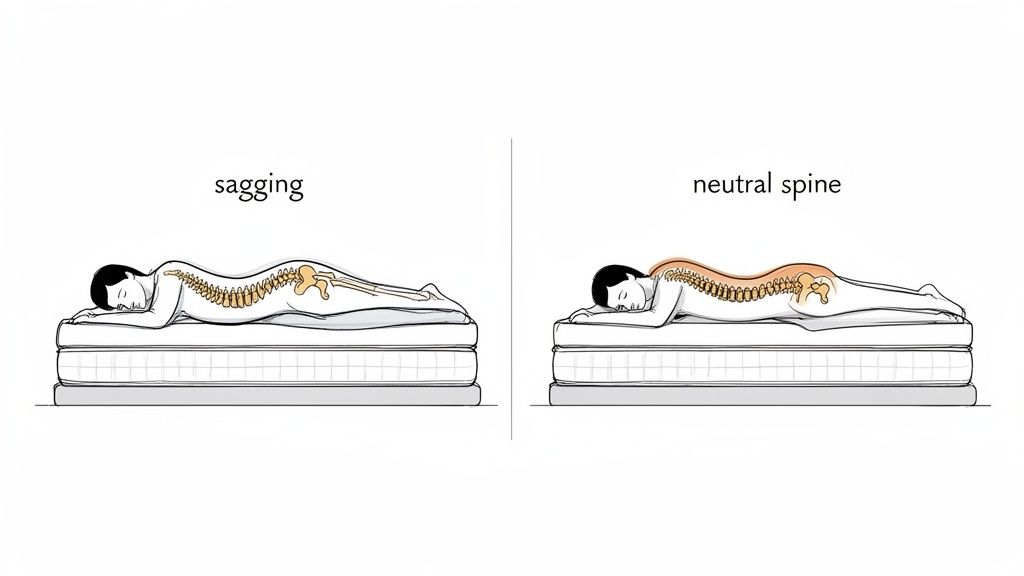
    Illustrations comparing a person's spine on a sagging mattress versus a supportive mattress for neutral alignment.

    Over time, mattresses wear out. The foams and springs that once held you up can soften and break down, creating a hammock-like dip right in the middle. When that happens, your spine is forced into an unnatural curve, straining muscles and ligaments all night long.

    Identifying the Root of the Problem

    Figuring out why your current mattress is causing you pain is the first step toward finding a real solution. Is it too soft, letting your hips sink way too far and throwing your spine out of whack? Or is it too firm, creating painful pressure points on your shoulders and hips while leaving your lower back totally unsupported?

    Here are a few tell-tale signs that your mattress is the source of your back pain:

    • Visible Sagging or Body Indentations: This is a clear indicator that the support system has failed.
    • Waking Up Stiffer Than When You Went to Bed: This means your body isn't being held in a neutral, relaxed position while you sleep.
    • Tossing and Turning to Find a Comfortable Spot: Your body is instinctively trying to get away from bad alignment and pressure points.

    The goal isn't just to buy a new mattress; it's to find the right mattress that solves these specific problems. When you focus on fundamentals like spinal alignment and personalized support, you can cut through the marketing noise and find genuine, lasting relief.

    This guide will walk you through exactly what makes a mattress supportive, helping you understand what to look for based on your own needs. Making a smart choice starts with knowing what you’re looking for, and trying different options firsthand is an important part of the process. At Woodstock Furniture & Mattress Outlet, our knowledgeable team is ready to help you explore these solutions in person, ensuring you find a mattress that will truly support a healthier back for years to come.

    The Science of Support and Spinal Alignment

    To get to the bottom of your back pain, you have to look past marketing slogans and understand what a mattress is really supposed to do. Think of your spine as a gently curving bridge—it needs consistent support from end to end. The number one job of your mattress is to provide that support, helping you maintain what sleep experts call neutral spinal alignment all night long.

    When your spine is neutral, it holds its natural S-curve without being pushed or pulled into an awkward position. This allows the muscles, ligaments, and discs in your back to finally relax and recover while you sleep. A mattress that can’t keep you aligned is often the direct cause of that dreaded morning stiffness and pain.

    Support vs. Firmness: What Is the Difference?

    This is easily one of the biggest points of confusion for mattress shoppers. People use the terms "support" and "firmness" interchangeably, but they are two very different things. Getting this right is critical for finding real back pain relief.

    • Support is the mattress's ability to push back against your body, keeping your spine in that ideal neutral alignment. This comes from the inner workings, like the coil system or high-density foam core. A properly supportive mattress keeps your heavier parts, like your hips and shoulders, from sinking in too far.
    • Firmness is simply how hard or soft the mattress feels right on the surface. It's that immediate impression you get when you lie down. This is all about the top comfort layers—things like memory foam, latex, or soft pillow tops.

    Here's the key takeaway: you can have a very soft mattress that is incredibly supportive, or you can have a rock-hard mattress that offers almost no support at all. The goal is to find a mattress with a strong, supportive core and then pick a firmness level that feels comfortable for your body and the way you sleep.

    The Myth of the Extra-Firm Mattress

    For decades, the common advice for back pain was to sleep on the hardest mattress you could find. We now know that's not good advice for everyone. Modern sleep science and real-world feedback tell us that a mattress that’s too firm can be just as bad as one that's too soft.

    If a mattress is too firm, it won't let your shoulders and hips sink in even a little bit. This can push your spine into an unnatural, flat line and create painful pressure points. Your lower back may end up getting no support, and you can wake up feeling just as sore and stiff as you would on an old, sagging mattress.

    Finding Your Ideal Firmness Level

    So, what’s the right firmness for you? It's all about finding a balance that’s tailored to your body and your sleep habits, not a one-size-fits-all solution. There are two main factors that will point you in the right direction:

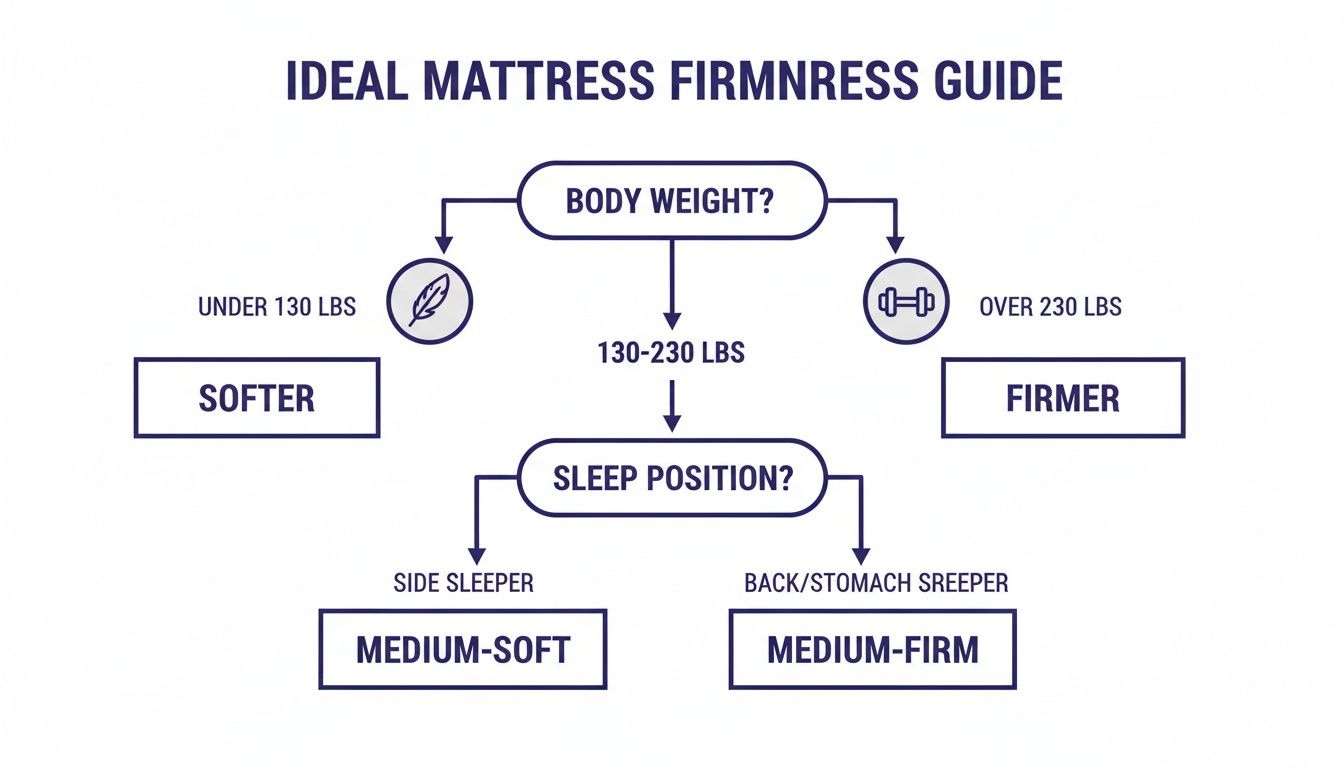
    1. Your Body Weight: Sleepers with a lighter frame (under 130 lbs) often do better on a slightly softer mattress. They need that extra give to get proper contouring and pressure relief. On the flip side, individuals with a heavier frame (over 230 lbs) typically need a firmer, more substantial mattress to prevent sinking too deep and to ensure their spine stays supported.
    2. Your Primary Sleep Position: The position you sleep in most of the night drastically changes how your weight is distributed across the mattress. A side sleeper needs a lot more cushioning for their hips and shoulders, while back and stomach sleepers generally need a firmer surface to keep their spine from dipping.

    Of course, a good mattress is just one piece of the puzzle. Adding some core stability exercises for a stronger back can build up the muscles that support your spine, making you more resilient to pain. When you combine a supportive sleep surface with a stronger core, you’ve got a powerful strategy for long-term relief.

    Armed with this knowledge, you can now look at mattresses with a more critical eye. You're no longer just shopping for a mattress; you're looking for a real solution for your back.

    Comparing Mattress Types for Back Pain Sufferers

    Once you’ve got a handle on support vs. firmness, you can start digging into the different kinds of mattresses out there. It’s easy to get lost in brand names, but it’s more helpful to look at how a mattress is actually built. Each type—from memory foam to hybrid—has its own unique feel and support system, and that’s what makes one better than another for you.

    The mission is simple: find a mattress construction that keeps your spine in a neutral line while also feeling comfortable enough to sleep on. There’s no single "best" type for everyone with back pain. The right choice is all about your body, how you sleep, and what feels right when you lie down. Let’s break down the main categories so you know what you’re getting into.

    Memory Foam Mattresses: Who They Are For

    Memory foam is famous for that deep, body-hugging sensation. It uses your own body heat to soften and mold to your shape, creating a cradle that’s amazing for relieving pressure. This makes it a go-to for anyone who needs serious cushioning around their joints.

    This type can be a great match for:

    • Dedicated Side Sleepers: The way it contours allows your shoulders and hips to sink in just enough, which is key to keeping your spine straight when you’re on your side.
    • Individuals with Sharp Pressure Points: If you’re constantly waking up with sore hips or shoulders, the way memory foam absorbs that pressure can be a game-changer.
    • Couples Concerned with Motion Transfer: Memory foam is incredible at isolating movement. Your partner can toss and turn all night, and you’re much less likely to feel a thing.

    Latex Mattresses: Who They Are For

    Latex mattresses offer a really unique feel that’s both contouring and responsive. Instead of the slow-sinking feeling of memory foam, latex gives you a more buoyant, lifting support. It feels more like you’re sleeping on the mattress rather than in it. It still molds to your curves, but it bounces back into shape almost instantly.

    You might want to consider a latex mattress if you are:

    • A Combination Sleeper: The springy, responsive nature of latex makes it super easy to switch positions during the night without feeling like you’re stuck in quicksand.
    • Someone Who Sleeps Hot: Natural latex is naturally breathable and doesn't hold onto heat the way some traditional memory foams are known to do.
    • Looking for Exceptional Durability: High-quality latex is one of the toughest, most durable mattress materials you can find. It’s fantastic at resisting sagging and body impressions for years to come.

    This visual guide is a helpful starting point for connecting your body weight and sleep style to the right firmness level, which is a huge part of picking the right mattress type.

    Flowchart guiding ideal mattress firmness by body weight and sleep position for different comfort levels.

    As the chart shows, lighter sleepers generally get better pressure relief from a softer mattress, while heavier sleepers usually need a firmer surface to get the spinal support they need.

    Innerspring Mattresses: Who They Are For

    Traditional innerspring mattresses are the kind most of us grew up sleeping on. The core is built from interconnected steel coils, which gives them a firm, bouncy feel and allows for tons of airflow. While they don’t offer the same deep contouring as foam beds, modern innerspring designs are much more comfortable than they used to be.

    An innerspring mattress could be the right fit for:

    • Strict Stomach and Back Sleepers: These positions really benefit from a firm, even surface that keeps the hips from sinking and throwing the spine out of alignment.
    • Shoppers Prioritizing Airflow: The wide-open structure of a coil system lets air move freely, making innerspring mattresses one of the coolest options you can buy.
    • Those Who Prefer a Bouncy Feel: If you like a responsive surface that makes getting in and out of bed easy, you can’t beat the classic bounce of an innerspring.

    Hybrid Mattresses: Who They Are For

    Just like the name says, hybrid mattresses aim to combine the features of other mattress types. They start with a support core of individually pocketed coils (like an innerspring) but top it with thick comfort layers made of memory foam, latex, or other materials. The goal is to deliver both robust support and pinpoint pressure relief.

    A hybrid mattress is often a go-to recommendation for back pain because it balances robust support from the coils with the conforming comfort of foam or latex, providing a solution that works for a wide range of sleepers.

    This do-it-all option can be excellent for:

    • Sleepers Needing a Balance of Support and Cushioning: This is where hybrids shine. The coils provide the foundational support your spine craves, while the foam layers cushion your joints.
    • Couples with Different Preferences: The blend of features often makes both partners happy, even if one prefers foam and the other prefers springs.
    • Anyone Unsure Where to Start: Because they offer such a balanced feel, hybrids are a fantastic starting point for people who are just beginning their search for a mattress to help with back pain.

    To help you compare these options at a glance, we've put together a simple chart outlining the key characteristics of each mattress type for those dealing with back pain.

    Mattress Type Characteristics for Back Pain Sufferers

    Mattress Type Primary Support Mechanism Pressure Relief Level Ideal For Sleep Position Typical Feel
    Memory Foam High-density foam core High Side sleepers Deep contouring, slow response
    Latex Latex foam core Medium to High Combination sleepers Buoyant, responsive
    Innerspring Interconnected steel coils Low Stomach & back sleepers Bouncy, firm
    Hybrid Pocketed coils & foam layers High All positions Balanced, supportive

    Ultimately, this table is just a guide. The best way to know for sure is to try them out yourself, but this should give you a much clearer idea of what to expect from each construction.

    How Your Sleep Position Determines Your Mattress Needs

    Even if we’ve picked the perfect materials and construction, there's one more piece to the puzzle that trumps just about everything else: your favorite sleep position. This is probably the single most critical factor in finding relief from back pain.

    The way you sleep every night determines where your body puts the most pressure on the mattress and exactly what kind of support you’ll need to keep your spine in that happy, neutral alignment. A mattress that feels like heaven to a side sleeper could be a total nightmare for someone who sleeps on their back. It’s all about finding the mattress that’s perfectly matched to you.

    Needs of the Side Sleeper

    Side sleeping is incredibly common, but it also creates a unique challenge for keeping your spine straight. When you’re on your side, your body's widest points—the shoulders and hips—dig into the mattress more than anything else.

    If the mattress is too firm, it’ll just push back against those pressure points, forcing your spine to curve uncomfortably. This is a fast track to waking up with sore shoulders, hips, and a strained lower back. On the flip side, a mattress that’s too soft will let you sink in too deep, causing your spine to sag into a hammock-like position. Not good.

    For side sleepers, the sweet spot is a mattress with enough give in the top layers to cushion the shoulders and hips. You want them to sink in just enough to let your spine stay perfectly straight from your neck all the way down. This is usually found in medium-soft to medium-firm mattresses, particularly hybrids or memory foam models.

    Needs of the Back Sleeper

    Sleeping on your back is generally considered one of the best positions for spinal health, but there's a huge catch: your mattress must provide solid support to your lower back, or lumbar region.

    The biggest pitfall for back sleepers is a mattress that allows the lower back to sink down, creating a gap. When your lumbar spine isn't supported, your muscles have to work overtime all night to hold you in place, which is why you might wake up stiff and sore.

    A mattress that’s too soft will let you sag, and one that's too firm can also create a gap because it doesn't conform to your body's natural curve. The goal is to find a surface that perfectly fills in and supports the small of your back. This is why a medium-firm feel often hits the mark, giving you that ideal balance of contouring and deep-down support.

    Needs of the Stomach Sleeper

    Of all the positions, stomach sleeping is easily the riskiest for your back and neck. Lying on your stomach puts a ton of stress on your spine. Since most of us carry our weight in our midsection, that area tends to sink deepest into the mattress.

    When your hips dip lower than your shoulders, it forces your lower back into a dramatic, unnatural arch. Holding that posture for hours is a recipe for chronic pain. For this very reason, stomach sleepers almost always need a firmer mattress.

    A firm or even extra-firm surface keeps the hips from sinking, which helps keep the spine on a more level plane. You still want a little cushioning for comfort, but preventing that spinal curve has to be the top priority. Innerspring and firm hybrid mattresses are often great choices here.

    Recent analysis confirms just how critical finding this balance is. Some studies show that a medium-firm feel helps maintain the spine's natural curve, and that proper spinal alignment is a key priority for shoppers with back pain. You can read the full analysis of mattress features for back pain to better understand these connections.

    Why You Should Always Test a Mattress In Person

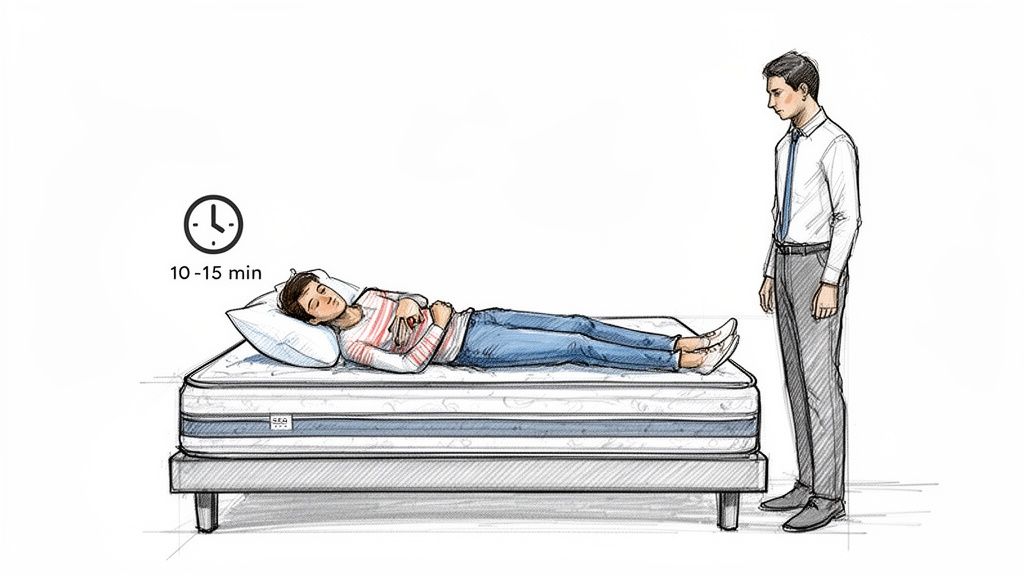
    A woman lies on a mattress, while a man in a suit observes, with a '10-15 min' timer icon.

    Reading online reviews and comparing specs is a great way to start your mattress search. It helps you narrow down the field. But here’s the thing: no amount of research can tell you how a mattress will actually feel when you lie on it. That’s why there’s no substitute for testing a mattress in person.

    Think about it. Words like "medium-firm" or "plush" are completely subjective. What feels like a cloud to one person might feel like a rock to another. The only way to truly know if a mattress gives your back the support it needs is to lie down and let your body decide.

    How to Properly Test a Mattress in a Showroom

    Walking into a showroom is the final, most important step of your research. To get the most out of your visit, don’t just pop in for a quick look. Treat it like a proper test drive.

    • Wear Comfortable Clothes: You wouldn't test drive a car in a tuxedo, right? Wear something loose and comfy, like what you’d lounge around the house in.
    • Assume Your Position: Don’t just sit on the edge. Lie down in the exact position you normally sleep in, whether you’re a side, back, or stomach sleeper. This is the real test.
    • Stay for a While: This one’s key. Don’t just lie down for 30 seconds and hop off. Plan to spend at least 10-15 minutes on any mattress you’re seriously considering. This gives your body time to settle and really feel how the mattress contours and supports you.
    • Focus on Key Areas: Pay close attention to your lower back, hips, and shoulders. Do you feel any uncomfortable pressure? Critically, is there a gap between your lower back and the mattress, or does it feel properly supported?

    The goal of an in-store visit isn't to be sold, but to be educated. Our team is here to offer guidance and give you the space you need to make a confident, unhurried decision.

    This hands-on experience is where you can truly feel the difference between different mattress technologies. For instance, you can read about a hybrid mattress with a zoned coil system, but you can’t understand how that targeted lumbar support feels until you try it. Some designs focus on this kind of targeted support, which may help reduce lower back and hip pain compared to a standard innerspring for some individuals.

    Ultimately, reading about mattress tests is helpful, but feeling the support for yourself is what makes all the difference. To dig deeper into how mattress construction can impact your sleep quality, you can explore the findings of comprehensive mattress tests from industry experts. A little time spent in a showroom is a great way to ensure you find a long-term solution you’ll love for years to come.

    Finding Your Long-Term Back Pain Solution

    Ultimately, the journey to finding a mattress that actually helps your back pain isn’t about chasing a specific brand. It's about finding the one that gives you personalized support and neutral spinal alignment for your own unique body and the way you sleep. The real solution is understanding what you need, whether that’s a side sleeper needing pressure relief or a back sleeper who requires solid lumbar support.

    Making the right choice means you’ve got to shift your focus from marketing claims to the core principles we’ve talked about. A mattress that truly works for you is a long-term investment in your health, setting you up for restorative sleep night after night.

    Enhancing Your Sleep System

    To really dial in your comfort, don’t forget how other pieces can help with pain relief. An adjustable base, for example, can be a total game-changer. It lets you raise your head or feet, helping you find those perfect angles that take a ton of pressure off your lower back.

    A whole-body approach usually gets the best results. Lasting relief from back pain often involves more than just a great mattress. For instance, you might find it helpful to look into additional strategies for back and shoulder pain relief to better support your body during the daytime too.

    Building long-term trust through honest education is how we help our customers. We believe an empowered shopper makes the best decision for their health and home.

    At Woodstock Furniture & Mattress Outlet, that customer-first mindset is behind everything we do. Our team is experienced and knowledgeable, and we’re here not just to sell you a mattress, but to help you find a lasting fix for better sleep and a healthier back.

    We invite you to come visit one of our North Georgia showrooms and try these options out for yourself. Feel the difference, ask us all your questions, and let us help you find the right foundation for a pain-free night's sleep.

    Frequently Asked Questions About Mattresses for Back Pain

    Shopping for a mattress can bring up a ton of questions, especially when you're trying to solve a real problem like nagging back pain. Here are answers to a few common questions our furniture experts get from shoppers every day, designed to give you clear, straightforward info to help you make your decision with confidence.

    How Long Should I Try a New Mattress for My Back Pain?

    Most sleep experts say you need to give a new mattress a minimum of 30 nights to really know if it’s working for you. This gives your body time to adjust to the new support system and also allows the mattress materials to fully break-in and settle.

    Don't be surprised if you feel a little different or even slightly sore for the first few nights. That's your spine learning to hold a new, healthier alignment! This is exactly why many mattress brands and retailers offer trial periods—it gives you plenty of time to be sure the mattress is truly helping your back pain without feeling rushed.

    Is a Firm or Soft Mattress Better for Lower Back Pain?

    There’s an old myth that a rock-hard mattress is the only way to fix back pain. However, sleep science consistently shows that a medium-firm mattress is the sweet spot for many people. Why? It offers a great combination of robust support and gentle, pressure-relieving comfort.

    A mattress that's too firm will create painful pressure points on your hips and shoulders and can actually leave your lower back hanging without support. On the flip side, if it’s too soft, your hips will sink in too far, knocking your spine right out of alignment. The goal is to find that perfect balance where your body is held in place and cushioned at the same time.

    Can an Adjustable Base Help With My Back Pain?

    For those dealing with chronic back pain, an adjustable base can be a game-changer. By letting you raise your head and feet, it helps you find what sleep pros often call a “zero-gravity” position. This can take a huge amount of pressure off your spine.

    For instance, slightly elevating your upper body can relieve discomfort from certain conditions, while lifting your legs can ease the strain on your lower back. When you pair an adjustable base with a compatible mattress, you’re creating a custom sleep system built specifically to manage your pain and boost your overall sleep quality.


    Here at Woodstock Furniture & Mattress Outlet, our whole goal is to give you the knowledge and the hands-on experience you need to find lasting relief. Come on down to the showroom to explore these options for yourself and let us help you find the right sleep solution for a healthier, happier back. Find out more at https://woodstockoutlet.com.