
You've found the wall where a wardrobe might fit, but the bedroom still needs drawers for socks, folded shirts, and everyday clothes. A separate dresser and armoire could solve both problems, yet two pieces may crowd the walking path. A dresser armoire combo looks appealing because it places both storage types in one cabinet, but the decision depends on more than the furniture's listed width. You also need to know how far the drawers extend, how widely the doors open, and whether the room remains usable afterward.
What a Dresser Armoire Combo Actually Does
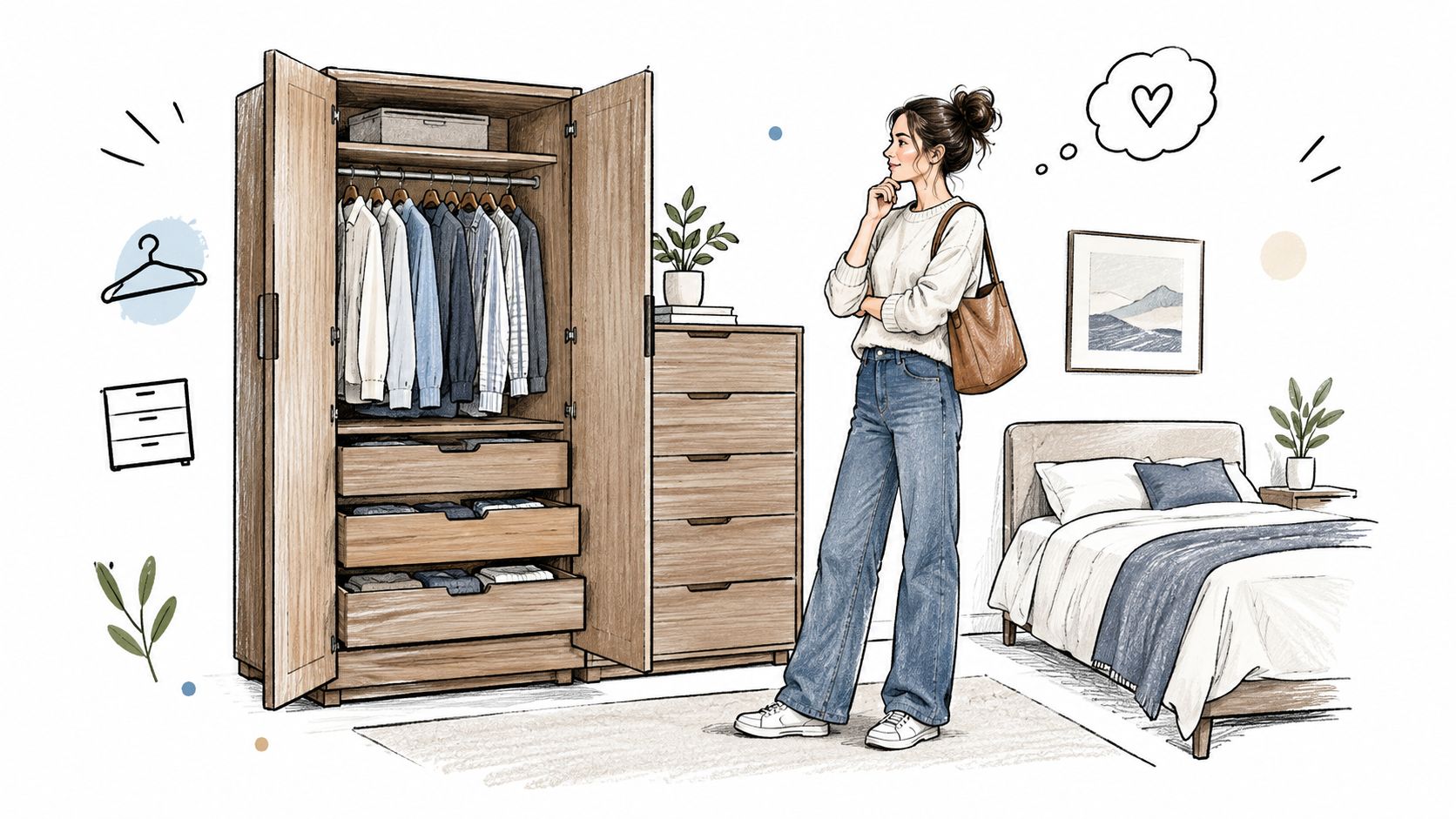
A shopper furnishing a smaller bedroom often starts with two competing needs: hanging space for dress shirts and blouses, plus drawers for folded clothes and accessories. If the available wall can accept one tall piece but not two separate furniture footprints, a dresser armoire combo can bring both functions together.
The lower section works like a traditional dresser. Its drawers can hold folded garments, socks, undergarments, and smaller accessories. The upper section operates like a compact armoire, typically using a hanging rod, interior shelves, or both behind doors that close over the wardrobe area. That arrangement creates one organized clothing zone instead of spreading storage across different parts of the room.
Why the combined layout helps
The main benefit isn't that the unit makes clothing disappear. It's that it stacks storage vertically, allowing one wall position to handle hanging and folded items. That can help in a guest room, apartment bedroom, shared room, or older home without a generous built-in closet.
Historically, both dressers and armoires developed from European storage furniture that evolved from medieval presses into purpose-built clothing cabinets. The word armoire has linguistic roots in late-12th-century Old French, while the modern armoire form is generally traced to 17th-century France. The earliest documented use of dresser appears in 16th-century England, and by the 18th century wardrobes commonly included drawers, shelves, and sliding trays, combining storage functions that later made dresser-armoire furniture practical. Historical background on armoires and wardrobes provides useful context for that evolution.
Good organization also depends on what you keep in the unit. If the bedroom feels crowded with clothing, baskets, and loose accessories, ideas that transform clutter into calm can help you decide what belongs in drawers, on shelves, or on hangers.
How a Combo Differs from a Dresser and an Armoire
Start with each piece on its own.
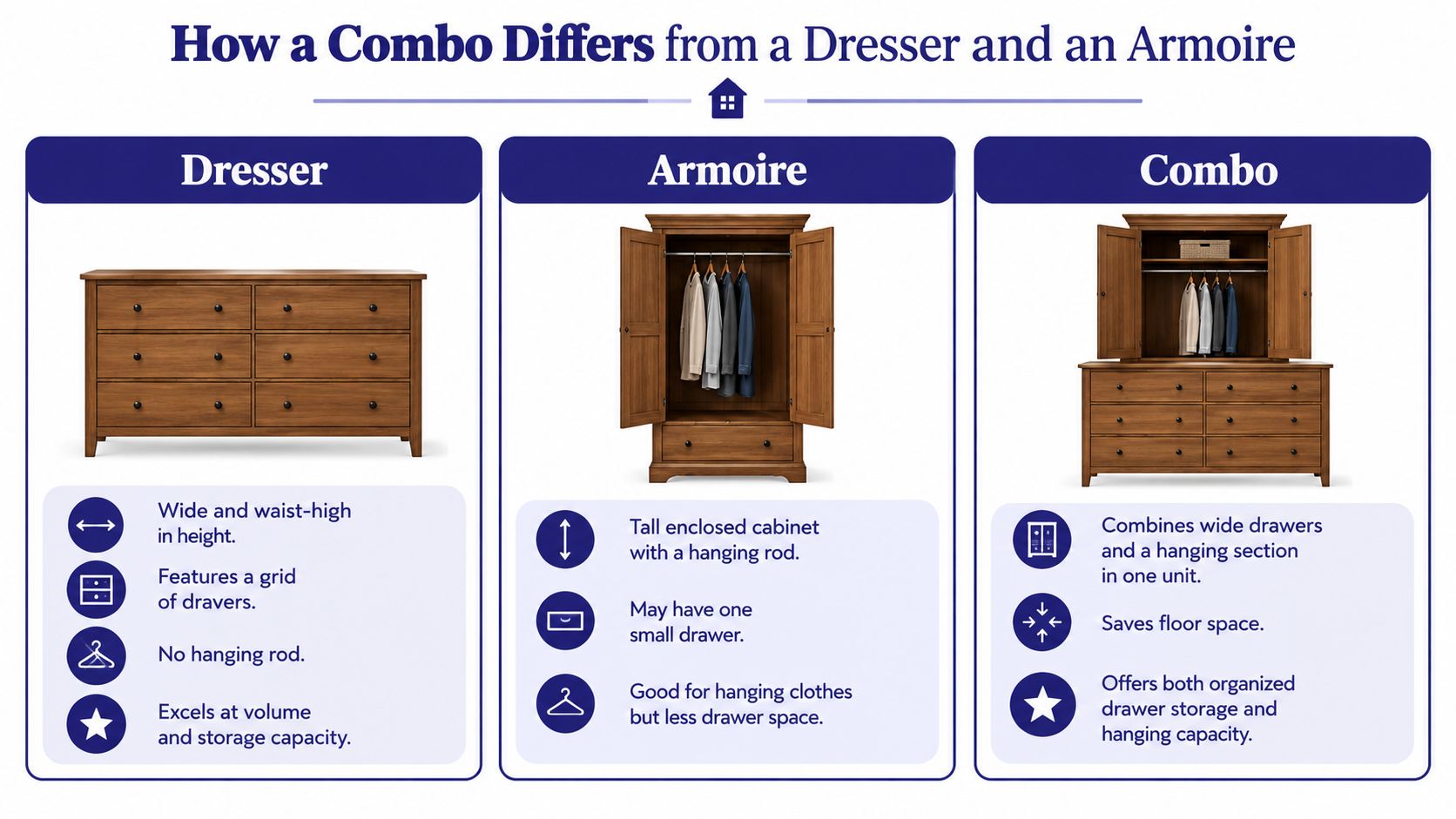
A dresser is generally lower and wider, with a bank of drawers and a broad top surface. It's well suited to folded clothing and can support a mirror, lamp, or television, depending on the room. Its limitation is straightforward: without a hanging rod, it can't store garments that need to remain on hangers.
An armoire is taller and more cabinet-like. Doors conceal a hanging rod and may also cover shelves, making it useful for shirts, jackets, dresses, or other garments that benefit from vertical storage. It usually offers less drawer capacity than a dresser.
A combo places these two storage geometries in one cabinet. The lower portion resembles a dresser, while the upper portion resembles an enclosed armoire. The result is normally as tall as wardrobe furniture, but it uses less horizontal wall length than positioning a dresser beside a separate armoire.
The feature that defines the category
A dresser with a mirror isn't automatically a combo. A wardrobe with drawers beside the hanging cabinet isn't necessarily one either. The defining feature is the integrated upper-and-lower arrangement, with drawer storage below and hanging or shelf storage above.
That distinction matters during shopping because product names can vary. Independent furniture guidance describes an armoire as a wardrobe for hanging garments, while a dresser is typically lower and wider, with drawers for folded clothing and a usable surface. A practical comparison of dressers, chests, and armoires can help clarify terminology before you compare listings.
Typical Sizes and Why the Operating Footprint Matters
A furniture listing gives you the cabinet's dimensions, but those numbers don't tell you how much room you need to use the piece. A combo may fit against the wall and still make the bedroom uncomfortable once you open a drawer or swing a door.
Independent size guidance places common combo-dresser footprints around 48 to 60 inches wide, 18 to 20 inches deep, and 48 to 60 inches high, while traditional armoires are often around 36 to 48 inches wide, 20 to 24 inches deep, and 60 to 72 inches high. Bedroom furniture sizing guidance explains why depth becomes important when the upper section needs to accommodate hanging garments without excessive sleeve compression.
| Piece | Width | Height | Depth | Operating clearance |
|---|---|---|---|---|
| Dresser armoire combo | 48 to 60 in | 48 to 60 in | 18 to 20 in | Measure drawers and doors separately |
| Traditional armoire | 36 to 48 in | 60 to 72 in | 20 to 24 in | Allow for door swing and access |
| Typical wardrobe and desk combo example | 90.90 in long | 67.40 in high | 20.00 in wide | Plan the entire wall and work area |
The operating footprint is the space required when the furniture is active, not closed. A guide describing a typical combo around 42 inches wide, 22 inches deep, and 73 inches high notes that an armoire's real footprint can expand from about 7 square feet to closer to 12 square feet when doors swing open. Real-room clearance guidance for dresser-armoire furniture highlights the measurement many shoppers miss: the open space in front of the case.
Think in movement, not just placement
A drawer needs room to extend and room for your hands to reach inside. A hinged door needs room to open without striking a bed, wall, nightstand, or nearby doorway. The unit may be compact when closed, but its working zone can be much larger.
A product listing for a bedroom wardrobe and desk combo illustrates how substantial some designs become, measuring 90.90 inches long, 20.00 inches wide, and 67.40 inches high. This wardrobe and desk combo listing shows why the surrounding wall and furniture arrangement deserve as much attention as the cabinet itself.
Measuring Your Bedroom Before You Buy
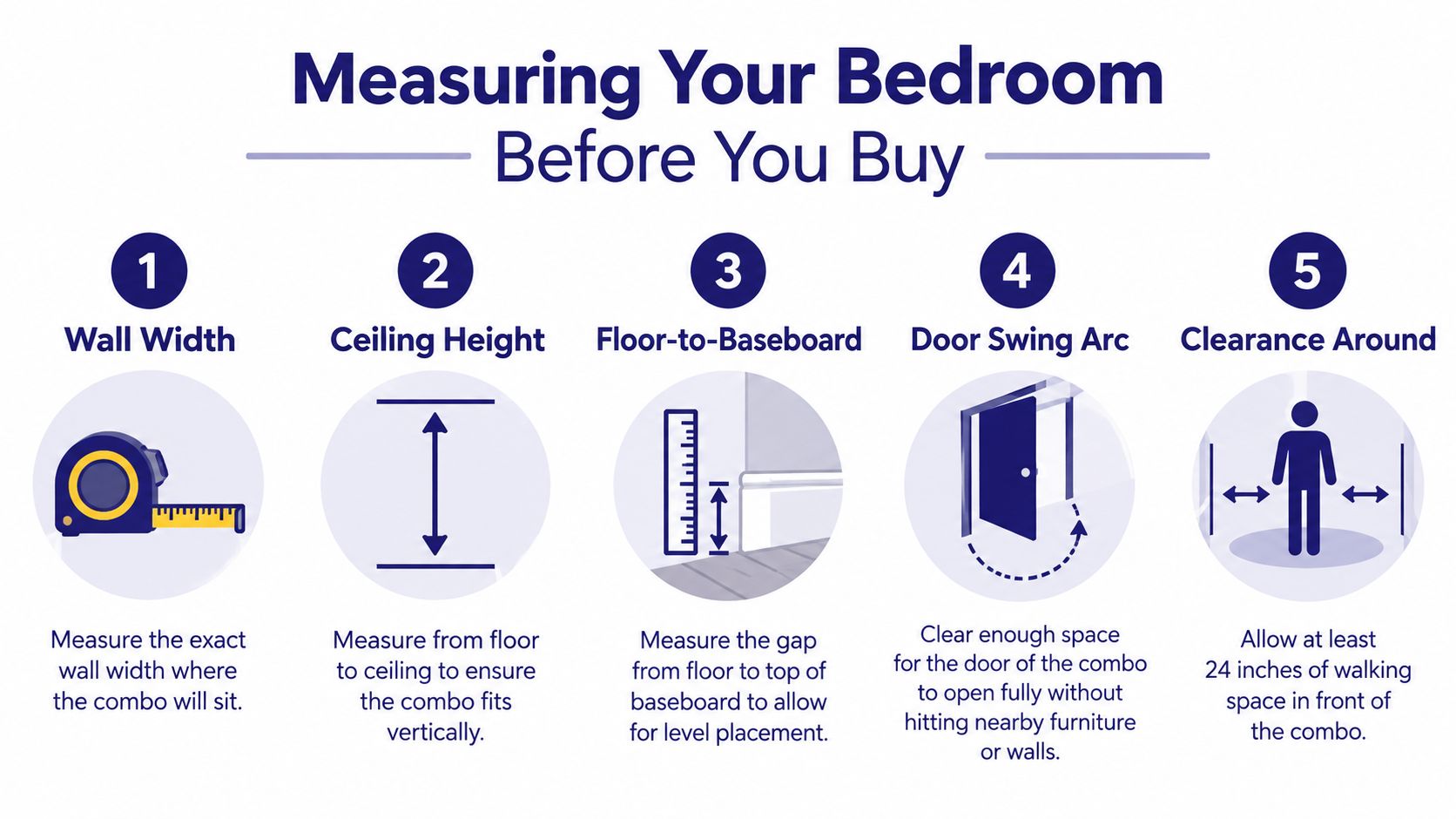
Measure the room before you fall in love with a finish. Start with the wall where the combo will sit, then record the ceiling height and the distance from the floor to the top of the baseboard. Those measurements establish the basic envelope, but they won't reveal every clearance problem.
Five measurements to put on your sketch
Wall width: Measure the exact usable span, including any corner interruptions, trim, or nearby door casing.
Ceiling height: Check the floor-to-ceiling distance and look for crown molding, sloped ceilings, or a window trim line that could reduce vertical clearance.
Baseboard and wall obstacles: Note the baseboard depth, vent covers, outlets, and cable connections. These can push the unit away from the wall and change the room's effective depth.
Door swing arc: Open nearby bedroom, closet, hallway, and bathroom doors fully. Mark where each arc travels so the combo's doors won't block access.
Drawer pull-out space: Stand in front of the proposed location and allow the full drawer depth plus hand room. The provided measurement infographic also calls out at least 24 inches of walking space in front of the unit as a practical planning reference.
Draw the room as it functions
Use a simple sketch with arrows for door swings and lines for drawer extension. Mark the bed, nightstands, vents, and the path from the entry door to the closet. Bring that sketch when you shop. It gives a furniture specialist something concrete to evaluate instead of relying on memory.
A piece that fits the wall may still fail the circulation test. If the open doors overlap the bed or a drawer blocks the only walking route, the combo could become frustrating every day.
A short visual demonstration can reinforce the measuring process:
Combo versus Two Separate Pieces
The right comparison isn't “one piece versus two.” It's whether the room needs compact vertical storage or greater flexibility across separate locations.
| Factor | Dresser armoire combo | Two separate pieces |
|---|---|---|
| Floor space | Stacks functions into one footprint | Spreads storage across two footprints |
| Storage layout | Drawers and hanging space stay together | Each piece can offer a more specialized interior |
| Cost | Depends on materials and construction | Depends on the quality and materials of both pieces |
| Flexibility | One large unit is harder to reposition | Pieces can move or be replaced independently |
A combo usually makes sense when the room is short on wall width but has useful ceiling height. It can be practical in a narrow bedroom or small guest room where placing a dresser beside a wardrobe would interfere with the bed or walking path.
Two separate pieces may serve better when the room is wide and storage needs are high. A separate dresser can provide a broader drawer arrangement, while an armoire can offer a longer hanging section. You can also place them on different walls, move one to another room, or replace one without changing the entire storage plan.
Consider the next room arrangement
A combo's fixed geometry is both its strength and its limitation. The stacked design keeps categories together, but the tall cabinet may dominate a smaller room visually and physically. Separate pieces create more options if the room later becomes a nursery, office, shared bedroom, or guest space.
Cost doesn't follow configuration automatically. A well-constructed combo isn't necessarily cheaper than two mid-range pieces, and two separate items aren't necessarily more expensive. Compare drawer construction, hardware, backing, finish, and delivery requirements rather than assuming that fewer pieces mean a lower total.
The most useful tally is simple: limited width plus available height favors a combo. Ample width, changing needs, and a demand for specialized storage favor separate furniture.
Styles and Materials Worth Comparing
Material affects more than appearance. It influences weight, handling, finish behavior, and how the piece relates to furniture already in the bedroom.
| Material family | What to expect | Points to inspect |
|---|---|---|
| Solid wood | Commonly oak, pine, or maple, with substantial construction and weight | Joinery, finish consistency, and movement around doors |
| Engineered wood | Often paired with veneer or laminate for consistent surfaces and lighter handling | Edge treatment, corners, backing, and resistance to moving damage |
| Metal or mixed media | A contemporary visual language that may suit modern rooms | Frame stability, shelf support, and coordination with other finishes |
Solid wood can suit classic North Georgia interiors, including farmhouse and Craftsman-influenced rooms, but it may be heavy to move. Engineered wood with veneer or laminate can offer a consistent finish and easier handling, though edges and corners deserve careful attention during delivery or a future move. Metal and mixed-media designs can work well in contemporary bedrooms, but they may feel less connected to traditional room furnishings.
Match undertones, not just labels
Finish names can mislead. Compare the actual undertones of the combo with the floor, bed, nightstands, and trim. Warm honey and cherry finishes generally coordinate more naturally with golden oak flooring, while gray and espresso finishes tend to sit more comfortably with cooler palettes.
Inspect the piece in person if possible. Open every drawer, check the joinery, operate the doors, and look at the top and side panels under the same light. If you're also changing the window treatment, these modern bedroom curtain ideas can help you coordinate the storage finish with the room's larger visual palette.
A matching color isn't enough if the profiles conflict. A detailed traditional dresser may feel out of place beside a very minimalist bed, even when both pieces share a brown finish.
Stability, Anchoring, and Safe Loading
Tall clothing furniture deserves a safety plan before you fill it. A combo with a high wardrobe section and a relatively shallow base can be less stable than a low dresser, particularly when drawers are open or heavier items sit near the top.
The U.S. Consumer Product Safety Commission recommends anchoring dressers and similar clothing storage units to the wall. The CPSC's clothing-storage safety standard explains why anchoring is a central control for tip-over hazards.
Secure the cabinet correctly
Use the anti-tip hardware supplied with the furniture and follow its installation instructions. A plastic drywall anchor, metal toggle bolt, and screw driven into a wall stud don't provide the same connection, so the wall construction matters. In a household with children, securing the restraint into a wall stud is the prudent approach whenever the layout allows it.
The mechanics are simple. A tall unit creates a longer lever arm, and open drawers shift weight forward. A child pulling on a drawer can also turn the furniture into a climbing aid.
Safety rule: Anchor the unit before loading it, not after the room is already in use.
Load from the bottom upward
Place heavier folded clothing in the lowest drawers or shelves. Australian product-safety guidance also warns that top-heavy furniture is easier to tip and recommends storing heavier items low. Keep the hanging rod balanced rather than placing heavy coats on one side, and don't use the upper shelves for dense storage that could shift the center of gravity upward.
Close drawers when you're finished using them. Keep the floor around the cabinet clear so children and adults don't trip while opening doors or reaching into lower storage.
Shopping Tips for North Georgia Buyers
Treat an in-store visit as a hands-on inspection, not a quick visual check. Pull each drawer all the way open and close it slowly. Listen for rough movement, check whether the fronts sit evenly, and look at how the drawer joints are constructed. Dovetail joinery and stapled joints provide different signals about construction, but the overall fit and finish still matter.
Examine the back panel, the top, and the side surfaces. Some shoppers focus only on the front, even though delivery crews and future moves can expose unfinished edges or lightly attached backing. Operate each door and confirm that it aligns when closed, doesn't scrape, and leaves enough interior access for the garments you plan to hang.
Account for the local home
North Georgia bedrooms can experience seasonal humidity changes. Solid wood case goods may respond to those changes, and a climate-controlled showroom won't behave exactly like an older, less insulated bedroom. Ask how the construction and finish are expected to perform in a home with changing indoor conditions, and keep the unit away from direct moisture sources.
Delivery access deserves equal attention. Measure narrow doorways, stair turns, hallway corners, and entry paths, especially in ranch and split-level homes around Gainesville, Dawsonville, and Cleveland. A cabinet that fits the bedroom may not make it through the route to the room.
Before committing, clarify the return policy for large furniture, whether assembly is included, and whether delivery is standard or white-glove. Inspect the combo for damage, alignment, and finish issues before signing the delivery receipt.
If the furniture becomes the room's visual anchor, planning nearby decoration can help. Resources that let you browse room specific art can be useful after the storage footprint and finish are settled.
Woodstock Furniture & Mattress Outlet offers bedroom storage options that include armoires, wardrobes, dressers, chests, and bedroom sets, so you can compare a combined solution with separate pieces in person. Visit Woodstock Furniture & Mattress Outlet with your room sketch and measurements, and ask the staff to help evaluate door swing, delivery access, finish coordination, and anchoring needs before choosing a dresser armoire combo.