
You already have a queen mattress, but bedtime still involves rearranging pillows. Maybe you want your upper body raised while your partner wants to lie flat. Or you're hoping a different position will make nights with reflux or snoring more comfortable.
An adjustable base is worth considering, but the decision involves more than finding a comfortable showroom position. The right setup also needs to fit through your home, work with your mattress, and suit the way you and your partner use the bed.
What a Queen Adjustable Base Does for Your Sleep
A queen adjustable base is a motorized mattress-support platform with sections that move to change your resting position. Rather than stacking pillows behind your shoulders, you adjust the support beneath the mattress. Depending on the model, you can raise the upper body, lift the legs, or combine those movements.
That flexibility addresses a specific problem: a flat foundation gives you no way to change the mattress's position. It doesn't establish why you're uncomfortable, and it doesn't turn an unsuitable mattress into a suitable one.
Start with the problem you want to solve
Consider a couple who share a flat queen. One person wants to read upright before sleeping; the other wants to settle down immediately. An adjustable base may help with positioning, but the couple still needs to decide whether they can comfortably share the same setting.
Someone who sleeps comfortably on a flat bed has a different decision. If the adjustment would mainly be a novelty, a conventional foundation may remain the more sensible choice.
Before comparing features, identify the actual goal:
- Evening comfort: Do you want supported positioning for reading or relaxing?
- Sleeping position: Are you trying to find a comfortable alternative to lying flat?
- Shared preferences: Does your partner want the same position you do?
- Unexplained tiredness: Are you assuming new furniture will resolve a problem that needs assessment?
For that last question, Total Mental Wellness's resource on possible causes of daytime drowsiness offers a useful starting point for a healthcare conversation. Persistent sleepiness deserves attention beyond the bed itself.
Why the queen designation matters
The queen became a major standardized U.S. mattress product in the late 1950s. A patent's historical account identifies Simmons's introduction in 1958 and describes research into the space couples occupied while sleeping, helping explain the format's shared-sleeping purpose and its importance for compatible bedding and furniture (queen mattress history and standardization).
That standardization makes shopping easier, but it isn't a blanket compatibility guarantee. You still need to confirm that your particular mattress can articulate and that the selected base suits its construction.
Practical rule: Choose an adjustable base to solve a positioning problem, not because a feature name promises better sleep.
If reflux, snoring, pain, or another health concern is driving the purchase, separate the comfort decision from the medical one. A position that feels pleasant in the showroom is useful information, not a diagnosis or a treatment plan.
Measuring Your Room and Doorways Before You Buy
Measure the actual base, not just the mattress. When you're comparing an adjustable base queen size listing, the size category tells you which mattress it's intended to support. It doesn't tell you the exact outside dimensions, assembled height, or delivery requirements.
That distinction matters in a bedroom where a dresser already narrows the walkway or a nightstand sits close to the mattress edge. Start with the furniture you intend to keep, rather than measuring an empty rectangle and assuming everything else will work around it.
Queen Mattress and Queen Base Dimensions
The published examples below show why the model's specification sheet matters. These are examples, not universal minimums and maximums for every queen base (published queen adjustable-base dimensions and weights).
| Measurement | Standard Queen Mattress | Queen Adjustable Base Range |
|---|---|---|
| Width | Nominally 60 inches | Approximately 59.1 to 60 inches in the cited examples |
| Length | Nominally 80 inches | Approximately 78.7 to 80 inches in the cited examples |
| Height | Depends on the mattress | Listed examples include approximately 3.9 to 10.3 inches |
| Weight | Depends on the mattress | Listed examples range from approximately 79.5 to 130 pounds |
Don't combine the smallest measurement from each listing into an imaginary compact model. Use the complete dimensions of the base you're considering, including the leg configuration and any surrounding frame.
Other designs can occupy more space. A room-planning guide describes a base extending to approximately 63 by 83 inches, circulation of roughly 24 to 36 inches on accessible sides, and a tighter minimum around 18 inches; its 10-by-10-foot bedroom example leaves about 21 inches per side with the bed centered (queen adjustable-base room-planning guidance).
That room might accommodate the bed without comfortably accommodating your routine. Think about opening dresser drawers, carrying laundry past the foot, and reaching the window without turning sideways.
Follow the delivery route before checking out
Use a tape measure, painter's tape, and a phone camera. Mark the proposed footprint on the floor, then walk the route from the delivery entrance to the bedroom.
- Doorways: Record the clear opening with the door positioned as it will be during delivery. Include trim and any projecting hardware.
- Hallway turns: Photograph tight corners and measure the space available to rotate a bulky component.
- Stairs and landings: Note railings, ceiling changes, and the turning area at the top and bottom.
- Bedroom obstacles: Include wall-mounted shelves, sconces, radiators, and furniture that could interfere with movement.
- Delivery configuration: Ask whether the selected model arrives folded, modular, or assembled, and request its packaged dimensions.
An older North Georgia home may have enough bedroom floor space but an awkward hallway approach. An apartment may present the opposite problem: straightforward access, but little usable clearance once the bed is installed.
Give the delivery team those details before purchase. A photograph of the difficult turn can be more useful than saying the hallway is “pretty narrow.”
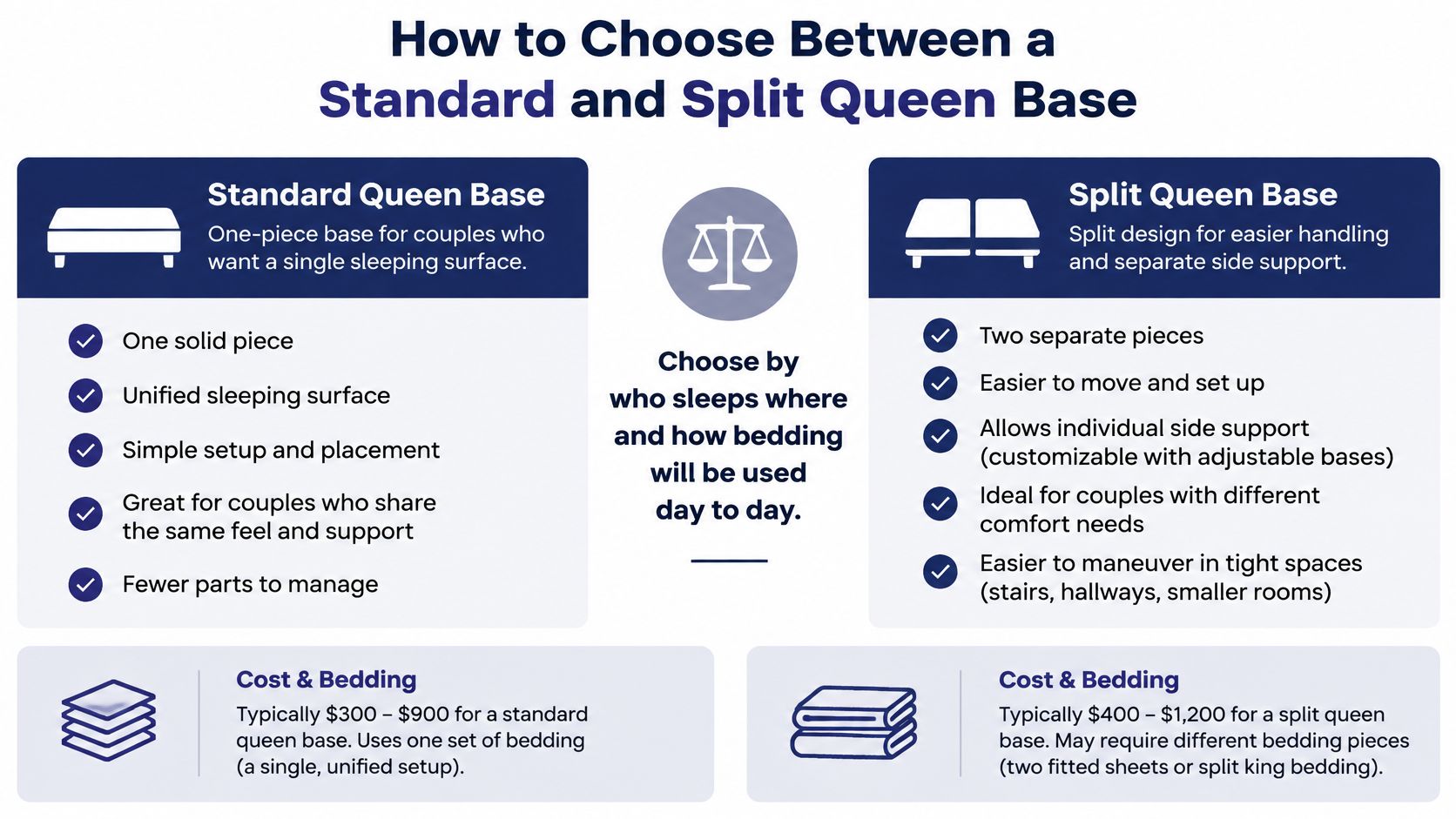
How to Choose Between a Standard and Split Queen Base
The main choice isn't which design has more features. It's whether you want a continuous shared sleeping surface or independently controlled sides.
Use this comparison to connect the base configuration with your nightly routine.
A standard queen keeps the surface unified
A conventional queen arrangement suits sleepers who want to share a continuous mattress and are comfortable using the same elevation. It's also worth considering for someone sleeping alone who doesn't need independent sides.
The compromise becomes apparent when partners disagree. If one wants the upper body raised and the other wants a flat position, a shared moving surface requires agreement. Being able to adjust the bed doesn't necessarily mean each sleeper can adjust it separately.
Try that disagreement in the showroom. Have one partner choose a preferred position, then ask the other to settle into it rather than briefly sitting beside them.
A split queen separates the positioning decisions
A split queen uses two independent 30-by-80-inch mattress halves with separate adjustable bases. Together, they occupy the nominal queen footprint while allowing each sleeper to control their own position; the trade-offs include a center seam and the need to keep the sides aligned (split-queen configuration and independent movement).
That independence can be useful when partners have different preferences. It also changes what lying close together, making the bed, and replacing bedding feel like.
- Sheets and protectors: Verify exact sizing and articulation compatibility before ordering. Standard queen fitted sheets and ordinary Twin sheets aren't dependable substitutes for split-queen bedding.
- Daily upkeep: Ask how the mattresses stay aligned and what happens to the center gap when the sides move differently.
- Mattress selection: Confirm that each half is approved for the intended base, rather than assuming a flexible feel proves compatibility.
- Replacement costs: Price the complete bedding arrangement and check availability, not just the base.
These bedding and everyday-use considerations are important counterweights to independent adjustment (split-queen bedding and compatibility trade-offs).
A demonstration can help you prepare questions about movement and operation before trying a setup in person.
At Woodstock's Sleep Center, shoppers can compare adjustable bases, foundations, protectors, and sheets with staff who can explain the practical trade-offs. Professional delivery and setup are available, and the team can walk through warranty and returns information before you decide.
Ask whether the mattress, base, bedding, and delivery service have separate return terms. Don't assume an advertised mattress comfort policy automatically covers the adjustable foundation or a split configuration.
Independent movement is worthwhile only if you prefer living with the complete setup, including its bedding and center seam.
Checking Weight Limits, Power, and Bedframe Fit
A base can fit inside the bedroom and still be unsuitable for the load, frame, or electrical arrangement. These checks belong before delivery, when you can still change the plan without moving heavy equipment.
Verify the model's load instructions
Queen is a size category, not a weight rating. Ask for the selected model's manual and determine what the stated capacity includes. Occupants, mattress, bedding, and accessories all need to be considered according to that manufacturer's instructions.
A commonly cited full/queen safety limit is 450 pounds, or 204 kilograms, alongside warnings against sitting on raised sections. Treat that as a model-specific figure to verify, not a universal queen-base capacity; the snoring-study safety discussion also emphasizes checking the manufacturer's load guidance (inclined-bed study and safety considerations).
Don't test a raised foot section by sitting on its edge. Ask staff to demonstrate how to enter, exit, and operate the chosen model safely.
If the required capacity is beyond the residential models you're considering, broaden the search rather than accepting a marginal fit. DME Superstore provides a place to find bariatric adjustable bed options, which can help you prepare questions about higher-capacity equipment without assuming any particular product meets your needs.
Check the surrounding frame and hardware
An existing bed can remain part of the room only if its construction works with the selected base. Bring photographs of the interior supports, side rails, headboard connections, and footboard.
- Inside dimensions: Compare the clear interior opening with the base's complete specifications.
- Support method: Ask whether the base must stand on its legs or is explicitly approved for installation on a platform.
- Hardware: Confirm whether headboard brackets are included, optional, or unsuitable for the existing headboard.
- Moving clearances: Have staff identify where the deck, mattress, or bedding could contact surrounding furniture.
Woodstock's related article on platform-bed and adjustable-base compatibility is a useful supporting topic when keeping your current platform is central to the decision.
Plan power and accessories deliberately
Locate an appropriate outlet and ask how the manufacturer requires the power supply to be connected. Plan cord routing so moving components won't pinch it, and leave the controls reachable from your normal resting position.
Bed rails deserve their own assessment. The FDA cautions that automatic use of rails can create unwarranted safety hazards, so mobility, entrapment risk, getting in and out, and the particular bed design all matter (FDA clinical guidance on bed-rail safety).
Safety check: An accessory isn't automatically safer because it's sold for use beside a bed.
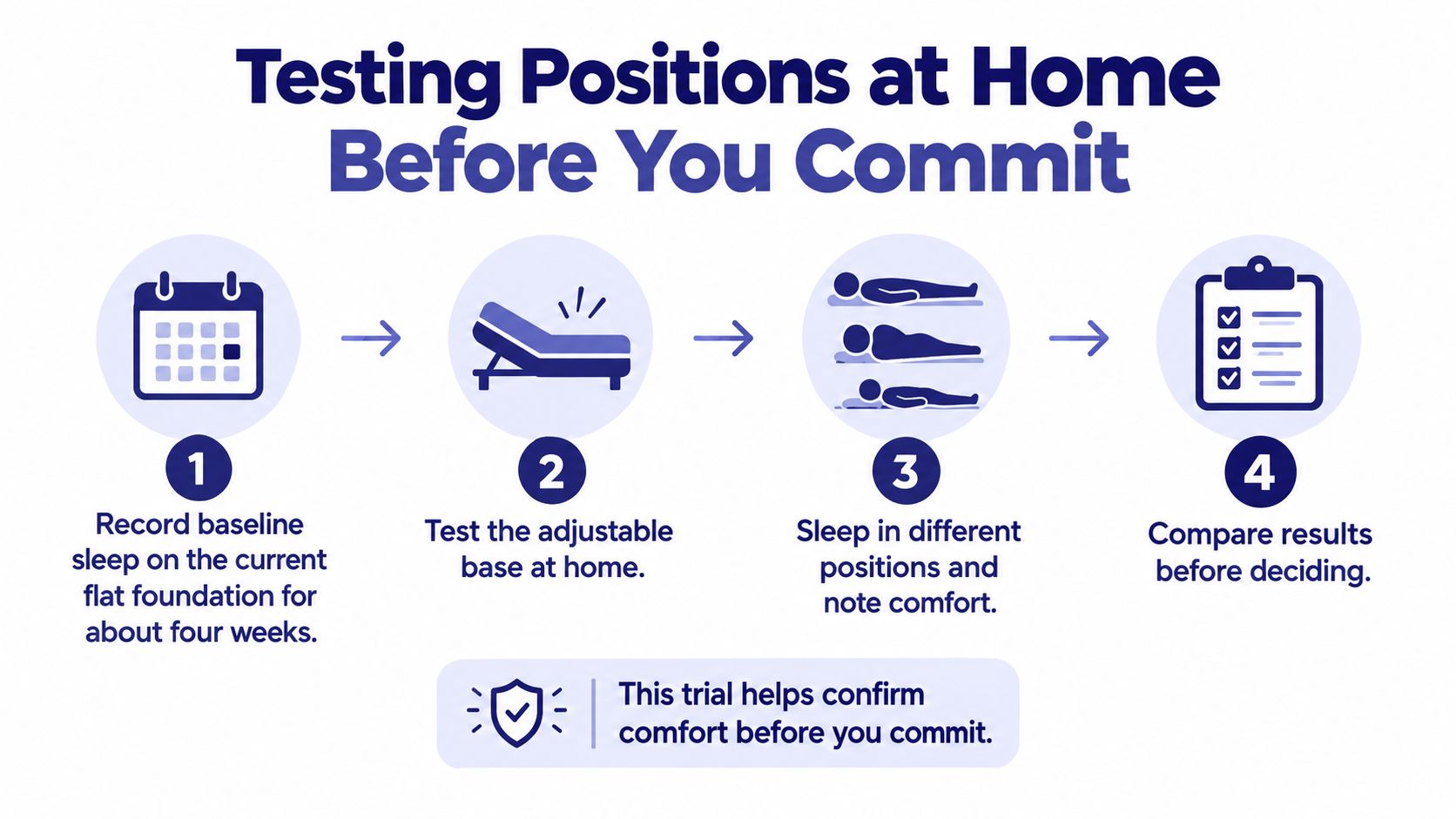
Testing Positions at Home Before You Commit
A showroom test helps you reject an uncomfortable arrangement. A home comparison helps you judge whether a promising one improves your actual routine.
First, confirm whether a home trial is available for the specific base and what returning it would involve. Don't plan an extended experiment on the assumption that adjustable foundations follow the same terms as mattresses.
Use this sequence only within the return and trial arrangements you've confirmed.
Establish a comparison you can use
A practical research-based approach is to record sleep on the existing flat foundation for four weeks, then compare it with four weeks using the adjustable base. In an 8-week study of 26 healthy adults, covering more than 1,100 tracked nights, researchers measured 21 additional minutes of total sleep, 5 additional minutes of REM sleep, and 3 fewer minutes awake after sleep onset during the adjustable phase, with improved comfort and sleep satisfaction also reported (home study of adjustable-base sleep outcomes).
Those results describe within-person changes in a small sample. They don't establish that every sleeper will improve or that a particular retail model will reproduce the findings.
Keep your own record simple enough that you'll maintain it:
- Sleep timing: Note bedtime, estimated time asleep, and final waking time.
- Interruptions: Record remembered awakenings and time spent trying to settle again.
- Morning comfort: Note stiffness, pressure, or discomfort rather than relying only on a general satisfaction score.
- Refreshment: Record how rested you feel, along with unusual circumstances such as illness or a disrupted schedule.
- Partner experience: Keep separate notes so one person's enthusiasm doesn't conceal the other's discomfort.
Change the position gradually
Begin with a shallow incline and adjust in small increments. Don't chase the highest setting or assume a preset's name means it's appropriate for sleeping.
Pay attention to your whole body. Avoid forcing a position that leaves you sharply bent at the hips, sliding down the mattress, or uncomfortable around the neck. Check that the mattress follows the deck and that fitted sheets don't pull tight enough to restrict movement.
Test the controls, return-to-flat function, and every programmed position you expect to use. Include the ordinary tasks: reaching the nightstand, changing position, and getting out of bed.
People with sleep apnea, reflux, pain, or mobility limitations should treat elevation as a comfort experiment and seek individualized healthcare advice. If sleep apnea is part of the concern, the Pain and Sleep Therapy Center's information on oral appliances for obstructive sleep apnea offers a separate topic to discuss with a qualified clinician, not a reason to replace prescribed care with bed positioning.
Your Next Step Toward a Better-Fitting Bed
You don't need to arrive at a showroom knowing which base to choose. You need enough information to rule out arrangements that won't work in your home.
The most useful preparation connects the physical room with the people using it. A floor plan without sleep preferences leaves out the daily compromise. A preferred position without delivery measurements leaves out whether the setup can reach the bedroom.
Bring a short, practical pre-visit list
Save the information on your phone or bring a marked-up sheet of paper. Photographs are especially helpful when an existing frame or tight access route is involved.
- Room and access measurements: Include the intended bed location, remaining furniture, doorway openings, and awkward turns.
- Existing bed details: Bring the frame's interior measurements, mattress model information, and photographs of its supports and hardware.
- Sleeper preferences: Note who sleeps where, which positions each person wants, and whether shared adjustment sounds workable.
- Bedding expectations: Decide how important a continuous surface and straightforward bed-making are to your routine.
- Capacity and installation questions: Ask for the model's manual, load instructions, power requirements, and delivery plan.
- Written policy questions: Clarify warranty coverage, service arrangements, trial eligibility, and return responsibilities for each component.
If you've already kept sleep or comfort notes, bring those too. Specific observations, such as discomfort when your hips bend or difficulty reaching the nightstand, give staff something concrete to evaluate.
Make the showroom visit resemble bedtime
Wear clothing that lets you lie down comfortably, and try the bed rather than judging it while seated at the edge. If you share the bed, visit together when possible.
Ask to compare the positions you'd use. Reading upright may feel pleasant, but it doesn't answer whether you can turn onto your side comfortably or settle into your usual sleeping posture.
You can visit a Woodstock location in Woodstock/Acworth, Canton, Dallas/Hiram, Rome, Covington, or Douglasville to discuss adjustable-base options and the practical differences between arrangements. Staff can also help address delivery access and setup questions before you choose.
There's no need to select a more complicated system just because it offers more functions. If independent adjustment matters, investigate it carefully; if your current flat setup already meets your needs, keeping it is a reasonable outcome.
A base that doesn't fit the room or the nightly routine isn't good value. Bringing measurements, clear preferences, and policy questions makes the in-store conversation shorter and more useful. It also gives you permission to pass on a comfortable demonstration if the complete arrangement doesn't suit your home.
Woodstock Furniture & Mattress Outlet offers adjustable bases, foundations, and sleep accessories, along with help evaluating compatibility, delivery, and setup. Bring your measurements and bedtime preferences when you visit Woodstock Furniture & Mattress Outlet, and ask the team to walk through the options that fit your room and routine.