Blog

  • How Long Should a Mattress Last? A Practical Guide to Longevity

    How Long Should a Mattress Last? A Practical Guide to Longevity

    Most people hear that a mattress should last somewhere between 7 and 10 years. While that’s a decent rule of thumb, it’s really more of a guideline than a hard-and-fast expiration date. The real story of your mattress’s lifespan is written by its materials, the quality of its construction, and how well you take care of it over the years.

    The 7 to 10 Year Rule and Why It's Not That Simple

    It’s tempting to hear "a decade" and just set a calendar reminder, but the truth is a bit more complicated. Think of it like the tires on your car. The manufacturer gives you a mileage estimate, but your actual driving habits, the road conditions, and how you maintain them determine how long they really last. A mattress is no different; its durability depends on its materials and how you use it every night.

    A mattress tucked away in a guest room that only sees occasional use is going to hold up much longer than the one you sleep on day in and day out. Things like body weight, sleeping position, and even whether you share the bed play a huge role in how quickly its support systems wear down. The goal is to get past that generic 7-to-10-year rule and learn how to judge your mattress on its actual performance.

    Understanding Lifespan by Mattress Type

    When it comes to longevity, not all mattresses are created equal. The materials used inside are the single biggest predictor of how many years of comfortable, supportive sleep you can expect.

    Here's a quick look at what you can expect from the most common mattress types on the market today.

    Average Mattress Lifespan by Type

    Mattress Type Average Lifespan (Years) Key Durability Factor
    Latex 12 – 15 Natural resilience of rubber foam
    Memory Foam 8 – 10 Density of the foam layers
    Innerspring 6 – 8 Quality and gauge of the steel coils
    Hybrid 7 – 10 Combination of coil quality and foam density

    As you can see, the materials make a big difference. Let's break down why.

    According to research from industry experts, the typical lifespan falls in that 7 to 10 year range, but the timeline shifts dramatically based on what's inside. For instance, latex mattresses often take the lead in durability, lasting up to 15 years, while traditional innerspring models tend to have the shortest lifespan at just 6 to 8 years because their coils can fatigue and sag over time. High-quality memory foams and hybrids usually land somewhere in the middle. You can see more details on these mattress lifespan findings from SleepFoundation.org to dig deeper into the numbers.

    This chart gives you a quick visual breakdown of what to expect.
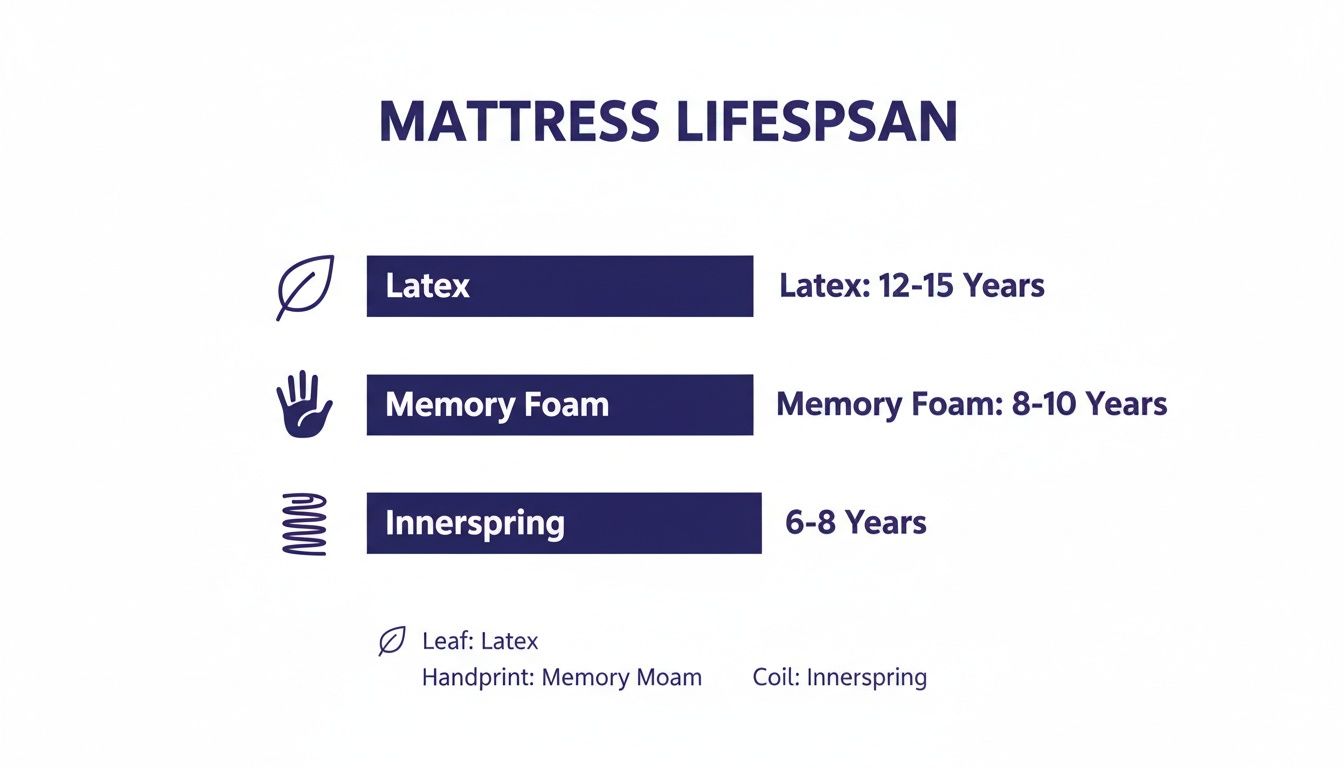
    Infographic showing mattress lifespan: Latex 12-15 years, Memory Foam 8-10 years, and Innerspring 6-8 years.

    The takeaway is clear: latex generally offers the longest potential for use, while you might find yourself shopping for a replacement for a traditional innerspring bed sooner.

    Why Some Mattresses Last Longer Than Others
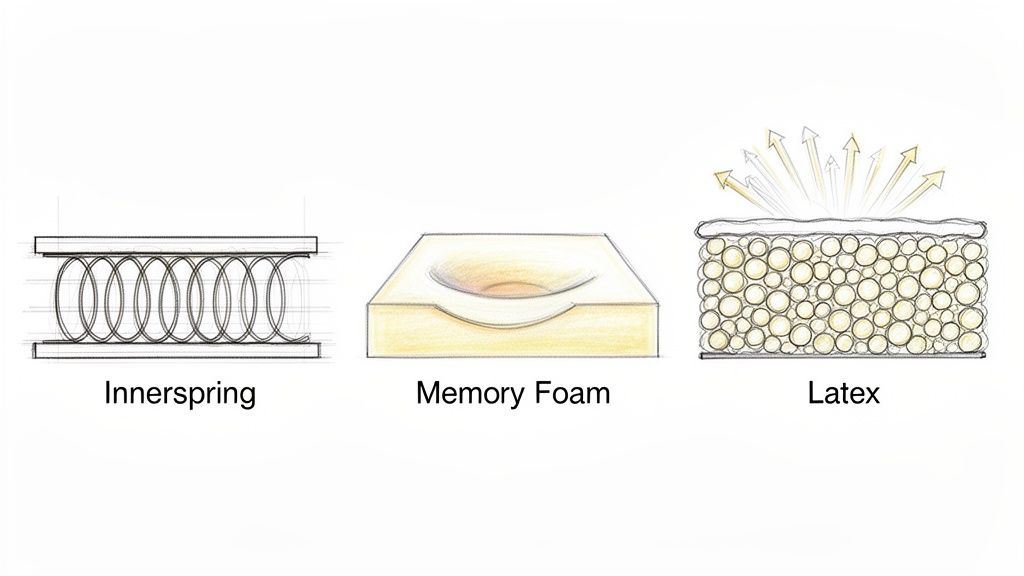
    Three mattress cross-sections illustrating innerspring, memory foam, and latex structures.

    Ever wondered why that old innerspring mattress from the guest room developed a permanent sinkhole years before a newer memory foam bed even started to feel different? It all comes down to the materials inside and how they handle the stress of supporting you, night after night.

    Think of it like bending a paperclip. The first few times, it snaps right back into shape. But if you keep bending it back and forth, the metal gets tired, weakens, and eventually breaks. Your mattress goes through a similar, much slower process of wear and tear every single night.

    The Innerspring Lifespan

    A traditional innerspring mattress is built on a core of steel coils. When the mattress is new, these springs are full of life, compressing and rebounding perfectly to give you that firm, bouncy support. But just like that paperclip, years of nightly compression eventually lead to metal fatigue.

    Over thousands of nights, the coils lose some of their height and strength. This is the classic culprit behind the deep body impressions and noticeable sagging that plague older innerspring beds.

    • Coil Gauge: A key factor here is the thickness of the steel. Thicker, lower-gauge coils are tougher and hold up to fatigue better.
    • Coil Count: While it's a popular marketing number, the total count is less important than the quality of the individual coils.
    • Edge Support: If a mattress doesn't have a reinforced border, the edges will be the first to break down—especially if you often sit on the side of the bed.

    Eventually, those tired coils just can't provide the even support they once did, leaving you with valleys and dips that throw your spine out of alignment and lead to those dreaded morning aches.

    How Foam Mattresses Age Differently

    Memory foam and other polyfoams operate on a totally different system. There are no mechanical springs here; instead, they use a structure of tiny, open cells filled with air. When you lie down, the foam compresses, air is squeezed out, and the mattress hugs your body's curves.

    The aging process for foam isn't about metal wearing out—it’s about the foam losing its elasticity.

    Over time, the cell walls inside the foam can start to break down from the nightly cycle of compression, body heat, and moisture. This weakens the foam's structure, causing it to spring back more slowly… or not spring back all the way.

    This is why a failing foam mattress feels different from a failing innerspring. Instead of one big crater, you’ll probably notice the foam just feels softer and less responsive, developing permanent shallow impressions where you sleep. Higher-density foams have stronger cell walls, which is why they outlast their lower-density cousins by a long shot. A foam's density, measured in pounds per cubic foot (PCF), is one of the best clues to its durability.

    Why Latex Mattresses Lead in Longevity

    When it comes to durability, latex is a standout material in the mattress world, especially natural latex. Its incredible longevity comes down to the unique, resilient nature of rubber foam.

    Unlike memory foam that squishes down by displacing air, latex has a naturally springy structure that pushes back against pressure almost instantly. This "bounce" allows it to endure nightly compression with surprisingly little wear and tear on its internal structure.

    Because of this incredible resilience, a quality latex mattress can easily last 12 to 15 years or more without any significant sagging or loss of support. It simply resists the permanent body impressions that wear down other materials, making it a fantastic long-term investment for consistently good sleep.

    Seven Signs Your Mattress Is Past Its Prime
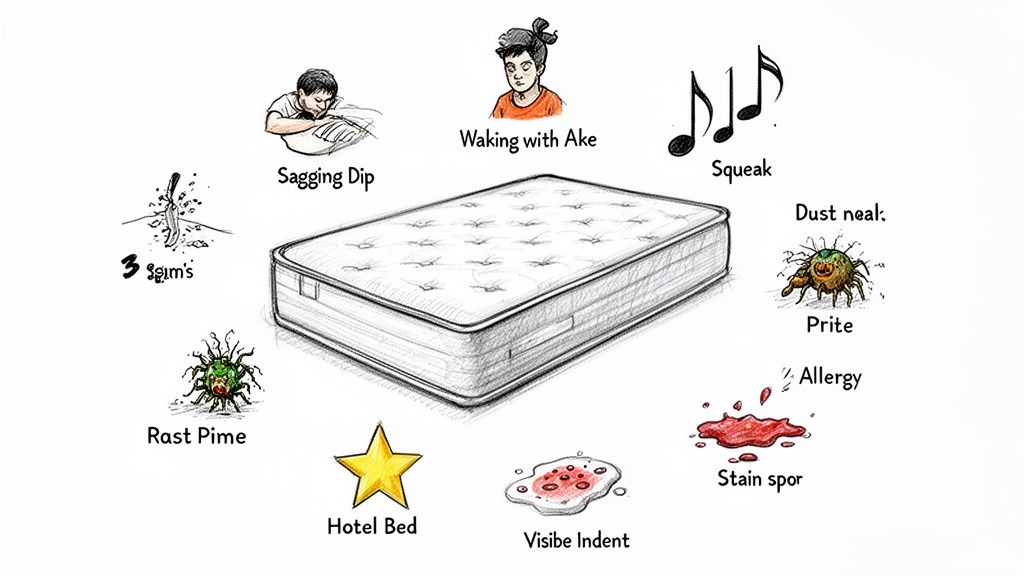
    An illustration of a mattress surrounded by various common problems like sagging, squeaks, stains, and pests.

    Sometimes, the calendar isn't the best way to know when your mattress is ready for retirement. Your body is usually the first to tell you, sending subtle (and sometimes not-so-subtle) signals that your sleep surface is failing. Instead of just focusing on how long a mattress should last, it’s much more helpful to recognize the real-world signs that it’s no longer giving you the support you need.

    These signs are more than just minor annoyances; they're direct symptoms of poor sleep health. When you can connect the dots between your mattress's condition and your own well-being, you'll know exactly when it's time for a change.

    1. Obvious Sagging and Body Impressions

    This is the classic, most visible sign of a worn-out mattress. After years of use, the materials inside—whether it's coils or layers of foam—start to break down and lose their ability to bounce back. The result is a permanent ditch or valley right where you sleep most often.

    A visible sag of 1.5 inches or more is a dead giveaway that the mattress has lost its structural integrity. This dip makes it impossible for your spine to stay in a neutral alignment, which is a direct cause of back pain and stiffness. If you can see that "hammock effect," the support system has definitely failed.

    2. Waking Up with Aches and Pains

    Sound familiar? You go to bed feeling fine but wake up with a sore lower back, a stiff neck, or aching hips. This is one of the most common complaints from people sleeping on an old mattress. As the support layers weaken, they can no longer cushion your pressure points or keep your body properly aligned.

    Your mattress should relieve pressure, not create it. If morning pain has become part of your daily routine and it fades as you start moving around, your bed is the likely culprit. It’s forcing your body into unnatural positions for hours on end.

    A supportive mattress is the foundation of restorative sleep. If you consistently wake up feeling more tired and sore than when you went to bed, it's a strong signal that your mattress is actively working against your body's needs.

    3. You Hear Noises Every Time You Move

    A mattress should be silent. If you're hearing creaks, squeaks, groans, or popping sounds whenever you shift positions or get in and out of bed, that’s a clear sign the internal components are breaking down. This is especially common in older innerspring mattresses.

    These noises usually come from old, fatigued coils inside the mattress or from the box spring underneath. A noisy bed isn't just annoying; it’s a symptom of a support system that has lost its strength and stability.

    4. Your Allergies Are Worse in the Morning

    Over many years, mattresses become a haven for dust mites, dead skin cells, pet dander, and other allergens. These microscopic particles thrive in the warm, humid environment of a bed.

    If you find yourself waking up with a stuffy nose, watery eyes, or other allergy symptoms that seem to get better once you're out of bed, your mattress could be the source. Knowing when your mattress is past its prime is crucial for good sleep, just as it's important to be aware of the 7 clear signs of dirty air ducts that signal a need for attention in your home.

    5. You Sleep Better Elsewhere

    This is one of the most telling signs there is. Does a night in a hotel bed or at a friend's house leave you feeling remarkably refreshed? If you consistently get a better night's sleep away from your own bed, it’s a clear signal that your mattress at home is the problem.

    6. Noticeable Lumps and Bumps

    Run your hand over the surface of your mattress. Does it feel uneven, lumpy, or bumpy? This happens when the foam or fiber comfort layers inside shift and clump together over time. These lumps create an inconsistent sleeping surface that can't provide uniform support.

    7. It’s Simply Uncomfortable

    At the end of the day, the most important sign is your own comfort. If you find yourself tossing and turning all night, struggling to find a good position, or feeling every single movement from your partner, it's time to listen to your body. Trust your instincts—if your bed just doesn't feel good anymore, it's time to start looking for a new one.

    How to Extend the Life of Your Mattress
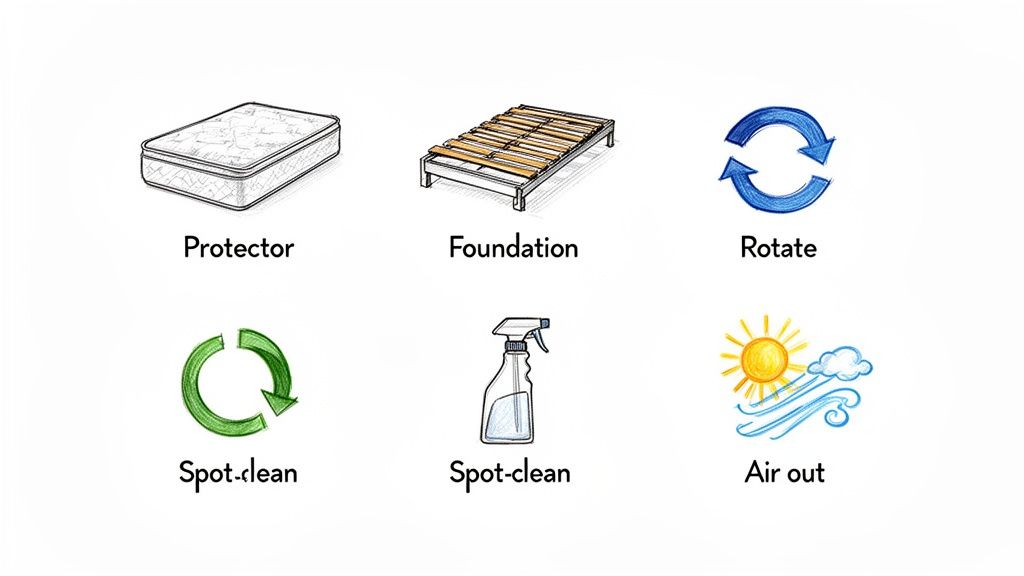
    Illustration showing six tips for mattress care: protector, foundation, rotate, spot-clean, and air out.

    While every mattress eventually wears out, you have a surprising amount of control over how long you get comfortable, supportive sleep. Think of it like maintaining a car; a little consistent care goes a long way and can add years of reliable performance. Taking a few simple steps protects your investment and ensures you get every last bit of value from it.

    These tips are basically the owner's manual for your bed. They're straightforward habits you can build to delay the sagging, softening, and general wear that send a mattress into retirement. With proper care, you can help your mattress reach or even exceed that recommended 7 to 10 year lifespan.

    Start with a Solid Foundation

    The very first step to a long-lasting mattress has nothing to do with the mattress itself—it’s about what you put underneath it. A mattress needs a sturdy, supportive base to do its job. An old, sagging box spring or a platform bed with slats spaced too far apart will cause even a great new mattress to break down prematurely.

    • For Innerspring Mattresses: A matching box spring is usually a good option. It’s designed to work with the mattress to absorb shock and distribute weight evenly.
    • For Foam and Hybrid Mattresses: These heavier beds need a more rigid, solid base. Look for a solid platform foundation or a slatted base where the slats are no more than 2.75 inches apart. This prevents dipping that can damage the foam layers over time.

    Seriously, using the wrong foundation is one of the fastest ways to void your warranty. Make sure your bed has the right support from day one.

    Always Use a Mattress Protector

    If you only do one thing on this list, make it this one. A high-quality mattress protector is a non-negotiable shield against the things that degrade a mattress from the inside out: moisture, spills, and allergens.

    Sweat, body oils, and the occasional spilled coffee seep into the mattress layers. This not only breaks down foams and fibers but also creates a breeding ground for mold, mildew, and dust mites. A waterproof yet breathable protector is an inexpensive investment that keeps your mattress clean, hygienic, and free of stains that can void a warranty.

    For an extra layer of defense against pests and allergens, consider using a mattress encasement for protection.

    Rotate Your Mattress Regularly

    Remember the old advice to flip your mattress? That’s mostly a thing of the past. Modern mattresses, especially hybrids and memory foam models, are built with specific layers from the bottom up and aren't meant to be flipped over.

    For the vast majority of today's one-sided mattresses, the rule is to rotate, not flip. Just turn the mattress 180 degrees every 3 to 6 months. What was at the head of the bed is now at the foot. This simple move ensures wear and tear is distributed evenly, preventing deep body impressions from forming in one spot.

    Decoding Your Mattress Warranty

    It's one of the biggest points of confusion when you're out shopping for a new mattress. You see a 10-year warranty tag and think, "Great! This bed is guaranteed to last me a decade!" Who could blame you? Unfortunately, that common misunderstanding can lead to a lot of frustration down the road.

    It’s really important to see a mattress warranty for what it is: a manufacturer's promise against specific defects in how it was made, not a guarantee of how comfortable it will feel for ten years. Think of it as protection against a product flaw, not an insurance policy against normal wear and tear.

    Prorated vs. Non-Prorated Coverage

    When you dig into the fine print, you’ll run into two key terms: "prorated" and "non-prorated." These words basically decide who pays for what if you have a successful warranty claim.

    • Non-Prorated: This is what you hope to see. For the first few years of most warranties, if a covered defect pops up, the manufacturer will repair or replace your mattress. You might have to cover shipping, but that's usually it.
    • Prorated: After the non-prorated period is over, things change. With prorated coverage, you’ll have to chip in a percentage of the original price to get a replacement. That percentage usually goes up the longer you've owned the bed.

    A typical 10-year warranty might be non-prorated for the first two years, then switch to a prorated plan for the final eight.

    So, What Does a Warranty Actually Cover?

    A warranty is laser-focused on structural failures, not your personal comfort. The number one issue that's actually covered is significant sagging or body impressions that form when nobody is on the bed.

    Here's the catch: most mattress companies define a "defect" as a visible dip of 1.5 inches or more. Anything less than that is just considered normal wear.

    This means your mattress can feel a lot less supportive and develop some noticeable shallow spots long before it ever qualifies for a warranty claim. This is the perfect example of why a mattress's real-world lifespan is often much shorter than its warranty period.

    Common Mistakes That Will Void Your Warranty

    Even if you have a legitimate, deep sag that should be covered, a few simple missteps can get your claim denied. Be careful to avoid these common warranty-killers:

    1. Removing the Law Tag: You know that tag at the end of the mattress that says, "Do Not Remove Under Penalty of Law"? That's not really for you, it's for retailers. But for manufacturers, that tag is the bed's I.D. Rip it off, and you've almost certainly voided your warranty.
    2. Using the Wrong Foundation: If you put a brand-new mattress on an old, worn-out box spring or a bed frame with slats that are too far apart, you're asking for trouble. Lack of proper support will damage the mattress and give the manufacturer an easy reason to deny your claim.
    3. Stains and Spills: This is the big one. Any liquid stain on the mattress is pretty much an automatic disqualification. It's considered an unsanitary condition, and they won't touch it. This is exactly why a high-quality mattress protector is a non-negotiable from day one.

    Choosing a New Mattress Built for Durability

    When the time finally comes to get a new mattress, your goal should be simple: find one that’s going to last as long as possible. Shopping for a durable mattress isn't just about finding the firmest bed on the floor; it’s really about understanding how quality materials and solid construction come together to give you years of consistent, comfortable sleep.

    Thinking about longevity from day one is the smartest way to invest in your sleep health for the next decade. Instead of getting hung up on brand names, let's peel back the cover and look at the components that actually make a mattress last.

    What to Look for in a Durable Mattress

    When you’re testing out new mattresses, some features are dead giveaways for how well a bed will fight off sagging and wear over time. If you keep an eye on these specifics, you can see past the marketing fluff and focus on what truly matters.

    Here are the key factors to check:

    • Foam Density: For any mattress with memory foam or latex, higher density is your best friend. Denser foams have a much stronger cell structure that’s built to resist compression and those dreaded body impressions that form over the years.
    • Coil Quality: In a hybrid or traditional innerspring mattress, you'll want to look for lower-gauge (thicker) steel coils and a higher coil count. Individually wrapped, or pocketed, coils tend to provide more durable, targeted support than the old-school, interconnected spring systems.
    • Construction Techniques: The little details make a huge difference. Pay attention to things like reinforced edge support, which keeps the sides from collapsing when you sit on them. Another classic sign of quality is hand-tufting, a traditional method that physically sews the layers together, preventing them from shifting or clumping down the road.

    Connecting Longevity to Your Needs

    How long you need a mattress to last can also depend heavily on where you are in life. Market analysis shows that how often people replace their mattress changes quite a bit with age.

    Younger folks between 18 and 35 tend to swap out their mattresses every 6.6 years on average. Those in the 36 to 55 age bracket hold on to theirs for about 9.1 years. And consumers 55 and older get the most mileage out of their beds, keeping them for around 11.6 years. You can dive deeper into these mattress statistics and what they mean for shoppers if you're curious.

    This info can help frame your own purchase. If you’re in a temporary spot, like a first apartment, a mattress with a 7-year lifespan might be all you need. But if you’re settling into your forever home, investing in a mattress built to last 10 years or more just makes good sense.

    Here at Woodstock Furniture & Mattress Outlet, our team can walk you through all the different options in a friendly, no-pressure environment. We truly believe the best way to choose with confidence is to feel the difference for yourself. Our goal is to give you the expertise you need to find a mattress that will support your well-being for years to come.

    A Few Lingering Questions About Mattress Longevity

    Even with a solid grasp of mattress types, warranties, and the tell-tale signs of a worn-out bed, a few practical questions always seem to pop up. Let's get straight to the point and tackle some of the most common things people ask right before they decide to buy a new mattress.

    Does Flipping or Rotating a Mattress Really Help?

    Yes, it absolutely makes a huge difference, but what you should do depends entirely on the kind of mattress you own. The vast majority of modern mattresses—memory foam, latex, and hybrids included—are designed with specific layers from the bottom up. They're strictly one-sided and should never be flipped over.

    For these newer beds, you'll want to rotate them 180 degrees (head to foot) every three to six months. This one simple move prevents you from sleeping in the exact same spot night after night, which helps spread out the wear and tear and dramatically slows down the development of sags or body impressions.

    Now, if you've got an older, traditional innerspring mattress, the old advice still stands. Those are often two-sided, meaning you should both flip and rotate them every few months. When in doubt, always check the manufacturer's care instructions for your specific bed.

    Can a Mattress Topper Save an Old Mattress?

    Think of a mattress topper as a bandage, not a miracle cure. It's a great temporary fix, but it's not a long-term solution for a fundamentally broken-down mattress. A good topper can definitely add a layer of softness to a bed that feels a little too firm or has lost some of that initial plush comfort.

    But here’s the critical part: a topper cannot fix a sagging mattress. If your bed already has a noticeable crater or dip, the topper is just going to sink right into that same valley. It won't give you the flat, supportive surface your spine needs. A topper is meant to enhance a good mattress, not resurrect a dead one.

    What Is the Most Durable Type of Mattress?

    When it comes to pure, rugged longevity, latex mattresses are the undisputed champions. The natural springiness and resilience of latex foam make it incredibly resistant to sagging and forming permanent body impressions over time. It's not uncommon for a high-quality latex mattress to provide consistent support for 12 to 15 years, and sometimes even longer.

    Coming in at a close second are high-density memory foams and well-built hybrid models that use strong, individually pocketed coils. For any mattress type, the rule is pretty straightforward: better ingredients make a better bed. Denser foams and thicker steel coils directly translate to a longer and more comfortable life for your mattress.


    Here at Woodstock Furniture & Mattress Outlet, our knowledgeable team knows the ins and outs of every mattress type. We can walk you through the differences in person, helping you feel the materials and understand the construction so you can find a durable mattress that fits your sleep style and your budget. Stop by one of our North Georgia locations and let us help you find your best night's sleep.
  • How to Choose Mattress Firmness for Better Sleep

    How to Choose Mattress Firmness for Better Sleep

    Picking the right mattress firmness goes beyond what just feels good at first. The goal is finding a mattress that keeps your spine in a neutral, natural line all night long. Nobody wants to wake up stiff and sore, and the right firmness is what prevents your body from either sinking into a hammock-like position or resting on a surface that’s too rigid.

    For most people, that sweet spot tends to be a medium (5-6/10) or medium-firm (7-8/10) mattress.

    Why Mattress Firmness Is More Than Just a Feeling

    It’s time to move past the old "soft vs. hard" debate. While everyone's idea of comfort is different, a mattress has one critical job: to provide proper support. And that's where firmness is everything.

    When a mattress is too soft, your heaviest points—usually your hips and shoulders—sink in too deep. This throws your spine into an unnatural curve, which is a recipe for waking up with nagging lower back pain and stiffness. It might feel cozy for a few minutes, but your back will pay the price after a full night.

    On the other hand, a mattress that’s too firm creates its own set of problems. It doesn't contour to your body's shape, leading to uncomfortable pressure points and pushing your spine out of alignment. If you're a side sleeper, you’ll especially feel this in your shoulders and hips. The right mattress strikes a delicate balance, supporting your body evenly from head to toe.

    The 1-10 Firmness Scale Explained

    To help shoppers make sense of it all, the mattress industry uses a 1-10 scale. While it's not a perfectly standardized system, it gives you a great starting point for understanding what you're looking for when you walk into a showroom.

    Here’s a quick breakdown of what those numbers actually mean.

    Firmness Level (1-10) Feel Description Generally Good For
    1-4 (Soft) A deep, sinking, "in-the-bed" feel with lots of body contouring and hug. Lightweight side sleepers who need maximum pressure relief for their joints.
    5-6 (Medium) A balanced feel with gentle contouring and noticeable underlying support. A wide variety of sleepers, but especially average-weight back and combination sleepers.
    7-8 (Medium-Firm) A supportive, "on-top-of-the-bed" feel with just a little bit of give. Sleepers with back pain, heavier individuals, and many back or stomach sleepers.
    9-10 (Firm) A very solid surface with minimal sinkage. Feels like sleeping on the floor. Strict stomach sleepers and those who need the most robust level of support.

    Think of this scale as a way to turn a feeling into something you can more easily shop for. It takes the guesswork out and helps you narrow down your options to find the right long-term fit.

    A Growing Focus on Spinal Health

    Lately, the conversation around mattresses has shifted. It's less about "comfort" and more about overall health and wellness. With so many people dealing with back and joint pain, shoppers are smarter than ever and are actively looking for beds that provide real support and pressure relief.

    This is a big reason why many ultra-soft beds have fallen out of favor. People now realize that letting your spine sag all night is a bad idea. As a result, foam and hybrid mattresses in the medium to medium-firm range have become very popular—they offer the contouring people love without sacrificing the support needed for issues like lower-back pain. You can read more about these mattress market trends here.

    For shoppers here in North Georgia, this means putting your spinal health first. Figure out what support you need, and then fine-tune it to the comfort you want.

    Aligning Firmness With Your Sleep Position

    If there's one single clue that tells us more about your ideal mattress firmness than anything else, it's how you sleep. Your go-to sleep position dictates where your body puts the most pressure on the mattress. More importantly, it determines what kind of support you need to keep your spine in a healthy, neutral alignment all night long.

    Getting this right is the difference between waking up refreshed and waking up sore.

    Think of it like this: your mattress should conform to your body's natural curves, not the other way around. Each sleep style creates its own unique pressure points and support gaps, and the right firmness is the solution.

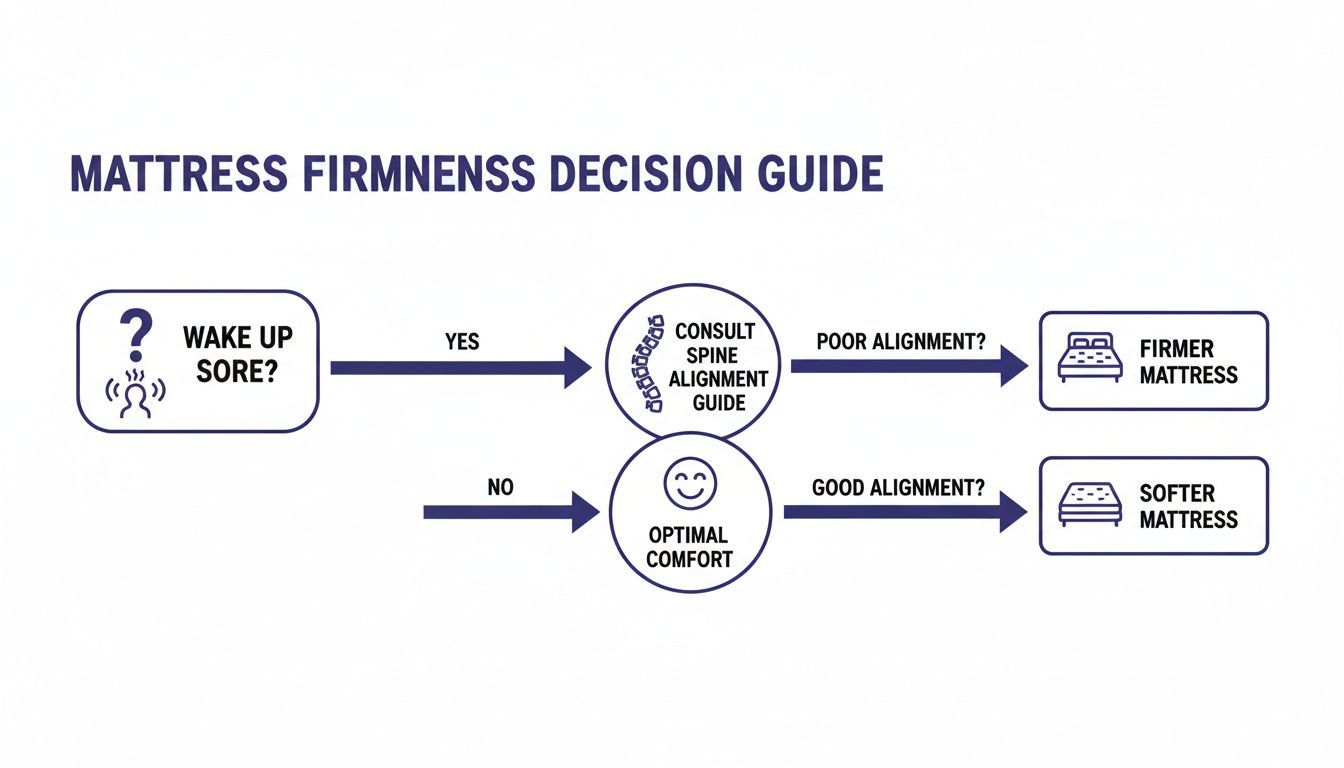
    This guide can help you visualize how your sleeping habits point toward the right firmness for you.

    A mattress firmness decision guide flowchart to choose between firmer or softer mattresses.

    If you're waking up with nagging soreness, that’s often your body telling you that your spine is out of alignment. The fix is usually finding a mattress that better supports your spine’s natural curve.

    Side Sleepers Need Pressure Relief

    Side sleeping is the most common position, but it also creates a ton of pressure on your hips and shoulders. A mattress that’s too firm won't let these joints sink in properly. Instead, it pushes back, forcing your spine into an unnatural upward curve that can cause everything from discomfort to numbness in your arms.

    To fix this, side sleepers almost always do best with a soft to medium (3-6/10) mattress. This allows the surface to contour around the body's widest points, giving you that critical pressure relief while the support layers underneath keep your spine straight.

    Back Sleepers Require Balanced Support

    If you’re a back sleeper, your mission is to maintain the natural “S” curve of your spine. When a mattress is too soft, your hips will sink lower than your shoulders, creating a hammock effect that puts strain on your lower back. On the flip side, a mattress that’s too firm won’t have enough give to support the small of your back, leaving a gap.

    For this reason, back sleepers often find their sweet spot in the medium to medium-firm (5-8/10) range. This level of firmness strikes the right balance — it offers gentle contouring to fill in the lumbar gap and has enough backbone to keep your hips elevated and aligned.

    Stomach Sleepers Must Prioritize Firmness

    Of all the positions, stomach sleeping can put the most strain on your spine. The biggest danger here is your midsection sinking too deep into the mattress. This causes your back to arch in a way it’s not meant to, leading to significant lower back pain over time.

    To prevent this, stomach sleepers need a medium-firm to firm (7-9/10) surface. A firmer mattress gives you the pushback required to keep your hips and abdomen on top of the bed, ensuring your spine stays in a much straighter, healthier position all night.

    Key Takeaway: The goal is always a neutral spine. A soft mattress helps a side sleeper achieve this by cushioning the shoulders and hips, while a firm mattress helps a stomach sleeper achieve it by preventing the hips from sinking.

    What About Combination Sleepers?

    Do you find yourself tossing and turning all night, starting on your side, rolling to your back, and maybe ending up on your stomach? If that sounds familiar, you're a combination sleeper, and you need a mattress that can keep up.

    The real challenge for you is finding a firmness that works for multiple positions. You need a surface that’s soft enough for when you’re on your side but firm enough to support you when you’re on your back or stomach.

    A medium-firm (6-7/10) mattress is usually a great choice for combination sleepers, as it offers a compromise of support and contouring. You’ll also want to look for a responsive mattress, like one with latex or pocketed coils, that lets you change positions easily without feeling like you’re stuck. This way, you get consistent support no matter how much you move around.

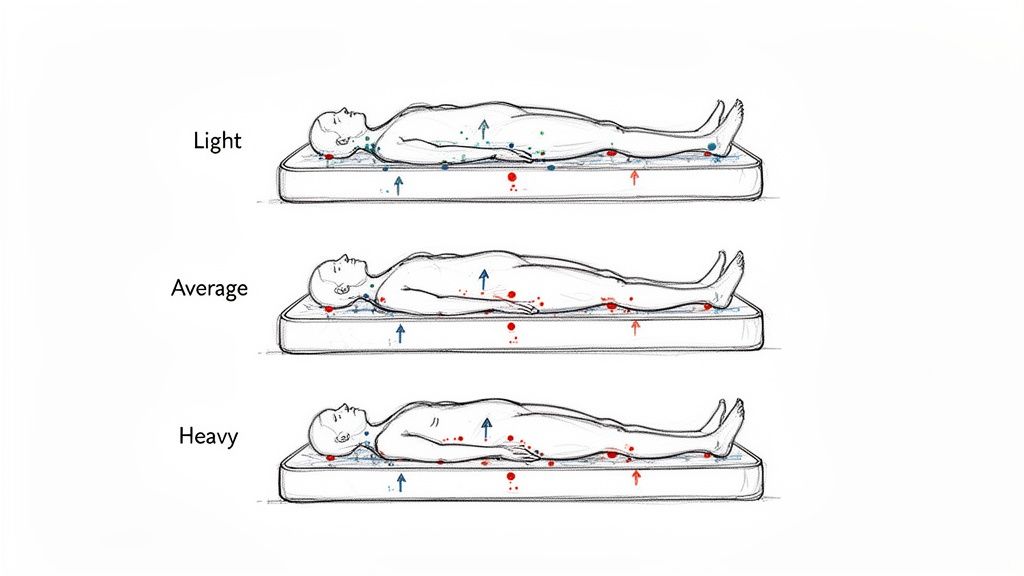
    How Body Weight Changes How a Mattress Feels

    Have you ever laid on a mattress a friend raved about, only to find it feels completely different to you? It happens all the time, and it highlights a critical point: mattress firmness isn't a fixed, universal measurement. It's a highly personal perception, and your body weight is the single biggest factor that changes how a mattress feels underneath you.

    A firmness rating on a label is just a starting point. The real test is how the mattress responds when you're actually lying on it. What feels like a supportive medium-firm surface to one person might feel like an unyielding board to someone lighter, or like unsupportive quicksand to someone heavier.

    Getting a handle on this dynamic is key to choosing a mattress that will actually do its job for you.

    Illustrations comparing mattress support and pressure points for light, average, and heavy individuals lying on their backs.

    Lighter Sleepers (Under 130 lbs)

    For those who weigh less than 130 pounds, firmer mattresses can be a real problem. Lighter individuals don't exert enough pressure to sink into the comfort layers of a medium-firm or firm mattress the way they're designed to be used.

    The result? You end up feeling like you're floating on the very top surface, missing out on contouring and pressure relief. This can lead to pressure points and throw your spine out of alignment, especially if you're a side sleeper. A soft to medium-soft (3–5/10) mattress is almost always a better fit, as it allows your body to sink in just enough to cushion joints and support your natural curves.

    Average Weight Sleepers (130–230 lbs)

    If your weight falls into this range, you're in luck. Most mattress firmness ratings are built with you in mind. When a manufacturer calls a mattress "medium-firm," it's very likely to feel that way to someone between 130 and 230 pounds.

    This group has a wide variety of good options, typically from medium to medium-firm (5–8/10). Your choice within this sweet spot will have more to do with your sleep position and personal preference than your weight alone. For instance, a back sleeper might lean toward the firmer end of that range, while a side sleeper will probably prefer something a little softer.

    Heavier Sleepers (Over 230 lbs)

    For sleepers weighing over 230 pounds, robust support becomes the top priority. A mattress that's too soft is going to cause excessive sinkage, especially around the hips and torso. When that happens, your spine can fall into an unhealthy, hammock-like position, which is a recipe for chronic lower back pain.

    Heavier folks need a mattress that provides serious pushback to keep the spine properly aligned. A medium-firm to firm (7–9/10) mattress is usually the right call to make sure the core support layers can do their job effectively. It's also a good idea to look for mattresses made with durable, high-density materials that won't sag or break down under more pressure over time.

    Why Sinkage Matters: Proper sinkage isn't about being swallowed by your bed. It’s about letting your body’s curves—like your shoulders and hips—dip in just enough so that the mattress can rise up to support the rest of your body, like your lower back. This is what keeps your spine straight and pain-free.

    The "Default" Firmness for Most People

    Although mattress labels often go from 1 to 10, real-world buying habits show that most people land somewhere in the middle. Queen-size mattresses—which are overwhelmingly offered in medium to medium-firm feels—now account for about 40–46% of global mattress sales by size. This isn't just a coincidence; a medium to medium-firm queen is a proven "default" for adults between 130–230 lbs.

    On top of that, industry data shows that foam mattresses, often engineered for that 5–7/10 medium feel, hold roughly 45% of the market by type, partly because they excel at pressure relief. You can dig deeper into these global mattress market trends if you're curious. For our customers at Woodstock Furniture & Mattress Outlet, this all boils down to a simple rule of thumb: unless your body weight or sleep style is an outlier, a medium to medium-firm mattress is a statistically sound place to start your search.

    Finding a Solution for Aches, Pains, and Partners

    Figuring out the basics like sleep position and body weight gets you most of the way there, but real life often throws a couple of curveballs into the mattress shopping process. The two biggest hurdles we see shoppers face are dealing with chronic pain and sharing a bed with a partner who has completely different sleep needs.

    These situations call for a bit more finesse than just picking a number off the firmness scale. You're no longer just buying a mattress; you're looking for a solution. The goal is to find a bed that actively alleviates pressure on a sore hip or ensures one person’s tossing and turning doesn’t feel like a seismic event for the other.

    Navigating Chronic Aches and Pains

    If you’re waking up sore, that’s your body’s way of telling you that your mattress isn’t pulling its weight. Different kinds of pain often point toward different firmness solutions.

    • For Lower Back Pain: This is one of the most common complaints we hear. When a mattress is too soft, your hips sink in too far, knocking your spine out of alignment and putting strain on your lower back. A medium-firm (7/10) mattress is often the sweet spot, providing enough lift to keep the hips supported while still offering a comfortable cushion.

    • For Shoulder or Hip Pain: Side sleepers, we're looking at you. A mattress that's too firm will feel like you’re sleeping on a board, creating intense pressure points right on your shoulders and hips. A softer, more contouring mattress—typically in the medium-soft to medium (4-6/10) range—is a much better fit. It allows your shoulders and hips to sink in just enough to relieve pressure and keep your spine perfectly straight. Keep an eye out for mattresses with zoned support, which are often designed to be softer under the shoulders and firmer under the hips for targeted comfort.

    A Note on Compromise: Let's be real—finding the right mattress to fix a specific pain point sometimes involves a small tradeoff. For instance, a stomach sleeper who also has shoulder pain might need a mattress that’s just firm enough to support their hips without being so rigid that it makes their shoulder ache.

    For a clearer picture, we've put together a quick reference table to help you connect common sleep issues with potential mattress solutions.

    Finding the Right Firmness for Common Issues
    Common Problem Primary Sleep Position Suggested Firmness Range Why It Helps
    Lower Back Pain Any Medium-Firm (6-7/10) Prevents hips from sinking too low, promoting better spinal alignment.
    Shoulder or Hip Pain Side Sleepers Medium-Soft to Medium (4-6/10) Cushions pressure points and allows the shoulders and hips to sink in comfortably.
    Waking Up Stiff Back or Stomach Sleepers Medium to Firm (6-8/10) Offers robust support to maintain a neutral spine position throughout the night.
    Restlessness/Tossing & Turning Any Medium (5-6/10) Provides a balanced feel that accommodates multiple positions without creating pressure points.

    This table is a great starting point, but remember that personal comfort is always the final decider.

    Sharing a Bed With a Partner

    Shopping for one person is hard enough. When you're trying to find a mattress that works for two people with different body types, sleep styles, and preferences? It can feel downright impossible.

    Thankfully, you don't have to resort to separate bedrooms. Modern mattresses offer some fantastic solutions.

    A medium-firm (6-7/10) mattress is a great starting point for many couples. It’s the universal crowd-pleaser of the mattress world, often serving as a happy medium that satisfies a wide variety of sleepers.

    But what if one partner is a 110-pound side sleeper and the other is a 240-pound back sleeper? A single firmness level might be asking for trouble. In cases like this, you need to look at other mattress features. Beds with excellent motion isolation, like memory foam or pocketed coil hybrids, are non-negotiable. They are designed to absorb movement, so when one person rolls over or gets up, the other person sleeps on, undisturbed.

    For couples with truly polar opposite needs, a split king mattress can be a great problem-solver. A split king is simply two Twin XL mattresses placed side-by-side on a king frame. This setup allows each person to choose their own mattress with their own ideal firmness. No more compromising—each of you gets exactly what you need for a good night’s sleep.

    Why You Should Test a Mattress In Person

    Reading online descriptions, customer reviews, and looking at firmness scales are great for doing your homework and narrowing down the field. But they can only get you so far.

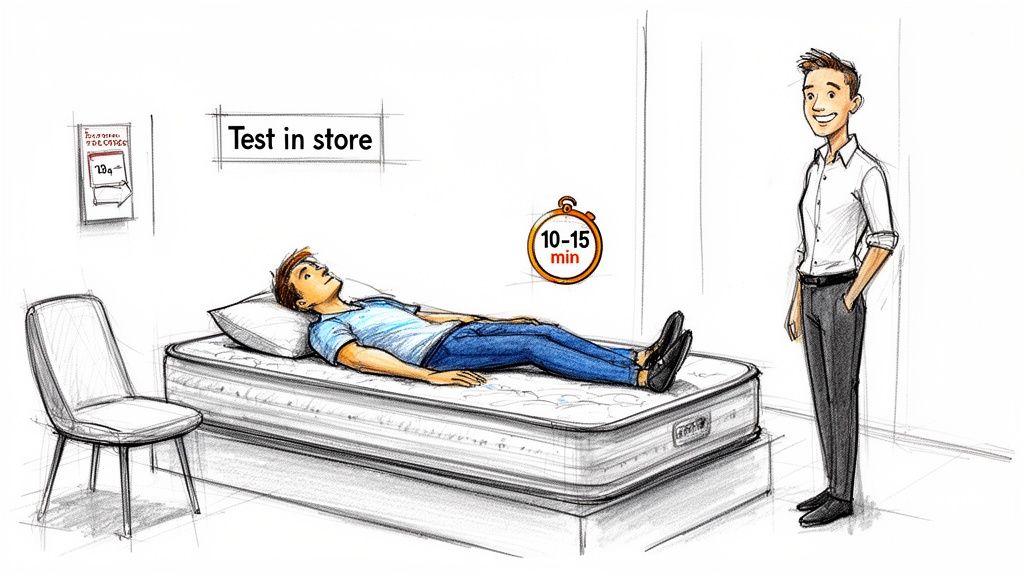
    The honest truth is that firmness is subjective. What one brand calls a “medium-firm” can feel completely different from another’s. It all comes down to the unique materials and construction they use. This is why trying a mattress in-store is still so important. It’s your only real chance to feel how a mattress supports your body, taking the guesswork out of a major investment in your health.

    A man tests a mattress in a store for 10-15 minutes, observed by a salesperson.

    Making the Most of a Showroom Visit

    To get an accurate feel for a mattress, you have to do a little more than just push down on it with your hand. Think of your showroom visit as a dress rehearsal for a fantastic night's sleep.

    Here’s what our experienced staff often suggest to customers:

    • Dress Comfortably: You’ll want to wear clothes that are easy to move around in. This isn't the time for stiff jeans or business attire.
    • Assume the Position: Don’t be shy! Lie down in your go-to sleeping position, whether you’re a side, back, or stomach sleeper.
    • Stay a While: You’ve got to give it a real test drive. Plan to lie on any serious contender for at least 10-15 minutes. This gives your body time to settle in so you can truly feel its support and pressure relief.
    • Bring Your Partner: If you share a bed, you absolutely should shop together. Both of you need to lie on the mattress at the same time to see how it handles movement and if it can comfortably support two different people.

    While you're lying there, listen to your body. Do you feel your shoulders or hips getting pinched? Is there a gap under your lower back, or does it feel properly supported? The goal is to feel cradled and supported with your spine in a neutral, straight line.

    A mattress should conform to your body, not force your body to conform to it. If you feel your spine arching or your joints getting pinched, it’s a clear sign that the firmness level isn’t right for you.

    Global Trends Meet Local Needs

    Believe it or not, where people live can even shape their mattress preferences. North America holds roughly 32–35% of the global mattress market landscape and, as a whole, we tend to prefer thicker, more supportive mattresses with a wide variety of firmness options. This is a bit different from the Asia-Pacific region, for instance, where balanced-firmness mattresses that fit smaller living spaces are more popular.

    For a retailer right here in North Georgia, these stats just confirm what we see every day. Our local shoppers have high expectations for both comfort and support, which is why offering a great selection of firmness levels is a must for us.

    And please, don't ever hesitate to ask questions. Our team is here to guide you, not rush you into a decision. Visiting one of our showrooms gives you that critical hands-on experience you need to feel confident you’re choosing a mattress that will give you years of restful sleep.

    Common Questions About Mattress Firmness

    Even after sorting through sleep positions, body weight, and your own aches and pains, a few questions always seem to pop up right at the end. Let's tackle some of the most common ones we hear from shoppers in our showrooms to clear up any final confusion and help you feel confident in your choice.

    Is It Better to Sleep on a Firm or Soft Mattress?

    This is the classic question, but the truth is, the answer is always: it depends entirely on you.

    Neither firm nor soft is automatically "better." A plush, soft mattress can be a dream come true for a lightweight side sleeper who needs serious pressure relief for their shoulders and hips. On the flip side, a firm mattress is often the perfect solution for a stomach sleeper who needs to keep their hips elevated to prevent their spine from falling out of alignment.

    The best mattress isn't the one that's hardest or softest; it's the one that keeps your spine in a neutral, straight line all night long.

    How Do I Know If My Mattress Is Too Firm?

    Your body will tell you. If your mattress is too firm, you'll start noticing a few telltale signs. You might wake up with a nagging soreness or even numbness in your shoulders and hips—that's because the surface isn't giving your pressure points the cushion they need.

    Another dead giveaway is feeling like you’re sleeping on the bed rather than in it. If you lie flat on your back and there's a noticeable gap between your lower back and the mattress, that's a clear signal it's too rigid to conform to your body’s natural curves.

    What Is the Most Popular Mattress Firmness?

    By a long shot, the crowd favorite is medium-firm. It’s the versatile sweet spot that works for a huge range of people.

    It’s especially popular with back sleepers, combination sleepers, and even couples who have different sleep styles. A medium-firm mattress just strikes that perfect balance, offering plenty of support to keep the spine aligned while still having enough give for comfort.

    Can Firmness Prevent Back Pain?

    Getting a mattress with the right firmness can absolutely help ease or even prevent back pain. For many people struggling with back issues, especially in the lower back, a medium-firm mattress is the go-to recommendation.

    This level provides enough support to keep the hips from sinking in too deep—a common cause of spinal strain—but it isn't so hard that it creates new pressure points. The goal is always proper alignment. While mattress firmness is a huge piece of that puzzle, don't forget to consider a holistic approach to sleeping better by looking at other ways to improve your rest.

    At the end of the day, picking a mattress firmness is a personal journey. This guide gives you a solid starting point, but the final decision really comes down to what feels best for your unique body and sleep habits.


    Here at Woodstock Furniture & Mattress Outlet, our team has years of experience helping people navigate these choices. We invite you to come visit one of our North Georgia showrooms, test out a few different firmness levels, and let us help you find the right mattress for years of restful sleep. Learn more about our locations and what to expect.

    Article created using Outrank

  • Memory Foam vs Hybrid Mattress: A Complete Comparison

    Memory Foam vs Hybrid Mattress: A Complete Comparison

    When it comes down to it, the choice boils down to this: a memory foam mattress is all about deep, body-hugging contour and superior motion isolation, giving you a sink-in feel with minimal bounce. On the other hand, a hybrid mattress brings together coils and foam for a responsive, breathable, and supportive bed that has a little bit of spring to it. The right one for you depends on whether you prefer to be cradled by your mattress or want a more balanced, cooler sleep.

    Memory Foam vs Hybrid Mattresses: A Quick Guide

    Shopping for a new mattress can feel overwhelming, but a helpful place to start is understanding the real differences between the two most popular choices out there—memory foam and hybrid. Each is built with a different sleep philosophy in mind, which results in a distinct feel, unique performance, and benefits for different kinds of sleepers.

    The goal isn't to find a single "best" mattress, because that doesn't exist. It's about finding the mattress that solves your specific sleep problems. We're here to cut through the marketing fluff and give you straightforward information on how they're built, how they feel, and who they're really for.

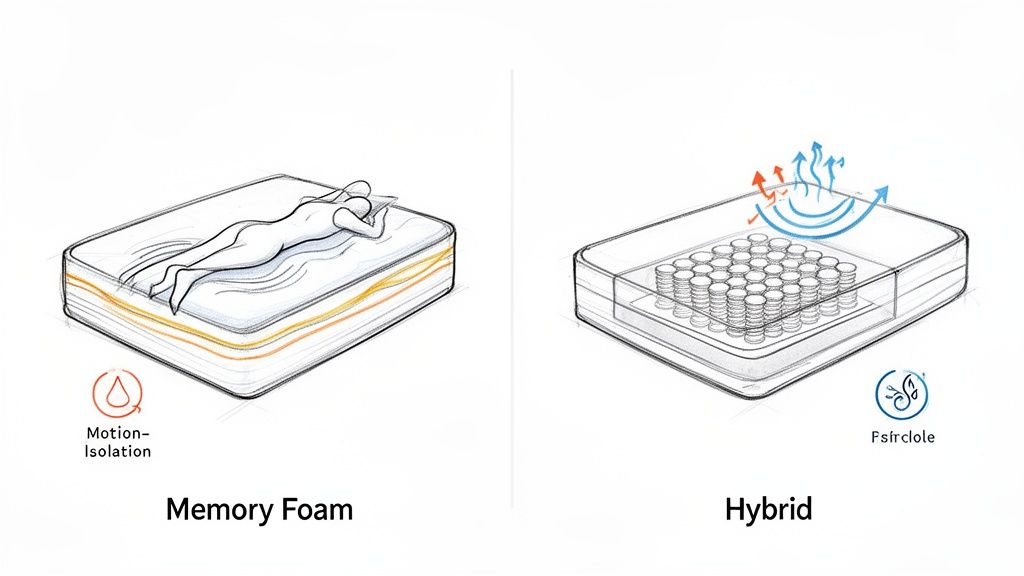
    Illustrations comparing memory foam mattress motion isolation with hybrid mattress breathability and support features.

    To kick things off, let's break down the key differences you'll notice right away.

    Key Differences at a Glance

    For those who just want the highlights, this table gives you a quick snapshot of what sets these two mattress types apart. It’s a great starting point before we dive deeper into what these features actually mean for your sleep.

    Feature Memory Foam Mattress Hybrid Mattress
    Feel Deep contouring, body-hugging, slow response Balanced, gentle contouring with some bounce
    Support System High-density polyfoam core Pocketed innerspring coil system
    Motion Isolation Excellent; absorbs nearly all movement Good; coils may transfer minor motion
    Temperature Can retain heat; look for cooling features More breathable due to airflow through coils
    Edge Support Fair to good; edges can compress Very good to excellent; reinforced perimeter
    Durability Typically 6-8 years Typically 8-10+ years

    As you can see, the core construction really dictates how each mattress performs. Now, let’s get into the details of what these differences feel like in the real world.

    What’s Inside a Memory Foam Mattress? A Closer Look

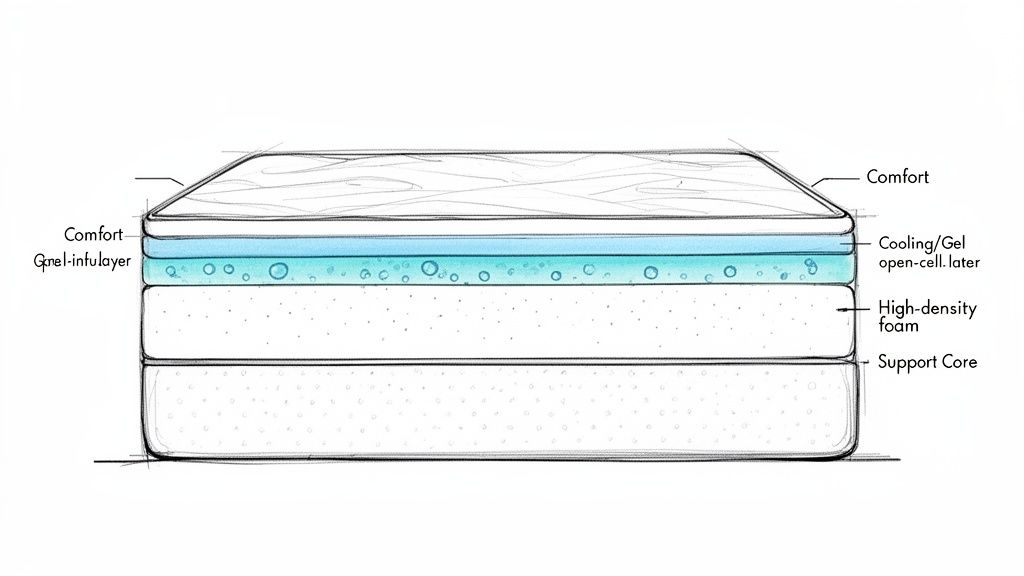
    To really understand the memory foam vs hybrid mattress debate, we need to look at what’s inside, starting with memory foam. At its heart, a memory foam mattress is made entirely of different foam layers, with each one doing a specific job to create that classic body-hugging feel. The construction is a bit simpler than a hybrid's, but the real story is in the details of these layers.

    The star of the show is viscoelastic foam, a material engineered to respond to both your body's pressure and its heat. When you lie down, your natural body warmth softens the foam, letting it slowly contour to your exact shape. This is what creates that deep, cradling sensation memory foam is famous for, and it’s excellent for pressure relief because it distributes your weight evenly.

    Underneath those top comfort layers, you’ll find a sturdy base made of high-density polyurethane foam. This core layer is much firmer, giving the mattress its structure, stability, and long-term durability. It’s the unsung hero that keeps you from sinking in too far and makes sure the mattress holds its shape for years to come.

    Detailed cross-section diagram illustrating the various comfort, cooling gel, high-density foam, and support layers of a mattress.

    Foam Density & Type: What It Means for Your Sleep

    Not all memory foam is the same. The density and the specific type of foam used in those top comfort layers will drastically change how a mattress feels, performs, and how long it lasts. Knowing a little about these factors can help you understand mattress specifications more clearly.

    Foam density is a key indicator of quality and durability, measured in pounds per cubic foot (PCF). Here’s a quick breakdown:

    • Low-Density Foam (Under 3.5 PCF): This foam feels on the softer side and bounces back pretty quickly when you move. The trade-off is that it might not be as durable and could offer less support in the long run.
    • Medium-Density Foam (3.5 to 5.0 PCF): This is a common density for many mattresses, offering a good balance of durability, support, and pressure relief.
    • High-Density Foam (Over 5.0 PCF): This is a highly supportive and durable foam. It has a much slower response time, which creates that classic, slow-sinking feeling many people associate with memory foam.

    A key takeaway for shoppers is that higher-density foams often lead to a longer-lasting mattress. While the initial feel might be firmer, these foams are less likely to develop body impressions or lose their supportive qualities prematurely.

    Modern Foam Technologies

    The earliest memory foam mattresses had a reputation for sleeping hot. It made sense—that dense material was great for comfort but could also trap body heat. To address this, manufacturers have come up with clever innovations that are now standard in many modern memory foam beds.

    These new technologies are all about improving airflow and moving heat away from your body, making for a cooler night's sleep.

    • Gel-Infused Foam: Tiny gel beads or swirls are mixed right into the memory foam. These gels are designed to absorb heat and pull it away from your body, helping to keep the sleeping surface at a comfortable temperature.
    • Open-Cell Foam: This type of foam is made with a different internal structure. The "open cells" create millions of tiny pathways for air to move through the mattress, which keeps heat from getting trapped.
    • Copper and Graphite Infusions: Much like gel, these conductive materials are infused into the foam. Their job is to draw heat away from you and distribute it across the mattress so it can dissipate.

    By understanding these components—the viscoelastic comfort layers, the supportive polyfoam core, and the various foam technologies—you can better judge how any given memory foam mattress will actually perform for you. This knowledge lets you see past marketing and choose a bed based on what’s really inside.

    Deconstructing the Hybrid Mattress

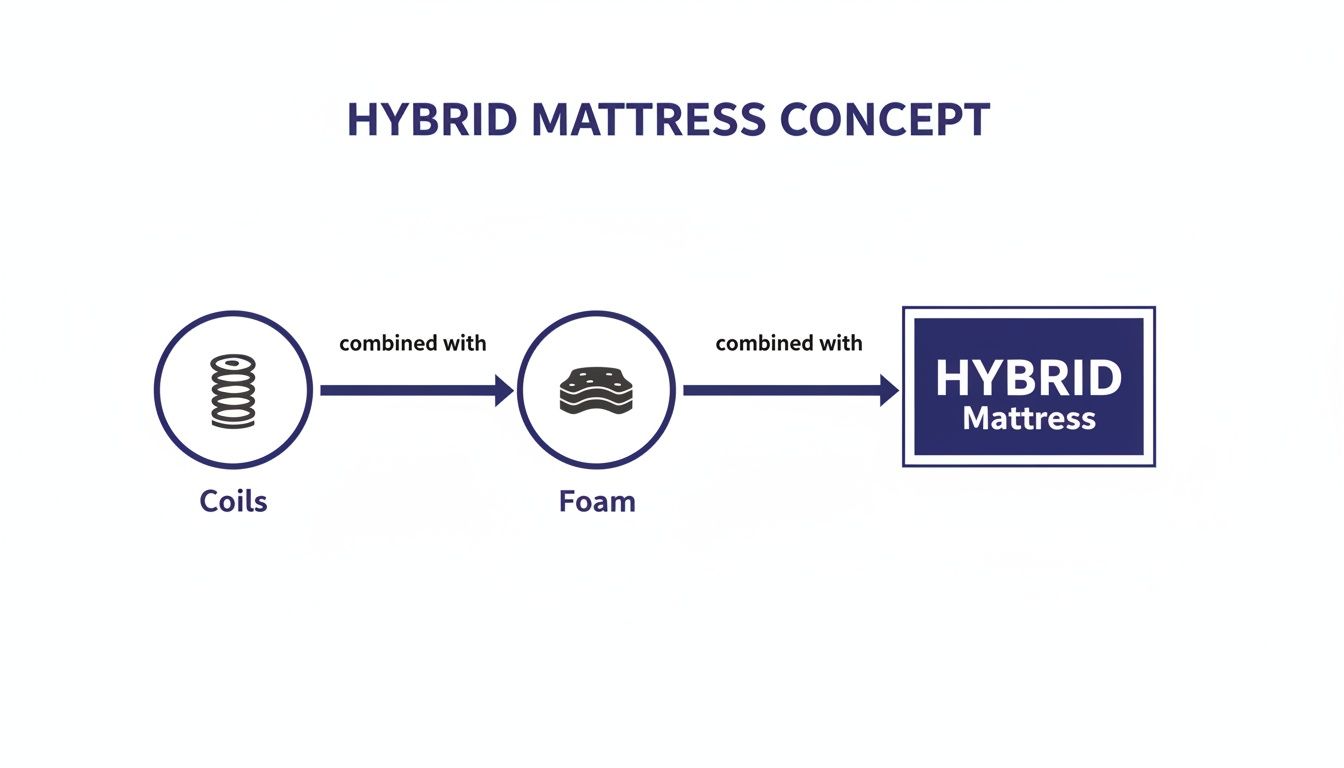
    Where a memory foam mattress is made entirely of different foam layers, a hybrid mattress is exactly what it sounds like—a combination of two different mattress technologies in one multi-layered design. The whole idea is to get the benefits of both, pairing the sturdy, responsive lift of coils with the pressure-relieving hug of foam or latex.

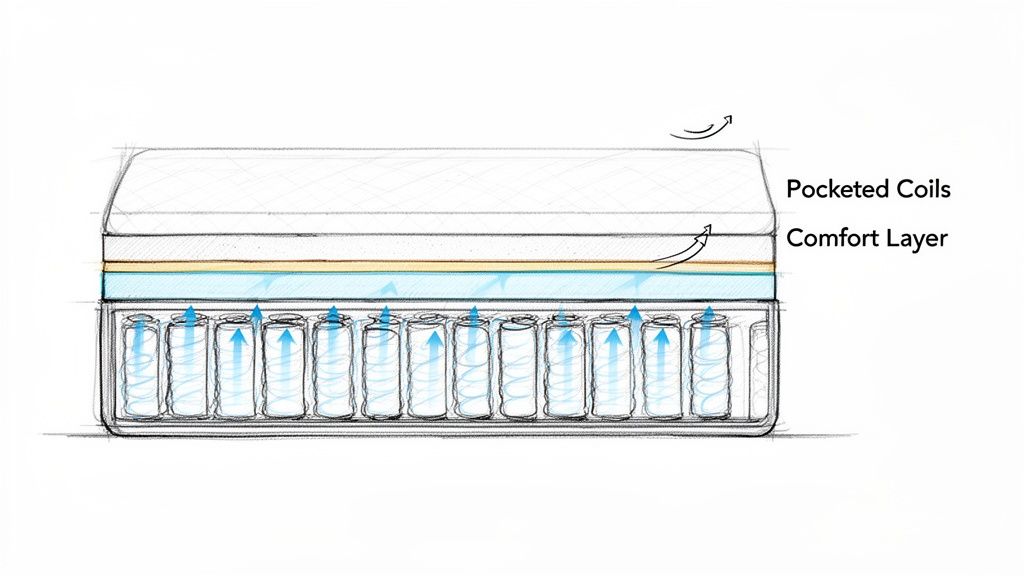
    The foundation of any true hybrid mattress is its pocketed coil support system. This isn't your grandparents' old innerspring bed where all the coils are wired together. Instead, a hybrid has hundreds, sometimes thousands, of individual steel coils that are each wrapped in their own fabric pocket. This allows every single spring to move independently, giving you much more targeted support and greatly reducing motion transfer. It's also the secret to why hybrids tend to sleep cooler, as air moves freely between the coils, preventing heat from getting trapped.

    Cross-section diagram of a mattress showing internal layers: top pocketed coils, comfort layers, and individual pocketed coils with air circulation.

    The Comfort Layers and Coil System

    Stacked right on top of that coil base are the comfort layers. This is where the "hybrid" concept really comes to life, because manufacturers can use all sorts of materials to create a specific feel.

    • Memory Foam: Many hybrids use memory foam comfort layers to provide that classic body-contouring feel and excellent pressure relief.
    • Latex Foam: You'll also find models using latex, which has a more responsive, almost buoyant sensation. It's also known for being naturally cool and very durable.
    • Proprietary Foams: Many brands also develop their own unique foams designed for specific perks like better cooling, quicker response, or extra durability.

    This marriage of coils and foam has become a major force in the mattress industry. In fact, the market for "hybrid or memory foam mattresses" hit a value of around USD 12.5 billion in 2024 and is projected to nearly double by 2033. That kind of growth shows just how much shoppers appreciate mattresses that blend technologies for a more balanced night's sleep. You can always explore more data on mattress market trends to see how these designs continue to evolve.

    How Coils Influence the Feel

    It’s not enough to just know a hybrid has coils; the type of coils makes a huge difference in how the mattress feels and performs.

    One of the biggest advantages of a hybrid is its responsiveness. That pocketed coil system gives it a subtle but noticeable bounce, making it much easier to roll over or change positions at night. This helps avoid the "stuck" feeling that some people experience with traditional memory foam.

    When you're comparing hybrids, there are two key specs to look for: coil count and coil gauge.

    • Coil Count: This is simply the total number of individual coils in the mattress. As a general rule, a higher coil count (usually between 800 to over 2,000) means more precise, conforming support for your body.
    • Coil Gauge: This tells you how thick the steel wire is. It’s a bit counterintuitive, but a lower gauge number means a thicker, firmer wire, while a higher gauge number means a thinner, more flexible wire.

    These details, working together with the comfort layers on top, ultimately decide the mattress's final firmness, the amount of bounce it has, and how well it supports you all the way to the edge. Grasping this combined construction is key to figuring out where you land in the memory foam vs hybrid mattress debate.

    Comparing Key Performance Differences

    Now that we know what’s going on inside these mattresses, we can talk about how those differences actually feel when you lie down. Let's move past the marketing jargon and get into a practical, side-by-side breakdown of what will really impact your sleep, night after night. Each mattress type has its own strengths, and figuring out these trade-offs is the key to choosing with confidence.

    Honestly, this decision is at the very heart of the mattress shopping journey. We see it in our showrooms all the time—that tension between the deep, contouring comfort of memory foam and the bouncy, supportive feel of a hybrid. Both options are incredibly popular for a reason. In fact, foam mattresses brought in around USD 38.7 billion in revenue in 2024, while hybrids are often considered the largest market segment. If you want to nerd out on the numbers, you can explore detailed mattress market insights to see how these trends are shaping the beds we sleep on.

    Feel and Responsiveness

    The very first thing you'll notice is how the mattress reacts to your body. This "feel" is a huge part of the memory foam vs. hybrid mattress debate.

    A memory foam mattress is known for its slow-moving "sink." When you get into bed, the foam uses your body heat and weight to soften and mold to your exact shape. This gives you that deep, body-hugging sensation, almost like the mattress is giving you a gentle hug. Because it responds so slowly, some people find it takes a bit more effort to change positions.

    A hybrid mattress, on the other hand, has a much more balanced and responsive feel. The coil system underneath provides a gentle "bounce" or lift, making you feel like you're sleeping on the mattress rather than sinking in it. This makes it way easier to move around and switch from your back to your side without feeling like you're stuck in quicksand.

    Pressure Relief and Support

    Both mattresses are designed to relieve pressure, but they go about it in completely different ways, which can make a big difference for your spinal alignment and overall comfort.

    • Memory Foam offers amazing pressure relief by distributing your body weight evenly across the surface. Its deep contouring is a lifesaver for cushioning sensitive spots like hips and shoulders, which is why it's so often recommended for side sleepers.
    • Hybrid Mattresses give you a more dynamic kind of pressure relief. You get the contouring comfort from the foam layers on top, but the pocketed coils below provide strong, targeted support. This one-two punch helps keep your spine in a neutral position, a huge plus for back and stomach sleepers who need to stop their hips from sinking too low.

    The core difference really comes down to deep compression versus responsive lift. Memory foam absorbs pressure by letting you sink in, while a hybrid pushes back against pressure with the uplifting support of its coils, all balanced by the softness of its foam layers.

    Motion Isolation

    If you share a bed with a partner, a pet, or a restless sleeper, motion isolation is non-negotiable. This is where you'll find one of the biggest differences between the two.

    Memory foam is the undisputed champion here. Its dense, viscoelastic structure is incredible at absorbing movement. If your partner is tossing and turning or gets up for a midnight snack, you're much less likely to feel any of it on your side of the bed.

    Hybrids have gotten much better in this department, thanks to the individually pocketed coils that move on their own and cut down on motion transfer. But at the end of the day, they still have springs, so a little bit of vibration can still travel across the mattress. While they perform quite well, they just can't match the nearly perfect motion-deadening power of an all-foam bed.

    Temperature Regulation

    Sleeping hot is a common complaint that can completely ruin a good night's sleep, and your mattress construction plays a surprisingly big role in how cool you stay.

    Traditionally, memory foam had a reputation for trapping body heat because it’s so dense. While today's memory foams have come a long way with cooling technologies like gel infusions and open-cell designs, they still mostly rely on passive cooling.

    This is where hybrids have a built-in advantage. That pocketed coil support layer isn't just for support—it allows air to flow freely through the mattress, wicking heat away from your body and preventing it from building up. This superior airflow makes hybrids one of the coolest sleep surfaces you can find.

    When looking at any mattress, it’s also smart to think about the materials and certifications involved. For example, understanding guidelines like those for crib mattress safety standards can give you a wider perspective on material safety and quality construction across the entire mattress industry.

    Matching a Mattress to Your Sleep Style

    When it comes down to memory foam vs. hybrid, there's no single "best" mattress. The only thing that matters is which one is best for you. The right answer almost always boils down to two key things: your go-to sleeping position and your body type.

    How you sleep and how much you weigh are the biggest factors determining the kind of support and pressure relief you'll need to wake up feeling great. A mattress that’s a dream for a back sleeper could be a nightmare for a side sleeper, creating aches and pains. By the same token, a bed that feels perfect for someone under 150 pounds might feel like a hammock for someone over 230 pounds. Getting these details right is the secret to choosing with confidence.

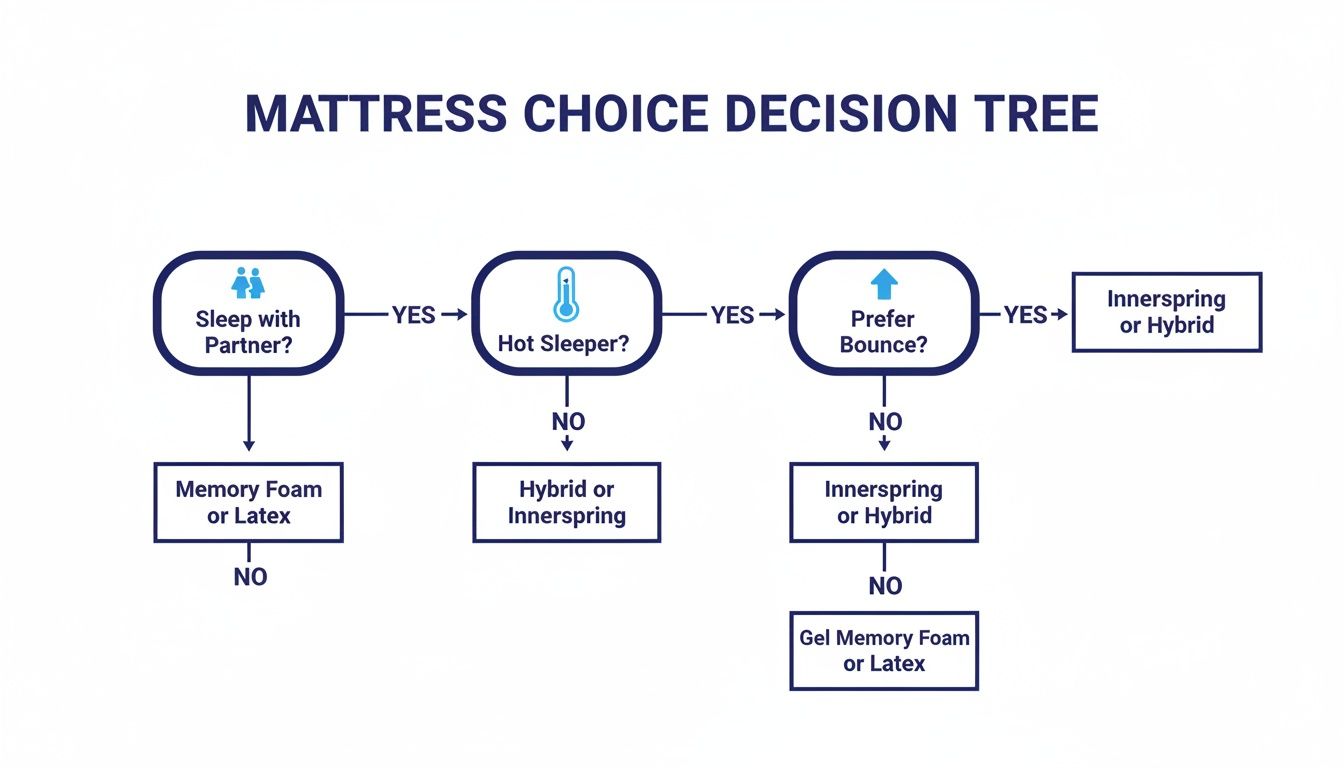
    To make it a bit easier, we've put together a visual guide that walks you through the key questions.

    A mattress choice decision tree flowchart helping users decide between memory foam, latex, innerspring, or hybrid.

    This decision tree shows how things like sharing a bed, sleeping hot, or wanting a little bounce can point you in the right direction.

    Guidance for Side Sleepers

    If you're a side sleeper, your mattress has one critical job: to cushion your shoulders and hips while keeping your spine straight. If it can't contour properly, your spine gets thrown out of alignment, and that’s a recipe for aches and pains.

    This is where memory foam really shines. Its signature slow-sinking feel is perfect for cradling those pressure points, letting your shoulders and hips sink in just enough. The result is deep, targeted relief right where you need it most.

    A hybrid mattress can work very well too, but you'll want to look for one with a cushier comfort layer. The key is finding one with thick enough foam or latex layers on top of the coils to give you that necessary plushness.

    Guidance for Back and Stomach Sleepers

    For back and stomach sleepers, the game is totally different. Your number one priority is solid, even support to keep your hips from dipping too low. If your midsection sinks, it puts a ton of strain on your lower back.

    This is exactly why hybrid mattresses are so often a preferred pick for back and stomach sleepers. The pocketed coil core provides that firm, uplifting foundation that keeps your spine in a healthy, neutral position. You still get the comfort from the foam layers on top, but without sacrificing that all-important support.

    A firmer memory foam mattress can also be a good option, but you have to be sure its high-density support core is sturdy enough to keep you from sinking in too much.

    The bottom line is this: side sleepers need to prioritize pressure relief to cushion their joints, while back and stomach sleepers have to prioritize zoned support to keep their spine aligned.

    How Body Weight Influences Your Choice

    Your body weight is the other huge piece of the puzzle. It directly affects how much pressure you put on the mattress and how it will respond to you.

    • Lighter Individuals (Under 150 lbs): If you're on the lighter side, a very firm mattress might not let you sink in enough to get any of the contouring benefits. You'll likely find that a softer memory foam or a hybrid with a plush top offers better pressure relief and just feels more comfortable.

    • Heavier Individuals (Over 230 lbs): For heavier folks, the name of the game is durability and support. You need a mattress with a rock-solid core to prevent sagging and ensure it holds up over time. The robust coil base of a hybrid mattress is often a clear choice here, providing superior support and preventing that "bottoming out" feeling.

    The market definitely reflects these needs. As of 2024, foam mattresses held about 45% of the global market share, largely thanks to sleepers looking for that deep pressure relief. At the same time, hybrids are often called the fastest-growing segment because of how well they balance that soft comfort with sturdy support.

    Of course, finding the right mattress is just one part of the equation. It's also worth looking into other methods of optimizing deep sleep for your overall health and recovery.

    How to Test a Mattress in Person

    Reading online reviews and comparisons is a fantastic first step in the memory foam vs. hybrid mattress debate. But let’s be honest, the only way to be certain about how a mattress feels is to test it yourself. An in-person visit to a showroom can turn theory into reality, letting you feel the subtle differences that spec sheets just can’t capture.

    A successful showroom visit is about more than just a quick sit on the edge of the bed. To get a real feel for a mattress, you have to simulate how you actually sleep at home. This means taking your time and not feeling rushed or self-conscious about it.

    Prepare for Your Visit

    Before you head out, a little prep work can make your test much more effective.

    • Wear Comfortable Clothes: You’re going to be lying down, so wear something you can move around in easily. Ditch the bulky coat or restrictive clothing.
    • Bring Your Partner: If you share a bed, you absolutely have to test mattresses together. You’ll want to pay close attention to things like motion transfer and whether you both feel comfortable.
    • Know Your Sleep Position: Be ready to get into your primary sleep position—whether you're a side, back, or stomach sleeper. After all, this is how you'll be using the mattress every single night.

    Once you arrive, the goal is to spend some quality time on your top contenders. Don’t just lie down for 30 seconds and hop up.

    Plan to spend at least 10 to 15 minutes on each mattress you’re seriously considering. This gives your body enough time to relax and settle in, allowing you to notice how the support and comfort layers truly respond to you.

    What to Look for When Testing

    As you lie on each mattress, focus on these key points. They’ll help you move beyond a simple "soft" or "firm" assessment and understand how the bed actually performs for your body.

    1. Spinal Alignment:
    This is the single most critical factor. Ask your partner or a sleep expert to check if your spine is straight when you’re in your usual sleep position. For side sleepers, your spine should be horizontal; for back sleepers, it should maintain its natural S-curve without sagging.

    2. Pressure Points:
    Pay close attention to your shoulders, hips, and lower back. Do you feel any uncomfortable pressure, or does the mattress gently cushion these high-impact areas? A good mattress will distribute your weight evenly and prevent that nagging pressure buildup.

    3. Ease of Movement:
    Try changing positions. Is it easy to roll from your back to your side? A responsive hybrid will make this feel effortless, while some memory foams might have a slower response that feels more like you’re sinking into it.

    4. Edge Support:
    Sit on the edge of the mattress like you’re putting on your shoes. Do you feel stable, or does the edge collapse under your weight? Strong edge support gives you more usable sleeping surface and makes getting in and out of bed much easier.

    Visiting a showroom with experienced staff can make all the difference. Our team can offer no-pressure guidance, helping you compare a memory foam vs hybrid mattress side-by-side and find the one that fits your body and sleep style.

    Common Mattress Questions Answered

    Even after we've broken down the construction, feel, and performance of both mattress types, you might still be wrestling with a few last questions. It happens to everyone. So, let's tackle some of the most common things we hear from shoppers to clear up any final confusion.

    Do Memory Foam Mattresses Have a Smell?

    Yes, sometimes a brand new memory foam mattress will have a distinct smell right out of the packaging. This is called off-gassing, and it's caused by the release of harmless compounds called VOCs (volatile organic compounds) left over from the manufacturing process. The good news is that the smell isn't considered harmful and usually disappears within a few days.

    To speed things up, just let the mattress air out in a room with good ventilation. Most modern foams, especially any with a CertiPUR-US® certification, are made with low-VOC materials to keep this to a minimum. Hybrids can have a slight odor too, but it’s often less of an issue because the open coil design lets air flow through and carry it away faster.

    Which Mattress Type Is More Durable?

    This is a great question, and when we're talking about pure longevity, hybrids tend to have a slight advantage.

    • A well-made hybrid mattress will often give you 8 to 10 years of solid performance, sometimes even more. Their steel coil support core is very durable and great at resisting sag over the long haul.
    • A quality memory foam mattress typically lasts somewhere in the 6 to 8-year range. Its lifespan really depends on the density of the foam — the denser the foam, the longer it will hold up.

    No matter which you choose, rotating your mattress every six months is a good practice to ensure it wears evenly and you get the most life out of your investment.

    The key takeaway is that while both offer years of comfort, the robust coil base in a hybrid often gives it a longer functional lifespan compared to an all-foam construction.

    Can I Use an Adjustable Base with Either Mattress?

    Absolutely! This is one of the best upgrades you can make for your sleep, and both memory foam and hybrid mattresses are generally perfect for adjustable bases.

    Memory foam is especially suited for it; it can flex and bend into any position you want without putting any stress on the mattress itself. Most modern hybrids are also designed with flexible, pocketed coils that move right along with the base. That said, it’s always a smart idea to double-check the manufacturer’s warranty and recommendations just to be safe. Pairing your mattress with an adjustable base is a game-changer for reading, watching TV, or even helping with things like snoring or acid reflux.

    What About the Weight Difference?

    There’s definitely a noticeable weight difference, and it's something to think about. Hybrid mattresses are quite a bit heavier than memory foam mattresses, and that’s all because of the steel coil system inside.

    It might not seem like a huge deal at first, but it can be a real challenge on moving day or even when you just need to rotate the mattress. If you live by yourself, move often, or have a tough time with heavy lifting, the lighter weight of a memory foam mattress is a practical perk you shouldn't overlook.


    Ultimately, picking between a memory foam vs hybrid mattress comes down to your personal needs. But you don't have to figure it all out alone. Here at Woodstock Furniture & Mattress Outlet, our knowledgeable team is here to give you straightforward, no-pressure advice and let you test out as many models as you'd like. Come visit one of our North Georgia showrooms and let's find a great mattress for your sleep and your budget.

    Explore Our Full Mattress Collection and Find a Showroom Near You

    Article created using Outrank

  • What Is a Memory Foam Mattress and How Does It Work?

    What Is a Memory Foam Mattress and How Does It Work?

    So, what exactly is a memory foam mattress? At its core, it’s a mattress made from a material called viscoelastic foam. This unique foam reacts to your body's heat and pressure, softening and contouring to cradle your unique shape. It's well-known for delivering pressure relief and absorbing movement, making it a popular choice for anyone looking for personalized comfort.

    From NASA Technology to Your Bedroom

    The journey of memory foam didn't start in a mattress factory. It began with NASA back in the 1960s. The goal wasn't a good night's sleep, but to improve the safety and comfort of aircraft cushions for astronauts during takeoff. They needed a material that could absorb significant shock while still providing customized support.

    Decades later, that same technology was refined for consumer use, eventually making its way into the mattresses we see in showrooms today.

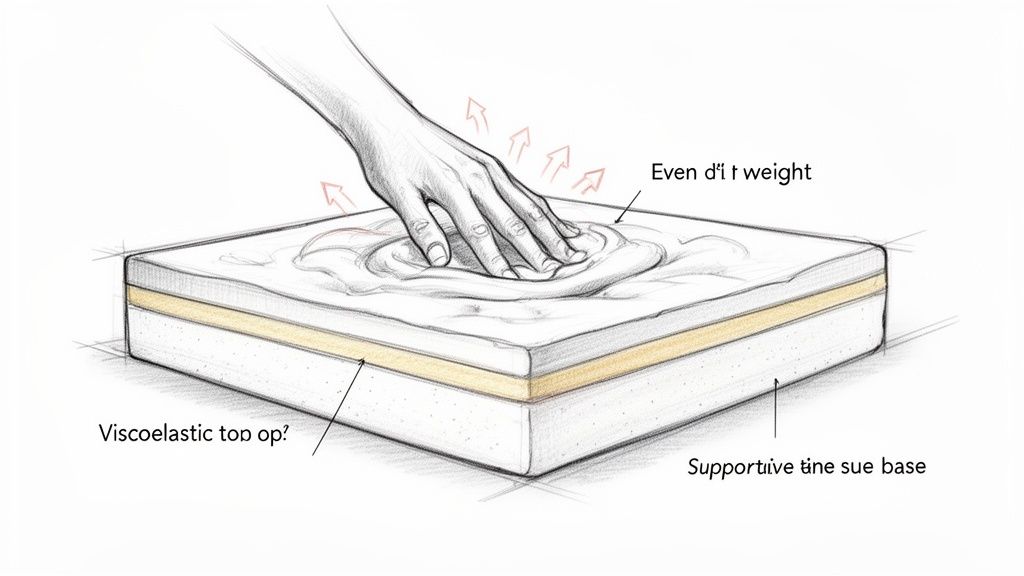
    Think of it like pressing your hand into a piece of soft dough. You see how it holds the impression for a few seconds before slowly bouncing back? That's the basic idea behind memory foam. When you lie down, your body heat softens the foam, allowing it to gently mold around your shoulders, hips, and back. This contouring action spreads your weight evenly across the entire surface, which is the secret behind its most popular benefits.

    Illustration of a hand pressing into a memory foam mattress, demonstrating viscoelastic conformity and even weight distribution.

    Core Benefits of Memory Foam

    Once you understand where it came from, it’s easy to see why so many people have found it beneficial.

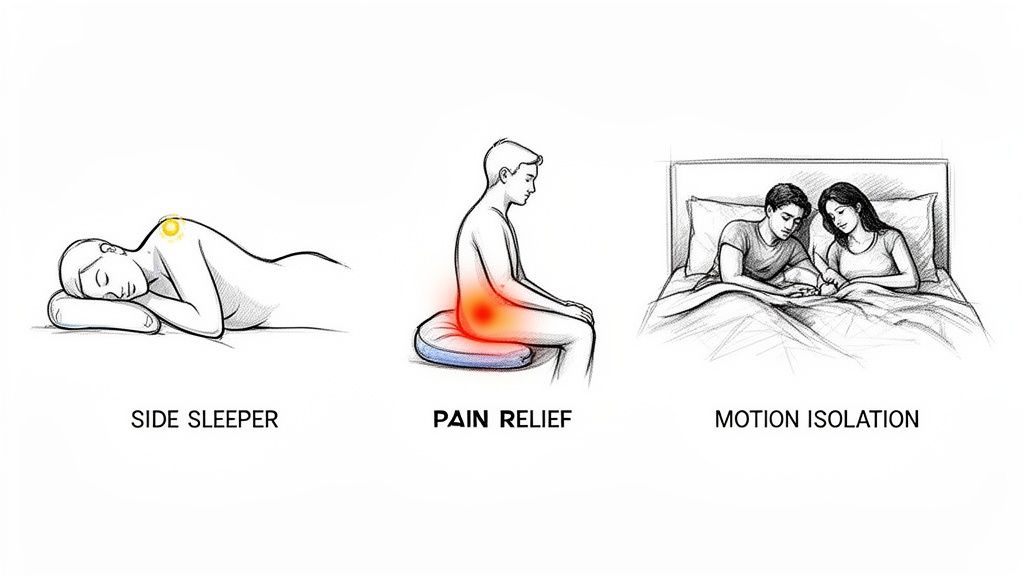
    • Exceptional Pressure Relief: By conforming so closely to your body, memory foam helps eliminate painful pressure points. This can be a significant benefit for side sleepers and may lead to less tossing and turning.
    • Motion Isolation: The foam is brilliant at absorbing energy. If you share a bed with a restless partner (or a pet that jumps on and off all night), you’re far less likely to feel their movements.

    This unique combination of contouring support and motion absorption is why memory foam has become a go-to solution for sleepers looking to minimize disturbances and alleviate discomfort. It provides a quiet, still, and deeply supportive sleep environment.

    In the end, it’s all about creating personalized comfort that adapts to you, not the other way around. Understanding what a memory foam mattress is and how it works is a huge step in the pursuit of a perfect night's sleep. Once you demystify the material, you can decide if that signature "hugging" sensation is the right match for you.

    The Science Behind That 'Hugging' Sensation

    That signature "hugging" feeling you get from a memory foam mattress isn’t magic — it’s material science. The unique feel all comes down to two key properties working together: viscosity and elasticity. Once you understand how these two things react to your body, you’ll know if memory foam is the right choice for you.

    At a microscopic level, memory foam has what’s called an open-cell structure. An easy way to picture this is to think of a sponge full of millions of tiny, interconnected air bubbles. When you lie down, your body weight and pressure push the air out of the cells directly beneath you and into the neighboring cells all around. This slow, controlled transfer of air is what creates that gradual, adaptive response. The foam doesn’t just squish down; it gently yields and molds to your exact shape.

    This is very different from a traditional innerspring mattress, which relies on the instant pushback from metal coils. With memory foam, the mattress adapts to you, not the other way around.

    The Role of Body Heat

    There's another crucial ingredient in the mix: your own body heat. Viscoelastic foam is temperature-sensitive, which means it gets softer and more flexible as it warms up.

    As you get comfortable in bed, the foam directly touching your body starts to warm. This softening allows the mattress to contour even more closely to your individual curves, especially around pressure points like your shoulders and hips. Meanwhile, the foam that isn't in direct contact with you stays a bit firmer, providing consistent support. It's this temperature-driven contouring that creates that custom-fit, cradled feeling that many people enjoy.

    Viscosity and Elasticity Explained

    To really understand what’s going on, let's break down those two terms. Think of them as two sides of the same coin, working in harmony to give memory foam its unique feel.

    • Viscosity is about the foam's ability to resist flow and absorb energy. A good real-world example is honey. If you drop a spoon into a jar of honey, it sinks in slowly because the honey absorbs the impact. In a mattress, this high viscosity is what gives memory foam its excellent motion isolation. It deadens movement, so when your partner tosses and turns, that motion is absorbed by the foam instead of being transferred across the bed to you.

    • Elasticity is the foam's ability to bounce back to its original shape after you get up. While the "visco" part lets the foam mold to your body, the "elastic" part makes sure it doesn't just stay flat. This slow, gentle return to form provides continuous support all night long without creating the hard "push-back" or bounciness you'd get from springs.

    In a nutshell, viscosity lets the mattress absorb your weight and movement, while elasticity ensures it keeps supporting you by slowly recovering its shape. This scientific dance is what creates a sleep surface that is both deeply contouring and reliably supportive.

    By understanding this interplay between the foam's open-cell structure, its reaction to temperature, its viscosity, and its elasticity, it’s easy to see how a memory foam mattress delivers such a unique and personalized night's sleep. It’s a material designed from the ground up to adapt, absorb, and support.

    Understanding the Different Types of Memory Foam

    Just as cars have evolved into sedans, trucks, and hybrids, memory foam has also evolved from its original design. Not all memory foam is the same, and knowing the key differences can help you find a mattress that actually solves your sleep problems — whether that’s sleeping hot or feeling “stuck.”

    Innovations in foam technology have led to several distinct types, each bringing its own unique properties to the table. Understanding what makes them different is your first step toward picking a mattress that truly fits your comfort needs.

    This graphic breaks down the basic science behind memory foam — how your body heat influences the foam's viscosity (its ability to flow and contour) and its elasticity (its ability to bounce back).

    Foam science concept map illustrating how body heat increases viscosity, influencing elasticity.

    As you can see, body heat is the catalyst that softens the foam, which is what gives it that signature deep contouring and pressure relief.

    Traditional Memory Foam

    This is the original viscoelastic foam that started it all. It’s known for that slow-moving, deep-sinking feel that provides notable pressure relief. When people talk about getting that classic "hugging" sensation from their mattress, this is usually what they're referring to.

    It’s excellent at absorbing motion and contouring closely to your body, making it a solid choice if pressure point relief is your top priority. The one common critique is that its dense structure can sometimes trap body heat, which is a problem that newer foam types were specifically invented to solve.

    Gel-Infused Memory Foam

    One of the most popular solutions to the heat problem is gel-infused memory foam. This type of foam has tiny gel beads or swirls of liquid gel mixed into the foam during the manufacturing process.

    These gel particles are designed to absorb and pull heat away from your body, helping you maintain a more comfortable, neutral sleeping temperature. This was a significant step forward, making it possible to enjoy the deep pressure relief of memory foam without overheating, as could sometimes happen on older models. It's a very popular choice for sleepers who love the contouring feel but tend to sleep warm.

    Plant-Based Memory Foam

    For those looking for a more responsive and breathable option, plant-based memory foam is a compelling alternative. In this version, mattress makers replace a portion of the usual petroleum-based ingredients with plant-derived oils, like soy or castor oil.

    This change in the composition has two main effects:

    1. It’s More Breathable: Plant-based foams usually have a more open-cell structure, which lets air flow more freely and helps move heat away from you more effectively than many traditional foams.
    2. It Responds Faster: These foams tend to bounce back to their original shape more quickly. This reduces that "stuck" feeling some people experience, making it much easier to change positions during the night.

    Plant-based memory foam gives you a slightly bouncier and cooler sleep experience while still delivering the pressure-relieving benefits that memory foam is known for.

    Open-Cell Memory Foam

    Here's another clever engineering fix for sleeping hot: open-cell memory foam. While technically all memory foam has an open-cell structure, these newer versions feature much larger, more interconnected cells.

    Imagine the difference between a dense pound cake and a light, airy sponge cake. The sponge's more open structure lets air pass through it easily. It's the same idea here. The enhanced internal structure of open-cell foam creates small airways that improve ventilation and allow heat and moisture to escape. This design tackles heat buildup by promoting constant airflow all night, offering a cooler sleep without giving up that contouring support.

    The Real-World Pros and Cons of Memory Foam

    Every mattress material has its pluses and minuses, and memory foam is no different. Knowing both sides of the coin is key to making a good decision. Let's take a balanced look at the pros and cons to see if a memory foam mattress is the right fit for you.

    The growth in popularity of memory foam comes from real benefits that solve some of the most common sleep issues people face. The foam mattress segment has become a major part of the global market, accounting for 45.2% of the total share in a recent analysis. This indicates that many people find that foam meets their needs. For a deeper dive into these numbers, you can review market analyses on the subject.

    The Clear Advantages of Memory Foam

    When memory foam is a good match for a sleeper, it can be an excellent one. Here are the main reasons people find it so beneficial.

    • Exceptional Pressure Relief: This is a key strength of memory foam. The way it molds perfectly to your body’s unique shape—especially around hotspots like shoulders, hips, and your lower back—spreads your weight out evenly. This takes a ton of pressure off sensitive joints, which means less tossing and turning and fewer aches when you wake up.

    • Superior Motion Isolation: If you share a bed with someone who tosses and turns (or a pet that jumps on and off the bed), memory foam can be a great solution. Its dense, absorbent nature stops movement in its tracks. When your partner rolls over, the energy gets soaked up by the foam instead of rippling across to your side, leading to a much more peaceful, undisturbed night.

    • Durable and Long-Lasting Support: High-quality memory foam is very resilient. It doesn’t have springs that can wear out or sag over time. This means you get consistent, reliable support for years. With proper care, it'll keep its supportive, contouring feel for its entire lifespan.

    And it’s not just mattresses! The unique feel of memory foam is great for other sleep accessories too. For example, exploring the memory foam pillow benefits for better sleep can show you how to get that same contouring comfort for your head and neck.

    Potential Drawbacks and Honest Considerations

    Of course, no mattress is perfect for everybody. It’s just as important to get familiar with the potential downsides so you can make a truly informed choice.

    Understanding the potential cons isn’t about finding fault; it’s about managing expectations. Modern memory foams have addressed many of these concerns, but knowing what to look for is crucial.

    • Heat Retention Concerns: This is the oldest complaint about memory foam. Early, traditional versions of the foam had a dense structure that could trap body heat. The good news is that modern mattress makers have largely solved this with innovations like gel infusions, copper particles, and open-cell designs. These technologies are designed to improve airflow and actively pull heat away from you.

    • The "New Foam" Smell (Off-Gassing): When you first unwrap a new memory foam mattress, you might notice a distinct smell. This is called off-gassing, and it’s just the release of harmless volatile organic compounds (VOCs) left over from the manufacturing process. While the name sounds a bit scary, it’s not considered harmful and almost always airs out and disappears completely within a few hours to a couple of days. Be sure to let it breathe in a well-ventilated room.

    • A Slower Response Time: That slow-sinking, deep-hugging feeling is a huge plus for many people, but it can be a deal-breaker for some. If you’re an active sleeper who changes positions a lot, you might feel a slight delay as the foam recovers and adjusts to your new shape. For those who prefer a quick, bouncy feel, an innerspring or hybrid mattress might be a better fit.

    Who Is a Memory Foam Mattress Really For?

    Now for the big question: we've talked about what a memory foam mattress is, but is it the right mattress for you? Knowing how it works is one thing, but figuring out if it’ll solve your specific sleep problems is what really counts. Memory foam is an excellent choice for some sleepers, but for others, it’s just not the right fit.

    The goal here isn't to say one mattress type is better than another, but to help you figure out if memory foam’s unique feel lines up with what you need to get a great night's sleep.

    Three illustrations depict comfort benefits: side sleeping support, seated pain relief, and couples experiencing motion isolation in bed.

    Side Sleepers Seeking Pressure Relief

    If you spend most of the night on your side, a memory foam mattress should definitely be on your short list. When you sleep on your side, you put a ton of weight on your shoulders and hips, creating major pressure points. Memory foam’s signature contouring lets those areas sink in just enough to keep your spine properly aligned, which helps you avoid that next-day soreness from a mattress that’s too firm.

    By cradling your body's curves, memory foam distributes weight away from sensitive joints. This provides targeted support that helps prevent you from waking up to numb arms or aching hips.

    Individuals with Chronic Pain or Soreness

    For folks dealing with chronic pain from conditions like arthritis or fibromyalgia, the gentle, pressure-relieving qualities of memory foam can be a huge help. The foam’s conforming nature doesn't put any extra stress on already tender parts of the body.

    This even weight distribution can mean waking up with much less pain and stiffness. The mattress essentially creates a custom-fit cradle that supports you without pushing back, which can make a world of difference in your comfort level.

    Couples and Light Sleepers

    The motion isolation you get from memory foam is a game-changer for anyone who shares a bed. Since the foam absorbs movement instead of transferring it across the mattress, you're way less likely to be woken up by a partner who tosses and turns, gets up for a midnight snack, or is on a completely different sleep schedule. It makes for a calmer, more stable sleep surface for both of you.

    Who Might Want to Consider Other Options

    Let's be honest, memory foam isn't the perfect mattress for everyone. Knowing who it doesn't work for is just as important as knowing who it helps.

    • Stomach Sleepers: This sleeping position really needs a firm, supportive surface to keep the hips from sinking in too much and knocking the spine out of alignment. The deep hug of memory foam can sometimes make this problem worse.
    • Those Who Prefer a Bouncy Feel: If you love that springy, responsive feel of a traditional innerspring bed, the slow-sinking sensation of memory foam might feel a bit like quicksand to you.
    • Combination Sleepers Who Move Frequently: While today's memory foams are much more responsive than they used to be, some active sleepers might find it a little harder to change positions on a bed that contours so deeply.

    Ultimately, finding the right mattress comes down to your body, how you sleep, and what feels most comfortable to you.

    How to Care for Your Mattress to Maximize Its Lifespan

    A quality mattress is an important investment in your well-being. It makes sense that you'd want it to last as long as possible, and a little routine care can make a massive difference. With the right maintenance, a well-made memory foam mattress can typically last anywhere from 7 to 10 years, sometimes even longer depending on the foam density and how it’s treated.

    Protecting this investment is actually pretty straightforward and doesn't require much effort. All it really takes are a few simple, consistent habits to keep your mattress feeling supportive and clean for years to come.

    Simple Steps for Long-Lasting Comfort

    The popularity of memory foam continues to grow, and its market share shows a strong consumer preference for its unique feel and benefits. The global memory foam mattress market is projected to reach over $29 billion by 2035 — a testament to its staying power. To get the most from this popular mattress choice, a few key practices are essential. Discover more insights about this growing market and its future trends.

    To help you protect your purchase, here are a few simple, actionable tips to make it last:

    • Use a High-Quality Mattress Protector: This is one of the most important things you can do. A waterproof, breathable protector guards your mattress against spills, sweat, allergens, and dust mites, all of which can break down foam over time. It’s an easy way to protect your mattress.

    • Provide a Supportive Foundation: Memory foam needs a solid, flat base to perform its best. A weak or sagging foundation can cause the mattress to break down unevenly. Make sure you’re using a proper bed frame, box spring, platform bed, or adjustable base that offers consistent support across the entire mattress.

    Maintaining Even Wear and Tear

    Unlike many old-school innerspring mattresses, you’re not supposed to flip a memory foam mattress over. Most are built with very specific layers — a dense support core on the bottom and softer comfort layers on the top.

    However, rotating your mattress is highly recommended. This simple action prevents body impressions from forming in one spot and ensures the foam wears down evenly over time, preserving its supportive feel.

    A good rule of thumb is to rotate your mattress 180 degrees (from head to foot) every 3 to 6 months. This easy habit helps maintain a consistent feel across the whole sleep surface and can significantly extend the life of your mattress. Follow these simple guidelines, and your mattress will give you restorative sleep for many years.

    Common Questions About Memory Foam Mattresses


    When you’re looking into a new mattress, especially one made from a material as unique as memory foam, you’re bound to have a few questions. That’s perfectly normal. Getting straight answers can clear up any doubts and help you feel confident in your choice.

    Let's dive in and tackle some of the most common questions shoppers have when they start exploring the world of memory foam.

    Can I Use a Memory Foam Mattress with an Adjustable Base?

    Yes, absolutely. In fact, memory foam mattresses and adjustable bases are an excellent combination.

    Because they’re built entirely from foam layers and don't have a rigid innerspring core, they are incredibly flexible. This lets them bend and move effortlessly with the base as you lift your head or feet. This pairing means you can enjoy all the comfort and health benefits of an adjustable base—like reducing snoring or easing acid reflux—without worrying about damaging your mattress.

    Will a Memory Foam Mattress Make Me Sleep Hot?

    This is probably the number one concern we hear from customers, and it’s a fair question based on the memory foams of yesterday. The earliest models had a very dense structure that could trap body heat, which sometimes made for a warm, uncomfortable night.

    However, the mattress world has come a long way since then. Modern memory foam has largely solved this problem. Today’s mattresses are packed with advanced cooling features designed specifically to keep you from overheating.

    Some of these solutions include:

    • Gel-Infused Foam: Tiny gel beads or swirls are mixed right into the foam to actively pull heat away from your body.
    • Copper-Infused Foam: Copper is a natural conductor, and it does a fantastic job of drawing heat away from the sleeping surface.
    • Open-Cell Designs: This is a big one. This type of foam has a more breathable internal structure with larger, connected cells that let air flow freely, allowing heat to escape instead of building up.

    So, while the concern is understandable based on old technology, today's memory foam mattresses are engineered for a much cooler, more comfortable sleep.

    What Is Off-Gassing and Is It Harmful?

    When you first unbox a new memory foam mattress, you might notice a slight smell, kind of like a "new car" scent. This is totally normal and it's called off-gassing.

    It’s simply the release of volatile organic compounds (VOCs), which are a byproduct of the mattress manufacturing process. While the name "VOCs" sounds a bit scary, the off-gassing from mattresses made by reputable brands is not considered harmful. Certifications like CertiPUR-US® are your guarantee that the foam is made without certain harsh chemicals and has very low VOC emissions.

    The smell is temporary and usually disappears within a few hours to a couple of days. A simple trick to speed things up is to put the new mattress in a well-ventilated room and let it air out for a bit before you make the bed.

    Getting these questions answered helps pull back the curtain on memory foam, letting you focus on the most important thing—finding a mattress that gives you the comfort and support you deserve.


    Ultimately, the best way to know if a memory foam mattress is the right fit for you is to try one out for yourself. Here at Woodstock Furniture & Mattress Outlet, our knowledgeable team can walk you through all the different types and technologies, helping you find a great match without any pressure. Come visit one of our North Georgia showrooms to feel the difference firsthand. Find out more at woodstockoutlet.com.

    Article created using Outrank

  • What Is a Hybrid Mattress and How Does It Work?

    What Is a Hybrid Mattress and How Does It Work?

    Ever felt stuck trying to decide between a traditional spring mattress and one of the newer memory foam beds? You're not alone. It's a common dilemma, and it's exactly where the hybrid mattress comes in.

    Think of a hybrid as a peace treaty between two different mattress technologies. It takes the supportive innerspring coil system from a traditional mattress and tops it with comfort layers made of foam or latex. The result is a single mattress designed to offer the benefits of both worlds.

    So, What Is a Hybrid Mattress, Really?

    In simple terms, a hybrid mattress is a modern solution to the common complaints people have about older mattress types.

    We all know traditional innerspring beds. They have that familiar bounce and solid support, but sometimes they can create pressure points, and you might even feel the springs over time. On the flip side, all-foam mattresses are incredible at contouring to your body, but some people find they sleep a bit warm or miss that responsive, bouncy feel.

    A hybrid mattress is engineered to address these issues. By thoughtfully layering these different materials, manufacturers create a sleep surface that's both supportive and conforming. It’s a unique feel that works well for a wide variety of sleepers.

    The Innovation Is in the Layers

    The real genius of a hybrid is how its distinct layers work in harmony. While specific designs can vary from one brand to the next, just about every hybrid mattress is built on two fundamental parts: a support core and a comfort system.

    • The Support Core: This is the foundation of the mattress, made from steel coils. In most modern hybrids, these aren't just any old springs; they're pocketed coils. This means each spring is individually wrapped in fabric, allowing it to move independently. This is a significant feature because it cuts down on motion transfer (so you won't feel your partner tossing and turning) and provides more targeted, personalized support.
    • The Comfort System: Stacked right on top of the coils, you'll find one or more layers of foam or latex. This is where you get that cushioning feeling. These layers might include memory foam for deep pressure relief, gel-infused foam to help keep you cool, or natural latex for a more buoyant, responsive feel.

    This tag-team approach of bouncy coils and cushioning foam delivers a balanced sleep experience. You get more pressure relief than a basic innerspring without that "sinking" feeling some people dislike in all-foam beds.

    To break it down even further, here's a look at how each component contributes to your night's sleep.

    Key Components of a Hybrid Mattress

    Layer What It Is What It Does for You
    Comfort Layer(s) The top section, typically 2+ inches thick, made of materials like memory foam, gel foam, or latex. Provides pressure relief by contouring to your body's curves, especially at the shoulders and hips.
    Support Core The bottom section, consisting of individually pocketed innerspring coils. Offers foundational support, promotes airflow for cooling, adds bounce, and isolates motion between sleepers.

    As you can see, it's not just about throwing two materials together. It’s about leveraging the strengths of each to create something better than the sum of its parts.

    A Look Inside a Hybrid Mattress, Layer by Layer

    To really understand what a hybrid mattress is all about, we need to peel back the cover and look at how it’s put together. While the exact recipe can vary from brand to brand, most hybrids follow a similar layered construction. Each component is engineered to solve a specific sleep problem.

    This visual shows you the basic idea: supportive coils and contouring foam come together to create a hybrid mattress.

    Diagram illustrating the hybrid mattress concept: coils combined with foam to form a hybrid mattress.

    It’s a simple equation, really. Coils plus foam. This combination is the key to a hybrid’s balanced feel, giving you the benefits of both worlds in a single mattress.

    The Foundation: A Sturdy Base Layer

    Every great structure needs a solid foundation, and a hybrid mattress is no different. Way down at the bottom, you'll find a layer of high-density polyfoam, usually about an inch thick. This layer isn’t about comfort; its job is purely structural.

    The main purpose of this base is to give the pocketed coils above it a stable platform. It gives the springs a firm surface to rest on and push against, which keeps them from sagging and helps ensure the whole mattress stays durable for years to come. Think of it as the subfloor in a house—you never see it, but everything built on top of it relies on its strength.

    The Support Core: Pocketed Coils

    This is the engine of the mattress. The support core is made up of hundreds, and sometimes thousands, of individually wrapped steel coils. These are a significant advancement over the interconnected springs of the past.

    Here’s why that matters:

    • Motion Isolation: Since each coil is wrapped in its own fabric pocket, it can compress and react to pressure all by itself. This means that when your partner tosses and turns, the motion gets absorbed by just a few coils instead of sending a shockwave across the whole bed. For couples, this can be a very helpful feature.
    • Targeted Support: The independent coils contour to your body’s unique shape. They provide firmer support where you need it most (like your lower back) and a softer give at pressure points like your shoulders and hips.
    • Enhanced Airflow: Unlike a dense block of foam, the space between all those coils lets air circulate freely. This helps pull body heat away, making hybrids a suitable choice for anyone who tends to sleep warm.

    The Comfort System: The Cushioned Top

    Stacked right on top of the coil system are the comfort layers. This is where a hybrid mattress gets its plush, pressure-relieving personality. The comfort system is typically at least two inches thick and can be made from a few different materials, each designed to tackle a different need.

    What to expect from comfort layers: This part of the mattress is all about cushioning your body and making sure you don't feel the firm coils underneath. The material used here has the biggest impact on how the mattress actually feels when you lie down.

    Some common materials you'll find are:

    • Memory Foam: Famous for its deep, body-hugging feel, memory foam is a champion of pressure relief. This makes it a great fit for side sleepers.
    • Gel-Infused Foam: This is simply memory foam with cooling gel beads or swirls mixed right in. The gel helps absorb and pull heat away from you, tackling one of the most common complaints about traditional memory foam.
    • Latex: Whether it's sourced from rubber trees or created synthetically, latex offers a more responsive, bouncy feel. It contours to your body but springs back into shape quickly, so you never get that "stuck in the mud" feeling.

    The Real-World Benefits of a Hybrid Mattress

    Okay, so we've talked about the different layers inside a hybrid mattress. That's great, but how does that complex design actually help you sleep better? It's all about how the supportive coils and contouring foam work together to solve some of the most common sleep problems people face every night.

    A diagram showcasing mattress benefits, including pressure relief, edge support, and motion isolation.

    The biggest advantage is a truly balanced feel. If you've ever felt "stuck" in a traditional memory foam bed, you know what we're talking about. A hybrid’s pocketed coil system gives it a responsive, uplifting bounce, making it much easier to change positions without feeling like you’re fighting your way out of quicksand.

    At the same time, those top comfort layers are working to deliver amazing pressure relief, cradling hotspots like your shoulders and hips to keep your spine aligned. While hybrids are fantastic for support, anyone looking for an extra layer of targeted comfort might want to explore the best mattress topper for back pain to customize their sleep setup even further.

    A Cooler and More Comfortable Night

    If you're someone who tends to sleep hot, a hybrid mattress can feel like a breath of fresh air. Dense, all-foam mattresses have a reputation for trapping body heat, which can lead to a sweaty, uncomfortable night. Hybrids are built to fix this.

    The innerspring core is the key. All that space between the coils creates natural airways, letting air circulate freely and carry heat away from your body. This ventilation helps keep the mattress at a much more comfortable temperature. Plus, many modern hybrids add extra cooling features like gel-infused foam or breathable covers to really double down on temperature regulation.

    Robust Edge Support and Durability

    Ever sat on the edge of a mattress and felt like you were about to slide right off? That’s a classic sign of poor edge support, a common complaint with some all-foam models. Hybrids tackle this problem head-on by reinforcing the perimeter with stronger, sturdier coils.

    This simple design choice creates a solid, consistent surface from one side of the bed to the other. Here’s why that matters:

    • You get more usable sleep space. You can sleep right up to the edge without feeling like you're going to roll off.
    • Getting in and out of bed is easier and safer, which is a big deal for anyone with mobility concerns.
    • The mattress holds its shape better and is far less likely to sag at the edges over the years.

    With the right care, a quality hybrid mattress can easily last between 7 to 10 years. That robust coil system provides a durable foundation that resists sagging much better than many all-foam alternatives, making it a smart long-term investment.

    Comparing Hybrid Mattresses to Other Types

    To really wrap your head around what a hybrid mattress is, it helps to see how it stacks up against the other options on the floor. Since it’s a blend of different technologies, a hybrid naturally shares some DNA with innerspring, memory foam, and latex beds, but its unique construction truly sets it apart. The goal isn’t to find one single “best” mattress type, but to find the one that’s the best fit for you.

    It's also worth taking a moment to understand how spring mattresses compare to foam mattresses, since that’s the fundamental combination a hybrid is built on. Knowing the basics of each makes it much easier to see why putting them together is such a game-changer.

    Hybrid vs Traditional Innerspring

    A traditional innerspring mattress is what most of us grew up with. It's built with a network of interconnected steel coils, which gives it that classic bouncy and firm feel. While it’s great for basic support, this old-school design can sometimes create pressure points and doesn't do much to stop motion from traveling across the bed. If your partner tosses and turns, you feel every bit of it.

    A hybrid mattress is the modern evolution of this. Instead of interconnected springs, it uses individually pocketed coils. This simple change makes a huge difference, providing more targeted, body-contouring support and drastically cutting down on that motion transfer. Most importantly, a hybrid then adds thick comfort layers of foam or latex on top, delivering the kind of pressure relief that traditional innerspring beds just can't offer.

    Hybrid vs Memory Foam

    An all-foam mattress, especially one made with memory foam, is famous for that deep, body-hugging sensation. It’s fantastic at relieving pressure and isolating motion, making it a go-to for side sleepers and couples who are light sleepers. The downside? Some people find that memory foam can sleep hot and create a "stuck in the mud" feeling that makes changing positions a chore.

    A hybrid mattress tackles these issues head-on. By pairing those plush foam comfort layers with a breathable coil core, it allows air to flow freely for a much cooler sleep. The coils also provide a responsive, slightly bouncy surface that prevents you from feeling trapped. You still get all the pressure-relieving benefits of foam, but with a more uplifting, easy-to-move-on feel.

    Hybrid vs Latex

    Latex mattresses are loved for their responsive, almost buoyant feel and incredible durability. Much like a hybrid, latex offers pressure relief without the slow-sinking feel of memory foam, and it’s naturally very breathable. An all-latex mattress provides a very consistent feel from the top layer all the way down to the bottom.

    A hybrid mattress can use latex in its comfort layers to give you that same springy, responsive feel, but it combines it with the deep, foundational support of a pocketed coil system. This combo often results in a mattress with a bit more bounce and much more robust edge support than you’d typically find in an all-latex model.

    Mattress Type Comparison

    To make things a little clearer, let's break down how these mattress types perform side-by-side in the categories that matter most to sleepers.

    Feature Hybrid Mattress Memory Foam Innerspring Latex
    Feel Balanced (bouncy & contouring) Deep "sinking" contour Bouncy & firm Buoyant & responsive
    Support Excellent (targeted coil support) Good (conforms to body) Basic (interconnected coils) Good (consistent support)
    Pressure Relief Excellent Excellent Fair to Poor Very Good
    Motion Isolation Very Good Excellent Poor Good
    Temperature Very Good (breathable coil core) Fair to Good (can trap heat) Excellent (very breathable) Very Good (naturally breathable)
    Durability Very Good Good Fair Excellent

    As you can see, the hybrid really shines by taking the best features from other mattress types and minimizing their weaknesses, offering a fantastic all-around sleep experience for many people.

    The rise of the hybrid mattress isn't just a passing trend; it's a huge shift in what sleepers are demanding. The global market for hybrid mattresses was valued at $3.23 billion in 2025 and is projected to hit $5.77 billion by 2030—a growth rate that's outpacing much of the mattress industry. This tells us one thing loud and clear: people want beds that blend robust support, deep comfort, and modern features without compromise. You can dig into more of the data on the hybrid mattress market growth on MordorIntelligence.com.

    Who a Hybrid Mattress Is Really For

    Alright, so we've broken down what a hybrid mattress is, but the real question is whether it's the right mattress for you. No single mattress is a perfect fit for everyone on the planet, but a hybrid's "best of both worlds" design makes it a fantastic choice for several types of sleepers, especially those who feel like other mattresses just miss the mark.

    Infographic detailing who hybrid mattresses suit: couples, combination, and hot sleepers; not for tight budgets or deep sinkers.

    This balanced approach is a game-changer because it solves common sleep problems by blending features that used to be totally separate. Let's take a closer look at who really clicks with this kind of design.

    Couples Sharing a Bed

    If you share a bed, you know the struggle all too well. One person’s late-night bathroom trip or 5 AM alarm can feel like an earthquake to the other person. Hybrids are often a great solution for couples because they nail two key features:

    • Motion Isolation: The pocketed coils are brilliant at this. They absorb movement right where it happens, so you’re way less likely to feel your partner tossing and turning all night.
    • Responsiveness: Unlike some all-foam beds that can make you feel like you're stuck in quicksand, a hybrid’s bounce makes it easy to move around and switch positions without disturbing the whole bed.

    This combination creates a much more peaceful, shared sleep surface. It’s a true compromise where both partners can finally get some undisturbed rest.

    Combination and Hot Sleepers

    Do you find yourself constantly changing positions throughout the night? If you cycle from your back to your side and then to your stomach, you’re what we call a combination sleeper. A hybrid is a great friend here. The responsive coil system and contouring foam layers adapt almost instantly as you move, giving you continuous support without that "stuck" feeling.

    Along the same lines, if you’re the type of person who’s always kicking off the covers, a hybrid is built to help you out. That innerspring core isn't just for support; it creates tons of room for air to flow. This allows body heat to escape instead of getting trapped in dense foam, making it a go-to for hot sleepers.

    The Takeaway: A hybrid mattress shines for anyone who needs a blend of features. It’s for the sleeper who wants the pressure relief of foam but craves the supportive bounce of coils, creating a feel that's incredibly versatile and accommodating.

    Who Might Not Prefer a Hybrid

    Now, in the spirit of good, honest advice, a hybrid isn't for absolutely everyone. If you truly love that extreme, slow-sinking "hug" you get from a super-soft memory foam mattress, a hybrid might feel a bit too firm or responsive for your personal taste.

    Also, let's talk about price. Because of their more complex construction and the quality materials involved, hybrids usually have a higher price tag than a basic innerspring or a simple all-foam model. For shoppers on a really tight budget, one of those simpler mattress designs might be a more practical place to start.

    How to Choose the Right Hybrid Mattress

    Alright, so you know what a hybrid mattress is. That’s a huge first step! But now comes the fun part: picking the one that’s going to give you the best night’s sleep you’ve had in years. Thinking through a few key details will help you sort through the options and land on a bed that truly gets you.

    Start With Firmness

    The first stop on your mattress-buying journey should always be firmness. You’ll usually see this rated on a scale from 1 to 10, with 1 being cloud-soft and 10 being board-firm. Honestly, most people are happiest somewhere in the middle, generally between a 5 (medium) and a 7 (medium-firm).

    So how do you find your magic number? Your sleep position is the best guide you've got.

    • Side Sleepers: You’ll probably feel best on something in the medium-soft to medium range (4–6). This allows your shoulders and hips to sink in just the right amount, keeping your spine straight and happy.
    • Back Sleepers: Look for a medium-firm feel (6–7). This provides the support your lower back needs without letting your hips sag and throw things out of alignment.
    • Stomach Sleepers: You'll want something on the firmer side (7–8) to keep your midsection from sinking down, which is a one-way ticket to back pain.

    Quality Materials Make All the Difference

    Firmness is just one piece of the puzzle. The quality of what’s inside the mattress is what determines how it feels tonight and how it holds up over the next decade. When you’re looking at a hybrid, get a little nerdy about the details. Ask about the coil count in the support layer—more coils usually mean more precise, targeted support where you need it.

    For the foam layers on top, foam density is a key indicator of durability. Higher-density foams simply last longer.

    These material choices are directly reflected in the price. A standard hybrid might run you about $1,300, but one with premium memory foam or natural latex could be closer to $1,500. It’s no surprise that these premium models are popular; they made up a whopping 40% of the hybrid market size in 2024. If you want to dive deeper, you can check out more mattress sales statistics to see how these factors shape the industry.

    Don't Sweat the Small Stuff (But Do Think About It)

    Finally, let's talk about the practical side of things. Are you thinking about an adjustable base? Many hybrids work great with them, which is a game-changer if you like to read or watch TV in bed. Just be sure to double-check with the manufacturer to make sure your mattress and base are compatible.

    There's simply no substitute for trying a mattress out in person. Lying down for a few minutes gives you a real feel for how the coils and foam layers work together to support your body—something you just can't get from a picture online.

    At Woodstock Furniture & Mattress Outlet, our team is here to guide you through all these choices. Our goal is to provide helpful information so you can find a mattress that you'll look forward to sleeping on for years to come.

    A Few Final Questions About Hybrid Mattresses

    To wrap things up, let's go over a few of the most common questions shoppers have when they're trying to decide if a hybrid mattress is the right choice for them.

    Do Hybrid Mattresses Need a Box Spring?

    In most cases, no. Think of hybrid mattresses as part of the modern mattress era, designed for modern support systems. A traditional box spring just doesn't provide the rigid, consistent support they need.

    Instead, a solid platform bed, a sturdy foundation, or an adjustable base will give your hybrid the flat, even surface required to perform its best and prevent premature sagging. It's always a good idea to double-check the manufacturer's recommendations just to be sure you're using a compatible base.

    Are Hybrid Mattresses Good for Back Pain?

    They can be a fantastic option. The secret is that "best of both worlds" construction we talked about. The combination of a supportive coil core and pressure-relieving foam layers is often a perfect recipe for maintaining proper spinal alignment.

    The pocketed coils provide targeted, uplifting support that keeps your hips from sinking too far, while the comfort layers of foam or latex contour to the curve of your lower back. It's this one-two punch of support and relief that many people with back pain are looking for.

    How Long Do Hybrid Mattresses Last?

    With proper care, a quality hybrid mattress should last you a good 7 to 10 years. Their robust pocketed coil systems make them quite durable and much more resistant to developing body impressions and sagging than many all-foam mattresses.

    Article created using Outrank