You're standing in a narrow entryway with keys in one hand, mail in the other, and a blank wall that needs something useful. A mirrored console table looks like the answer, until you start wondering how deep it can be, whether it'll wobble, and how often you'll have to wipe fingerprints off it.
Those are the right questions. A mirrored console isn't just a decorative shine. It's a weight-bearing, wall-facing furniture system with reflective panels, a frame that carries load, and wood or board parts that react to indoor humidity. Treat it that way from the start and you'll choose a size that fits, anchor it correctly, and keep it looking calm instead of cluttered.
Typical Sizes and Parts of a Mirrored Console Table
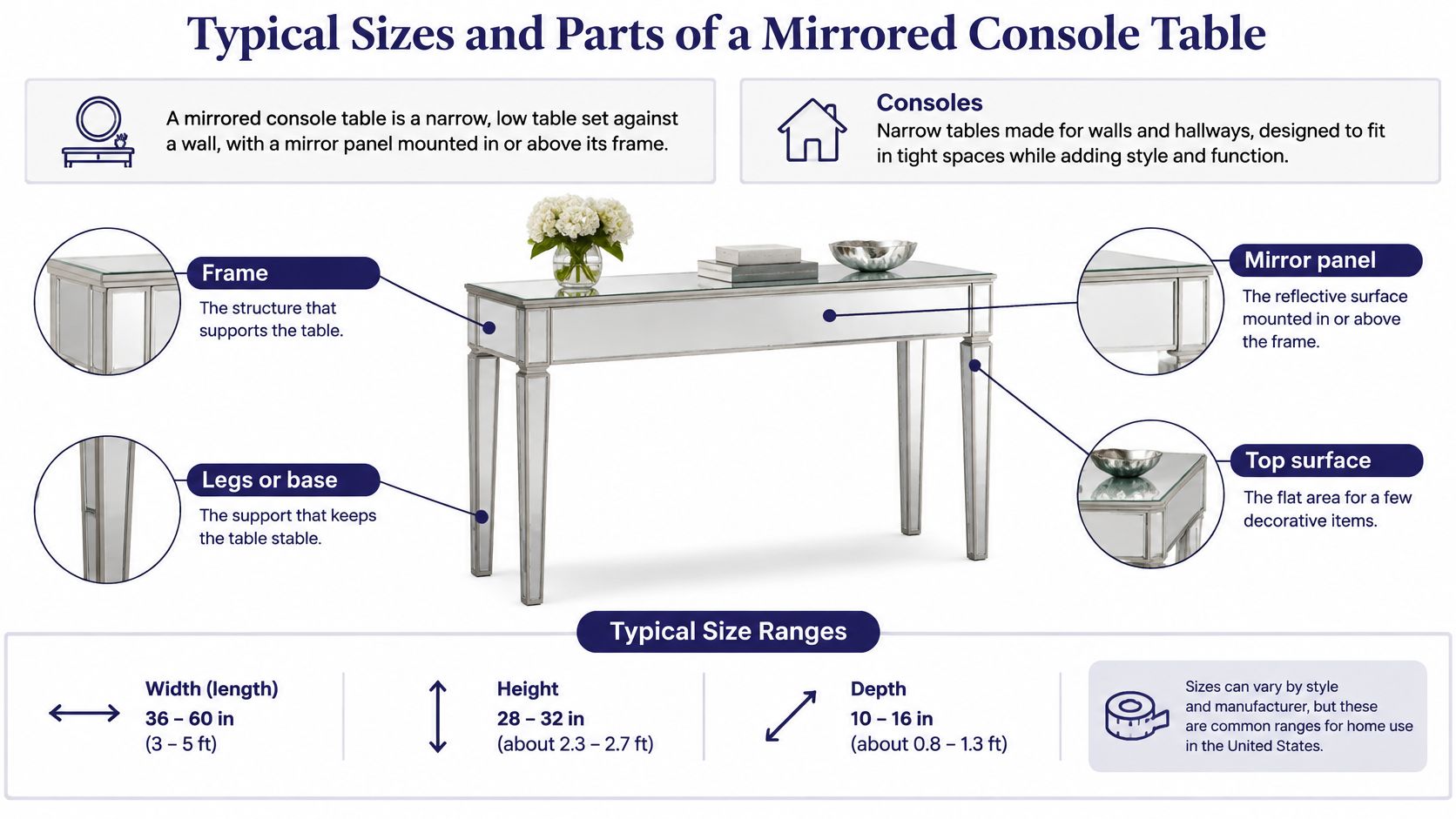
A mirrored console table is a narrow, low table set against a wall, with a mirror panel mounted in or above its frame. That simple definition explains most of what follows. It's built for a wall, not for the middle of a room, and reflection is part of how it works.
Consoles were built as display furniture for 17th-century Italian and French interiors, and the mirror-over-table pairing followed. The Britannica entry on console furniture identifies the console as a side table normally placed against a wall, with support concentrated at the front rather than provided by four independent legs. It also notes a group created for Rome's Palazzo Colonna between 1675 and 1678, and French consoles later produced in pairs to sit beneath matching mirrors.
Reference Sizes by Placement
Use these as typical ranges to start measuring. The listed size of the specific piece you're considering governs your final decision.
Typical console dimensions by room
| Placement | Typical width | Typical depth | Typical height |
|---|---|---|---|
| Entryway or narrow hall | 36 to 48 inches | 10 to 12 inches | 30 to 33 inches |
| Living room behind a sofa | 48 to 60 inches | 12 to 16 inches | 30 to 34 inches |
| Dining or buffet wall | 54 to 72 inches | 14 to 18 inches | 32 to 36 inches |
Width is the easiest number to get wrong. A table that's too wide crowds door trim and corners. A table that's too narrow for a long wall looks lost, even if the depth and height are right.
Parts You'll See
- Mirror panel: The reflective surface, often on the top, drawer fronts, or apron.
- Carrier board: The board behind the mirror that supports the reflective layer and keeps it flat.
- Top: The flat landing surface for a tray, lamp, or bowl.
- Frame or apron: The structure under the top that carries the load.
- Legs or base: The support that contacts the floor and sets stability.
- Drawers or shelves: Storage, if included, that changes weight and clearance needs.
The frame carries the load, not the mirror. The carrier board keeps the mirror panel supported, but it isn't a substitute for a sound frame.
Measure first: Wall length, clear walkway depth in front of the wall, and the height available for art or a mirror above.
Bring those three numbers when you shop. They'll narrow your options faster than finish or style will.
Materials, Mirror Types and Finishes Compared
Materials explain how a mirrored console table will age, how it'll feel to clean, and what you should check before you buy. Start with this comparison, then read listings for the details behind each row.
Common materials and finishes compared
| Option | What it is | Typical strengths | Trade-offs to check |
|---|---|---|---|
| MDF carrier board | Engineered wood board behind the mirror | Flat, stable surface for mirror panels | Edges can swell if exposed to standing water |
| Plywood frame | Layered wood sheets forming the case | Holds fasteners well | Edge finish varies by maker |
| Solid wood legs | Lumber, often hardwood or softwood | Can be refinished over time | Moves more with indoor humidity |
| Glass or mirror top | Tempered or float glass set over a base | Easy to wipe clean | Shows fingerprints and dust |
| Beveled mirror | Mirror with an angled edge | Adds visual detail | Edges need careful handling |
| Antiqued mirror | Mirror with aged or spotted backing | Vintage appearance | Finish varies from piece to piece |
| Lacquer or painted finish | Coating applied over wood or board | Wide color range | Can chip at corners and edges |
How the Mirror Is Held
A mirror panel is usually bonded or clipped against a carrier board. That backing supports the reflective layer and helps it stay flat across a wider surface. When you look at the back or underside, you want to see a continuous, finished backing rather than exposed, unsupported mirror edges.
An MDF carrier board often gives a smooth base, but its edges need protection from standing water. A plywood frame typically holds screws and fasteners well, which matters for legs and drawer hardware. Solid wood legs can be touched up or refinished, but they'll move more as humidity changes, so tight joints in winter may feel different in summer.
Surface and Finish Trade-Offs
A glass or mirror top wipes clean quickly. It also shows fingerprints, dust, and a charging cable more readily than an opaque finish does. That isn't a flaw. It's a daily-use fact you should accept before placing it by a busy front door.
A beveled mirror catches light at the edge and adds detail without extra color. Handle those corners carefully during moving and cleaning. An antiqued mirror has intentional spotting or clouding, so expect variation from piece to piece and view the actual pattern when you can. Lacquer or painted finishes offer color choice, but corners are where chips usually show first.
Reading a Listing
Look for these items in writing:
- Carrier board named: MDF, plywood, or another specific board.
- Frame material: The actual case and leg materials, not just a finish name.
- Mirror backing: Whether the mirror is backed and how it's retained.
- Finish type: Lacquer, paint, veneer, or another stated coating.
- Weight capacity: Top capacity and drawer capacity listed separately.
In a showroom, ask whether the mirror is backed, what the frame is made from, and what load the top is rated to hold. Some specifications may not appear online, so ask the manufacturer or store to confirm them. Measured wording such as typically and often is honest here, because construction varies by maker.
Where to Place a Mirrored Console Table
Placement starts with the walkway, not the wall. Keep at least 36 inches of clear floor in front of the console so doors swing freely and people don't have to turn sideways with bags or laundry baskets. If that clearance disappears, the table is too deep for the spot, even if it fits against the wall.
Mirror Height and What It Reflects
Hang a separate mirror so its bottom edge sits roughly 6 to 12 inches above the top, centered on the table or the wall section it belongs to. Put its center at comfortable eye level for the people who will use it. That keeps the mirror and table reading as one arrangement instead of two unrelated objects.
Stand back and check the reflection before you drill. Avoid aiming the mirror at a cluttered opposite wall, a window directly across from it, or a bright glare source. A mirrored console table will repeat whatever it faces, good or bad.
If you enjoy learning how mirrors earned their place on walls in the first place, you can explore the history of yoke mirrors as a separate example of a functional form becoming a decorative one. The lesson carries over. Form works best when it still serves the room.
Small Spaces and Multipurpose Rooms
Depth is your main lever. A 10 to 12 inch profile preserves walkway space in an apartment hall or rental entry. A 14 to 16 inch profile holds larger lamps, baskets, and serving pieces, but it takes more floor and makes drawer clearance more important.
That choice matters more as homes get smaller. Recent market reporting summarized by Shopify's home furnishing trends overview says the median size of newly built U.S. homes fell to 2,150 square feet in 2024, the smallest level in 15 years. In a smaller floor plan, a console often has to do more than look finished. It may need to act as a landing zone, a home office edge, or display space in the same week.
- Open shelves: Good for baskets, books, and decorative objects you can see and reach.
- Drawers: Better for hiding cables, mail, and small clutter so the top stays clear.
- No lower storage: Leaves legroom if you'll sometimes pull up a stool.
If the console will double as an occasional desk, check that drawers don't block knee space underneath. Many layouts overlook that detail until someone sits down. Because a reflective surface makes clutter more visible, plan one landing tray near the door instead of letting keys spread across the whole top.
Stand where you'll walk, sit where you'll use it, and open every nearby door before you buy.
That simple test tells you more than a styled photo. If your hips, knees, or door swing argue with the tape measure, choose a shallower profile.
How to Anchor the Table to the Wall
A mirrored console can be top-heavy. Reflective panels add weight high on the frame, and objects or open drawers near the front shift weight forward. Anchoring isn't an optional finishing touch for a tall, narrow piece. It's part of installing it correctly.
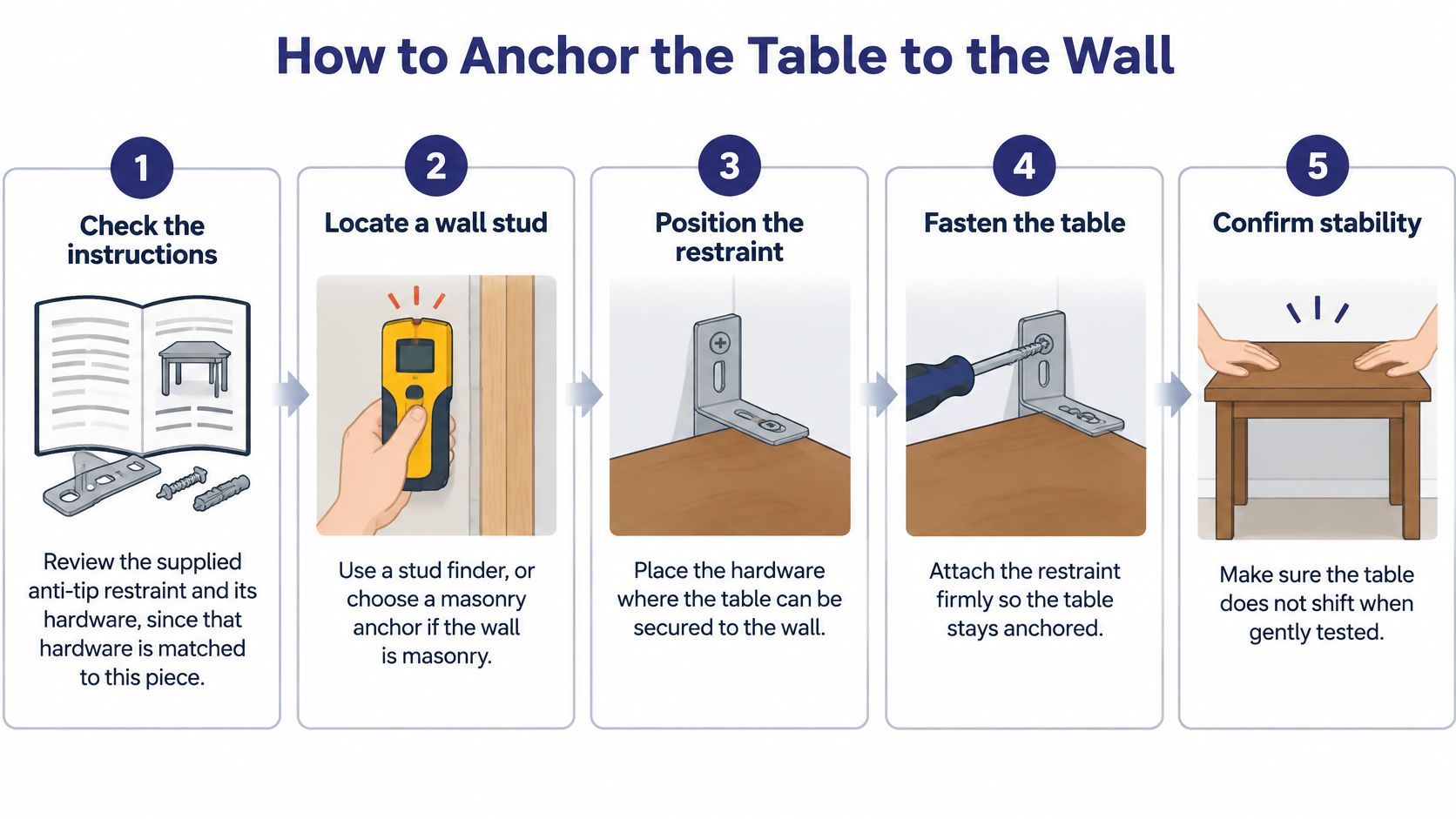
Anchoring Steps
- Check the instructions. Find the supplied anti-tip restraint and its hardware, since that hardware is matched to this piece.
- Locate support. Use a stud finder to locate a wall stud, or choose a masonry anchor rated for your wall material and the load.
- Mark two points. Mark one on the wall and one on the back of the console. Following your product's instructions, a wall point set lower than the furniture point generally keeps the strap pulling down and back.
- Install the wall anchor. Fasten it securely and keep the strap snug with minimal slack.
- Attach the strap. Use the supplied screws into the console. Don't substitute hardware that isn't rated for the piece.
- Level and test. Level the table, tighten the strap, press firmly on the top edge, and confirm the frame doesn't rock. Open each drawer and test again.
- Recheck over time. Inspect the anchor after moves, seasonal changes, or any time children climb or pull on drawers.
Why Strap Position Matters
The U.S. Consumer Product Safety Commission furniture tipover briefing recommends installing supplied anti-tip restraints and placing heavier contents in lower storage areas. It describes stability testing for applicable storage furniture using fully extended drawers and a 50-pound load on one open drawer, and its testing found that connecting the wall point lower than the furniture attachment point can improve resistance to tipping.
That gives you two practical rules. Keep heavier decor low and centered, not perched near the front edge. Before using drawers for heavy items, check the stated maximum load in the assembly documentation. A piece sold as an accent table shouldn't be assumed to meet requirements meant for clothing-storage furniture.
Choose the widest, deepest base that fits the room when you can. A broader footprint, a frame that doesn't rock, and a snug strap work together. No single feature replaces the others.
Styling Without Overloading the Top
A reflective top makes whatever sits on it read larger and busier. You see the object and its reflection, plus the reflection of the room behind you. Fewer pieces usually look cleaner, and they'll leave room for the table to function.
This example shows a restrained arrangement you can adapt to your own wall.
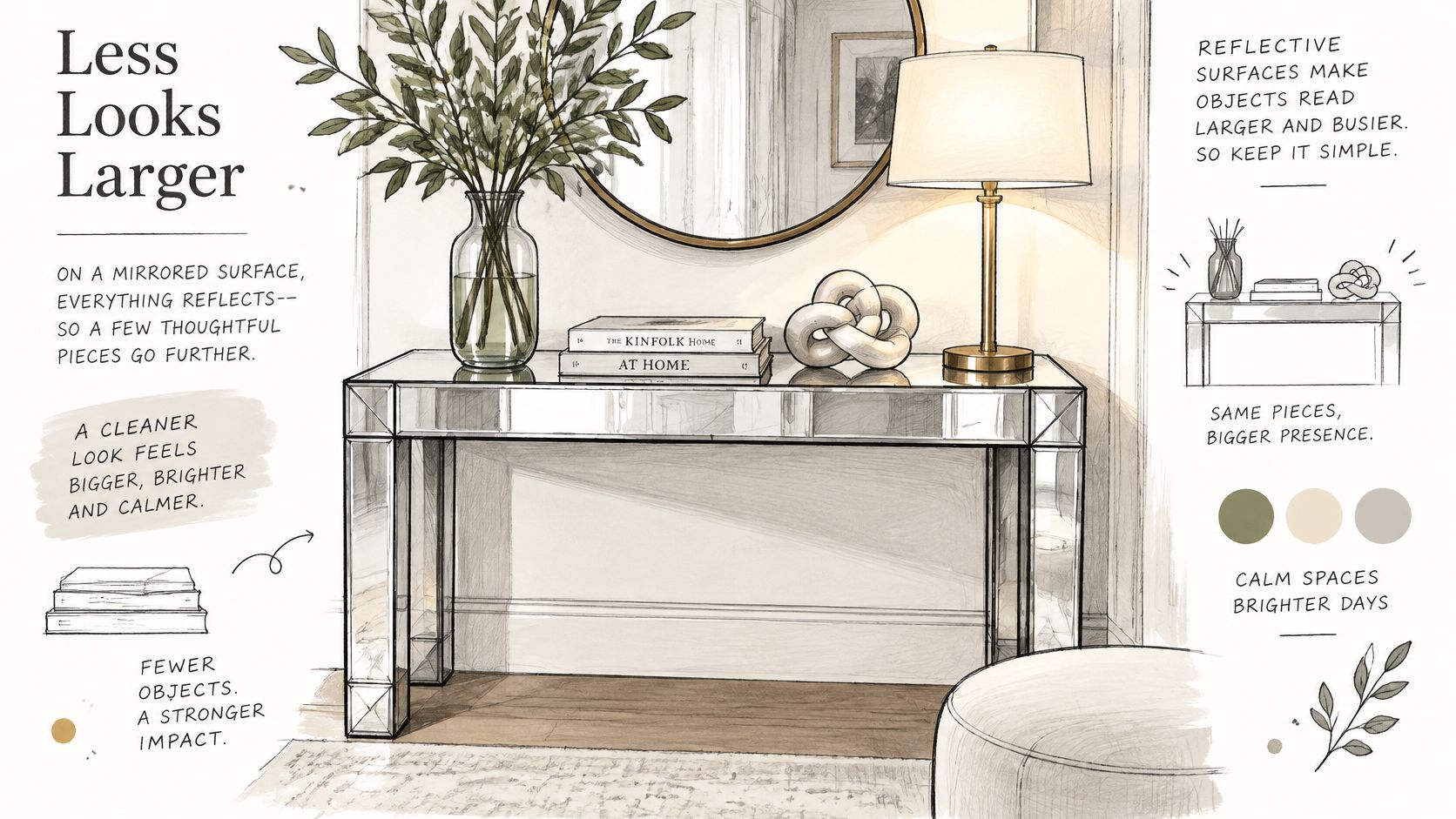
Start with three elements. Use one taller piece, such as a lamp or vase. Add one lower piece, such as a bowl or tray. Finish with one object in a different texture, such as woven, matte ceramic, or natural wood against the mirror's shine.
Group in odd numbers if you like that look, but keep the front edge clear. Drawers and doors should open without knocking anything over. Keep the heaviest pieces low and toward the back, and check the stated weight rating before you add stone, cast metal, or dense decor to a glass top.
For proportion, a wall mirror about two-thirds of the console width often looks balanced. A mirror wider than the console can look unanchored, because the visual weight on the wall outweighs the base under it. You can find inspiration for houseplant displays if you want the softer texture to come from leaves rather than another hard object, but keep pots on a tray so water stays off seams and edges.
The video below walks through a setup in real time, which helps you judge spacing instead of guessing from a still photo.
Finish with a quick home checklist:
- Count objects: Can you remove one and improve it?
- Check weight: Is everything within the stated rating?
- Clear the front edge: Can drawers open freely?
- Step back: Does it read as calm from the doorway?
Say you're styling an entry for weekday use. A tray near the door, a lamp toward the back, and a small plant or bowl may be enough. Keys land in one place, the reflection stays open, and you aren't moving decor every time you need the surface.
Caring for the Mirror and Wood Frame
Care protects two different materials at once. The mirror needs gentle, low-moisture cleaning. The wood or board frame needs stable indoor conditions. A routine handles both.
Care routine for a mirrored console
| Task | How often | Why it matters |
|---|---|---|
| Wipe the mirror with a dry or lightly damp microfiber cloth | Weekly | Removes dust and fingerprints without pooling liquid at the edges |
| Wipe spills immediately | As needed | Keeps moisture out of seams and joints |
| Check indoor humidity with a hygrometer | Seasonally | Helps keep wood moisture in a stable range |
| Check mirror panels and fasteners for looseness | Every 3 months | Catches movement at mirror-retention points early |
Why Humidity Deserves Attention
Wood components change dimension as indoor humidity changes. That movement can stress joints, trim, and mirror-retention points, which is why a panel that sat flush in one season may look slightly off in another.
The U.S. Environmental Protection Agency moisture-control guidance, citing the USDA Wood Handbook, identifies an average wood moisture content of 15% or less, and maximum readings of 19% or less, as a way to reduce dimensional-change problems. Those percentages come from a wood moisture meter, not a room hygrometer.
That distinction confuses many owners. You probably don't need to meter your furniture. A hygrometer tracking indoor relative humidity is a practical way to watch conditions, since interior wood moisture depends on humidity, ventilation, moisture sources, and dehumidification.
Cleaning and Placement for Care
Place the table away from HVAC discharge, exterior doors, bathrooms, and direct wet-cleaning exposure. Wipe spills promptly so moisture doesn't migrate into seams. Use a dry or lightly damp microfiber cloth on the mirror, spray cleaner onto the cloth rather than the panel if you use it, and avoid ammonia-based cleaners, abrasives, and excess water at mirrored edges where liquid can enter seals.
After delivery, let the piece acclimate indoors before final leveling and anchoring. That's especially helpful after transport from a hot, humid warehouse or a cold vehicle. Give the materials time to settle, then level once.
Watch for three signs that need attention:
- Panel not flush: A mirror edge lifting or sitting proud of the frame.
- Joint opening: A visible gap where trim or frame parts meet.
- Fastener loosened: Movement after a seasonal humidity change.
Catching those early is simpler than correcting finish or backing damage after moisture has had time to work into an edge.
Decide Whether a Mirrored Console Fits Your Home
A mirrored console fits well when the room, the wall, and your habits support it. It fits poorly when you have to fight clearance, humidity, or daily traffic to keep it safe and clean. Use this decision checklist before you commit.
A Practical Checklist
Choose a mirrored console if:
- Wall and walkway fit: Your measurements match the size range for the placement.
- Humidity stays fairly stable: The room isn't steamy or exposed to frequent wet cleaning.
- You can anchor it: There's a stud or a rated masonry anchor at the right location.
- You accept light upkeep: Weekly wiping and periodic fastener checks sound reasonable.
Consider a different style, such as a solid wood console with an opaque top, if children are likely to climb or pull on drawers and you can't anchor the piece. The same caution applies if large pets routinely push against entry furniture or the room stays very humid. That's not a judgment on mirrored furniture. It's matching the piece to the household.
Verify the Claims That Matter
Before buying, confirm the dimensions, weight rating, backing type, and frame material in writing from the manufacturer or store. A listing claim without a documented basis can't be verified by you later if a drawer sags or a panel isn't built the way you expected.
That caution reflects a broader advertising principle. The Federal Trade Commission advertising substantiation guidance says advertisers must substantiate both express and implied claims before disseminating an advertisement, and consumers are generally assumed to expect a reasonable basis for a claim when no specific level of support is communicated. For your purposes, prefer measurements and material descriptions over broad phrases you can't test.
Keep your own short list in your phone: wall length, walkway depth, and anchor location. Add the height available above the table. With those four notes, you can compare pieces quickly and say no to a beautiful table that won't work in your home.
Our knowledgeable, experienced staff can talk through sizing for your specific wall, and we offer design services if you want help comparing scale and placement. Seeing mirror edges, carrier boards, and finishes side by side in person often resolves questions that photos leave open.
Bring your wall length, walkway depth, and anchor notes to Woodstock Furniture & Mattress Outlet and let our knowledgeable, experienced staff help you compare mirrored console proportions, materials, and finishes in person. We offer design services and a great selection at great prices, so you can check edges, backing, and stability for yourself before deciding what belongs in your home.
Leave a Reply
You must be logged in to post a comment.