Generally speaking, a good mattress for most side sleepers falls somewhere in the medium-soft to medium-firm range. This area usually gives the right mix of cushioning pressure relief for the shoulders and hips, while still being sturdy enough to keep the spine straight and help prevent morning backache.
Why Your Sleep Position Shapes Your Mattress Needs
If you’re one of the millions who curls up on their side at night, you may already know the struggle. You might spend half the night trying to find that one spot that doesn't make your shoulder go numb or your hip ache by morning. It’s not in your head—it’s just physics. When you lie on your side, your body's curves create significant pressure points, and a mattress that isn't a good fit can make it worse.
Think of it like trying to fit a key into a lock. Your body has its own unique shape, especially with the pronounced curves at your shoulders and hips. A mattress that's too firm is like the wrong key; it doesn’t fit your shape, jamming up against those curves and creating painful pressure. On the flip side, a mattress that’s too soft lets you sink in too far, bending your spine out of alignment and causing a different kind of discomfort.
The Goal: Pressure Relief Meets Support
A well-suited mattress for a side sleeper is one that fits the body's contours just right, helping to unlock a restful night’s sleep. It needs to be soft enough to cradle your pressure points but supportive enough to hold your spine in a straight, neutral line. For side sleepers, getting this balance right is essential if you want to wake up feeling refreshed and pain-free.
But finding this balance is about more than just picking a familiar brand name. It's about understanding how a few key factors work together to create the right sleep surface for you. These elements include:
- Mattress Firmness: This is a major factor. It determines how much "give" the surface has.
- Mattress Materials: From memory foam to latex to hybrid coils, different materials offer very different feels and benefits.
- Your Body Type: Your own weight and shape will change how you interact with any mattress.
At its core, the biggest challenge for a side sleeper is finding a mattress that can spread body weight evenly across the entire surface. If it can’t, the shoulders and hips are left to carry most of the load, which can lead to tossing, turning, and waking up sore.
This guide is here to walk you through each of these pieces of the puzzle. Our goal is to give you clear, honest information and take the confusion out of the mattress buying process. Once you understand what your body actually needs, you’ll be able to confidently choose a mattress that can give you lasting comfort and truly support the way you sleep.
Decoding Mattress Firmness for Side Sleepers
When you're trying to find a suitable mattress for side sleeping, firmness isn't just a matter of personal preference—it's one of the most important keys to a night of pain-free rest. Think of firmness as the amount of "push back" a mattress gives your body. The goal here is to find one that balances this pushback with a gentle, cradling feel.
Go too firm, and your shoulder and hip will feel like they're jammed against a board, unable to sink in at all. This can force your spine out of alignment and is a classic recipe for waking up with sore joints and a stiff lower back. But swing too far the other way with a mattress that's overly soft, and your heavier hips will sink way too deep, causing your spine to curve downward like a hammock.
Finding the Right Balance
For the vast majority of side sleepers, the ideal range is medium-soft to medium-firm. On the typical 1-10 firmness scale you see online, that usually translates to a 4 to 7.
This range is often a "Goldilocks" solution. It's soft enough to cushion the widest parts of your body (your shoulders and hips), but it’s also firm enough to properly support your waist and lower back. This combination is what helps keep your spine in a straight, neutral line all night long.
A lot of people think a firmer mattress automatically means better support. That’s a common myth. True support comes from proper alignment, not from sleeping on a rock-hard surface. A mattress that actually adapts to your body's curves is what provides genuine, restorative support.
This visual guide breaks down the balancing act every side sleeper has to manage: finding a mattress that relieves pressure without sacrificing that essential spinal support.
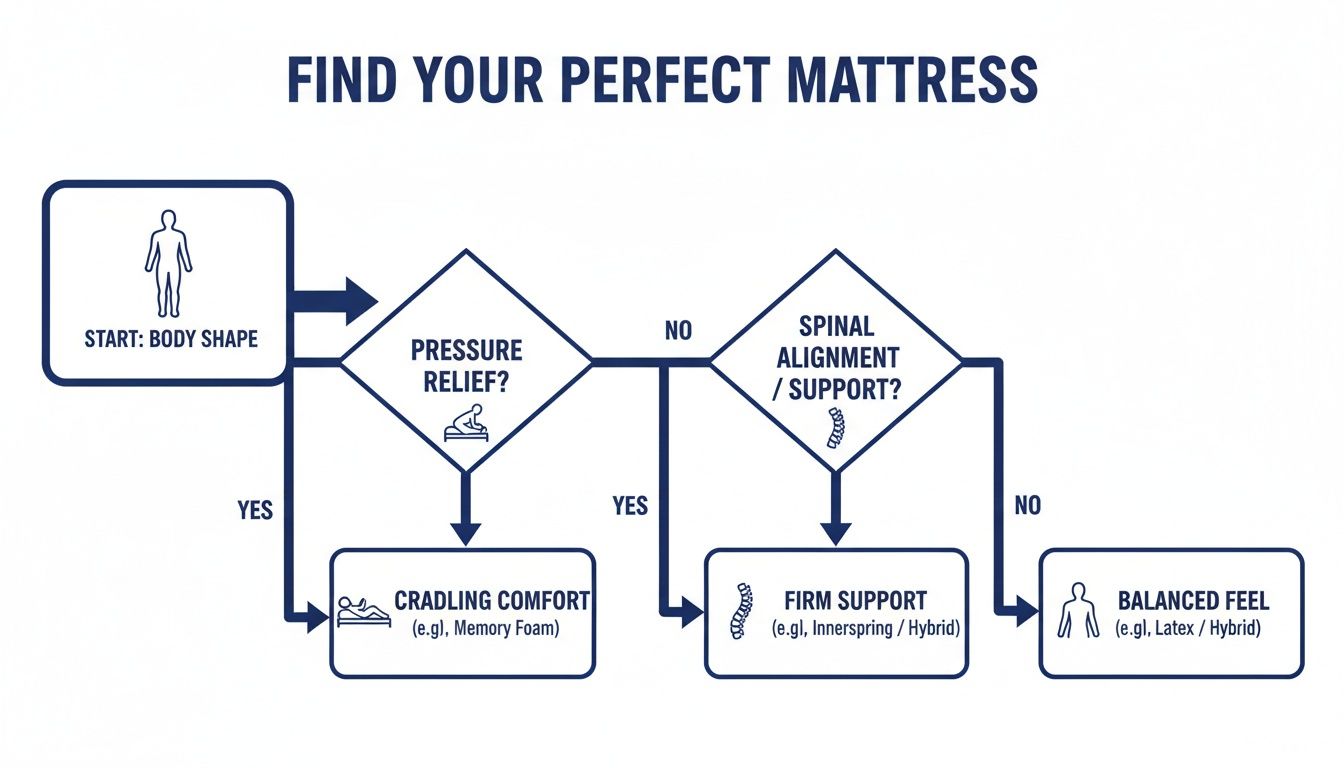
As the chart shows, you need both cradling pressure relief and straight spinal support. For a side sleeper, these two things are equally critical for real comfort.
How Body Weight Affects Firmness Needs
Your body weight is a huge piece of this puzzle because it dictates how much pressure you put on the mattress. A bed is going to feel completely different to someone who weighs 120 pounds versus someone who weighs 220 pounds.
Lighter folks may need a softer surface to get enough contouring, while heavier sleepers may need a firmer mattress to keep from sinking in too much and losing support. It's simple physics: more weight requires more resistance to get the right amount of sinkage and alignment. Understanding this relationship takes the guesswork out of the equation and helps you find a mattress that feels well-suited for you.
The key takeaway here is that mattress firmness is not one-size-fits-all. Your body type is a major factor in determining which firmness level will give you the right mix of comfort and support when sleeping on your side.
This is especially important because side sleeping is a very common position—some studies show that side sleepers make up around 60% of the population. This has pushed mattress companies to innovate, leading to models specifically designed to cradle those pressure points. For instance, testing from the Sleep Foundation has shown that medium-firm hybrid mattresses with zoned support can reduce shoulder sinkage by up to 25% compared to standard models. You can even review more detailed mattress testing results for side sleepers to see just how big of a difference the right construction and firmness can make.
Firmness Recommendations by Body Weight
To make this a bit more concrete, we’ve put together a general guide to help you zero in on your ideal firmness level.
Mattress Firmness Guide for Side Sleepers by Body Weight
This table should give you a solid starting point for finding a suitable firmness based on your approximate body weight.
| Body Weight | Recommended Firmness (1-10 Scale) | Why It Works |
|---|---|---|
| Under 130 lbs | 4-5 (Medium-Soft) | Lighter individuals don't sink as deeply, so a softer mattress is often needed to allow the shoulders and hips to contour properly and relieve pressure. |
| 130 to 230 lbs | 5-7 (Medium to Medium-Firm) | This weight range aligns with standard firmness ratings. A medium feel offers a balanced blend of body-hugging comfort and robust spinal support. |
| Over 230 lbs | 7-8 (Medium-Firm to Firm) | Heavier individuals may need a firmer surface to prevent sinking too far into the mattress, which could compromise spinal alignment and support. |
Remember, this is a guideline. Personal preference still plays a role, but this chart can get you much closer to finding a mattress that works well for your body and sleeping style.
Comparing Mattress Materials for Pressure Relief
Once you have a general firmness level in mind, the next step is to figure out which materials can deliver that feel. For side sleepers, this decision is all about one thing: pressure relief. You need a surface that can contour to your body's curves and spread your weight out evenly.
Different materials get the job done in very different ways. Knowing what's inside a mattress gives you a good idea of what to expect in terms of feel, how long it will last, and even how hot or cool it will sleep. The goal here isn't to find a single "best" material, but to find the one that clicks with your own comfort preferences.
Memory Foam Mattresses
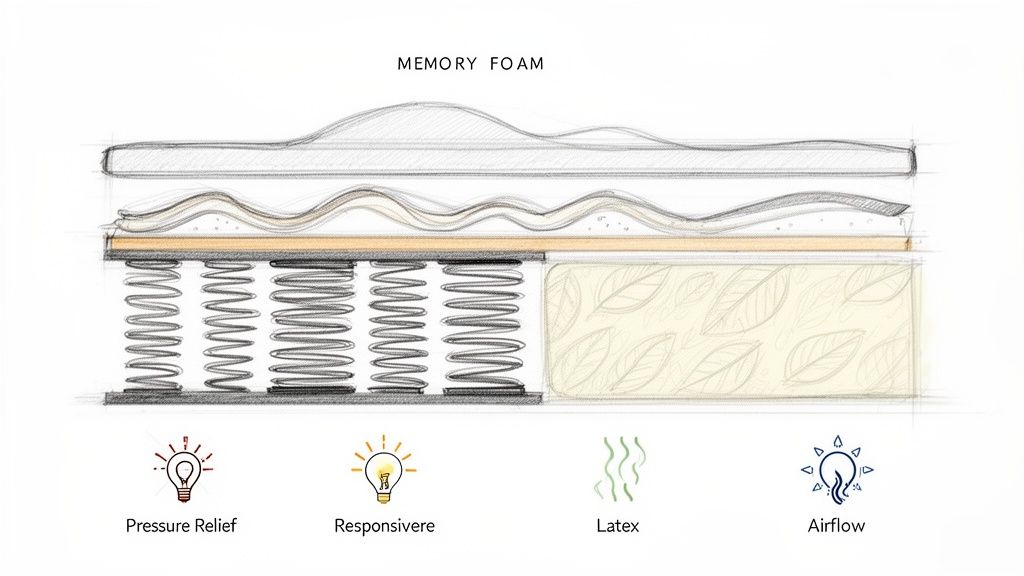
Memory foam is known for its deep, body-hugging feel. When you lie down, it slowly softens in response to your body heat and weight, creating a cradle-like impression. This is incredibly effective at taking the pressure off your shoulders and hips.
That slow-response sensation is exactly why memory foam is a go-to for side sleepers who complain about sharp pain points. It essentially absorbs pressure instead of pushing back against you.
- Who it’s for: Side sleepers who want significant pressure relief and like a distinct "sinking in" or "hugged" feeling. It's also a great choice for couples because its dense structure is amazing at absorbing movement and preventing one partner from waking the other.
- What to consider: A potential drawback of traditional memory foam is that it can trap body heat. However, many modern foams now include cooling technologies like gel infusions or perforated designs to improve airflow.
Hybrid Mattresses
Hybrid mattresses are a combination of materials. They typically combine a supportive core of innerspring coils with thick, comfortable layers of foam or latex on top. This construction gives you the benefits of both systems in a single mattress.
You get the pressure relief and contouring from the top foam layers, but you also get the responsive support, bounce, and breathability from the coil base below. For a lot of side sleepers, this strikes a great balance that isn't too extreme in any one direction.
A hybrid mattress is often an effective middle ground. It provides the deep cushioning a side sleeper’s joints need, while the coils help prevent that "stuck" feeling some people get from all-foam beds.
That coil system also promotes much better airflow through the whole mattress, making hybrids a great pick if you tend to sleep warm.
Innerspring Mattresses
Traditional innerspring mattresses are built around a core of interconnected steel coils. While they are known for being bouncy, supportive, and often more affordable, they can sometimes cause problems for people who sleep on their side.
The issue is that their comfort layers are usually quite thin, which means they don't always offer enough padding to properly cushion the hips and shoulders. A firm innerspring can sometimes create pressure points instead of relieving them.
- Who it’s for: While not always the first choice for dedicated side sleepers, an innerspring might work for combination sleepers who only spend some of the night on their side. They're also an option for anyone who prefers a very firm, bouncy surface.
- What to consider: If you're considering an innerspring, look for models with pocketed coils (where each spring is wrapped in its own fabric sleeve). They conform to your body much better and reduce motion transfer compared to older, interconnected spring systems.
Latex Mattresses
Latex mattresses are made from either natural or synthetic latex foam. They offer a totally different feel from memory foam's slow sink. Latex has a more buoyant and responsive contouring feel—it cradles your pressure points but has a gentle push-back that makes you feel like you're sleeping "on" the mattress, not "in" it.
This material is also naturally breathable and very durable. For side sleepers who want pressure relief without the deep hug of memory foam, latex is an excellent alternative. It contours to your shape but still makes it easy to roll over and change positions during the night.
Each of these materials comes with its own set of pros and cons. The only way to really know which one you'll prefer is to try them out. Visiting a showroom lets you compare these very different sensations side-by-side to find what feels best for your body.
Essential Features for a Side Sleeper's Mattress
Once you’ve got a handle on mattress firmness and materials, we need to talk about a few key features that can make or break your sleep. For side sleepers, these aren’t just industry buzzwords; they are practical solutions to waking up with a sore shoulder or an aching lower back.
Knowing what these features are and why they matter will help you cut through the marketing fluff and focus on what’s actually going to give you a great night’s sleep. Each of these elements works together to create a sleep surface that adapts to your body, not the other way around. Let’s dive in.
The Importance of Pressure Relief
For a side sleeper, one of the most important jobs a mattress has is to provide excellent pressure relief. Think of it as the mattress’s ability to gently cradle the widest parts of your body—your shoulders and hips—to keep pain and stiffness at bay. When you lie on your side, those two spots bear the brunt of your body weight.
Without enough pressure relief, all that force gets concentrated on those small areas. The result can be numbness, tingling, and aching joints in the morning. A mattress with good pressure relief spreads your weight out more evenly across the surface, effectively “hugging” your curves and stopping those pressure points from building up.
This is exactly why materials like memory foam and latex are so popular with side sleepers. They are designed to contour and give way under pressure, providing that critical cushioning right where you need it most.
The Foundation of Spinal Alignment
Just as important as pressure relief is spinal alignment. Picture a straight line running from the base of your neck all the way down to your tailbone. A suitable mattress for a side sleeper will keep this line neutral and straight all night long.
A huge part of what a quality mattress does is help you maintain proper posture while you sleep and keep spinal discs healthy. If a mattress is too firm, it can shove your hips and shoulders upward, causing your spine to bow uncomfortably. On the flip side, if it’s too soft, your midsection will sink way too deep, creating a hammock-like curve. Either way, you’re putting a ton of strain on your back muscles and setting yourself up for pain.
The ideal mattress has enough support underneath to hold up your waist and lower back, while being soft enough on top to let your shoulders and hips sink in just the right amount.
Other Important Features
While pressure relief and alignment are the two pillars of comfort for side sleepers, a few other features can seriously upgrade your sleep experience—especially if you share the bed.
Zoned Support: Some mattresses have zoned support systems. This means the mattress is built with different firmness levels in different areas. Usually, it’s firmer in the center third to support the heavier lumbar area and a bit softer at the head and feet to cushion the shoulders and legs. This targeted design is an effective way to address both pressure relief and alignment in a single mattress.
Motion Isolation: If you have a partner, motion isolation is important. This is all about the mattress's ability to absorb movement on one side of the bed so it doesn’t travel to the other. Dense materials like memory foam are great at this, making sure your partner’s tossing and turning doesn’t disturb your sleep.
Edge Support: Strong edge support simply means the perimeter of the mattress is sturdy and stable. Good edge support is great for couples because it lets you use the entire surface of the bed without that feeling that you might roll off. It also makes getting in and out of bed easier.
How to Properly Test a Mattress for Comfort
Reading reviews and looking at specs online is a solid first step. But at the end of the day, there’s no substitute for actually lying on a mattress. Your body is the only true judge of whether a mattress has that just-right blend of soft comfort and firm support.
Whether you're visiting a showroom or trying a bed in your own home, being intentional about how you test it can save you from a world of hurt. It's not about hopping on a few beds for thirty seconds; it's about giving your body a chance to really feel how the mattress responds. This is where all your research pays off.
The In-Store Test Drive
Walking into a showroom is your best chance to compare different materials and firmness levels side-by-side. A mattress that sounds like a dream on paper can feel totally wrong once you lie on it.
To get the most out of your visit, treat it like you're test-driving a car:
Wear Comfortable Clothes: You can’t get a real feel for a mattress in stiff jeans or a suit. Think sweatpants or athletic wear — something that lets you move and relax without feeling constricted.
Assume Your Position: Don't just sit on the edge. Lie down in the exact same side-sleeping position you use at home. Get comfortable, just like you would if you were turning in for the night.
Stay a While: This is the most important part. Your body needs time to settle in and really feel the mattress. Plan to spend at least 10 to 15 minutes on any mattress you're seriously considering. This is long enough to tell if your shoulder or hip starts to feel pinched or uncomfortable.
Perform a Spine Check: If you're shopping with a partner or friend, have them take a look at your back while you're on your side. Your spine should be in a straight, horizontal line from your neck to your tailbone. If it's sagging or bowing, that mattress isn't giving you the support you need.
The goal here is simple: see how the mattress feels right now. Does it immediately cradle your shoulder? Can you feel it supporting the curve of your waist? A few minutes of focused testing can tell you everything you need to know.
Visiting a store with a large selection, like the Sleep Center at Woodstock Furniture & Mattress Outlet, is a huge advantage. You can feel the distinct differences between memory foam, hybrid, and latex beds all in one trip, and our sleep experts can help point you in the right direction.
The At-Home Sleep Trial
Even the best showroom test can't fully predict how you'll feel after eight hours of sleep. That's where at-home sleep trials come in. Many brands will give you several weeks—or even months—to sleep on their mattress in your own bedroom, often with a return or exchange option.
This trial period is absolutely critical because every new mattress comes with an adjustment period. Your body has spent years getting used to your old bed, and it can take a couple of weeks to fully adapt to a new feel, even one that’s much healthier for you.
Before you commit, always read the fine print on the sleep trial. Look for any fees for returns or exchanges. Think of the trial as the final step in your research—a no-pressure way to confirm you’ve made a good choice for years of comfortable sleep.
Building Your Complete Sleep System
A great mattress is the heart of a good night's sleep, but it’s really only one piece of the puzzle. If you want to get the most out of your new mattress, you need to think bigger and build a complete sleep system where everything works together in harmony. For side sleepers, the right pillow and foundation are just as critical as the mattress itself for waking up pain-free.
The key is to start thinking about your mattress, pillow, and foundation as a single, cohesive unit. Why? Because each part directly impacts how the others feel and perform.
The Role of the Right Pillow
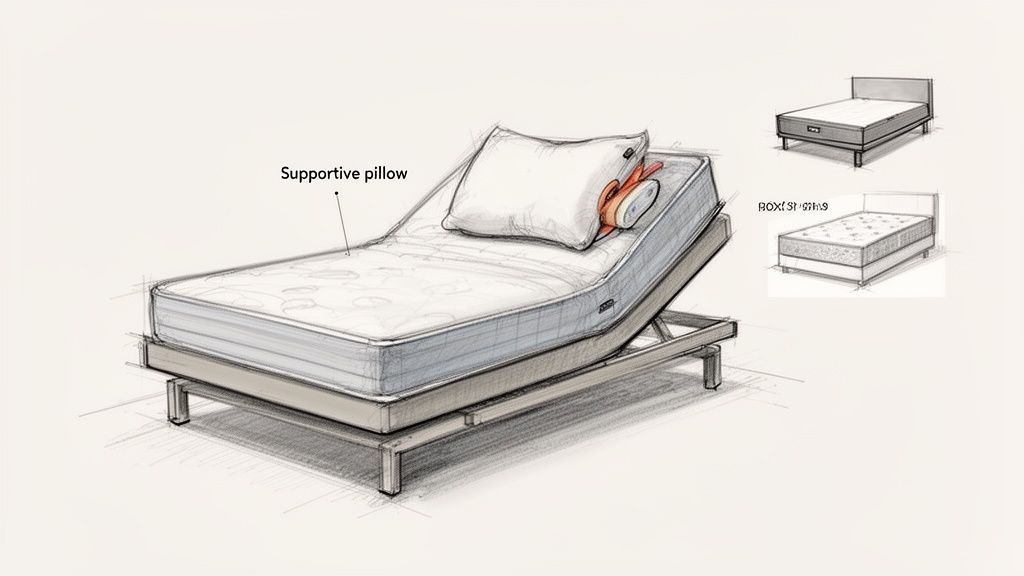
When you lie on your side, a pretty significant gap opens up between your head and the mattress. Your pillow’s job is to fill that space perfectly, keeping your head and neck in a straight line with the rest of your spine. If your pillow is too thin, your head will sag down. Too thick, and it’ll be pushed up at an awkward angle.
For side sleepers, a thicker, more supportive pillow is almost always necessary. The goal is to create a straight, horizontal line from your head to your tailbone, and the pillow is the final piece of that alignment puzzle.
Look for materials like memory foam, latex, or other dense fills that won’t flatten out under the weight of your head during the night. The ideal pillow should feel substantial and hold its shape while still contouring to your neck just right.
Choosing the Right Foundation
The foundation under your mattress does more than just get it off the floor. It provides crucial support that changes how the mattress feels and how long it lasts. In fact, using the wrong base can even void your mattress warranty.
Here are the most common options you'll run into:
- Platform Beds: These have a solid or slatted surface, giving your mattress firm, even support. They work great with most modern mattresses, especially memory foam and hybrid models.
- Box Springs: These are designed for traditional innerspring mattresses. A box spring has its own set of coils inside to absorb shock. They are not recommended for foam or hybrid mattresses because they don't provide a solid enough surface.
- Adjustable Bases: An adjustable base gives you ultimate control. For side sleepers, you can slightly raise your head and feet, which can help with things like acid reflux or snoring without forcing you onto your back.
To build a truly complete sleep system, it's crucial to understand how all these pieces fit together. For a deeper dive, check out this guide to selecting your ideal mattress. By pairing your perfect mattress with the right pillow and a supportive foundation, you create a personalized sleep sanctuary that sets you up for deeper, more restorative rest.
Common Questions from Side Sleepers
Even after you've learned the ropes on firmness, materials, and support, you might still have a few nagging questions. That’s totally normal. Finding the right mattress is a big deal, and it’s smart to cover all your bases before making a decision.
Below, we’ve tackled some of the most common questions our mattress experts hear from side sleepers every day. These straightforward answers may help you feel more confident in your search.
I Am a Combination Sleeper but Favor My Side What Should I Look For?
This is a really common scenario. For combination sleepers who find themselves on their side most of the night, a medium-firm hybrid mattress is usually a fantastic place to start. It gives you that critical pressure relief for your hips and shoulders when you're on your side.
Just as importantly, the responsive coils make it much easier to roll over and change positions without feeling like you’re fighting your way out of quicksand. You’re looking for that sweet spot—a mattress that offers both contouring comfort and a lively, buoyant feel.
Can a Mattress Topper Fix My Too-Firm Mattress?
Yes, sometimes a topper can be an effective and budget-friendly solution. If your mattress is still in good shape and offers solid support but just feels too firm, adding a 2-3 inch memory foam or latex topper can introduce that crucial layer of cushioning your pressure points are craving.
However, it's key to remember that a topper is just a band-aid, not a cure. It can change the feel of your mattress, but it absolutely cannot fix an old, sagging bed that has lost its core support.
Think of a mattress topper as a comfort adjustment, not a structural repair. It adds softness to a supportive base but won't bring a worn-out mattress back to life.
How Can I Tell if My Spine Is Aligned Correctly?
There's actually a pretty easy way to check your alignment, whether you're testing mattresses in a store or on your bed at home. Lie down in your usual side-sleeping position and have a partner or friend take a look at your back.
Your spine, from the base of your neck all the way down to your tailbone, should form a straight, horizontal line. If your hips sink in too far, your spine will sag downwards into a hammock shape. If the mattress is too firm, your spine will bow upwards. You should feel comfortably "held" without any weird strain.
What if My Partner and I Have Very Different Body Weights?
This is a common challenge for couples. Oftentimes, a medium-firm mattress can be a good compromise, as it can comfortably accommodate a wider range of body types and sleep styles.
When you have different needs, it’s also critical to look for a mattress with excellent motion isolation. Materials like memory foam or a well-made hybrid with high-quality pocketed coils are champs at absorbing movement, so you won’t feel every toss and turn from your partner. For couples with drastically different needs, some brands offer split king mattresses, which allow each of you to have your own ideal firmness on your side of the bed.
Finding a suitable mattress comes down to understanding your own unique needs and knowing what to look for. At Woodstock Furniture & Mattress Outlet, our sleep experts are here to guide you through the process, letting you test and compare dozens of options from well-regarded brands in our Sleep Center. Visit us to find the supportive, comfortable mattress you deserve.
Leave a Reply
You must be logged in to post a comment.