
If you're ready to upgrade to a king size bed, you're not alone. But before you dive in, there's a crucial detail to nail down: which kind of king are you talking about?
Most people don't realize there are two main types of king mattresses here in the U.S. Getting the dimensions straight from the get-go is the single most important step to make sure you end up with a bed that actually fits your room and your lifestyle.
Your Quick Guide to King Bed Dimensions
Let's cut right to the chase. A standard king size bed—often called an Eastern King—measures 76 inches wide by 80 inches long. It's the widest standard mattress available, making it a popular choice for couples who want plenty of personal space.
This size became more common in the mid-20th century as bedrooms in American homes started getting bigger. The logic was simple: a standard king is the exact same size as two Twin XL mattresses pushed together. This setup gave each person their own distinct sleep zone. You can find more on the history of mattress sizes at mllinens.com.
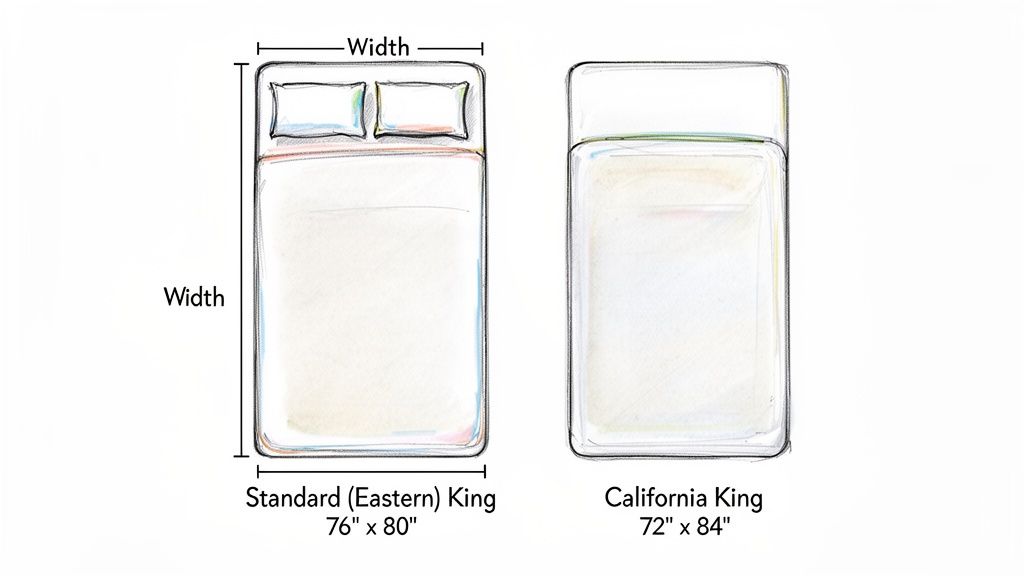
Comparing Standard and California King
The other major option is the California King, and this is where people sometimes get mixed up. It’s not bigger overall; it just distributes its size differently. It's longer, but also narrower than a standard king.
Seeing the numbers side-by-side makes the trade-off clear.
King vs. California King Dimensions at a Glance
| Feature | Standard King (Eastern King) | California King |
|---|---|---|
| Width | 76 inches | 72 inches |
| Length | 80 inches | 84 inches |
| Total Area | 6,080 sq. inches | 6,048 sq. inches |
As you can see, the total surface area is nearly identical. The choice really boils down to your priorities.
The key takeaway is simple: If you want maximum width for you, a partner, and maybe even kids or pets who like to pile in, the standard king is your answer. If you're tall and need extra legroom to avoid dangling feet, the California king was designed specifically to solve that problem.
This fundamental difference in shape—wider versus longer—is the most important factor to consider. As we continue, we’ll dig into how these measurements translate into real-world comfort and what they mean for your room’s layout.
Choosing Between a Standard and California King
The raw numbers on a king-size bed only tell you part of the story. The real decision between a standard king and a California king comes down to solving a specific problem you’re having with your current sleep setup. It’s less about which one is technically "bigger" and more about which shape is going to improve your sleep.
Here's an easy way to think about it: are you constantly fighting for more space side-to-side, or are your feet always hanging off the end? Once you answer that question, the right choice becomes much clearer.
When to Choose a Standard King
The standard king—sometimes just called an "Eastern King"—is all about width. At 76 inches wide, it gives each person in a couple the exact same amount of personal space as if they were sleeping alone on a Twin XL mattress. That alone makes it a great solution for some very common bedroom dilemmas.
- You sleep with a partner who moves around a lot. If your partner is an active sleeper—tossing, turning, or pulling the covers—those extra inches of width create a much-needed buffer zone. Their movements are far less likely to jolt you awake.
- Kids or pets frequently pile into bed with you. For families who enjoy a weekend morning snuggle or have a large dog who shares the bed, that extra width can be essential. It transforms the bed from a two-person sleeping space into a comfortable family hub.
- You just prefer having more personal space. Some of us just like to spread out. A standard king ensures you can stretch your arms and legs out wide without encroaching on your partner’s side.
If your main goal is to get more elbow room and stop feeling crowded, the standard king is almost always the right call.
A standard king is designed to solve the problem of width. It’s the go-to for couples, co-sleepers, and anyone who feels boxed in by their current mattress.
When a California King Makes More Sense
On the other hand, the California king is a specialist. It trades four inches of width for four extra inches of length, measuring in at 72 inches wide by 84 inches long. That might not sound like a huge swap, but for a very specific group of people, it makes all the difference.
A California king is likely your best fit if:
- You or your partner are over six feet tall. This is the number one reason to get a Cal king. Those four inches of extra length mean no more feet dangling off the edge of the bed. Taller folks can finally stretch out completely and sleep in a natural, comfortable position.
- Your bedroom is long and narrow. The slightly slimmer, longer profile of a California king can work well in a room that's more of a rectangle than a square. It can make the whole layout feel more balanced, preventing the room from looking cramped.
The choice is an incredibly practical one. The California king was developed to solve the problem of beds being too short for taller sleepers. If that’s your biggest frustration, giving up a little width is a fair trade-off for a full night of comfortable, stretched-out sleep.
How to Properly Measure Your Room for a King Bed
It’s a common story: you find a spacious king bed at a showroom, only to get it home and realize it has swallowed your entire bedroom. One of the biggest regrets people have is underestimating just how much floor space these beds really take up. A simple tape measurement of your room's length and width is a start, but it doesn't tell the whole story.
To make sure your new bed feels like a sanctuary and not a cluttered obstacle course, you have to think about functional space and flow. It's all about planning for "breathing room." Your bed doesn't exist in a vacuum; you need clear pathways to walk, space for closet doors to swing open, and room for essentials like nightstands.
The 30-Inch Rule and Beyond
As a general rule of thumb, try to leave at least 30 inches of clear walking space around the sides and foot of the bed. Anything less and the room will immediately feel cramped, making it difficult to get around or make the bed.
Before you decide, walk through these critical checkpoints in your room:
- Doorways and Drawers: Can your bedroom door, closet doors, and dresser drawers open completely without hitting the bed frame? This is an easy detail to overlook that can become a major frustration.
- Nightstand Placement: Don't forget your nightstands. Make sure there's enough room on both sides of the bed for them to fit comfortably. Measure their width and add that to the bed's total width to get a true sense of the required space.
- Other Furniture: Think about everything else in the room. Will there still be space for that bench at the foot of the bed, a vanity, or a reading chair?
This visual guide can help simplify the choice between getting more width with a standard king or more length with a California king.
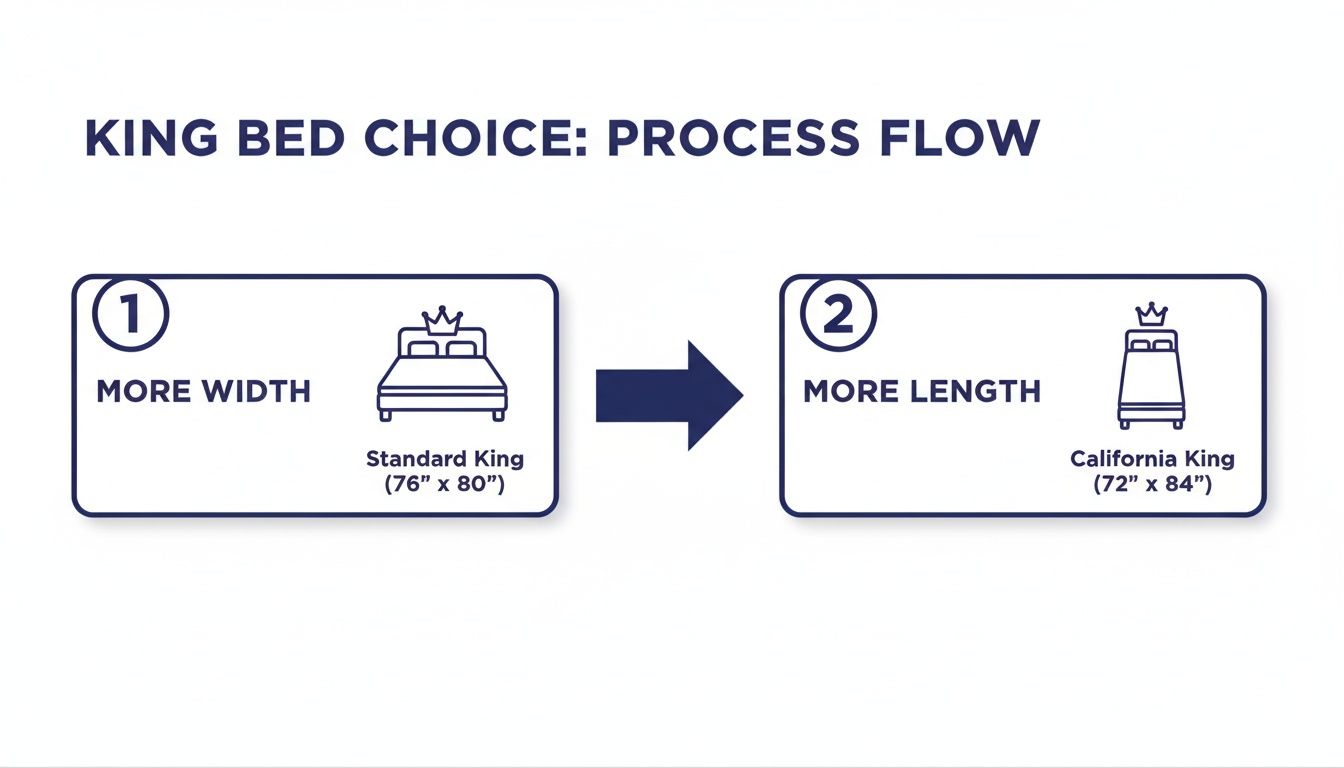
As the flowchart shows, it’s a direct trade-off: are you trying to maximize personal space for two sleepers, or do you need to accommodate someone who's tall?
A Pro Tip for Perfect Placement
Numbers on a screen or a tape measure can be deceiving. To really feel how a king bed will fit in your room, you need to visualize it in the space. A helpful way to do this is with a roll of painter's tape.
Use the tape to mark the exact 76" x 80" (Standard King) or 72" x 84" (California King) outline directly on your floor. Live with this taped-off area for a day or two. Walk around it, open your drawers, and see how it impacts the room's natural flow. This simple, practical step is one of the most effective ways to prevent a sizing mistake.
It's also worth noting that what we call a "king size" bed isn't universal. In the United Kingdom or Europe, a standard king measures just 152 cm × 198 cm (60 × 78 inches)—much narrower than its American counterpart. These differences show how beds have evolved to fit regional bedroom sizes and preferences. You can learn more about these global differences in bed sizing on Wikipedia. It’s a good reminder to always confirm local standards when you're shopping.
Accounting for Bed Frames and Headboards
The mattress dimensions are just the starting point. It’s a classic mistake to focus only on the sleeping surface—that 76 by 80 inches of a standard king, for instance—and completely forget about the structure holding it up. Your bed frame and headboard can add a surprising number of inches to the total footprint, turning a room that felt spacious on paper into a very tight squeeze.
Think of the mattress as the passenger and the frame and headboard as the vehicle. A slim, minimalist metal frame might only add an inch or two to the length and width. But a grand sleigh bed with a curved footboard or a deeply tufted, upholstered headboard can easily tack on an extra 6 to 10 inches of depth and width. Forgetting this is probably the most common oversight shoppers make.
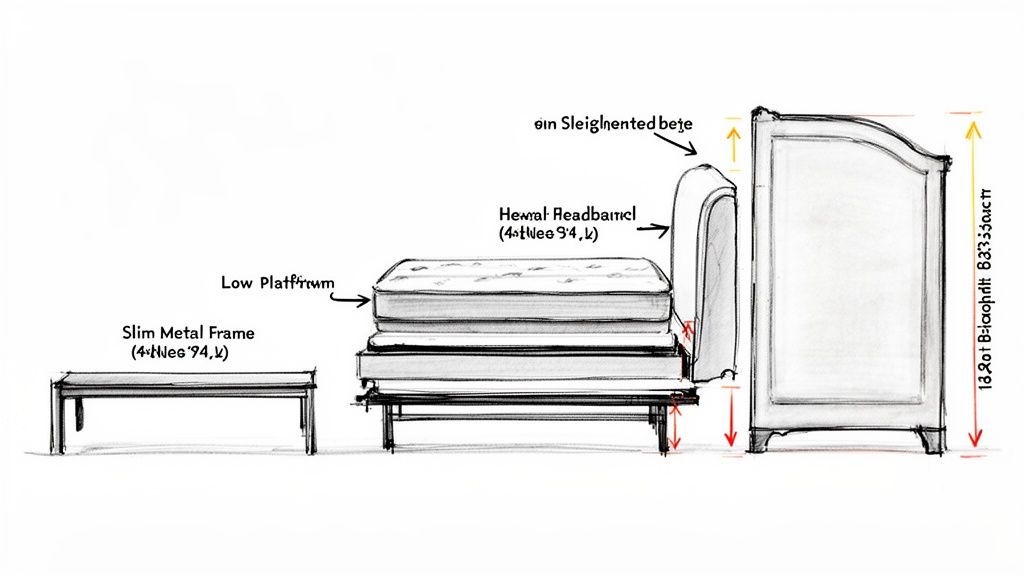
How Different Styles Impact Total Size
The style of the bed you choose has a direct impact on its final dimensions. You should always check the product specifications for the total measurements, not just the mattress size it’s built for. A good product page will list the fully assembled length, width, and height.
Here’s a general guide to what you can expect from different styles:
- Simple Metal Frames: These are your most space-efficient option, typically adding only 1-2 inches to the mattress dimensions.
- Platform Beds: A basic platform bed might add 2-4 inches in width and length. However, models with a wider lip or built-in side tables will demand more floor space.
- Upholstered Beds: All that plush, padded material on the headboard and side rails can add 4-8 inches to the total length and width. The thickness of the fabric and padding really adds up.
- Sleigh Beds: With their signature curved headboards and footboards, these tend to take up the most space. They often add 8-12 inches or even more to the total length.
- Beds with Storage: Frames that feature drawers or storage headboards are almost always wider and longer to accommodate the extra function.
Since these components can dramatically alter the final size of your bed, it's helpful to see how it all breaks down.
How Bed Components Add to Overall Dimensions
The table below gives you a quick reference for estimating how much extra space different bed parts will take up beyond the mattress itself.
| Component | Typical Added Width (Inches) | Typical Added Length (Inches) |
|---|---|---|
| Simple Metal Frame | 1-2 | 1-2 |
| Platform Bed (Standard) | 2-4 | 2-4 |
| Upholstered Frame | 4-8 | 4-8 (headboard/footboard) |
| Sleigh Bed | 3-6 | 8-12+ (due to curves) |
| Storage Bed | 2-5 | 4-10 (depending on design) |
Use these numbers as a ballpark when you're planning your room layout to avoid any unwelcome surprises on delivery day.
When you're in your room mapping things out with painter's tape, make sure you tape out the dimensions of the entire bed structure, not just the mattress. This one simple step will show you the bed's true real-world footprint.
Failing to account for the frame can lead to all sorts of frustrating problems, like a bed that juts out and blocks a walkway or a headboard so thick your nightstands no longer fit. By checking the complete specifications before you buy, you can choose a bed that fits perfectly in both theory and practice—enhancing your room without overwhelming it.
Navigating Delivery and Setup Challenges
One of the most overlooked parts of buying a new bed is simply getting it from the store into your bedroom. It can be quite a problem when a new king size bed arrives, only to get stuck in a tight stairwell. This is a frustrating and preventable issue.
Taking a few minutes to measure beforehand can mean the difference between a smooth delivery and a major headache.
Before your bed shows up, grab a tape measure and walk the entire path it will take. Don't just measure the bedroom itself; you need to account for every single twist and turn it'll make along the way.
Your Pre-Delivery Measurement Checklist
To make sure your installation goes off without a hitch, measure the width and height of these common obstacles:
- Doorways: This one’s obvious, but measure every doorway the bed has to pass through, from your front door to the bedroom. Don't forget to account for the thickness of the door itself and any doorknobs that stick out.
- Hallways: Check the width of your hallways. Pay very close attention to any sharp corners or 90-degree turns, because that's where things usually get stuck.
- Stairwells: If the bedroom is upstairs, measure the width of the stairs. You also need to check the ceiling height at any landings or turns to make sure there’s enough clearance to angle the mattress and foundation.
Most king mattresses have some flexibility, but the box spring or foundation is usually completely rigid. The dimensions of a king size bed foundation are what cause the most trouble in tight spaces.
If your delivery path looks a little challenging, a split box spring can be a great solution. It comes in two separate pieces, which makes maneuvering through narrow spots infinitely easier.
Planning for the delivery is just as important as measuring your room. A few minutes with a tape measure can save you from the disappointment of a failed delivery and ensure your new bed arrives stress-free.
You may also want to consider professional delivery and setup. An experienced delivery team has seen it all and knows how to navigate tricky spaces. They handle all the heavy lifting, assembly, and placement, letting you just relax and enjoy your new bed. It removes the guesswork and physical strain from the equation.
A Few Final Questions About King Beds
As you get closer to a decision, a few practical questions often come up. Let's tackle some of the most common ones we hear from shoppers sorting out the final details.
Can I Use Standard King Sheets on a California King Mattress?
No, the bedding for these two isn't interchangeable. It’s a common mix-up because of the similar names, but the shapes are completely different. A standard king is wider and shorter (76" x 80"), while a California king is narrower and longer (72" x 84").
If you try to put a standard king fitted sheet on a Cal king, it'll be too wide and not long enough. You'll end up with a loose, baggy fit that won't stay put. Always buy bedding that specifically lists your mattress size to make sure your sheets stay snug all night long.
What Is the Minimum Room Size for a King Bed?
As a good rule of thumb, you’ll want a room that's at least 12 feet by 12 feet. This isn't just about squeezing the bed in; it's about making sure the room still feels functional and comfortable.
A room this size usually gives you about 30 inches of clearance on both sides and at the foot of the bed. This is the "breathing room" you need to walk around, make the bed without bumping into walls, and add nightstands or a dresser without feeling cramped. If your room is much smaller than this, a queen usually creates a more balanced space.
Don't forget to account for all your furniture, not just the bed. The goal is to create a restful, uncluttered space, and proper spacing is key to getting that feeling right.
Is a Split King the Same Size as a Standard King?
Yes, exactly the same. When you put the two halves of a split king together, the total dimensions are 76 inches wide by 80 inches long, matching a standard king perfectly.
The "split" simply means it's made of two separate Twin XL mattresses (each 38" x 80") sitting side-by-side in a single frame. This setup is a popular choice for couples using an adjustable base, since it lets each person raise or lower their side of the bed independently without bothering their partner.
Do I Need Special Bedding for a Deeper Mattress?
You might, and it's a detail that’s easy to overlook. Many newer mattresses, especially those with thick pillow tops or hybrid layers, are much taller than older styles. If your mattress is over 12 to 14 inches high, you’ll probably need to look for deep-pocket sheets.
Standard fitted sheets just don't have enough fabric to stretch over that extra height and tuck securely underneath. You'll find the corners constantly popping off. Before you buy any new sheets, check the pocket depth listed on the packaging to guarantee a good fit.
Trying to keep all these details straight is a lot easier with a little help. At Woodstock Furniture & Mattress Outlet, our knowledgeable staff has years of experience helping people find the right bed for their space and their sleep needs. Come visit us in person to see these options for yourself and get answers to all your questions.
Leave a Reply
You must be logged in to post a comment.